Volume of a Pyramid (VCE SSCE General Mathematics): Revision Notes
📚Revision Notes
Volume of a Pyramid
Understanding pyramids and prisms
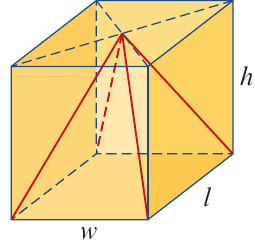
A pyramid is a three-dimensional shape with a polygon base and triangular faces that meet at a single point called the apex. When you place a pyramid inside a prism that has the same base and height, you'll discover an important relationship.
Note
The pyramid takes up exactly one-third of the space inside the prism. This one-third relationship is fundamental to calculating the volume of any pyramid.
Volume formula for pyramids
Because a pyramid occupies one-third of the volume of its corresponding prism, we can write:
Since the volume of a prism equals the area of its base multiplied by its height, this becomes:
Note
This formula works for any pyramid, regardless of the shape of its base - whether it's square, rectangular, triangular, hexagonal, or any other polygon.
Special case: square and rectangular pyramids
For pyramids with square or rectangular bases, we can write the formula in terms of the base dimensions:
where:
- = length of the base
- = width of the base
- = perpendicular height of the pyramid
Important
The height must always be the perpendicular (vertical) distance from the base to the apex, not the slant height along the face of the pyramid. Using the slant height is a common mistake that will give you an incorrect answer.
Worked example: square pyramid
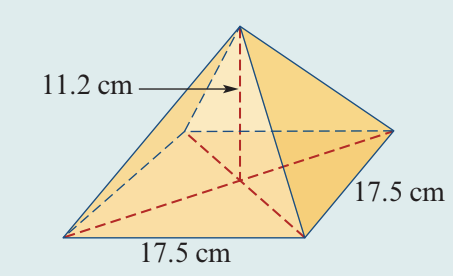
Let's find the volume of a square pyramid with a height of cm and a base length of cm. We need to give our answer to two decimal places.
Example
Worked Example: Finding the Volume of a Square Pyramid
Step 1: Write down the formula
Step 2: Identify the values
The base is a square with side length cm, so:
- Area of base = cm²
- Height = cm
Step 3: Substitute and calculate
Step 4: Round and include units
The volume of the pyramid is 1143.33 cm³ (to 2 decimal places).
Worked example: hexagonal pyramid
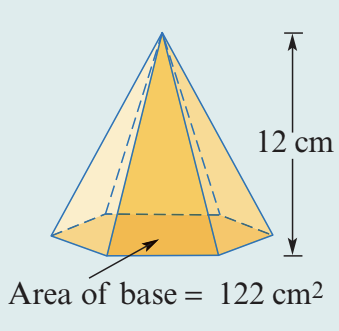
Now let's find the volume of a hexagonal pyramid that has a base area of cm² and a height of cm.
Example
Worked Example: Finding the Volume of a Hexagonal Pyramid
Step 1: Write down the formula
Step 2: Identify the values
We're given:
- Area of base = cm²
- Height = cm
Notice that we don't need to calculate the area of the hexagonal base because it's already given.
Step 3: Substitute and calculate
Step 4: Include units
The volume is 488 cm³.
Exam tips
Note
Tips for Success:
- Always check whether you're given the area of the base or the dimensions of the base. If you're given dimensions, you'll need to calculate the area first.
- Make sure you're using the perpendicular height, not the slant height.
- Remember to cube your units (cm³, m³, etc.) for volume.
- Show your working clearly, including substitution into the formula.
- Round your final answer appropriately as instructed in the question.
Remember!
Summary
Key Points to Remember:
- A pyramid occupies exactly one-third of the volume of a prism with the same base and height.
- The general formula for any pyramid is:
- For square or rectangular pyramids:
- Always use the perpendicular height (vertical distance from base to apex), not the slant height.
- Don't forget to include cubic units (cm³, m³) in your final answer.