Modelling Compound Interest Investments With Additions to the Principal (VCE SSCE General Mathematics): Revision Notes
📚Revision Notes
Modelling Compound Interest Investments With Additions to the Principal
Introduction
When you make an investment that earns compound interest and also add regular payments to it, you're dealing with a situation that combines two types of growth:
- Geometric growth: Your investment grows by a percentage each period (compound interest)
- Linear growth: Your investment grows by a fixed amount each period (regular additions)
This type of investment, where you regularly add money to a compound interest account, is known as an annuity investment.
Note
Recurrence relations are powerful mathematical tools that allow us to model complex financial situations. They show us exactly how the value changes from one period to the next, making it easier to predict future values and understand growth patterns.
We use recurrence relations to model these situations mathematically. A recurrence relation shows us how the value changes from one period to the next.
The general recurrence relation
For situations involving both geometric and linear growth or decay, we use a recurrence relation of this form:
Important
General Recurrence Relation Form
Where:
- is the value after periods
- is the growth multiplier (for geometric growth)
- is the fixed amount added or subtracted each period (for linear growth)
- The symbol means we can either add or subtract
This general form helps us represent financial situations where we have both types of growth happening together. The multiplication by R creates the geometric (percentage) growth, while the addition or subtraction of D creates the linear (fixed amount) growth.
Generating sequences from recurrence relations
To find the terms in a sequence, we start with the initial value and repeatedly apply the rule. Each new term depends on the previous term, following the pattern defined by the recurrence relation.
Example
Worked Example: Generating a sequence
Question: Write down the first five terms of the sequence generated by the recurrence relation
Solution:
Starting value:
Apply the rule (multiply by 4, then subtract 1) to generate more terms:
The first five terms are: 3, 11, 43, 171, 683
Modelling annuity investments
For compound interest investments where you make regular additions, we use this specific form of the recurrence relation:
Important
Annuity Investment Recurrence Relation
Where:
- is the value of the investment after additional payments
- is the principal (initial investment)
- is the additional payment made each period
- is the growth multiplier, calculated using:
- is the annual interest rate (as a percentage)
- is the number of compounding periods per year
Understanding the growth multiplier
The growth multiplier tells us what we multiply the current balance by to account for interest.
Note
The growth multiplier always starts at 1 (representing 100% of the current value), then adds the interest fraction. This is why the formula is rather than just .
For example:
- If the interest rate is 4% per year compounding annually, then
- This means each year the balance is multiplied by 1.04 (grows by 4%)
Example
Worked Example: Annual compounding
Question: Fred has saved $5000 and invests this in a compound interest account paying 4% per annum, compounding yearly. He also adds an extra $1000 each year. Model this investment using a recurrence relation where is the value of the investment after years.
Solution:
Step 1: Identify the principal and additional payment
- (initial investment)
- (amount added each year)
Step 2: Calculate the growth multiplier
Using where and (annual compounding):
Step 3: Write the recurrence relation
Example
Worked Example: Monthly compounding
Question: Nor invests $1200 and plans to add an extra $50 each month. The account pays interest at a rate of 3% per annum, compounding monthly. Model this investment using a recurrence relation where is the value of the investment after months.
Solution:
Step 1: Identify the principal and additional payment
- (initial investment)
- (amount added each month)
Step 2: Calculate the growth multiplier
Using where and (monthly compounding):
Step 3: Write the recurrence relation
Compounding periods
When interest compounds at intervals other than a year, we need to know how many compounding periods there are per year. Use these standard values:
Note
Standard Compounding Periods
| Compounding frequency | Number of periods per year () |
|---|---|
| Monthly | 12 |
| Quarterly | 4 |
| Fortnightly | 26 |
| Weekly | 52 |
| Daily | 365 |
These values are used in financial mathematics even though some are approximations (e.g., there are slightly more than 52 weeks in a year).
Using recurrence relations to analyse investments
Once we have a recurrence relation, we can use it to:
- Calculate the value after a specific number of periods
- Create graphs showing how the investment grows over time
These tools help us understand the long-term behavior of our investments and make informed financial decisions.
Example
Worked Example: Analysing an investment
Question: Albert has an investment that can be modelled by the recurrence relation:
where is the value of the investment after months.
a) State the value of the initial investment.
b) Determine the value of the investment after Albert has made three extra payments. Round your answer to the nearest cent.
c) What will be the value of his investment after 6 months? Round your answer to the nearest cent.
d) Plot the points for the value of the investment after 0, 1, 2 and 3 months on a graph.
Solution:
a) The initial investment was $400 (this is ).
b) To find the value after three payments, we calculate , , and :
- 400$`
- 432$`
- 464.16$`
- 496.48$`
The value of Albert's investment after three extra payments is $496.48.
c) We can continue the calculations manually or use a calculator:
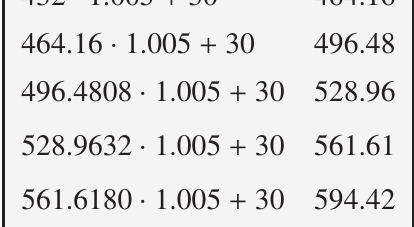
Following the pattern through to :
- 528.96$`
- 561.61$`
- 594.42$`
The value of Albert's investment after 6 months is $594.42.
d) Plotting the points for :
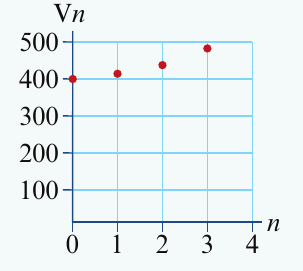
The graph shows how the investment value increases over time. Notice that the growth accelerates because you're earning interest on both the original amount and all previous additions.
Note
Calculator Tip: Efficient calculation of successive terms
You can use your CAS calculator to do these calculations efficiently:
- Type 400 and press ENTER (or EXE)
- Type and press ENTER (or EXE)
- Keep pressing ENTER (or EXE) to generate successive terms
This method is much faster than calculating each term manually!
Benefits of regular additions
Making additional payments on a regular basis causes your investment to grow faster. This is particularly beneficial when you make additions early, because compound interest is earned on those additional payments for a longer time. This makes annuity investments an excellent strategy for long-term goals like saving for retirement.
Important
The timing of your additional payments matters! Early contributions benefit from compound interest for longer periods, resulting in significantly more growth compared to later contributions of the same amount.
Finding the annual interest rate from a recurrence relation
Sometimes you're given a recurrence relation and need to work backwards to find the annual interest rate. We use the formula and solve for .
Example
Worked Example: Determining annual interest rates
Question: Determine the annual interest rates for each of the following investments.
a) An investment given by the recurrence relation: where is the value of the investment after months.
b) An investment given by the recurrence relation: where is the value of the investment after quarters.
Solution:
a) We know that interest compounds monthly, so .
From the recurrence relation, we can see that .
We need to solve:
Rearranging:
The annual interest rate is 6%.
b) We know that interest compounds quarterly, so .
From the recurrence relation, we can see that .
We need to solve:
Rearranging:
The annual interest rate is 4.8%.
Summary
Key Points to Remember:
-
An annuity investment is a compound interest investment where you make regular additions to the principal.
-
The recurrence relation for annuity investments is: where is the regular addition and is the growth multiplier.
-
The growth multiplier is calculated using: where is the annual interest rate and is the number of compounding periods per year.
-
Common compounding periods: monthly (), quarterly (), fortnightly (), weekly (), daily ().
-
To find successive values, apply the recurrence rule repeatedly, or use your calculator's ENTER/EXE function for efficiency.
-
Making additional payments early is particularly beneficial because compound interest is earned on those additions for longer.