Dividing Quantities in Given Ratios (VCE SSCE General Mathematics): Revision Notes
📚Revision Notes
Dividing Quantities in Given Ratios
Understanding the concept
When you divide a quantity according to a ratio, you're splitting it into parts based on the numbers in that ratio. The key is to think of the ratio as representing portions or shares.
Note
For example, if a quantity is divided in the ratio , there are parts in total. After division, one share has 5 parts and the other has 3 parts. If you divide $8 between two people in the ratio , one person gets $5 and the other gets $3.
The step-by-step method
To divide any quantity in a given ratio, follow these four steps:
Step 1: Add up all the numbers in the ratio to find the total number of parts.
Step 2: Divide the total quantity by the total number of parts. This tells you the value of one part.
Step 3: Multiply the value of one part by each number in the ratio to find each share.
Step 4: Check your answer by adding all shares together. They should equal the original quantity.
Important
Common Mistake to Avoid:
Many students forget to check their work at the end. Always verify that your calculated shares add up to the original total quantity. If they don't match, you've made an error somewhere in your calculations.
Worked examples
Let's see how this method works with different ratios.
Example
Worked Example: Dividing 60 students in the ratio 1:3
Calculate the number of students in each class if 60 students are divided in the ratio .
Step 1: Find the total number of parts
The total number of parts is .
Step 2: Calculate the value of one part
One group of students will have students.
Step 3: Calculate the other share
The other group will have students.
Step 4: Check the total
Answer: The two groups will have 15 and 45 students.
Example
Worked Example: Dividing 60 students in the ratio 1:5
Calculate the number of students in each class if 60 students are divided in the ratio .
Step 1: Find the total number of parts
The total number of parts is .
Step 2: Calculate the value of one part
One group of students will have students.
Step 3: Calculate the other share
The other group will have students.
Step 4: Check the total
Answer: The two groups will have 10 and 50 students.
Example
Worked Example: Dividing 60 students in the ratio 1:2:7
Calculate the number of students in each class if 60 students are divided in the ratio .
Notice this ratio has three parts instead of two. The method is exactly the same!
Step 1: Find the total number of parts
The total number of parts is .
Step 2: Calculate the value of one part
One group of students will have students.
Step 3: Calculate the other shares
The other groups will have students and students.
Step 4: Check the total
Answer: The three groups will have 6, 12 and 42 students.
Practice question
Note
Practice Question:
Divide $36 in the ratio .
Hint 1: Add up the total number of parts.
Hint 2: Divide $36 by this total to give the amount of one part.
Hint 3: Multiply this amount by each quantity in the ratio.
Real-world application: recipe scaling
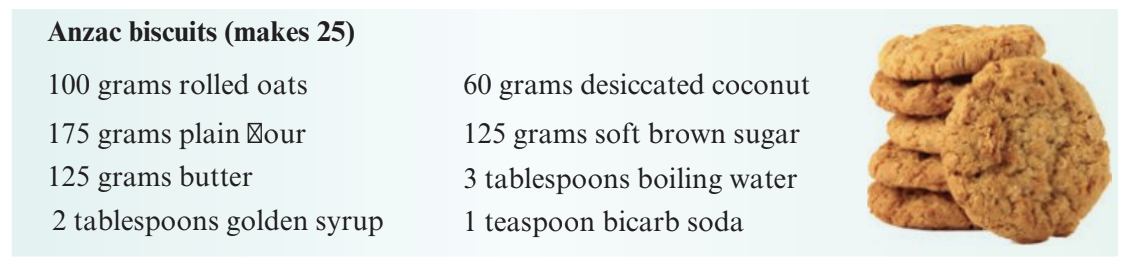
Ratios are useful when scaling recipes. Here's an example:
Note
The recipe shown makes 25 Anzac biscuits. If you wanted to make 75 biscuits (which is 3 times as many), you would need to multiply each ingredient quantity by 3.
The ratio of rolled oats to coconut to flour to brown sugar to butter in the original recipe is:
Key formula
Important
Essential Formula for Dividing Quantities in Ratios
To divide a quantity in a given ratio :
- Divide the quantity by the sum of and
- This gives the allocation of one part
- Multiply this one part value by and then by to give the required allocations
For three-part ratios , the process is the same but you divide by and multiply the one part value by each of , , and .
Remember!
Summary
Key Points to Remember:
- Find total parts first: Always add all numbers in the ratio before doing anything else.
- One part is the key: Dividing the total quantity by the total parts gives you the value of one part.
- Multiply to allocate: Multiply the one part value by each number in the ratio to find each share.
- Always check: Your final shares should add up to the original quantity.
- Works for any number of parts: The method works the same whether you're dividing in 2, 3, or more parts.