Percentages (VCE SSCE General Mathematics): Revision Notes
📚Revision Notes
Percentages
Introduction to percentages
A percentage is a way of expressing a number as a fraction of one hundred. The word "per cent" comes from the Latin words per centum, which means by the hundred.
The symbol we use for percentage is %.
For example, (seventeen per cent) means seventeen parts out of every hundred.
Percentages can be written as fractions or as decimals, making them very useful for comparisons and calculations.
Note
The percentage symbol % always represents "out of 100". This connection helps us understand why we multiply or divide by 100 when converting between percentages and other number forms.
Basic conversion rules
There are two key rules to remember when working with percentages:
Important
Fundamental Conversion Rules:
Rule 1: To change a fraction or decimal into a percentage, multiply by .
Rule 2: To change a percentage into a decimal or fraction, divide by .
These rules are the foundation for all percentage conversions.
Converting fractions to percentages
To convert any fraction to a percentage, multiply the fraction by .
Example
Worked Example: Converting a Fraction to a Percentage
Convert to a percentage.
Solution:
Multiply the fraction by :
Therefore, expressed as a percentage is .
Note
Exam tip: You can simplify the fraction first if you prefer, or multiply by straight away. Both methods work equally well.
Converting decimals to percentages
To convert a decimal to a percentage, multiply the decimal by .
Example
Worked Example: Converting a Decimal to a Percentage
Convert to a percentage.
Solution:
Multiply by :
Key point: When you multiply a decimal by , you move the decimal point two places to the right.
Converting percentages to fractions
To convert a percentage to a fraction, remember that the percentage sign means out of 100. Write the number as a fraction with as the denominator, then simplify if possible.
Example
Worked Example: Converting a Percentage to a Fraction
Convert to a fraction.
Solution:
Since means sixty-two out of one hundred:
Simplify by dividing both numerator and denominator by :
Converting percentages to decimals
To convert a percentage to a decimal, divide by (or write it as a fraction out of first).
Example
Worked Example: Converting a Percentage to a Decimal
Convert to a decimal.
Solution:
Write as a fraction out of :
Key point: Dividing by moves the decimal point two places to the left.
Finding a percentage of a quantity
To find a percentage of a number or quantity, remember this crucial mathematical principle:
Important
In mathematics, the word "of" means multiply.
Method:
- Write the percentage as a fraction out of
- Change "of" to multiply
- Calculate the result
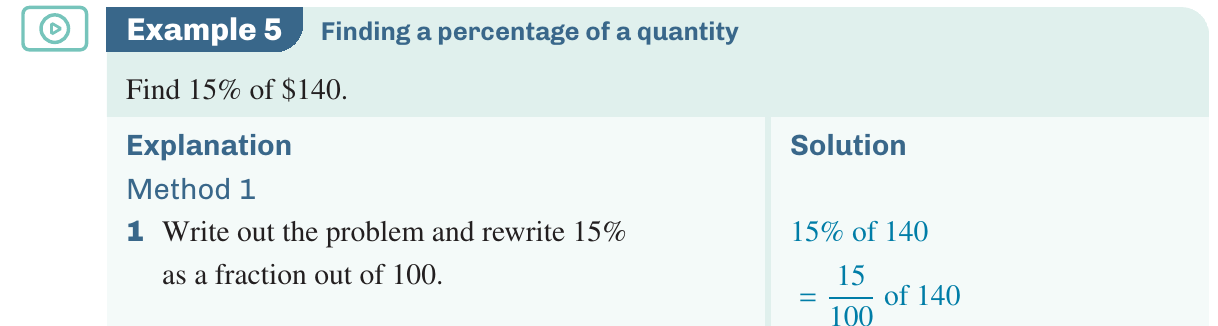
Example
Worked Example: Finding a Percentage of a Quantity
Find of $140.
Solution:
Write out the problem with as a fraction:
Change "of" to multiply:
Calculate:
Therefore, of $140 is $21.
Note
Exam tip: You can also use a calculator by entering , but make sure you understand the mathematical method.
Comparing two quantities
You can express one quantity as a percentage of another quantity. This is useful for making comparisons.
Important
Critical Rule: Both quantities must be in the same units before you can compare them.
Method:
- Check that both quantities have the same units
- Write the first quantity as a fraction of the second quantity
- Multiply by to convert to a percentage
Example
Worked Example 1: Comparing Quantities with Same Units
There are girls in a class of students. What percentage of the class are girls?
Solution:
Work out the fraction of girls:
Convert to a percentage by multiplying by :
Therefore, 72% of the class are girls.
Example
Worked Example 2: Comparing Quantities with Different Units
Express mm as a percentage of cm.
Solution:
First, convert centimetres to millimetres. Since there are millimetres in centimetre:
Now both quantities are in millimetres. Write mm as a fraction of mm:
Multiply by to convert to a percentage:
Note
Exam tip: Always check the units in comparison questions. If they're different, convert them to the same unit before starting your calculation.
Remember!
Summary
Key Points to Remember:
- A percentage is a number expressed as a part of one hundred. The symbol is %.
- To convert TO a percentage: multiply by
- To convert FROM a percentage: divide by
- In mathematics, "of" means multiply
- When comparing quantities as percentages, make sure both quantities are in the same units first
- - these are all equivalent ways of expressing the same value