An Introduction to Arithmetic Sequences (VCE SSCE General Mathematics): Revision Notes
📚Revision Notes
An Introduction to Arithmetic Sequences
What is an arithmetic sequence?
An arithmetic sequence is a pattern of numbers where you create each new term by adding or subtracting the same fixed amount to the previous term. This fixed amount stays constant throughout the entire sequence.
For example, consider the sequence
This is arithmetic because we add to each term to get the next one:

Note
Understanding arithmetic sequences is fundamental to recognizing patterns in mathematics. The key is that the change between consecutive terms remains constant, making these sequences predictable and easy to extend.
Here are more examples of arithmetic sequences and their rules:
| Sequence | Rule |
|---|---|
| To find the next term in the sequence, add to the current term | |
| To find the next term in the sequence, add to the current term | |
| To find the next term in the sequence, subtract from the current term | |
| To find the next term in the sequence, subtract from the current term |
The first two sequences are ascending (increasing), while the last two are descending (decreasing).
The common difference
The fixed amount that we repeatedly add or subtract in an arithmetic sequence is called the common difference. We use the symbol to represent this value.
Definition of common difference
Important
In an arithmetic sequence, the common difference, , is calculated using:
This value determines whether the sequence increases (positive ) or decreases (negative ).
For example, in the sequence , the common difference is:
The negative value tells us that the sequence is decreasing.
Often, you can spot the common difference just by looking at the pattern, without needing to formally calculate it.
Worked example: Finding the common difference
Example
Worked Example: Finding the Common Difference
Let's find the common difference and the next term for these arithmetic sequences:
Part a:
Since we know this is an arithmetic sequence, we find the difference between consecutive terms:
To find the next term, we add the common difference to the last known term:
Part b:
Finding the common difference:
Finding the next term:
The negative common difference indicates the sequence is decreasing.
Identifying arithmetic sequences
Not all sequences are arithmetic. To determine whether a sequence is arithmetic, check if the difference between successive terms remains constant throughout.
Example
Worked Example: Testing for Arithmetic Sequences
Let's examine these two sequences:
Part a:
Calculate the differences between successive terms:
Since the differences are constant, this sequence is arithmetic.
Part b:
Calculate the differences between successive terms:
Since the differences are not constant, this sequence is not arithmetic.
Important
Common Mistake to Avoid:
Don't assume a sequence is arithmetic just because it follows a pattern. Always verify by calculating the differences between consecutive terms. If these differences vary, the sequence follows a different rule (such as geometric or another pattern).
Tables and graphs of arithmetic sequences
Creating tables for arithmetic sequences
We can organize arithmetic sequences in tables, showing how each term number () corresponds to its term value (). This format highlights that sequences behave like functions, with each input having exactly one output.
For example, the sequence can be tabulated as:
| Term number, | 0 | 1 | 2 | 3 | 4 | 5 | 6 | 7 | 8 | 9 |
|---|---|---|---|---|---|---|---|---|---|---|
| Term value, | 3 | 6 | 9 | 12 | 15 | 18 | 21 | 24 | 27 | 30 |
This table shows that when , ; when , , and so on.
Note
Tables are particularly useful for identifying patterns and verifying that a sequence is truly arithmetic. By listing several terms, you can easily calculate and check that the differences remain constant.
Graphing arithmetic sequences
When we plot the term values () against their term numbers (), arithmetic sequences produce points that lie along a straight line. This makes sense because the term values increase (or decrease) by the same amount each time—the common difference .
The direction of the line depends on whether the common difference is positive or negative:
- When , the line slopes upward (positive slope), indicating linear growth
- When , the line slopes downward (negative slope), indicating linear decay
Worked example: Graphing an increasing arithmetic sequence
Example
Worked Example: Graphing an Increasing Arithmetic Sequence
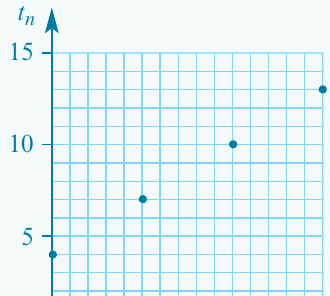
Consider the sequence with common difference .
Step 1: Create a table for the first four terms:
| Term number, | 0 | 1 | 2 | 3 |
|---|---|---|---|---|
| Term value, | 4 | 7 | 10 | 13 |
Step 2: Plot the points on a graph.
Use the horizontal axis for term numbers () and the vertical axis for term values (). Plot each point from the table: , , , and .
Step 3: Describe the graph.
The points lie along a rising straight line. Since (positive), the line has a positive slope, indicating the sequence is increasing.
Worked example: Graphing a decreasing arithmetic sequence
Example
Worked Example: Graphing a Decreasing Arithmetic Sequence
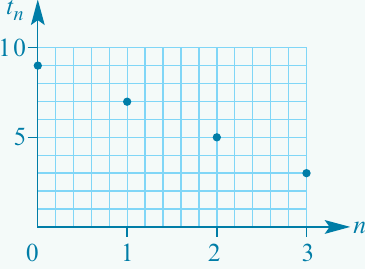
Consider the sequence with common difference .
Step 1: Create a table for the first four terms:
| Term number, | 0 | 1 | 2 | 3 |
|---|---|---|---|---|
| Term value, | 9 | 7 | 5 | 3 |
Step 2: Plot the points on a graph.
Use the horizontal axis for term numbers () and the vertical axis for term values (). Plot each point from the table: , , , and .
Step 3: Describe the graph.
The points lie along a falling straight line. Since (negative), the line has a negative slope, indicating the sequence is decreasing.
Key characteristics of arithmetic sequence graphs
Understanding the relationship between the common difference and the graph's slope is essential:
- Positive slope: When , the line rises from left to right, showing the sequence values are increasing
- Negative slope: When , the line falls from left to right, showing the sequence values are decreasing
Note
Visual Test for Arithmetic Sequences:
The advantage of graphing is that you can immediately see whether a sequence is arithmetic—the points must lie on a straight line. Any deviation from a straight line indicates the sequence is not arithmetic. This provides a quick visual confirmation of the sequence's nature.
Summary
Key Points to Remember:
- An arithmetic sequence is formed by repeatedly adding or subtracting the same fixed amount to get from one term to the next
- The common difference () is found by subtracting any term from the next term:
- To identify if a sequence is arithmetic, check that the difference between consecutive terms is constant
- When graphed, arithmetic sequences form points along a straight line
- A positive common difference () creates an upward-sloping line (increasing sequence)
- A negative common difference () creates a downward-sloping line (decreasing sequence)