An Introduction to Geometric Sequences (VCE SSCE General Mathematics): Revision Notes
📚Revision Notes
An Introduction to Geometric Sequences
What is a geometric sequence?
A geometric sequence is a special type of number pattern where each new term is created by multiplying the previous term by a fixed number. This fixed number is called the common ratio, which we represent with the letter .
Unlike arithmetic sequences where we add or subtract the same amount each time, geometric sequences grow (or shrink) through multiplication. This repeating multiplication process is an example of recursion.
Note
The key difference between arithmetic and geometric sequences:
- Arithmetic sequences: Add or subtract the same amount each time
- Geometric sequences: Multiply by the same amount each time
This fundamental difference in operations creates very different patterns of growth or decay.
The common ratio,
The common ratio is the multiplier that connects one term to the next in a geometric sequence. Understanding how to find and use the common ratio is essential for working with geometric sequences.
Understanding the common ratio through examples
Let's look at two examples to understand how the common ratio works:
Example
Worked Example: An Increasing Sequence
Consider the sequence:
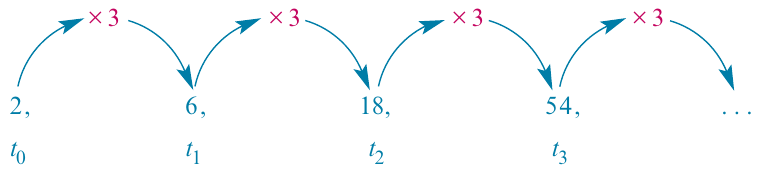
In this sequence:
- We start with
- To get the next term, we multiply by :
- Then multiply again by :
- And again:
The common ratio is .
Example
Worked Example: A Decreasing Sequence
Consider the sequence:

In this sequence:
- We start with
- Each new term is made by halving:
- Then:
- And:
The common ratio is . Note that dividing by is the same as multiplying by .
Formula for the common ratio
To find the common ratio in any geometric sequence, we divide any term by the previous term:
This ratio remains constant throughout the sequence.
Important
Common Ratio Formula
The common ratio can be found using any two consecutive terms:
This value must be the same for all pairs of consecutive terms in the sequence.
Note
In this course, we focus on common ratios that are greater than zero: . This prepares us for studying growth and decay in real-world situations.
Finding the common ratio
Let's work through examples to practice finding the common ratio.
Worked example: Finding in increasing sequences
Example
Worked Example: Finding in an Increasing Sequence
Question: Find the common ratio in the sequence
Solution:
Step 1: Calculate the common ratio using the first two terms
Step 2: Verify by checking if multiplying by produces each term
- ✓
- ✓
- ✓
Step 3: State the answer
The common ratio is .
Worked example: Finding in decreasing sequences
Example
Worked Example: Finding in a Decreasing Sequence
Question: Find the common ratio in the sequence
Solution:
Step 1: Calculate the common ratio
Step 2: Verify by checking
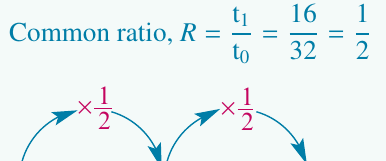
- ✓
- ✓
- ✓
Step 3: State the answer
The common ratio is .
Important
Exam Tip: Always verify your common ratio by checking that it works for multiple terms in the sequence. This helps catch calculation errors and confirms you have the correct value.
Identifying geometric sequences
Not every number sequence is geometric. To determine if a sequence is geometric, we need to check whether there is a constant ratio between successive terms.
How to identify a geometric sequence
A sequence is geometric if and only if the ratio between consecutive terms is the same throughout the entire sequence.
Note
Testing for a Geometric Sequence:
To verify a sequence is geometric:
- Calculate the ratio between at least three pairs of consecutive terms
- Check if all ratios are equal
- If all ratios are identical, the sequence is geometric
- If any ratio differs, the sequence is not geometric
Worked example: Is it geometric?
Example
Worked Example: Testing if a Sequence is Geometric (Part a)
Question a: Is a geometric sequence?
Solution:
Step 1: Calculate the ratios between successive terms
Step 2: Compare the ratios
All ratios equal , so the common ratio is .
Step 3: Conclusion
The sequence is geometric because the ratio is constant.
Example
Worked Example: Testing if a Sequence is Geometric (Part b)
Question b: Is a geometric sequence?
Solution:
Step 1: Calculate the ratios
Step 2: Compare the ratios
The ratios are different: .
Step 3: Conclusion
The sequence is not geometric because the ratios are not constant.
Important
Key Point: For a sequence to be geometric, all ratios between consecutive terms must be identical. Even if most ratios are the same, a single different ratio means the sequence is not geometric.
Percentage-based common ratios
Sometimes the common ratio is expressed as a percentage increase or decrease.
Note
Percentage Growth and Common Ratios:
When working with percentage-based growth or decay:
- If terms increase by , we calculate:
- If terms decrease by , we calculate:
For example, the sequence has , representing a growth at each step.
Using a CAS calculator to generate sequences
While we can manually calculate terms by repeated multiplication, a CAS calculator can automate this process, especially when finding many terms.
Basic method for both calculators
The process is similar on both TI-Nspire CAS and ClassPad calculators:
- Enter the first term
- Press ENTER (or EXE) to store it
- Type the multiplication by the common ratio (e.g., )
- Press ENTER repeatedly to generate successive terms
Example
Worked Example: Generating Terms with a Calculator
Generate the first six terms of
Steps:
- Enter and press ENTER
- Type and press ENTER
- Each additional press of ENTER generates the next term:
The first six terms are: .
Note
This recursive method is quick for generating a few terms but would be tedious for finding the term. For finding specific terms far into the sequence, we'll learn a direct formula method later.
Graphs of geometric sequences
Graphing geometric sequences helps us visualise patterns of growth or decay. Unlike arithmetic sequences that form straight lines, geometric sequences create curves.
Understanding the shape of geometric graphs
The appearance of a geometric sequence graph depends on the value of the common ratio:
Note
Graph Behavior Based on Common Ratio:
- When : the sequence increases and the graph curves upward (exponential growth)
- When : the sequence decreases toward zero and the graph curves downward (exponential decay)
Graphing an increasing sequence ()
Example
Worked Example: Graphing an Increasing Sequence
Question: Graph the geometric sequence
Solution:
Step 1: Find the next term
The next term is .
Step 2: Create a table of values
| Position, | 0 | 1 | 2 | 3 |
|---|---|---|---|---|
| Term, | 2 | 6 | 18 | 54 |
Step 3: Plot the graph
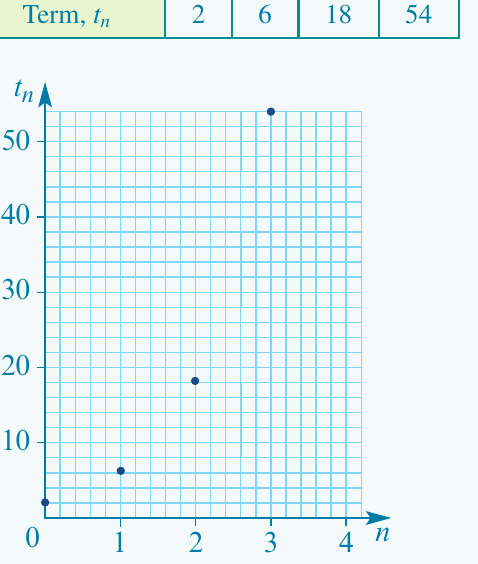
On the graph:
- The horizontal axis () represents the position number
- The vertical axis () represents the value of the term
- Plot each point from the table
Step 4: Describe the graph
The values lie along a curve, and they are increasing. This exponential growth pattern is characteristic of geometric sequences with .
Graphing a decreasing sequence ()
Example
Worked Example: Graphing a Decreasing Sequence
Question: Graph the geometric sequence
Solution:
Step 1: Find the common ratio and next term
The next term is .
Step 2: Create a table of values
| Position, | 0 | 1 | 2 | 3 |
|---|---|---|---|---|
| Term, | 32 | 16 | 8 | 4 |
Step 3: Plot the graph
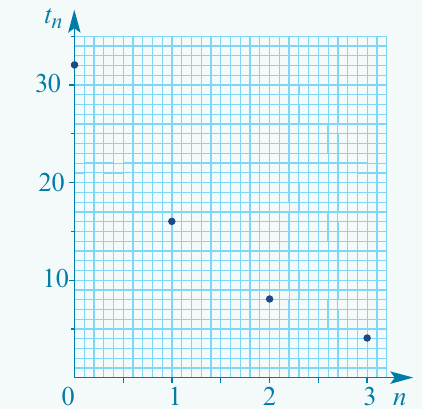
Step 4: Describe the graph
The graph is a curve with values decreasing and approaching zero. This exponential decay pattern is characteristic of geometric sequences with .
Key features of geometric sequence graphs
For positive common ratios ():
Note
Characteristics of Geometric Sequence Graphs:
-
Increasing graphs occur when
- The curve rises steeply
- Values grow rapidly
- Represents exponential growth
-
Decreasing graphs occur when
- The curve falls and flattens out
- Values approach zero but never reach it
- Represents exponential decay
Important
Exam Tip: When graphing, always label your axes clearly. Use for the position (horizontal axis) and for the term value (vertical axis). This makes your work easier to follow and helps avoid mistakes.
Summary of key formulas
Summary
Key Formulas to Remember:
Common ratio formula:
Behaviour of sequences:
- Geometric sequence is increasing if
- Geometric sequence is decreasing toward zero if
Remember!
Summary
Key Points to Remember:
- In a geometric sequence, each term is found by multiplying the previous term by the common ratio,
- To find the common ratio, divide any term by the previous term:
- A sequence is only geometric if the ratio between all consecutive terms is the same
- When , the sequence increases exponentially (growth)
- When , the sequence decreases toward zero (decay)
- Graphs of geometric sequences form curves, not straight lines like arithmetic sequences