Finance Applications Using Arithmetic Sequences and Recurrence Relations (VCE SSCE General Mathematics): Revision Notes
📚Revision Notes
Finance Applications Using Arithmetic Sequences and Recurrence Relations
In this topic, we explore how arithmetic sequences and recurrence relations can be used to model real-world financial situations. These mathematical tools help us understand and calculate simple interest on investments, depreciation of assets, and other scenarios involving regular increases or decreases in value.
Understanding linear growth and decay
Linear growth occurs when a quantity increases by the same fixed amount at regular intervals. For example, when money in a savings account earns simple interest, the same amount is added each year.
Linear decay occurs when a quantity decreases by the same fixed amount at regular intervals. For example, when a car loses value each year due to age or use, this is called depreciation.
Both situations can be modelled using recurrence relations - mathematical expressions that tell us how to find the next term in a sequence from the current term.
Note
Real-World Examples:
- Linear Growth: A savings account earning simple interest adds the same dollar amount each year
- Linear Decay: A car depreciating by a fixed amount each year due to age and usage
Both scenarios follow predictable patterns that can be expressed mathematically using recurrence relations.
Using recurrence relations to model simple interest
What is simple interest?
Simple interest is a way of calculating the interest earned on an investment (or owed on a loan) where the interest is based only on the original amount, called the principal. The interest is calculated by multiplying:
- The principal (): the original amount invested or borrowed
- The interest rate (): the percentage paid per year
- The time period: usually measured in years
The simple interest recurrence relation
For a simple interest investment, we can write:
where:
- is the value of the investment after years
- is the initial principal
- is the amount of interest added each year
The value of is calculated as:
Note
Converting Percentages:
We write the percentage as to convert it to a decimal. For example, becomes .
This conversion is essential for all interest and depreciation calculations.
Example
Worked Example: Finding Simple Interest
Question: An investment of $3500 pays interest at the rate of 4.2% per annum in the form of simple interest. Find the amount of interest paid each year.
Solution:
- is the value of the investment after years
- 147$`
Therefore, each year the investment earns $147 in simple interest.
Example
Worked Example: Using a Recurrence Relation for Simple Interest
Question: The following recurrence relation models a simple interest investment of $2000, paying interest at 7.5% per annum:
a) Use the recurrence relation to find the value of the investment after 1, 2 and 3 years.
b) When will the investment reach $2750 in value?
Solution:
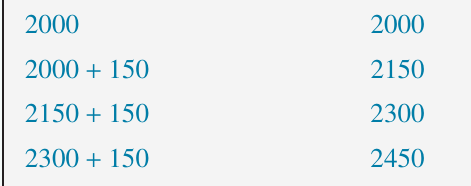
a) The recurrence relation tells us: "to find the next value, add 150 to the current value."
Starting with :
b) We continue the sequence until we reach $2750:
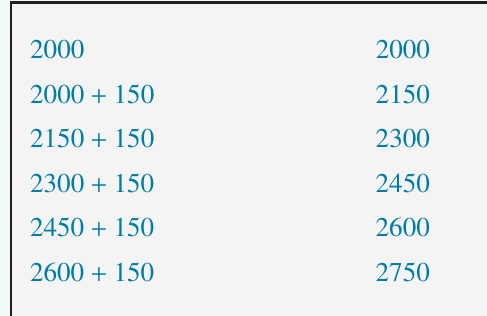
Counting the number of times we added 150, we find:
The investment will have a value of $2750 after 5 years.
Important
Exam Tip: Counting Years
When counting years, count how many times you added the common difference, not the number of terms on your calculator. This is a common source of errors in exams.
Using recurrence relations to model flat rate depreciation
What is flat rate depreciation?
When assets like cars, furniture, or equipment get older, they lose value. This is called depreciation.
Flat rate depreciation (also called fixed rate depreciation) is when an asset loses the same fixed amount of value each period. The amount lost can be:
- Given directly (e.g., $1850 per year)
- Calculated from a percentage of the original value
For flat rate depreciation based on a percentage rate:
where is the depreciation rate as a percentage.
The flat rate depreciation recurrence relation
For flat rate depreciation, we can write:
where:
- is the value of the asset after periods (usually years)
- is the fixed amount of depreciation each period
- Note: We subtract because the value is decreasing
Example
Worked Example: Flat Rate Depreciation
Question: The following recurrence relation models the flat rate depreciation of a car purchased for $18,500, depreciating at 10% per year:
where is the value of the car after years.
Note: The car depreciates $1850 per year because .
a) Use the recurrence relation to find the value of the car after 1, 2 and 3 years.
b) How long will it take for the car's value to depreciate to zero?
Solution:
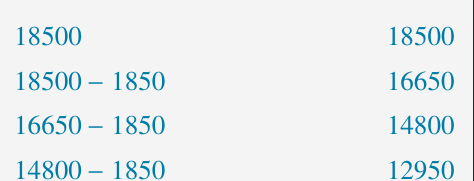
a) The recurrence relation tells us: "to find the next value, subtract 1850 from the current value."
Starting with :

b) We continue the sequence until the value reaches zero:
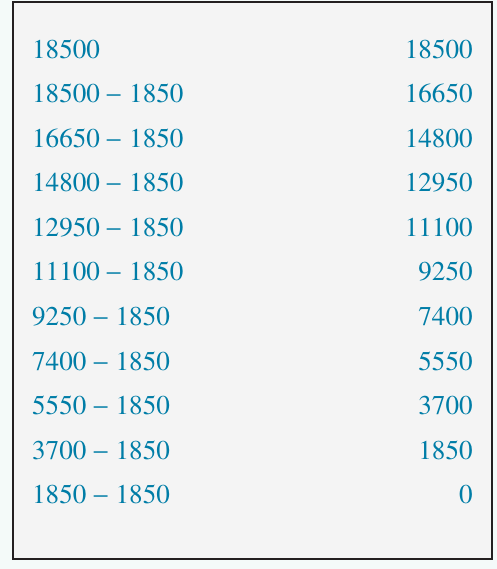
Counting the number of times we subtracted 1850, we find:
The car will have a value of zero after 10 years.
Using recurrence relations to model unit cost depreciation
What is unit cost depreciation?
Unit cost depreciation is when an asset's value decreases based on how much it is used, rather than how old it is.
For example:
- A car might depreciate based on kilometres travelled
- A printer might depreciate based on number of pages printed
- Machinery might depreciate based on hours of operation
In this method:
- represents the value after units of use
- is the cost per unit of each use
Note
Key Difference:
Unlike flat rate depreciation which is based on time, unit cost depreciation is based on usage. This makes it more accurate for assets whose value depends primarily on how much they're used rather than their age.
Example
Worked Example: Unit Cost Depreciation
Question: A car with a purchase price of $32,000 depreciates at a unit cost of $150 per 1000 kilometres.
a) State the recurrence relation for unit cost depreciation of the car, where represents the value after thousand kilometres.
b) Use the recurrence relation to find the value after 1000, 2000 and 3000 kilometres.
c) How many kilometres is the car expected to travel before its value depreciates by at least $1000?
Solution:
a) Starting value: Common difference:
Recurrence relation:
b) Starting with 32000$`:
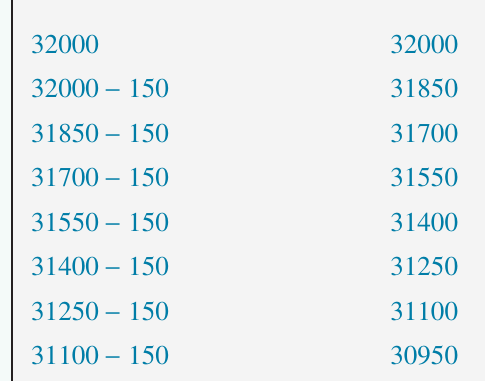
c) We want the value to be less than $31,000 (i.e., depreciated by at least $1000).
Continuing the sequence:
The car will have depreciated by at least $1000 after 7000 kilometres.
A rule for finding the nth term directly
While recurrence relations are useful for generating sequences step by step, it can be time-consuming to find a term far along in the sequence (like the 50th term). Instead, we can use a direct formula to calculate any term immediately.
The general formula
For any sequence involving linear growth or decay with the recurrence relation:
We can find the th term directly using:
where:
- is the value of the th term
- is the initial value
- is the term number
- is the common difference
Important
Important Distinctions:
- For linear growth, (positive)
- For linear decay, (negative)
Always check the sign of to ensure you're modelling the correct type of change!
Example
Worked Example: Using the nth Term Formula
Question: The following recurrence relation models a simple interest investment of $4000, paying interest at 6.5% per year:
a) How much interest is added to the investment each year?
b) Use a rule to find the value of the investment after 15 years.
c) Use a rule to find when the value first exceeds $10,000.
Solution:
a) $260 (this is the value of in the recurrence relation)
b) Using the formula with , , and :
c) We need to find when .
Substituting into :
Since interest is only paid after whole years, we round up to the next whole number.
The value will first exceed $10,000 after 24 years.
Important
Exam Tip: Rounding Time Periods
When solving for time periods, remember to round up to the next whole number if you get a decimal, because interest is typically paid at the end of complete periods. Simply truncating or rounding down would give an incorrect answer.
Summary
Key Points to Remember:
-
Simple interest adds the same amount to an investment each period, calculated as
-
Flat rate depreciation reduces an asset's value by the same fixed amount each period based on age
-
Unit cost depreciation reduces an asset's value based on how much it is used, not how old it is
-
The recurrence relation for linear growth is (where ), and for linear decay is (or where )
-
The direct formula allows you to find any term without generating all previous terms
-
Always check whether you're dealing with growth ( positive) or decay ( negative) when setting up your calculations