Finance Applications Using Geometric Sequences and Recurrence Relations (VCE SSCE General Mathematics): Revision Notes
📚Revision Notes
Finance Applications Using Geometric Sequences and Recurrence Relations
Introduction to geometric growth and decay
Geometric growth and geometric decay occur when a quantity increases or decreases by the same percentage at regular intervals. This type of pattern appears frequently in real-world financial situations.
Common examples include:
- Compound interest on investments or loans
- Reducing-balance depreciation on vehicles and equipment
Note
In reducing-balance depreciation, an asset loses value by a constant percentage of its current (depreciated) value each year, rather than by a fixed dollar amount. This creates a geometric decay pattern because the percentage is applied to the remaining value, not the original value.
Understanding recurrence models for growth and decay
A recurrence relation for a geometric sequence consists of two parts:
- A starting value (initial term)
- A rule to generate the next term from the current term
The general form is: ,
Identifying growth versus decay
The value of determines whether the sequence grows or decays:
Important
Critical distinction:
- For geometric growth: where R > 1
- Example: , (grows by multiplying by 5)
- For geometric decay: where 0 < R < 1
- Example: , (decays by multiplying by 0.5)
Key insight: When , each term is larger than the previous term, creating growth. When , each term is smaller than the previous term, creating decay.
Compound interest investments and loans
While simple interest is sometimes used, compound interest is far more common in real financial situations. With compound interest, any interest earned in one period is added to the principal and then earns interest itself in the next period.
This creates a snowball effect where the amount of interest earned increases over time. The investment value grows geometrically.
The recurrence relation for compound interest
For compound interest investments and loans (compounding yearly):
Let be the value of the investment after years.
Let be the percentage interest rate per compound period.
The recurrence relation is:
where:
Note
Why this formula works: If interest is 5% per annum, the value increases by 5% each year. This means the new value is 100% + 5% = 105% of the old value, which is the same as multiplying by 1.05.
Notice the plus sign in the formula - we're adding the interest rate because the value is growing.
Worked example: calculating investment growth
Example
Worked Example: Investment Growth with Compound Interest
Problem: An investment of $1000 pays 8% interest per annum, compounding yearly. The recurrence relation is:
where is the value after years.
Part a: Find the value after 1, 2, and 3 years.
Solution:
Starting with , we apply the recurrence relation repeatedly:
Using a calculator, you can generate these values efficiently:
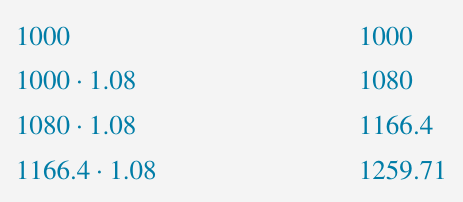
Part b: When will the investment first exceed $1500?
Solution:
Continue applying the recurrence relation and count how many times you multiply by 1.08 until the value exceeds $1500.
Answer: The investment will first exceed $1500 after 6 years.
Important
Exam tip: Use your CAS calculator to apply the recurrence relation repeatedly. Count the number of steps carefully to determine how many compounding periods have passed.
Different compounding periods
Interest can compound at different frequencies: yearly, quarterly, or monthly. You must adjust your recurrence relation accordingly.
Example
Worked Example: Different Compounding Periods
Sally borrows $6000 from a bank at 4.2% per annum. Write the recurrence relation if interest compounds:
a) Yearly compounding
Let be the value of Sally's loan after years.
The interest rate is 4.2% per annum, so:
Recurrence relation: ,
b) Quarterly compounding
Let be the value of Sally's loan after quarters.
Since interest is 4.2% per annum, the quarterly rate is:
Recurrence relation: ,
c) Monthly compounding
Let be the value of Sally's loan after months.
Since interest is 4.2% per annum, the monthly rate is:
Recurrence relation: ,
Note
Key principle: Divide the annual interest rate by the number of compounding periods per year (4 for quarterly, 12 for monthly) before calculating .

Reducing-balance depreciation
Reducing-balance depreciation is a method where an asset's value decreases by a constant percentage of its current value each year. Unlike flat-rate depreciation (which subtracts a fixed amount), reducing-balance depreciation results in geometric decay.
The calculations mirror compound interest, but with decay rather than growth.
The recurrence relation for reducing-balance depreciation
Let be the value of the asset after years.
Let be the annual percentage depreciation.
The recurrence relation is:
where:
Note
Why this formula works: If depreciation is 10% per year, the asset retains 100% - 10% = 90% of its value, which is the same as multiplying by 0.9.
Notice the minus sign in the formula - we're subtracting the depreciation rate because the value is decreasing.
Worked example: calculating depreciation
Example
Worked Example: Calculating Reducing-Balance Depreciation
Problem: A car is purchased for $18,500. It depreciates by 10% of its value each year. The recurrence relation is:
where is the car's value after years.
Part a: Find the car's value after 1, 2, and 3 years.
Solution:
The recurrence relation tells us: "to find the next value, multiply the current value by 0.9."
Starting with :
Using a calculator:
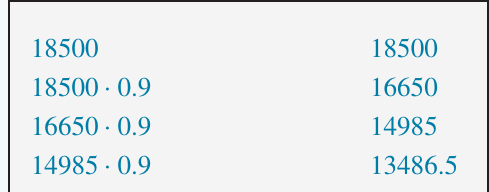
Part b: When will the car first be worth less than $10,000?
Solution:
Continue applying the recurrence relation and count the number of decreases until the value falls below $10,000:
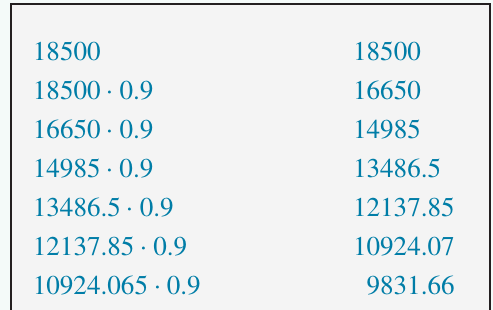
Answer: The car's value will first be less than $10,000 after 6 years.
Important
Exam tip: For both compound interest and depreciation problems, use your calculator to iterate the recurrence relation. Keep careful count of the number of periods that have passed.
Section summary
Summary
Geometric growth and decay:
- for R > 1 generates geometric growth
- for 0 < R < 1 generates geometric decay
Compound interest formula:
Let be the value after years and be the percentage interest per compound period.
Reducing-balance depreciation formula:
Let be the value after years and be the annual percentage depreciation.
For different compounding periods: Divide the annual interest rate by the number of periods per year before calculating .
Remember!
Summary
Key Points to Remember:
-
Geometric growth happens when R > 1. This models compound interest on investments and loans. Each term is larger than the previous term.
-
Geometric decay happens when 0 < R < 1. This models reducing-balance depreciation. Each term is smaller than the previous term.
-
For compound interest, use (add the percentage because value increases). For quarterly compounding, divide the annual rate by 4. For monthly, divide by 12.
-
For reducing-balance depreciation, use (subtract the percentage because value decreases).
-
Use your CAS calculator efficiently to apply recurrence relations repeatedly. Count iterations carefully to determine when a threshold is reached.