Number Patterns (VCE SSCE General Mathematics): Revision Notes
📚Revision Notes
Number Patterns
What are sequences?
A sequence is an ordered arrangement of numbers or symbols that follows a specific pattern. The individual numbers or items within a sequence are called terms. When writing sequences, each term is separated by a comma.
When a sequence continues indefinitely, or when there are too many terms to write them all out, we use an ellipsis (three dots: ...) after the first few terms to indicate the pattern continues. For example:
This notation tells us the sequence keeps going according to the same pattern.
Note
The ellipsis (...) is a mathematical convention that means "and so on" or "the pattern continues." It's essential for representing infinite sequences or sequences with many terms without writing them all out.
Types of sequences
Sequences can be created in two main ways: randomly or through recursion.
Random sequences
Random sequences have no predictable pattern. For example, if you rolled a die and recorded the numbers that came up, you might get:
Because there is no pattern connecting these numbers, you cannot predict what the next term will be. Random sequences are not the focus of this topic.
Recursive sequences
Recursion involves creating sequences by repeatedly applying a rule to a starting number. These sequences have recognizable patterns that allow you to predict future terms. The rule tells you how to get from one term to the next.
For instance, if you start with and use the rule "add to each term," you generate the sequence:

Knowing both the starting value and the rule means you can easily find any term in the sequence.

Behaviour of sequences
When sequences follow a pattern, they can exhibit different types of behaviour. Understanding these behaviours helps you classify and analyze sequences.
Increasing sequences
An increasing sequence is one where each term is larger than the previous term. The values get progressively bigger.
Example:
Each term increases from the one before it.
Decreasing sequences
A decreasing sequence is one where each term is smaller than the previous term. The values get progressively smaller.
Example:
Each term decreases by from the previous term.
Constant sequences
A constant sequence is one where all terms have exactly the same value. The sequence doesn't change.
Example:
Every term equals .
Oscillating sequences
An oscillating sequence is one where the terms alternate or change between two or more values. The sequence bounces back and forth.
Example:
The sequence alternates between and .
Another example:
The sequence oscillates between and .
Limiting values
Some sequences have a limiting value, which means the terms approach a particular number as the sequence continues. The terms get closer and closer to this value without necessarily reaching it.
Example:
As the sequence progresses, the terms get smaller and approach zero. We say this sequence has a limiting value of zero.
Another example:
Each term is divided by , so the sequence decreases and approaches zero as a limiting value.
Note
Identifying Sequence Behaviour:
To classify a sequence's behaviour, compare consecutive terms:
- If each term is greater than the previous → increasing
- If each term is less than the previous → decreasing
- If all terms are identical → constant
- If terms alternate between values → oscillating
- If terms get closer to a specific value → has a limiting value
Understanding recursion
Important
Recursion is the process of generating sequence terms by repeatedly applying a rule to find each new term from the previous one. This is a fundamental concept in working with sequences.
Different types of rules can be used, including:
- Adding or subtracting a number
- Multiplying or dividing by a number
- Squaring numbers
- Combining previous terms
The key to recursion is that you need two pieces of information:
- The starting value (first term)
- The rule that tells you how to find the next term
Once you have these, generating the sequence is straightforward.
Finding recursive rules
To identify the pattern in a sequence, you need to examine how consecutive terms relate to each other. Look at the difference between terms or the ratio between them.
Example
Worked Example: Addition Pattern
Sequence:
To find the next term:
Step 1: Calculate the difference between consecutive terms:
Step 2: Identify the pattern:
- The pattern is to add to each term
Step 3: Apply the rule to find the next term:
Answer: The next number is .
Example
Worked Example: Multiplication Pattern
Sequence:
To find the next term:
Step 1: Calculate the ratio between consecutive terms:
Step 2: Identify the pattern:
- The pattern is to multiply each term by
Step 3: Apply the rule to find the next term:
Answer: The next number is .
Example
Worked Example: Subtraction Pattern
Sequence:
To find the next term:
Step 1: Calculate the difference between consecutive terms:
Step 2: Identify the pattern:
- The pattern is to subtract from each term
Step 3: Apply the rule to find the next term:
Answer: The next number is .
Tips for finding patterns
Note
Pattern Detection Strategy:
- Calculate the difference between each consecutive term
- If differences are constant, the rule involves addition or subtraction
- If differences aren't constant, check ratios (division) between consecutive terms
- If ratios are constant, the rule involves multiplication or division
- Apply the rule you find to determine the next term
Generating sequences from starting values and rules
When you're given a starting value and a rule, you can generate as many terms as needed by repeatedly applying the rule.

Example
Worked Example: Generating a Sequence
Question: Write down the first five terms of the sequence with a starting value of and the rule "add to each term."
Solution:
Step 1: Start with the first term:
Step 2: Apply the rule to find the second term:
Step 3: Apply the rule to find the third term:
Step 4: Apply the rule to find the fourth term:
Step 5: Apply the rule to find the fifth term:
Answer: The sequence is .
Step-by-step process
When generating a sequence:
- Write down the starting value as your first term
- Apply the rule to the first term to get the second term
- Apply the rule to the second term to get the third term
- Continue applying the rule until you have the required number of terms
- Write your answer as a sequence with terms separated by commas
Using calculators to generate sequences
While you can generate sequence terms by hand, using a CAS calculator makes the process much faster, especially when you need many terms. The calculator can automate the repetitive application of a recursive rule.
Calculator method for addition-based sequences
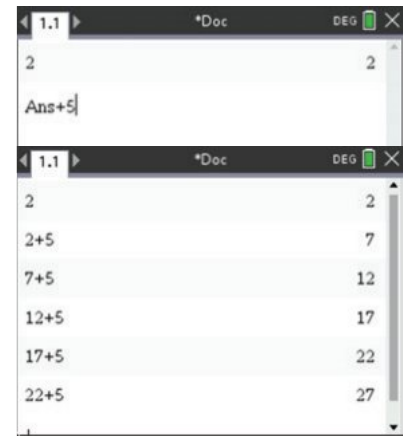
If your rule involves adding the same number repeatedly, you can use the calculator's "Answer" function to speed up calculations.
Note
Calculator Method for Sequences
Example: Generate the first six terms of the sequence
Method:
- Enter the first term: Type and press ENTER
- The calculator stores as the previous answer
- Type the rule: Enter (since the common difference is )
- Press ENTER to generate the second term:
- Keep pressing ENTER to generate subsequent terms:
Each time you press ENTER, the calculator adds to the previous result, automatically generating the next term in the sequence.
This method works because the calculator stores each result and uses it when you press ENTER again. The expression "Ans + 5" means "take the previous answer and add 5."
Benefits of calculator methods
Using a calculator for sequence generation:
- Saves time when finding many terms
- Reduces arithmetic errors
- Allows you to explore longer sequences
- Helps verify patterns you've identified by hand
Exam tips
Important
Critical Exam Strategies:
- Always check your pattern by testing it on at least three consecutive terms
- Write sequences clearly with commas between terms
- Use ellipsis (...) to show a sequence continues
- Show your working when finding patterns or generating terms
- Double-check arithmetic, especially with negative numbers
- Remember that the rule must work for all consecutive pairs of terms
Remember!
Summary
Key Points to Remember:
- A sequence is an ordered list of numbers or symbols following a pattern
- Terms are the individual numbers in a sequence, separated by commas
- An ellipsis (...) shows that a sequence continues
- Sequences can be increasing, decreasing, constant, oscillating, or have a limiting value
- Recursion creates sequences by repeatedly applying a rule to a starting value
- To find a pattern, examine differences or ratios between consecutive terms
- To generate a sequence, start with the first term and repeatedly apply the rule
- CAS calculators can automate sequence generation using the "Answer" function