Recursion With Geometric Sequences (VCE SSCE General Mathematics): Revision Notes
📚Revision Notes
Recursion With Geometric Sequences
What is a recurrence relation?
A recurrence relation is a mathematical way to describe how a sequence is generated. It tells you two things:
- Where to start (the initial value)
- How to get from one term to the next (the rule)
Instead of listing all the terms, a recurrence relation gives you a precise mathematical formula that captures the pattern.
Note
Understanding Recurrence Relations
A recurrence relation is powerful because it provides a complete description of a sequence using just two pieces of information: a starting point and a rule for progression. This compact representation can describe infinitely many terms.
Example: The sequence 2, 6, 18, ...
Example
Worked Example: Describing a Sequence with a Recurrence Relation
We can describe this sequence in words:
- "Start with 2"
- "To find the next term, multiply the current term by 3, and keep repeating"
Using mathematical notation with terms labeled :
- (initial or starting value)
- (after 1 application of the rule)
- (after 2 applications of the rule)
- (after 3 applications of the rule)
- (after 4 applications of the rule)
And generally, (after applications of the rule).
The recurrence relation for this sequence is written as:
This says: "The first term is 2, and each subsequent term equals the current term multiplied by 3."
General recurrence relation for geometric sequences
For any geometric sequence, the recurrence relation has the form:
Where:
- is the starting value (the first term, )
- is the common ratio (the number you multiply by each time)
This generates a geometric sequence where each term is times the previous term.
Important
The General Form
Every geometric sequence can be expressed using this standard recurrence relation form: . Recognizing this pattern is essential for working with geometric sequences efficiently.
Generating a geometric sequence using recursion
Let's work through an example to see how this works in practice.
Example
Worked Example: Generating the First Five Terms
Problem: Generate and graph the first five terms of the sequence defined by:
Solution:
Step 1: Identify the starting value
Step 2: Apply the rule repeatedly
The rule says "to find the next term, multiply the previous term by 2":
Step 3: Graph the terms
To graph, we plot against for :
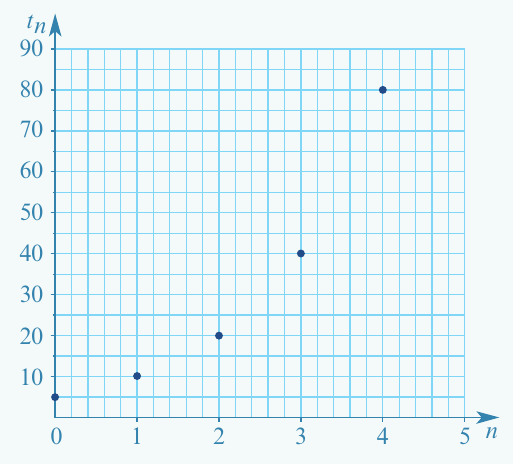
The graph shows the exponential growth of the geometric sequence.
Finding the nth term directly
While repeated multiplication works, it becomes very tedious for finding terms like . Instead, we can develop a direct formula to calculate any term without finding all the previous ones.
Important
Why We Need a Direct Formula
Using the recurrence relation to find would require calculating all 50 previous terms one by one. The direct formula allows us to jump straight to any term, making calculations much more efficient.
Developing the pattern
Consider the geometric sequence: defined by:
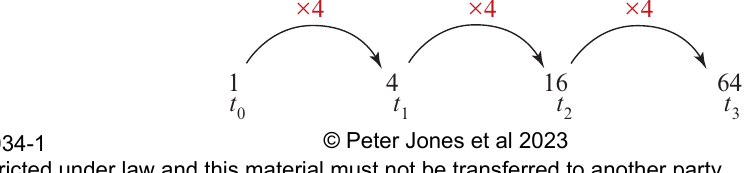
Let's trace what happens at each step:
- (after 0 applications of the rule)
- (after 1 application)
- (after 2 applications)
- (after 3 applications)
A pattern emerges: after applications of the rule:
Using this formula, we can find any term directly. For example:
Note
Recognizing the Pattern
Notice how the number of multiplications becomes the exponent in the direct formula. After applying the rule times, we've multiplied by the common ratio times, which is equivalent to raising it to the power of .
General formula for the nth term
This pattern can be generalised for any geometric sequence.
If the recurrence relation is:
Then the nth term can be found directly using:
Where:
- is the term number ()
- is the starting value
- is the common ratio
Important
The Direct Formula
The formula is one of the most important results for geometric sequences. Memorize this formula and understand that:
- The exponent represents how many times you've applied the rule
- You multiply by the starting value at the end
- This works for any geometric sequence, no matter how large is
Example
Worked Example: Finding a Specific Term
Problem: Consider the recurrence relation . Find .
Solution:
Step 1: Identify the starting value and common ratio
Step 2: Identify the term number
We want , so (this requires 12 applications of the rule)
Step 3: Substitute into the formula
Step 4: Evaluate
Answer:
Key formulas summary
Summary
Essential Formulas for Geometric Sequences
For a geometric sequence with starting value and common ratio :
Recurrence relation (recursive definition):
This tells you how to generate the sequence step by step.
Direct formula (explicit definition):
This allows you to find any term directly without calculating all previous terms.
Both formulas describe the same geometric sequence, but the direct formula is much more efficient for finding terms far along in the sequence.
Summary
Key Points to Remember:
- A recurrence relation specifies a starting value and a rule for generating subsequent terms
- For geometric sequences, the recurrence relation is
- The direct formula lets you find any term without calculating all previous ones
- In the formula, represents the number of times the rule has been applied (term number starting from 0)
- The direct formula is derived by recognising the pattern of repeated multiplications