Angles of Elevation and Depression (VCE SSCE General Mathematics): Revision Notes
📚Revision Notes
Angles of Elevation and Depression
Introduction
When we look at objects above or below our horizontal line of sight, we create specific angles that help us solve real-world problems involving heights and distances. These angles are called angles of elevation and depression, and they are essential tools in trigonometry for surveying, navigation, and engineering applications.
Note
These concepts have practical applications in many fields:
- Surveying: Measuring land elevations and creating topographic maps
- Navigation: Calculating distances to ships, aircraft, or landmarks
- Engineering: Designing ramps, roads, and structures with specific inclines
- Astronomy: Determining positions of celestial objects
Understanding angles of elevation
The angle of elevation is the angle formed when you raise your line of sight upward from a horizontal reference line to look at an object above you. Imagine standing on the ground and looking up at the top of a building or a bird flying overhead. The angle your line of sight makes with the horizontal ground is the angle of elevation.
Note
Key characteristics of angles of elevation:
- They are always measured from the horizontal upward
- They range from to
- The observer is typically at a lower position than the object being viewed
Understanding angles of depression
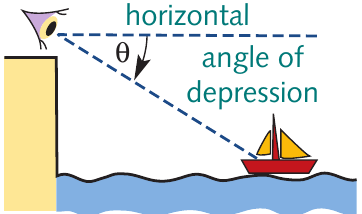
The angle of depression is the angle formed when you lower your line of sight downward from a horizontal reference line to look at an object below you. For example, if you're standing at the top of a lighthouse looking down at a boat on the water, the angle your line of sight makes with the horizontal is the angle of depression.
Note
Key characteristics of angles of depression:
- They are always measured from the horizontal downward
- They range from to
- The observer is typically at a higher position than the object being viewed
The relationship between angles of elevation and depression
There is an important geometric relationship between angles of elevation and depression. When two observers look at each other, one from above and one from below, the angle of elevation for the lower observer equals the angle of depression for the higher observer.
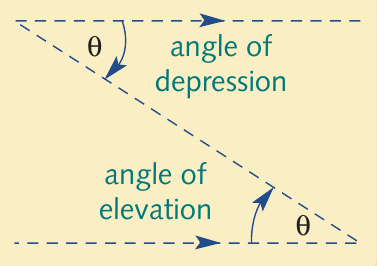
This equality occurs because these angles are alternate angles (also called Z-angles) formed by parallel horizontal lines and a transversal line of sight.
Important
Critical Relationship:
This relationship is extremely useful when solving problems, as it allows us to transfer angle information between different parts of a diagram. Always look for this relationship when working with both types of angles in the same problem.
Applying trigonometric ratios
To solve problems involving angles of elevation and depression, we use trigonometric ratios. The choice of ratio depends on which sides of the right-angled triangle are known or required:
Tangent ratio: Used when we know or need the opposite and adjacent sides
Sine ratio: Used when we know or need the opposite side and hypotenuse
Cosine ratio: Used when we know or need the adjacent side and hypotenuse
Note
Choosing the right ratio:
- Know opposite and adjacent? Use tangent
- Know opposite and hypotenuse? Use sine
- Know adjacent and hypotenuse? Use cosine
Worked example: Angle of elevation
Example
Worked Example: Finding Height Using Angle of Elevation
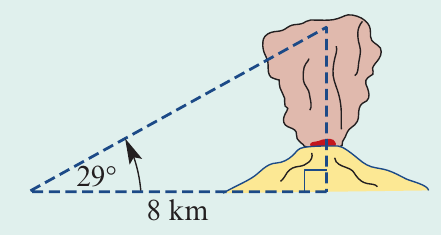
Problem: A park ranger measured the top of a plume of volcanic ash to be at an angle of elevation of . From her map she noted that the volcano was km away. Calculate the height of the plume to one decimal place.
Solution:
Step 1: Draw a right-angled triangle with the given information. Label the required height as .
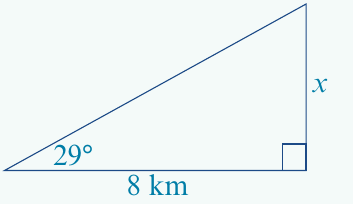
Step 2: Identify which trigonometric ratio to use. We know the adjacent side ( km) and need to find the opposite side (), so we use tangent.
Step 3: Substitute the known values into the formula.
Step 4: Multiply both sides by to solve for .
Step 5: Use a calculator to evaluate.
Step 6: Round to one decimal place.
Answer: The height of the ash plume is km.
Worked example: Angle of depression
Example
Worked Example: Finding Distance Using Angle of Depression
Problem: From the top of a cliff that is m above sea level, Chen saw a capsized yacht. He estimated the angle of depression to be about . How far is the yacht from the base of the cliff, to the nearest metre?
Solution:
Step 1: Draw a diagram showing the given information. Label the required distance as .
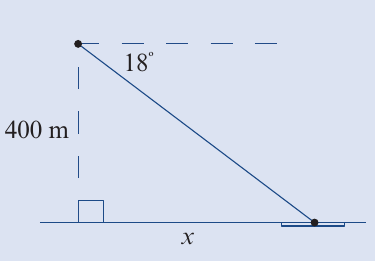
Step 2: Mark the angle inside the triangle. Due to alternate angles, the angle at the yacht corner is also .
Important
Common Mistake to Avoid: The angle between the cliff face and the line of sight is NOT . The angle of depression is measured from the horizontal, so the angle inside the triangle (at the yacht) is due to alternate angles.
Example
Step 3: Identify which sides are involved. We have the opposite side ( m) and need the adjacent side (), so we use tangent.
Step 4: Substitute the known values.
Step 5: Multiply both sides by .
Step 6: Divide both sides by .
Step 7: Calculate using a calculator.
Step 8: Round to the nearest metre.
Answer: The yacht is m from the base of the cliff.
Worked example: Rock climber
Example
Worked Example: Finding Height from Horizontal Distance
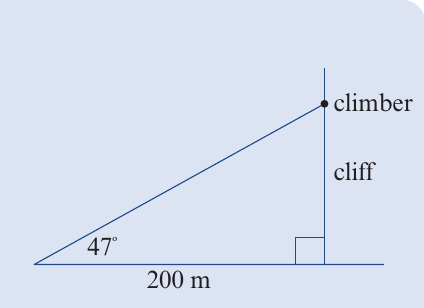
Problem: The angle of elevation of a rock climber scaling a vertical cliff is . The horizontal distance to the base of the cliff is m. How high is the climber up the face of the cliff? Answer to the nearest metre.
Solution:
Step 1: Identify the sides. The horizontal distance is the adjacent side ( m), and we need to find the height (opposite side).
Step 2: Write the trigonometric equation using tangent.
Step 3: Multiply both sides by .
Step 4: Calculate.
Step 5: Round to the nearest metre.
Answer: The climber is m up the cliff face.
Problems involving two triangles
Some problems require working with two connected right-angled triangles. The strategy is to solve one triangle first to find a common side, then use that value to solve the second triangle.
Example
Worked Example: Multi-Step Problem with Two Triangles
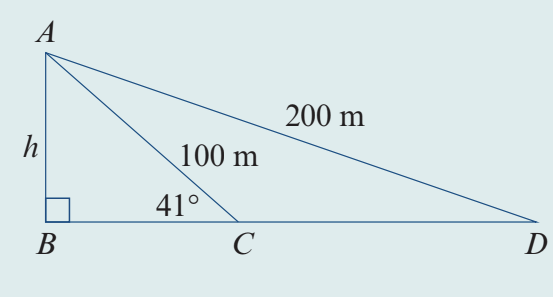
Problem: A cable m long makes an angle of elevation of with the top of a tower.
a) Find the height, , of the tower to the nearest metre.
b) Find the angle of elevation, to the nearest degree, that a cable m long would make with the top of the tower.
Solution to part a:
Step 1: Focus on the triangle with the m cable. The opposite side is (height) and the hypotenuse is m.
Step 2: Use the sine ratio.
Step 3: Substitute the known values.
Step 4: Multiply both sides by .
Step 5: Calculate and store the value.
Step 6: Round to the nearest metre.
Answer: The height of the tower is m.
Solution to part b:
Step 1: Consider the triangle with the m cable. Let the angle be . The opposite side is and the hypotenuse is m.
Step 2: Use the sine ratio.
Step 3: Substitute the values (use the stored value of from part a).
Step 4: Find using the inverse sine function.
Step 5: Calculate.
Step 6: Round to the nearest degree.
Answer: The m cable makes an angle of elevation of with the ground.
Note
Key Strategy for Two-Triangle Problems: When a problem involves two triangles, always solve for the common side first (in this case, the height ), then use that value in the second calculation. Remember to keep the unrounded value stored in your calculator for accuracy.
Problem-solving strategy
Summary
Step-by-Step Problem-Solving Guide:
When tackling angle of elevation or depression problems, follow these steps:
-
Draw a clear diagram showing all given information and label the unknown value
-
Identify the angle you'll use in your calculations (remember that angles of elevation and depression are alternate angles)
-
Determine which sides of the right-angled triangle are involved (opposite, adjacent, or hypotenuse)
-
Choose the appropriate trigonometric ratio (sine, cosine, or tangent)
-
Write the equation with the known values
-
Solve for the unknown by rearranging the equation
-
Calculate the answer using a calculator
-
Round appropriately according to the question requirements
Exam tips
Important
Essential Tips for Success:
-
Always check whether you're given an angle of elevation or depression, as this affects where you mark the angle in your diagram
-
Remember that angles of elevation and depression are equal when viewing the same line of sight from opposite ends
-
When working with depression angles, mark the equal alternate angle inside the triangle
-
Keep unrounded values stored in your calculator when solving multi-step problems, then round only your final answer
-
Check your answer makes sense in the context (e.g., heights and distances should be positive)
-
Draw large, clear diagrams with all information clearly labelled
Remember!
Summary
Key Points to Remember:
-
The angle of elevation is measured upward from the horizontal when looking up at an object
-
The angle of depression is measured downward from the horizontal when looking down at an object
-
Angles of elevation and depression are equal because they are alternate angles on parallel horizontal lines
-
Choose your trigonometric ratio based on which sides you know: use tangent for opposite and adjacent, sine for opposite and hypotenuse, cosine for adjacent and hypotenuse
-
Always draw a clear diagram, identify the angle inside the triangle, and label all known and unknown values before beginning calculations