Applications of Right-Angled Triangles (VCE SSCE General Mathematics): Revision Notes
📚Revision Notes
Applications of Right-Angled Triangles
Introduction
When you encounter real-world problems involving heights, distances, and angles, right-angled triangles provide a powerful tool for finding unknown measurements. This topic shows you how to use trigonometric ratios and their inverses to solve practical problems. The key skills you'll develop are drawing clear diagrams, identifying which sides and angles you know, and choosing the correct trigonometric function to solve for the unknown.
Note
The three essential skills for solving right-angled triangle problems are:
- Drawing clear, labelled diagrams
- Identifying which sides and angles are known
- Selecting the appropriate trigonometric function
Finding unknown lengths
Use trigonometric ratios to find an unknown side length when you know one angle (other than the right angle) and one side length. This approach allows you to calculate distances and heights that would be difficult or impossible to measure directly.
Step-by-step process
- Draw a clear diagram showing the right-angled triangle with all given information
- Label the unknown side with a letter (usually )
- Identify the sides relative to the given angle:
- Opposite: the side across from the angle
- Adjacent: the side next to the angle (not the hypotenuse)
- Hypotenuse: the longest side, opposite the right angle
- Choose the appropriate trigonometric ratio based on which sides are involved:
- Substitute the known values into the formula
- Solve for the unknown by rearranging the equation
- Calculate and round your answer appropriately
Example
Worked Example: Finding the height of a flagpole
Problem: A flagpole creates a shadow that measures 7.42 m along the ground. The sun's rays make an angle of 38° with the level ground. Calculate the height of the flagpole to two decimal places.
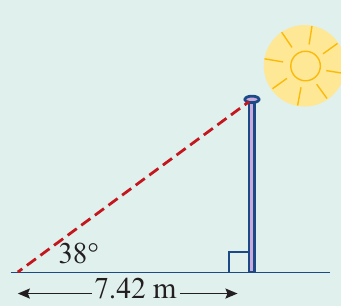
Solution:
Start by sketching a right-angled triangle representing this situation. Mark the known measurements and label the unknown height as .
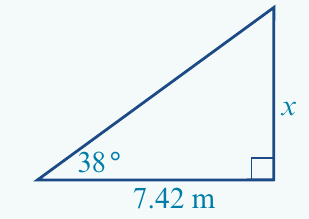
Since we're working with the opposite side (height) and the adjacent side (shadow length), the tangent ratio is appropriate:
Substitute the known values:
Multiply both sides by 7.42 to isolate :
Use your calculator to evaluate this:
Rounding to two decimal places:
The height of the flagpole is 5.80 m.
Note
Practice problem: Walking up a slope
Problem: A person walks 200 m up a slope inclined at 35° to the horizontal. How much have they risen vertically? Answer to the nearest metre.
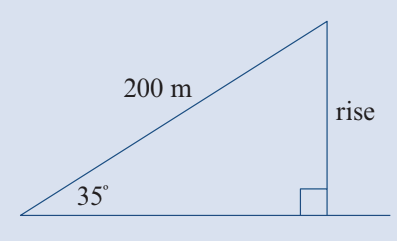
Hints:
- The sloping distance (200 m) is the hypotenuse
- The vertical rise is the opposite side to the 35° angle
- Use the trigonometric ratio that connects opposite and hypotenuse
Finding unknown angles
Use inverse trigonometric functions to find an unknown angle when you know two side lengths of the right-angled triangle. This technique is particularly useful when you need to determine the angle of elevation, inclination, or slope in practical situations.
Step-by-step process
- Draw a clear diagram showing the right-angled triangle with all given measurements
- Label the unknown angle with a Greek letter (commonly )
- Identify the known sides relative to the unknown angle:
- Opposite, adjacent, or hypotenuse
- Choose the appropriate inverse function based on which sides you know:
- Substitute the known values into the inverse function
- Use your calculator to evaluate the inverse function
- Round your answer to the required number of decimal places or nearest degree
Example
Worked Example: Finding the angle of a sloping roof
Problem: A sloping roof uses sheets of corrugated iron 4.2 m long on a shed that is 4 m wide. The roof sheets don't overlap past the sides of the walls. Find the angle that the roof makes with the horizontal, to one decimal place.
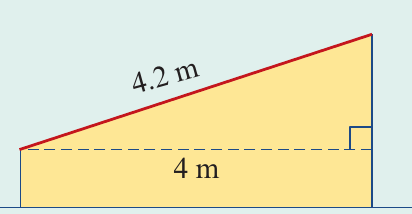
Solution:
Begin by sketching the right-angled triangle that represents this situation. Mark the known lengths and label the required angle as .
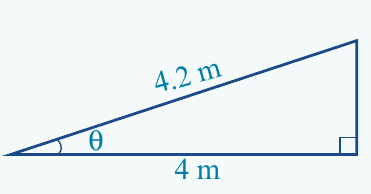
Since we know the adjacent side (4 m) and the hypotenuse (4.2 m), the cosine ratio is the appropriate choice:
Substitute the known values:
To find the angle, use the inverse cosine function:
Calculate this expression as a whole on your calculator:
Rounding to one decimal place:
The roof makes an angle of 17.8° with the horizontal.
Note
Practice problem: Finding the angle of a slide
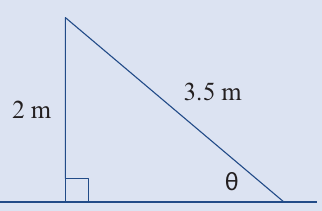
Problem: A vertical ladder of a children's slide is 2 m in height. The length of the slide itself is 3.5 m. Find the angle that the slide makes with the level ground, to the nearest degree.
Hints:
- Identify which sides you know: the opposite (2 m) and hypotenuse (3.5 m)
- Choose the inverse trigonometric function that uses these two sides
Important tips for solving problems
Draw diagrams first
Always begin by sketching a clear, labelled diagram. This helps you visualise the problem and identify which sides and angles are involved. A good diagram is the foundation of accurate problem-solving in trigonometry.
Label everything
Mark all known measurements on your diagram and clearly label the unknown quantity you're trying to find. This prevents confusion about which values to use in your calculations.
Important
Avoid rounding errors
Always evaluate a mathematical expression as a whole on your calculator, rather than breaking it into several smaller calculations. When you round intermediate answers and then use them in further calculations, rounding errors accumulate and your final answer becomes less accurate.
For example, calculate in one step, not as separate steps of "4 ÷ 4.2 = 0.95" then "".
Check your answer makes sense
After calculating, ask yourself: "Is this answer reasonable?" For instance, if you're finding the height of a flagpole and get an answer of 500 m, something has likely gone wrong!
Summary
Key Points to Remember:
-
For finding lengths: Choose the trigonometric ratio (, , or ) that connects the known angle and sides with the unknown side.
-
For finding angles: Choose the inverse trigonometric function (, , or ) that uses the two known sides.
-
Always start with a diagram: Draw and label a right-angled triangle showing all the given information before attempting calculations.
-
Use SOH-CAH-TOA: This helps you remember which ratio to use: Sine = Opposite/Hypotenuse, Cosine = Adjacent/Hypotenuse, Tangent = Opposite/Adjacent.
-
Minimize rounding errors: Calculate the entire expression in one step on your calculator rather than rounding intermediate values.