Trigonometry Basics (VCE SSCE General Mathematics): Revision Notes
📚Revision Notes
Trigonometry basics
Understanding trigonometry is essential for solving problems involving right-angled triangles. This note reviews the fundamental concepts you need to work confidently with trigonometric ratios. You may have studied some of this material before, but it's important to ensure you have a solid foundation.
Naming the sides of a right-angled triangle
In any right-angled triangle, we can identify three distinct sides. The names we give these sides depend on their position relative to the angle we're working with, which we typically label as (the Greek letter theta).
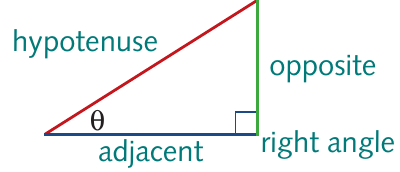
Understanding how to correctly identify each side is crucial for applying trigonometric ratios:
The hypotenuse represents the longest side in a right-angled triangle. It's always positioned opposite the right angle (the angle). No matter which angle you're considering, the hypotenuse never changes - it's always the longest side opposite the right angle.
The opposite side sits directly across from angle . This side changes depending on which angle you're examining. If you were to move to a different corner of the triangle, a different side would become the opposite side.
The adjacent side lies next to angle and forms one of the arms of this angle. It runs from to the right angle, but it's not the hypotenuse. Like the opposite side, which side is "adjacent" depends on the position of .
Important
The labels "opposite" and "adjacent" are relative terms - they depend entirely on which angle you're working with. If was positioned at a different corner, these labels would swap to different sides. Only the hypotenuse remains constant.
Example
Worked Example: Identifying the sides of a right-angled triangle
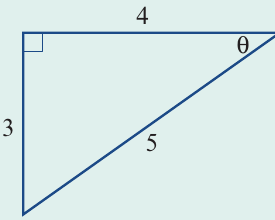
Let's identify the hypotenuse, opposite side, and adjacent side in the triangle shown below.
Solution:
To identify each side, we need to consider its position relative to angle and the right angle.
- The hypotenuse: (This is the longest side and sits opposite the right angle)
- The opposite side: (This side sits directly across from angle )
- The adjacent side: (This side lies between and the right angle)
The trigonometric ratios
Trigonometric ratios provide a way to relate the angles in a right-angled triangle to the lengths of its sides. There are three fundamental trigonometric ratios you need to know: sine, cosine, and tangent. We write these as , , and .
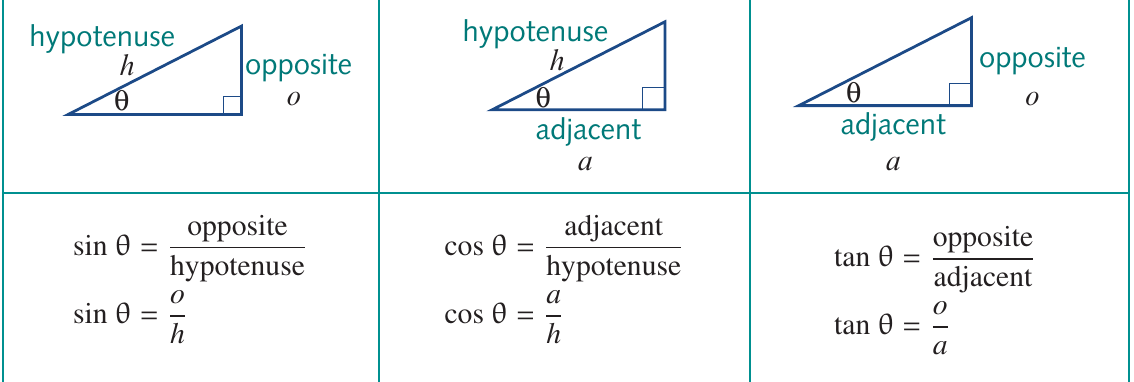
Each ratio represents a specific relationship between two sides of the triangle:
Sine relates the opposite side to the hypotenuse:
Cosine relates the adjacent side to the hypotenuse:
Tangent relates the opposite side to the adjacent side:
The SOH-CAH-TOA mnemonic
Students often use the mnemonic SOH-CAH-TOA to remember these three trigonometric ratios. Let's break down what this means:
- SOH reminds us that Sine equals Opposite over Hypotenuse
- CAH reminds us that Cosine equals Adjacent over Hypotenuse
- TOA reminds us that Tangent equals Opposite over Adjacent
Note
If you find SOH-CAH-TOA difficult to remember, you might prefer this alternative mnemonic:
"Sir Oliver's Horse Came Ambling Home To Oliver's Arms"
The first letters of each word correspond to the ratios: Sine, Opposite, Hypotenuse, Cosine, Adjacent, Hypotenuse, Tangent, Opposite, Adjacent.
Understanding what trigonometric ratios mean
When you use a calculator to find, for example, that , what does this actually tell us? This value means that in all right-angled triangles containing a angle, the ratio of the opposite side to the hypotenuse is always , regardless of the triangle's size.
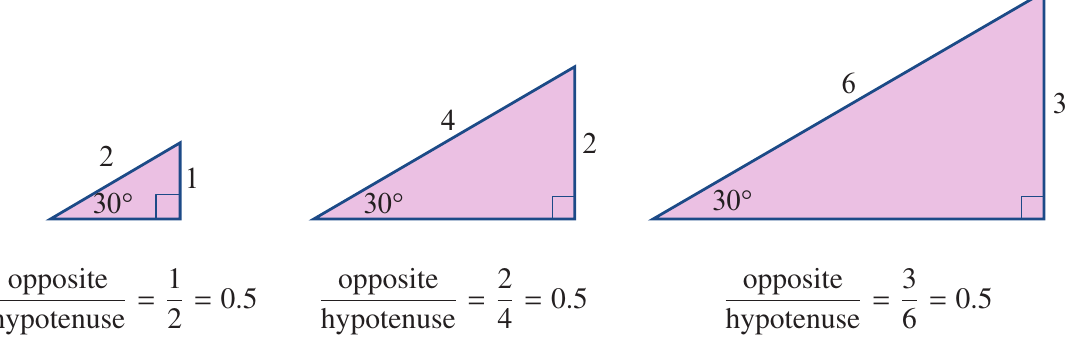
The diagram above shows three different right-angled triangles, each with a angle. Notice that:
- In the first triangle:
- In the second triangle:
- In the third triangle:
Even though these triangles are different sizes, the ratio remains constant at . This is the fundamental principle of trigonometry - the ratios depend only on the angle, not on the size of the triangle.
Similarly, for any right-angled triangle with a angle:
These values are always the same for a angle, no matter what size triangle you're working with.
Using a calculator to find trigonometric values
Your CAS calculator can quickly find the value of any trigonometric ratio for any angle. However, there's one critical setting you must check first.
Important
Always set your calculator to DEGREE mode
Before calculating any trigonometric values, you must ensure your calculator is set to DEGREE mode (not radian mode). The degree mode setting is usually indicated by "DEG" on your calculator display.
If your calculator is in the wrong mode, you'll get incorrect answers. Check the appendix or your calculator's user guide if you're unsure how to change this setting.

Example
Worked Example: Finding the values of trigonometric ratios
Use your calculator to find, to four decimal places, the value of:
a) b) c)
Solution:
First, ensure your calculator is set to degree mode. Then:
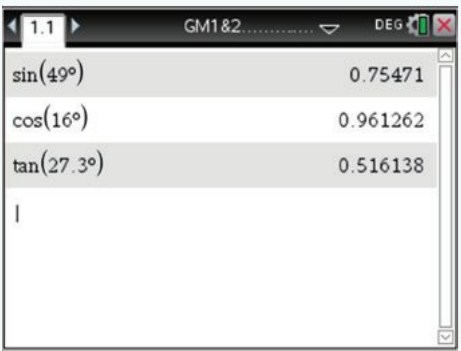
a)
b)
c)
To enter these calculations:
- Press the appropriate trigonometric function button (sin, cos, or tan)
- Type the angle value
- Press enter or EXE
- Round your answer to the required number of decimal places
Summary
Key Points to Remember:
- The hypotenuse is always the longest side and sits opposite the right angle
- The opposite and adjacent sides are named relative to angle - they change depending on which angle you're working with
- Use SOH-CAH-TOA to remember: , ,
- Trigonometric ratios are constant for any given angle, regardless of the triangle's size
- Always check your calculator is in DEGREE mode before calculating trigonometric values