Key Skills (VCE SSCE Health and Human Development): Revision Notes
📚Revision Notes
Key Skills
This section covers two essential skills you need to develop for studying youth health and wellbeing issues. While mental disorders are explored elsewhere in this unit, these skills can be applied to any youth health issue. The examples here focus on injury and road trauma to demonstrate how to apply these skills effectively.
Key skill 1: Research and collect data on a youth health and wellbeing focus
This skill requires you to investigate a specific health and wellbeing issue affecting young Australians in depth. You must go beyond simple description and engage in critical analysis of the issue.
What you need to include
When researching and analysing a youth health and wellbeing focus, you must address the following elements:
- Health status impact: Examine morbidity data (including prevalence and incidence where relevant), mortality rates, burden of disease figures, and other health indicators
- Dimensions of health and wellbeing: Analyse how the issue affects the physical, social, mental, emotional and spiritual health and wellbeing of young people who experience it
- Risk and protective factors: Identify factors that increase or decrease the likelihood of young people experiencing this health issue
- Costs: Examine the direct, indirect and intangible costs associated with the issue
- Management strategies: Investigate personal strategies and community or government programs designed to address the issue, including at least one health promotion program
Important considerations for critical analysis
Critical analysis means thinking deeply about your chosen health issue rather than simply describing it. Keep these points in mind:
Important
Youth focus: All data, factors and strategies must specifically relate to the youth stage of the lifespan (approximately 12-25 years). This is non-negotiable for all research and analysis you conduct.
- Evaluation of effectiveness: Comment on how well programs and strategies work. Consider their ability to reduce costs, any financial constraints they face, and whether they align with community values
- Balanced perspective: Not all programs are perfect. Identify both strengths and areas for improvement
- Use of evidence: Support your analysis with data presented in tables, graphs or case studies to draw meaningful conclusions
Note
Strong critical analysis moves beyond listing features or characteristics. Instead, focus on evaluating how effective strategies are, examining their limitations, and considering why certain approaches work better than others for young people specifically.
Example: Injury as a youth health and wellbeing issue
The following example demonstrates how to apply this key skill using injury as the health and wellbeing focus.
Definition and scope
Note
Definition: Injury refers to intentional or unintentional physical damage that occurs to the body as a result of trauma. For young Australians, common examples include drowning, car crashes, suicide and poisoning.
Injuries represent the second greatest contributor to mortality among young people in Australia, with land transport accidents being the leading single cause, followed by intentional self-harm.
Morbidity and mortality data
Beyond causing death, injuries can result in lifelong disability and contribute significantly to illness and hospitalisation among young people. When not fatal, injuries often require hospital admission and ongoing treatment, including rehabilitation services.
According to Australia's Health 2016, there were 19,531 cases of young people aged 15 to 17 years hospitalised due to injury, representing 15 per cent of all hospitalised injury cases in the youth age group. The incidence rate stood at cases per population. Males are more likely to be hospitalised for injuries than females.
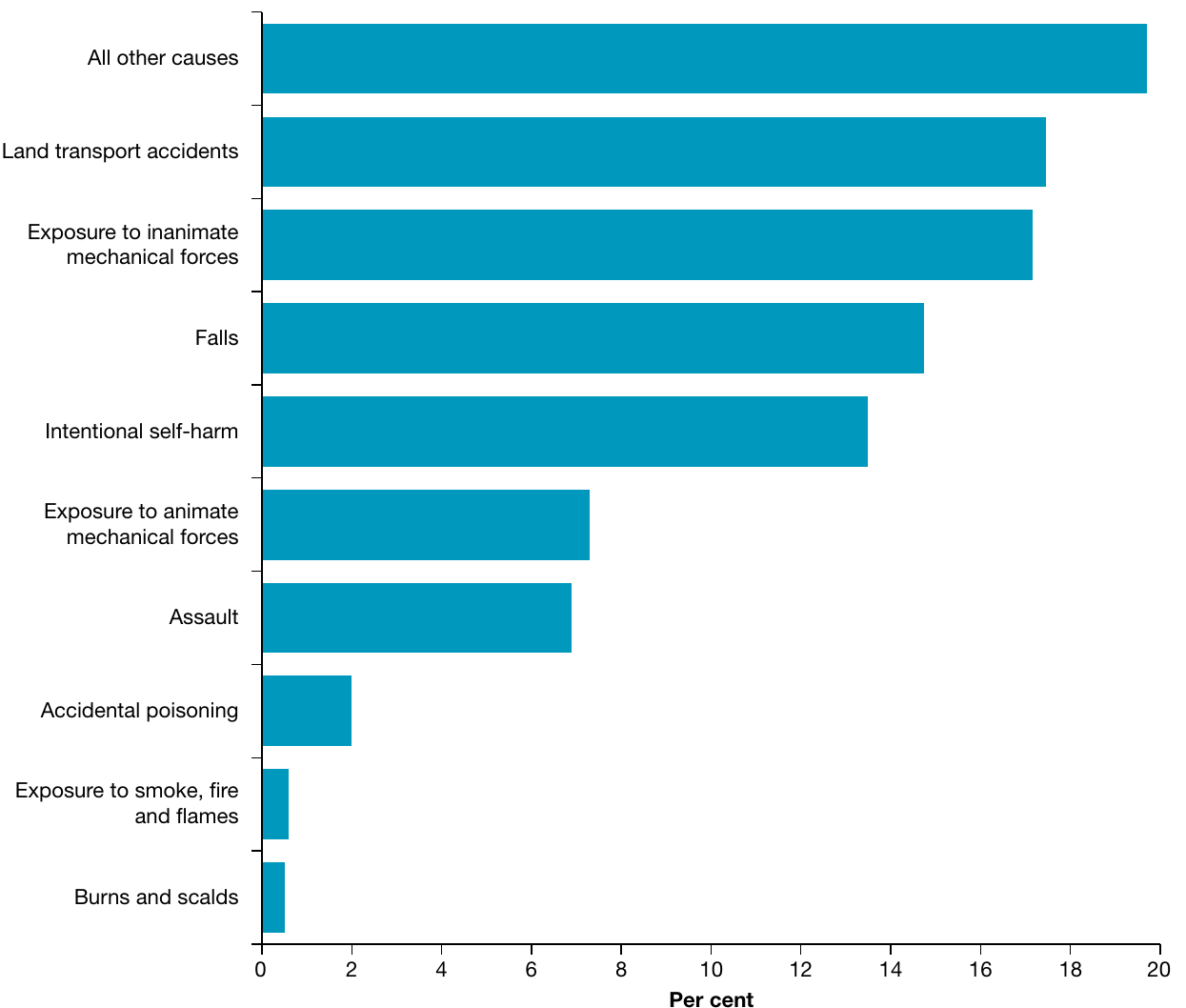
The chart above shows the various causes of injury requiring hospitalisation among 15-24 year olds. Land transport accidents, exposure to inanimate mechanical forces (such as being struck by objects), and falls represent the three leading causes.
Impact on dimensions of health and wellbeing
Injuries from road trauma or sport can affect multiple dimensions of a young person's health and wellbeing:
Physical health and wellbeing: Injuries such as broken bones, cuts, bruising or concussion prevent young people from performing daily tasks like attending school or socialising with friends without physical restrictions.
Social health and wellbeing: Recovery from injury can reduce access to social networks at school or sporting clubs, limiting opportunities for connection and interaction with peers.
Mental and emotional health and wellbeing: Serious injuries resulting in reduced physical function, such as spinal injuries, can create low mood, poor self-esteem and negative self-image. Physical limitations may also make it difficult for young people to respond to and manage their emotions appropriately, particularly when visited by friends during recovery.
Note
When analyzing impact on dimensions of health and wellbeing, always consider how one dimension can affect others. For example, physical injuries (physical dimension) often lead to social isolation (social dimension) and low mood (mental and emotional dimensions), creating a cascade effect across multiple dimensions.
Risk and protective factors
Several factors influence the likelihood of young people sustaining injuries:
Risk factors (increase the chance of injury):
- Alcohol and drug use
- Risk-taking behaviours
- Peer group influence
- Driver inexperience
- Mobile phone use while driving
Protective factors (decrease the chance of injury):
- Wearing seatbelts
- Obeying speed limits
- Wearing helmets when cycling or on motorcycles
- Breaking long road trips into manageable segments to prevent fatigue
- Avoiding distractions whilst driving
Costs associated with injury
The Australian government currently identifies the annual economic cost of road crashes in Australia as $33.16 billion per year. Understanding the different types of costs helps illustrate the full impact:
Direct costs: With thirty people hospitalised for every one death on Australian roads, direct medical costs are substantial. These include ambulance services, emergency department treatment, hospital stays, rehabilitation services, medication and ongoing care from general practitioners and allied health professionals.
Indirect costs: These include payments to carers who support injured young people, welfare payments to assist recovery, and lost productivity when young people cannot attend school or work.
Intangible costs: These are costs that cannot be easily measured in financial terms. They include anxiety and grief experienced by family members when a young person is injured, and the sense of loss and frustration experienced by young people who suffer permanent disability, such as spinal injury.
Important
Remember DII: When analyzing costs, you must address all three types:
- Direct costs (medical expenses, treatment)
- Indirect costs (lost productivity, welfare payments)
- Intangible costs (pain, suffering, anxiety)
Each type contributes to the true economic and social burden of health issues.
Healthcare services for injury
Young people affected by injuries can access various healthcare services:
- Ambulance services for transport to hospital following injury
- General practitioners to treat cuts, breaks and minor injuries
- Emergency departments at public hospitals for acute injury treatment
- Rehabilitation services to help regain physical and mental health and wellbeing
- Allied health professionals such as physiotherapists to regain full flexibility and movement
Health promotion program: Towards Zero campaign
The Transport Accident Commission (TAC) produces various initiatives, including advertising campaigns, aimed at reducing the incidence and severity of injuries from road accidents. The Towards Zero campaign exemplifies this approach and is produced in partnership with VicRoads, Victoria Police and the Victorian Government.

The Towards Zero campaign is an advertising strategy that encourages people to reduce their speed and therefore their risk of sustaining injuries on Victorian roads. The campaign utilises social media platforms such as Facebook to personalise road safety messages. It also provides a website containing video clips showing the different people affected by road trauma.
Example
Critical Analysis Example: Evaluating the Towards Zero Campaign
When critically analyzing a health promotion program, you need to examine both its strengths and limitations. Here's how to structure your analysis:
Step 1: Identify the strengths
- What makes the program effective?
- How does it reach its target audience?
- What specific health issue or risk factor does it address?
Step 2: Assess potential to reduce costs
- Which types of costs (direct, indirect, intangible) could be reduced?
- How would this reduction occur?
Step 3: Identify limitations
- Who might not be reached by the program?
- What barriers exist to its effectiveness?
- What characteristics of the target audience might reduce impact?
Strengths of the campaign:
The Towards Zero campaign uses media, particularly social media, to reach its target audience. Since young people frequently engage with social media, they are more likely to be exposed to the campaign's messages. The campaign educates people by accessing their social media profiles and creating personalised messages about the impact of road injuries.
The campaign is effective because it targets speed, which is a major contributor to land transport accidents - the leading cause of injury death among young people. By reaching young people through media they regularly use, the campaign may encourage them to reconsider risk-taking behaviours on the road, potentially decreasing injury death rates in this age group.
Potential to reduce costs:
If successful, the Towards Zero campaign can reduce direct costs such as general practitioner fees and hospital charges related to injuries. It may also reduce government expenditure on Medicare subsidies and Pharmaceutical Benefits Scheme payments for medical consultations and pain medication. Additionally, it can reduce intangible costs such as pain, suffering and frustration linked to reduced mobility following injury.
Limitations of the campaign:
Not all young people at risk of road injuries regularly access social media, meaning some may not be exposed to the Towards Zero messages. Furthermore, youth is often a time of risk-taking for some individuals. Even when exposed to the campaign, some young people may not respond to its message or may believe that accidents only happen to others, not themselves.
Note
When evaluating health promotion programs, consider whether the program aligns with the characteristics and values of the target audience. Programs targeting young people must account for developmental features like the sense of invincibility and risk-taking behaviours common during the youth stage.
Practice questions for key skill 1
- Identify and describe one health and wellbeing focus for Australia's youth that has become increasingly significant in the past ten years. Make sure you include:
- The name of the health and wellbeing focus
- A description of the health and wellbeing focus
- Morbidity data (including incidence and prevalence where appropriate), mortality rates, burden of disease data, trends and other health indicators
- Specific risk and protective factors at the youth stage
- Impact on all dimensions of health and wellbeing
- The costs associated with addressing the issue
- Identify personal strategies that a young person could use to prevent or manage the health and wellbeing focus.
- Explain a government or community program designed to address the health and wellbeing focus.
- Discuss the likely effectiveness of the program in promoting youth health and wellbeing.
Key skill 2: Plan advocacy and/or action for youth health and wellbeing
This skill requires you to identify a health and wellbeing focus or inequity affecting Australian youth and develop a plan for advocacy or action to address it.
What you need to include
Your advocacy or action plan must address:
- What needs to be promoted: The positive health behaviours or outcomes you want to encourage
- What needs to be done or changed: The specific issues or behaviours that require modification
- What is known about it: Current evidence and data about the issue
- What opportunities for action exist: Practical ways to address the issue
Important
You must critically evaluate the potential effectiveness of your advocacy plan. This means considering possible constraints that could limit effectiveness, such as resource limitations, community values, or characteristics of the target audience. A balanced approach is important - not all aspects of your plan need to be positive.
Example: Advocacy plan for road trauma
The following example demonstrates how to develop and evaluate an advocacy plan addressing road trauma among young people.
What needs to be promoted
The health and wellbeing focus requiring promotion is road trauma among young Australians. This advocacy plan aims to raise awareness of the impact road trauma has on the health and wellbeing of young people, given that land transport accidents are the single greatest cause of injuries for youth. The plan focuses on changing attitudes toward safe driving and increasing awareness of available resources among young people.
What needs to be done or changed
Young people need greater awareness of the risks associated with speeding and driver distraction, particularly from mobile phones. TAC statistics indicate that young drivers are 30 times more likely to crash when they begin driving on their P-plates. According to TAC data, when a driver takes their eyes off the road for two seconds at 50 km/h, they are effectively driving blind for 27 metres - a distance in which serious accidents can occur.
What is known about the issue
Statistical evidence highlights the significance of this issue among young people:
- In 2018, 14 per cent of drivers who lost their lives in Victoria were aged between 18 and 25 years
- Of these fatalities, 79 per cent were male
- This age group represented only 10 per cent of Victorian licence holders, meaning they are over-represented in road fatalities
These statistics demonstrate that young people, particularly young males, face disproportionately high risks on the road compared to their representation in the driving population.
Note
When planning advocacy, strong statistical evidence is crucial. Use specific data about the youth age group to demonstrate why the issue requires attention and how it disproportionately affects young people compared to other age groups.
Action plan
The advocacy plan involves organising a forum at a school assembly featuring:
- A member of the Victorian Police Road Accident Branch
- A road trauma victim to share their personal experience
- A paramedic to discuss emergency response to road accidents
- A young driver to provide peer perspective
The forum will include presentation of videos from the TAC 'Distractions' campaign, such as the video 'Blind', which demonstrates the consequences of driver inattention in a powerful and memorable way.
Example
Planning an Advocacy Action
A complete advocacy plan needs concrete, specific actions. Here's a framework:
Step 1: Identify the format
- What type of event or initiative will you run? (e.g., forum, campaign, workshop)
- Where will it take place?
- Who is the target audience?
Step 2: Determine who will be involved
- What experts or speakers will participate?
- What perspectives do they bring?
- Why are they credible for the target audience?
Step 3: Specify the content
- What information will be shared?
- What materials or resources will be used?
- How will the message be delivered effectively?
Step 4: Plan for evaluation
- How will you measure success?
- What outcomes do you expect?
Evaluation of potential effectiveness
Strengths of the advocacy plan:
This advocacy plan has strong potential for success for several reasons. It addresses mobile phone use and distraction, issues that are highly relevant to young people today. The use of personal stories from road trauma victims makes the message more memorable and emotionally engaging for young people. Including experts with first-hand experience of road trauma involving young people adds credibility and impact to the message.
The plan has potential to change attitudes and behaviours among young people regarding driving, speeding and mobile phone use whilst driving, which could reduce injury risks. It also helps clarify the laws related to mobile phone use while driving, ensuring young people understand their legal obligations.
Potential barriers and limitations:
The advocacy plan may face several challenges. If there is a poor relationship between police and young people in the local area, students may be less receptive to the police officer's message. Some young people may dismiss the information with an 'it won't happen to me' attitude.
Research suggests that even though young people can be aware of potential risks, they often believe they are less likely to experience these risks than their peers. At this stage of development, young people may have an unrealistic sense of invincibility, leading them to think that serious accidents only happen to other people, not themselves.
Important
Youth Developmental Characteristics
When planning advocacy for young people, always consider their developmental stage:
- Risk-taking behaviour is common during youth
- Sense of invincibility may reduce perceived personal risk
- Peer influence is particularly strong
- Young people may be more receptive to peer messengers than authority figures
These characteristics can both support and limit advocacy effectiveness depending on your approach.
Practice questions for key skill 2
- Identify a health and wellbeing focus or inequity related to Australia's youth that requires improvement.
- Plan advocacy or action to address it. Make sure you include:
- What needs to be promoted
- What needs to be done or changed
- What is known about it
- What opportunities for action exist
- How effective you predict you could be
Exam tip: Answering questions about advocacy
When responding to exam questions about advocacy, remember to:
- Provide specific examples of what the advocacy is trying to address (the problem or issue)
- Explain what the advocacy is trying to promote for young people (the desired outcomes)
- Include an explanation of how young people themselves can be involved in the advocacy efforts
- Consider both strengths and limitations of advocacy approaches
Summary
Key Points to Remember:
-
Critical analysis goes beyond description: When researching a youth health issue, think deeply about effectiveness, costs, barriers and impacts rather than simply describing features
-
Youth focus is essential: All data, risk factors, protective factors and programs must specifically relate to young people aged approximately 12-25 years
-
Three types of costs matter: Direct costs (medical treatment), indirect costs (lost productivity, welfare), and intangible costs (pain, suffering, anxiety) all contribute to the full impact of health issues
-
Effective advocacy requires planning: A good advocacy plan identifies what needs promoting, what needs changing, uses current evidence, and proposes realistic actions
-
Balanced evaluation is important: Not all programs or advocacy plans are perfect - identify both strengths and limitations to demonstrate critical thinking