Key Features of SDG 3: Good Health and Wellbeing (VCE SSCE Health and Human Development): Revision Notes
📚Revision Notes
Key Features of SDG 3: Good Health and Wellbeing
Sustainable Development Goal 3 focuses on ensuring healthy lives and promoting wellbeing for people of all ages. This goal aims to improve both physical and mental health whilst extending life expectancy by tackling the main causes of illness and death across high, middle and low-income countries worldwide.

Note
SDG 3 contains two distinct types of targets that work together. The first category consists of outcome targets - these are the specific health and wellbeing improvements we want to see. The second category consists of implementation targets (or actions) - these are the practical steps and strategies needed to make those health improvements happen.
Health and wellbeing outcome targets
The outcome targets identify eight key areas where SDG 3 aims to achieve measurable improvements in global health and wellbeing.
Reducing maternal mortality
SDG 3 sets out to lower maternal deaths to fewer than 70 for every 100,000 babies born alive. Maternal mortality refers to the death of a mother during pregnancy, whilst giving birth, or within six weeks following delivery. This target recognises that many women, particularly in low-income countries, still die from preventable complications during pregnancy and childbirth.
Note
Maternal mortality is defined as the death of a mother during pregnancy, childbirth, or within six weeks of delivery. This remains a critical issue, particularly in regions with limited access to quality healthcare services.
Ending preventable deaths of newborns and children under five
This target aims to eliminate deaths of newborns and young children that could be avoided with proper healthcare. Specifically, SDG 3 seeks to reduce:
- Neonatal mortality (deaths in the first 28 days of life) to 12 or fewer per 1,000 live births
- Under-5 mortality (deaths before the fifth birthday) to 25 or fewer per 1,000 live births
Many of these deaths result from treatable conditions such as infections, complications during birth, or malnutrition.
Ending epidemics of communicable diseases
SDG 3 targets the elimination of several major infectious disease epidemics, including:
- AIDS (caused by HIV)
- Tuberculosis (TB)
- Malaria
- Neglected tropical diseases (NTDs)
The goal also aims to combat hepatitis, water-borne diseases, and other communicable conditions.
Note
Tropical diseases are a group of illnesses that mainly occur in tropical and subtropical environments and are most common in countries where people lack access to safe water and sanitation. Examples include dengue fever, schistosomiasis, and sleeping sickness.
Reducing non-communicable diseases
This target seeks to lower premature deaths from non-communicable diseases by one-third through improved prevention and treatment measures. Non-communicable diseases include conditions such as heart disease, cancer, diabetes, and chronic respiratory diseases. These conditions are now major causes of death and disability globally, affecting both developed and developing nations.
Promoting mental health and wellbeing
SDG 3 recognises that mental health is just as important as physical health. This target aims to promote mental wellbeing and ensure people have access to support and treatment for mental health conditions such as depression, anxiety, and other psychological disorders.
Important
Mental health is equally important as physical health in achieving overall wellbeing. Access to mental health support and treatment must be prioritised alongside physical healthcare services.
Reducing substance abuse
This target focuses on strengthening the prevention and treatment of harmful substance use, including both drugs and alcohol. Substance abuse contributes to numerous health problems, injuries, and social issues that affect individuals, families, and communities worldwide.
Reducing road traffic accidents
SDG 3 aims to halve the number of global deaths and injuries caused by road traffic accidents. Traffic accidents are a major cause of premature death and disability, particularly among young people, and place significant burdens on healthcare systems.
Reducing deaths and illnesses from environmental hazards
This target seeks to decrease deaths and illnesses caused by:
- Hazardous chemicals
- Air pollution
- Water pollution and contamination
- Soil pollution and contamination
Environmental hazards affect health in numerous ways, from respiratory diseases caused by poor air quality to illnesses from contaminated water supplies.
Implementation targets (actions)
Implementation targets outline the practical actions and strategies required to achieve the health and wellbeing outcomes. These eight action areas provide the means through which SDG 3's health improvements can be realised.
Achieving universal health coverage
Important
Universal health coverage is an essential foundation for achieving SDG 3. This means expanding health and wellbeing services so that all people can access the healthcare they need without suffering financial hardship.
Everyone should be able to receive quality healthcare services at an affordable cost, regardless of their income level or where they live.
Ensuring an adequate and well-trained health workforce
Every country needs sufficient numbers of qualified healthcare professionals to deliver health services effectively. This includes doctors, nurses, midwives, community health workers, and other healthcare staff. These professionals must receive proper training to provide quality care and stay updated with current medical knowledge and practices.
Providing access to essential medicines and vaccines
Essential medicines are a range of medicines that meet the priority healthcare needs of the population. This target aims to ensure that people worldwide can access the medicines and vaccines they need, and that these are affordable. This includes life-saving drugs for treating diseases as well as vaccines that prevent illness.
Ensuring access to sexual and reproductive healthcare services
This target emphasises the importance of universal access to sexual and reproductive healthcare services. These services include family planning, maternal healthcare, prevention and treatment of sexually transmitted infections, and education about sexual and reproductive health. Access to these services is crucial for reducing maternal mortality and improving overall health outcomes.
Strengthening tobacco control measures
SDG 3 calls for strengthening the implementation of the WHO Framework Convention on Tobacco Control in all countries. This international treaty provides guidelines for reducing tobacco use through measures such as taxation, smoke-free policies, health warnings on packaging, and bans on tobacco advertising. Tobacco use is a major risk factor for numerous diseases including cancer, heart disease, and respiratory conditions.
Note
The WHO Framework Convention on Tobacco Control is an international treaty that provides comprehensive guidelines for reducing tobacco use worldwide through evidence-based policy measures.
Supporting research and development of vaccines and medicines
This target focuses on supporting research and development efforts to create new vaccines and medicines for both communicable and non-communicable diseases. Once developed, these medical innovations must be made accessible and affordable to populations that need them. This ensures that scientific advances benefit everyone, not just wealthy nations.
Increasing investment in healthcare services and staff
SDG 3 recognises the need for increased financial investment in healthcare infrastructure and workforce, especially in low-income countries and small island developing states. These regions often face the greatest healthcare challenges but have the least resources to address them. Greater investment helps build health systems that can deliver quality services to all citizens.
Strengthening capacity for early warning and risk management
This target aims to strengthen every country's capacity for early warning systems, risk reduction, and management of health and wellbeing threats. This includes preparing for disease outbreaks, natural disasters, and other health emergencies. Strong early warning systems help countries respond quickly to health threats, potentially saving many lives.
How implementation targets support outcome targets
The relationship between the implementation targets (actions) and outcome targets shows how practical strategies enable health improvements. Each action contributes to achieving multiple health outcomes, creating an interconnected approach to improving global health.
Example
Example: How Actions Connect to Outcomes
- Achieving universal health coverage supports all health outcomes by ensuring everyone can access needed services
- Access to sexual and reproductive healthcare services directly helps reduce maternal mortality and end preventable deaths of newborns
- Strengthening tobacco control measures contributes to reducing non-communicable diseases
- Increasing investment in healthcare services and workforce enables countries to deliver all the other targets effectively
The diagram below illustrates these connections, showing how the eight implementation targets on the left lead to the eight health and wellbeing outcomes on the right.
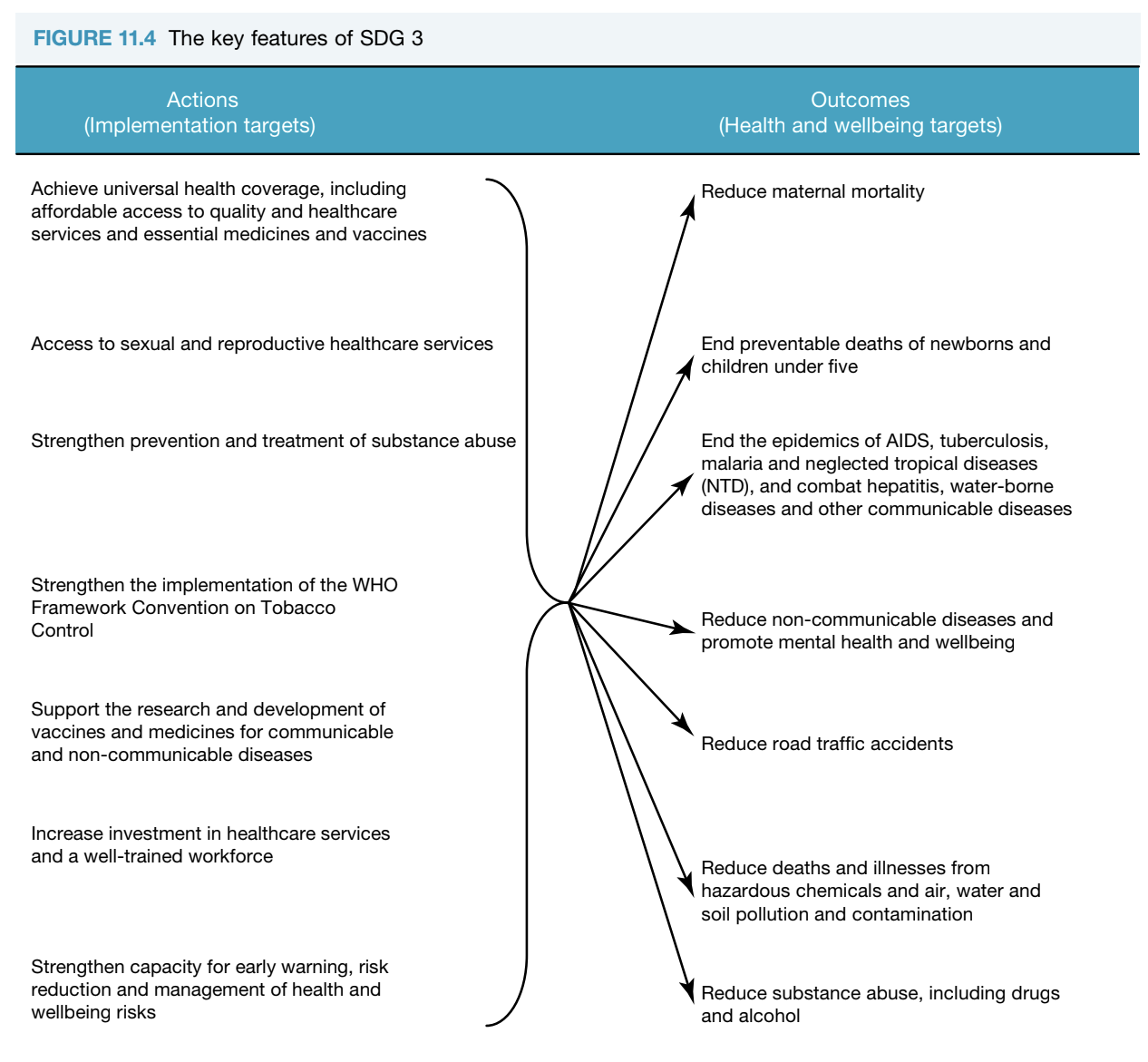
This visual representation demonstrates that achieving good health and wellbeing requires both clear health targets and practical actions to reach them. The implementation targets provide the foundation and tools necessary to accomplish the desired health improvements outlined in the outcome targets.
Key terminology
Understanding the following terms is essential for grasping the key features of SDG 3:
- Maternal mortality: The death of a mother during pregnancy, childbirth, or within six weeks of delivery
- Tropical diseases: A group of diseases that mainly occur in tropical and subtropical environments and are most common in countries where people lack access to safe water and sanitation
- Essential medicines: A range of medicines that meet the priority healthcare needs of the population
- Universal health coverage: A system where all people have access to the health services they need without suffering financial hardship
- Communicable diseases: Infectious diseases that can spread from person to person, such as tuberculosis, malaria, and AIDS
- Non-communicable diseases: Diseases that cannot spread between people, such as heart disease, cancer, and diabetes
Summary
Key Points to Remember:
- SDG 3 has two types of targets: outcome targets (health improvements to achieve) and implementation targets (actions needed to achieve them)
- There are eight outcome targets covering maternal mortality, child deaths, communicable diseases, non-communicable diseases, mental health, substance abuse, road accidents, and environmental hazards
- There are eight implementation targets focusing on universal health coverage, trained workforce, access to medicines and vaccines, reproductive healthcare, tobacco control, research and development, investment, and early warning systems
- Implementation targets provide the practical means to achieve the health outcome targets - they work together as an interconnected system
- Universal health coverage is recognised as an essential foundation for achieving all other aspects of SDG 3