SDG 3 Key Feature: Maternal and Child Health and Wellbeing (VCE SSCE Health and Human Development): Revision Notes
📚Revision Notes
SDG 3 Key Feature: Maternal and Child Health and Wellbeing
Sustainable Development Goal 3 focuses on ensuring healthy lives and promoting wellbeing for all at all ages. One of the key features of this goal is improving maternal and child health, which remains a critical challenge, particularly in low and middle-income countries. This note explores two main aspects: reducing maternal mortality and ending preventable deaths of newborns and children under five.
Reduce maternal mortality
What is maternal mortality?
Maternal mortality measures how many mothers lose their lives because of problems that arise during pregnancy or the birthing process. This is calculated using the maternal mortality ratio, which represents the number of mothers who die as a result of pregnancy, childbirth or associated treatment per 100,000 women who give birth.
Note
Key Definition: Maternal Mortality Ratio
The maternal mortality ratio is a standardized measure that allows for comparison between countries and regions. It is expressed as deaths per 100,000 live births, making it easier to track progress over time and identify areas needing intervention.
The majority of maternal deaths occur in countries with lower or middle levels of income, with five primary factors responsible for these deaths.
Main causes of maternal mortality
There are five leading causes of maternal mortality:
- Haemorrhage - This refers to excessive bleeding during or after childbirth, which can be life-threatening if not quickly addressed.
- Sepsis - A serious infection that affects the entire body, often resulting from unhygienic conditions during delivery or after birth.
- Obstructed labour - This occurs when the baby cannot pass through the birth canal, either because the mother's pelvis is too small or because the baby is not positioned correctly in the uterus.
- Unsafe abortion - Procedures performed without proper medical supervision or in unsafe conditions can lead to complications and death.
- Hypertensive disease - Heart conditions caused by high blood pressure during pregnancy can be fatal if not properly managed.
Important
The Hidden Killer: Malnutrition
In addition to the five main causes above, malnutrition significantly increases the risk of maternal mortality, especially in low and middle-income countries. Iron-deficiency anaemia alone contributes to 20 percent of all maternal deaths. This makes addressing nutrition a critical component of reducing maternal mortality.
Progress in reducing maternal mortality
There has been significant improvement in maternal survival rates since 2000. Between 2000 and 2017, the global rate of maternal deaths decreased by 38 percent.
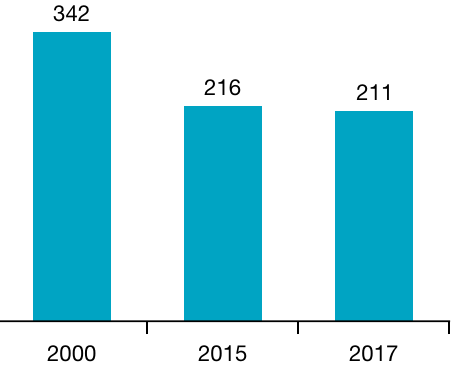
The maternal mortality ratio fell from 342 deaths per 100,000 live births in 2000 to 211 deaths per 100,000 live births in 2017. While this represents substantial progress, there is still much work to be done to meet the SDG 3 target.
Why maternal mortality has improved
Several factors have contributed to the decline in maternal deaths:
Increased access to sexual and reproductive health services
More women now have access to antenatal care, which refers to healthcare provided to women during pregnancy and just after birth. Antenatal care allows qualified health workers to monitor both the mother's and baby's health and wellbeing, identify potential complications early, and take preventive action.
Note
The Four Visit Standard
The World Health Organization recommends that pregnant women receive at least four antenatal care visits during pregnancy. However, only about half of all pregnant women globally can access these recommended visits, highlighting a major gap in service provision.
More births assisted by skilled health personnel
Between 2014 and 2019, 81 percent of births globally were attended by skilled birth attendants, an increase from 64 percent in 2000-2005. Skilled birth attendants can help with obstructed labour and provide medical assistance if a caesarean section (a surgical procedure where the baby is born through an incision in the mother's abdomen and uterus) is required, or if haemorrhaging occurs. Giving birth in a medical facility significantly reduces the risk of infection during childbirth.
However, disparities remain. Only 60 percent of births in sub-Saharan Africa and 77 percent in southern Asia are assisted by skilled health professionals. Women in rural areas are also much less likely to have access to these services compared to those in urban areas.
Fewer adolescent pregnancies
Fewer adolescent girls are now having children. In 2020, the adolescent birth rate was 41 births per 1,000 women aged 15-19. This is important because pregnancy during adolescence (the stage of life from puberty to 20 years of age) increases maternal mortality risk, as girls' bodies are often still developing and less able to cope with pregnancy and childbirth. Stillbirths (when a baby is born dead) and newborn deaths are 50 percent higher among infants born to adolescent mothers compared to those born to mothers aged 20-29.
Note
Adolescent pregnancy has declined in most regions but remains high in sub-Saharan Africa, where the adolescent birth rate in 2020 was 101 per 100,000 women aged 15-19 - more than double the global average. This represents a key area requiring targeted intervention.
Greater access to family planning services
In 2020, 76.8 percent of women aged 15-49 had access to modern contraceptive methods - technological advances that enable couples to control when they have children. This allows families to plan the number of children they have and the spacing between births. Allowing at least two years between births helps ensure that both mothers and infants are more likely to survive pregnancy and childbirth and remain healthy.
Access to contraception varies significantly by region. In sub-Saharan Africa, only 55.5 percent of women can access modern methods of contraception.
Strategies to reduce maternal mortality further
SDG 3 aims to reduce the maternal mortality ratio from 211 per 100,000 to fewer than 70 per 100,000 live births by 2030. Despite the progress made, hundreds of women still die every day during pregnancy or from childbirth-related complications.
Important
The Ongoing Crisis
Most maternal deaths occur in low-income countries, particularly in sub-Saharan Africa and southern Asia, where approximately 800 women die each day. In these regions, the maternal mortality ratio is approximately 14 times higher than in higher-income countries. This stark disparity highlights the urgent need for targeted interventions in the world's poorest regions.
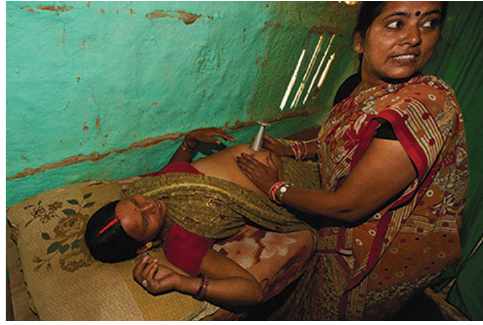
Most maternal deaths can be prevented by ensuring access to sexual and reproductive healthcare services. The following strategies are essential:
Four key interventions:
- Four antenatal care visits - Regular monitoring throughout pregnancy allows healthcare providers to identify and address problems early.
- Skilled birth attendants - Professional assistance during delivery significantly reduces the risk of complications and death.
- Post-birth care and support - Continued care in the weeks after childbirth ensures that any complications are quickly identified and treated.
- Access to modern contraceptive methods - Enabling women to plan pregnancies reduces risks associated with closely-spaced births and unwanted pregnancies.
Additionally, achieving universal healthcare ensures that all women, regardless of income or location, can access these life-saving services.
Note
Exam tip: When discussing maternal mortality, always mention both the causes and the solutions. Remember that most maternal deaths are preventable with proper access to healthcare services.
End preventable deaths of newborns and children under five
Understanding neonatal and child mortality
Many infant deaths occur during the neonatal period - the first 28 days of life. This is the most vulnerable time for babies:
- Up to half of all neonatal deaths occur within the first 24 hours of birth
- 75 percent occur during the first week of life
- The 48 hours immediately following birth is the most crucial period for newborn survival
Important
The Critical First Days
In 2018, 2.5 million newborns died, with most of these deaths occurring in the first week of life. The first two days after birth represent the most dangerous period in a human's entire lifespan. This makes immediate post-birth care absolutely critical for survival.
Children who survive to their fifth birthday have a much greater chance of living into adulthood. However, every day in 2019, 14,000 children died before reaching their fifth birthday.
Main causes of death
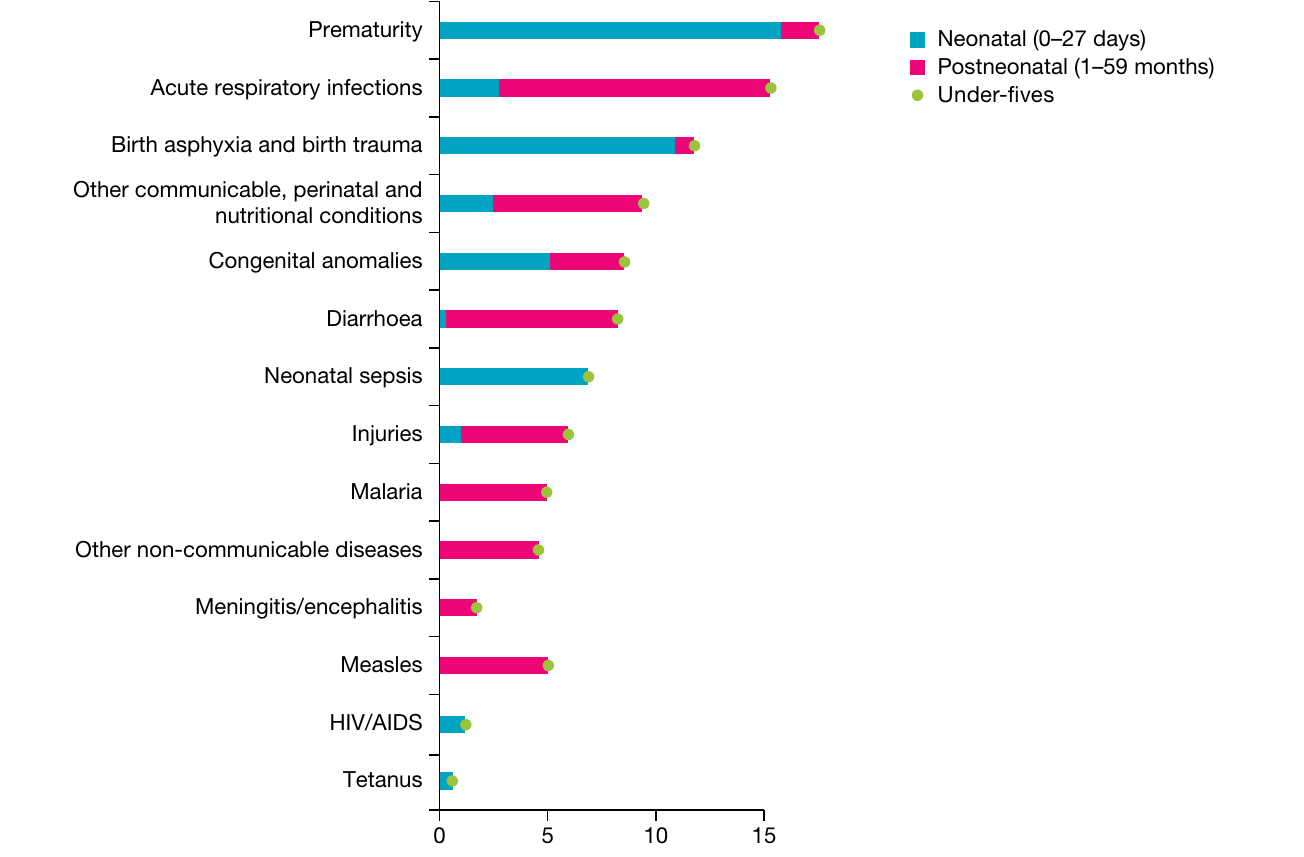
Neonatal deaths are primarily caused by:
- Premature birth (being born too early)
- Birth asphyxia - a condition where the baby's brain and other organs don't receive enough oxygen before, during or immediately after birth, potentially causing temporary or permanent damage
- Birth trauma
- Infections
Deaths of children under five are mainly due to:
- Acute respiratory infections (severe breathing problems)
- Diarrhoea
- Malaria
Note
The diagram above shows that prematurity, acute respiratory infections, and birth asphyxia account for the majority of deaths in children under five. Importantly, many of these conditions are preventable or treatable with proper healthcare access, meaning these deaths are largely avoidable.
Progress in reducing child mortality
Significant progress has been made in reducing child mortality since 2000:
Under-five mortality:
- The global under-five mortality rate was reduced by more than half between 2000 and 2018
- It fell from 76 deaths per 1,000 live births to 39 deaths per 1,000 live births
- This represents a reduction from 9.9 million deaths to 5.3 million deaths
Neonatal mortality:
- Neonatal mortality rates declined from 31 deaths per 1,000 live births in 2000 to 18 deaths per 1,000 live births in 2018
- This represents a reduction from 4 million neonatal deaths in 2000 to 2.5 million in 2018
However, sub-Saharan Africa continues to have the highest neonatal mortality rate at 28 deaths per 1,000 live births.
Why child mortality has improved
Several factors have contributed to the decline in child deaths:
Improved maternal health services
- Improved access to antenatal care
- More births assisted by skilled health personnel
- Fewer adolescent pregnancies
- Greater access to family planning services
Higher vaccination rates
Since 2000, increased childhood vaccination has saved almost 15.6 million lives. For example:
- The number of reported measles cases was reduced by 67 percent
- Approximately 86 percent of children worldwide received the required three doses of the Diphtheria-Pertussis-Tetanus (DPT) vaccine in 2018, compared to 72 percent in 2000
Note
Exam tip: Vaccination is one of the most cost-effective interventions for reducing child mortality. Be prepared to explain how vaccines prevent deaths from diseases like measles, diphtheria, pertussis and tetanus.
SDG 3 targets for child mortality
SDG 3 aims to:
- End preventable deaths of newborns and children under five
- Reduce neonatal mortality from 19.2 per 1,000 live births in 2015 to 12 per 1,000 live births by 2030
- Reduce under-five mortality rates from 43 deaths per 1,000 live births to 25 per 1,000 live births by 2030
Remaining challenges
Despite progress, significant challenges remain:
Important
The Scale of the Challenge
- One million newborns continue to die in their first week of life
- 2.5 million die during their first 28 days of life
- Four out of every five deaths of children under five occur in sub-Saharan Africa and southern Asia
- Children born into poverty are almost twice as likely to die before age five compared to children from wealthier families
- Children of educated mothers (even those with only primary schooling) are more likely to survive than children of mothers with no education
These disparities highlight how poverty and lack of education compound health risks for children in low-income regions.
Strategies to prevent child deaths
Preventable deaths of newborns and children under five can be reduced through multiple interventions:
Key strategies include:
- Provide access to sexual and reproductive healthcare services - Ensuring safe childbirth practices and neonatal care prevents many deaths.
- Breastfeeding - Provides essential nutrients and antibodies that protect babies from infections and diseases.
- Provide access to nutritious food - Malnutrition makes children more vulnerable to diseases and reduces their ability to recover from illness.
- Provision of safe water - Prevents diarrhoeal diseases, which are a leading cause of death in children under five.
- Provide access to immunisation - Vaccines prevent deaths from diseases such as measles, pneumonia and malaria. However, many children globally are not vaccinated or do not receive the full vaccination schedule due to lack of healthcare access.
- Increase investment in healthcare services and provide universal health coverage - Ensures all children can access the services they need, regardless of their family's income.
- Fund research and development into new vaccines - Investment is needed to develop vaccines for diseases such as malaria, HIV and tropical diseases, which are responsible for many deaths of children under five.
Note
Many deaths of children under five are due to preventable causes such as malnutrition, malaria, diarrhoea, measles and pneumonia. With proper investment in healthcare services and implementation of these strategies, most of these deaths can be prevented.
Impact of COVID-19
According to the United Nations, COVID-19 in 2020 was expected to have a significant impact on progress in maternal mortality rates and newborn and under-five mortality rates. Hundreds of thousands of additional under-five deaths were expected, along with tens of thousands of additional maternal deaths in 2020.
Summary
Key Points to Remember:
-
Maternal mortality has decreased by 38% globally between 2000 and 2017, but approximately 800 women still die daily in sub-Saharan Africa and southern Asia. The five main causes are haemorrhage, sepsis, obstructed labour, unsafe abortion and hypertensive disease.
-
Access to antenatal care, skilled birth attendants, and family planning services are critical for reducing maternal deaths. SDG 3 aims to reduce maternal mortality to fewer than 70 per 100,000 live births by 2030.
-
The first 48 hours after birth are the most critical for newborn survival. Three-quarters of neonatal deaths are due to prematurity, birth asphyxia and infections.
-
Child mortality has been cut by more than half since 2000, largely due to improved vaccination rates, better maternal health services, and increased access to healthcare. However, 14,000 children still die daily before their fifth birthday.
-
Preventable deaths can be ended through breastfeeding, access to nutritious food and safe water, immunisation, increased healthcare investment, and research into new vaccines. Children in poverty are almost twice as likely to die before age five compared to children from wealthier families.