Applications of Circular Functions (VCE SSCE Mathematical Methods): Revision Notes
📚Revision Notes
Applications of Circular Functions
Sinusoidal functions
A sinusoidal function can be written in either of these forms:
or
These functions are particularly useful for modelling periodic motion - situations where a pattern repeats at regular intervals. Examples include rotating wheels, tides, pendulums, and seasonal temperature variations.
Note
Sinusoidal functions are called "sinusoidal" because they produce wave-like patterns similar to sine and cosine graphs. The parameters , , , and control different aspects of the wave: its amplitude, frequency, phase shift, and vertical position.
Key features of sinusoidal functions
When working with sinusoidal functions that model real situations, you'll often need to find:
Period
The period is the time taken for one complete cycle of the motion. For a function with the form or , the period is:
Important
Period Formula:
where is the coefficient of inside the trigonometric function.
Remember: Always divide by the coefficient of , not by the entire expression inside the brackets.
Maximum and minimum values
For a function of the form :
- The maximum value of is
- The minimum value of is
Important
Watch out for negative amplitudes!
If is negative (like ), then:
- The minimum of the whole function occurs when
- The maximum of the whole function occurs when
The same principles apply to sine functions.
Worked example: Rotating wheel
Example
Worked Example: Rotating Wheel Motion
Problem: A wheel is mounted on a wall and rotates. The distance cm of a particular point on the wheel from the ground is given by:
where is the time in seconds.
Finding the initial position
Question: How far is point above the ground when ?
Solution: Substitute into the equation:
The point is 40 cm above the ground initially.
Calculating the period
Question: How long does it take for the wheel to rotate once?
Solution: Use the period formula with :
The wheel takes seconds (or seconds) to complete one rotation.
Finding maximum and minimum distances
Question: What are the maximum and minimum distances of point above the ground?
Solution: Since we have , the value depends on .
Minimum distance: This occurs when (making the subtracted term largest):
The minimum distance is 40 cm.
Maximum distance: This occurs when (making the subtracted term negative):
The maximum distance is 160 cm.
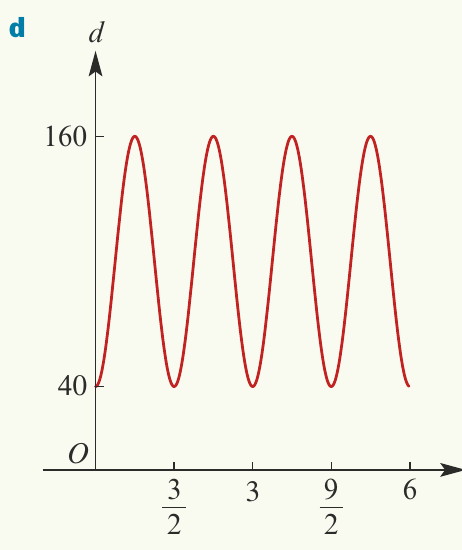
Sketching the graph
Question: Sketch the graph of against .
Solution: The graph shows:
- Period of seconds
- Oscillates between minimum cm and maximum cm
- Starts at cm when
Solving inequalities
Question: In the first rotation, find the intervals when point is less than cm above the ground.
Solution: We need to solve :
The general solutions where are and (in the first rotation).
Therefore:
From the graph, the distance is less than cm for:
- and
Worked example: Tide heights
Example
Worked Example: Modelling Tide Heights
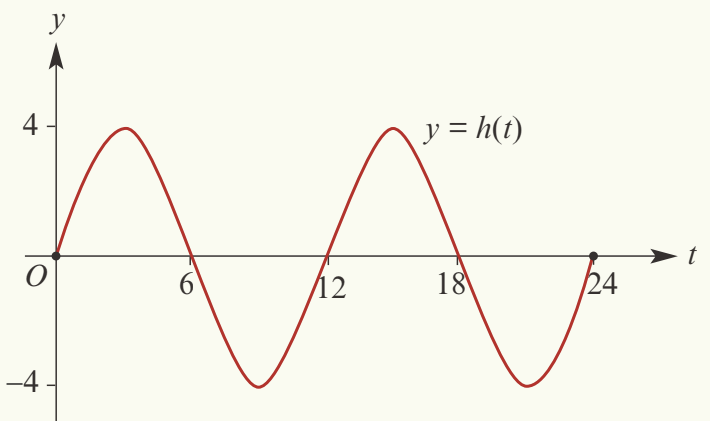
Problem: The height metres of the tide above mean sea level at Warnung on 1 January is given approximately by:
where is the number of hours after midnight.
Finding the period
First, note that the period is:
This means the tide completes one full cycle every 12 hours.
Finding when high tide occurs
Question: When was high tide?
Solution: High tide occurs when (the maximum value):
This occurs when:
High tide occurs at 03:00 and 15:00 (3 p.m.).
Finding the high tide height
Question: What was the height of the high tide?
Solution: The high tide has height 4 metres above the mean height.
Evaluating at a specific time
Question: What was the height of the tide at 8 a.m.?
Solution: Substitute :
At 8 a.m., the water is metres below the mean height (approximately metres below mean level).
A negative height means the tide is below the mean sea level. This is normal and expected as tides oscillate above and below the mean level throughout the day.
Solving practical constraints
Question: A boat can only cross the harbour bar when the tide is at least metre above mean sea level. When could the boat cross on 1 January?
Solution: We need to solve :
Using a calculator to find where :
(considering the first hours)
Converting to time format, the water is at height metre at:
- 00:29
- 05:31
- 12:29
- 17:31
The boat can cross the harbour bar:
- Between 00:29 and 05:31
- Between 12:29 and 17:31
These are the time intervals when the tide is at least metre above mean sea level. :::
Summary
Key Points to Remember:
-
Sinusoidal functions have the form or and are ideal for modelling periodic motion.
-
To find the period, use the formula: Period where is the coefficient of .
-
Maximum and minimum values occur when the sine or cosine function equals or - pay attention to the sign of the amplitude .
-
When solving equations involving sinusoidal functions:
- First isolate the trigonometric function
- Then solve for the angle
- Finally solve for
-
Always check whether your solutions make sense in the context of the problem - consider the domain and what the model represents physically.