Defining Circular Functions: Sine, Cosine, and Tangent (VCE SSCE Mathematical Methods): Revision Notes
📚Revision Notes
Defining Circular Functions: Sine, Cosine, and Tangent
Introduction to the unit circle
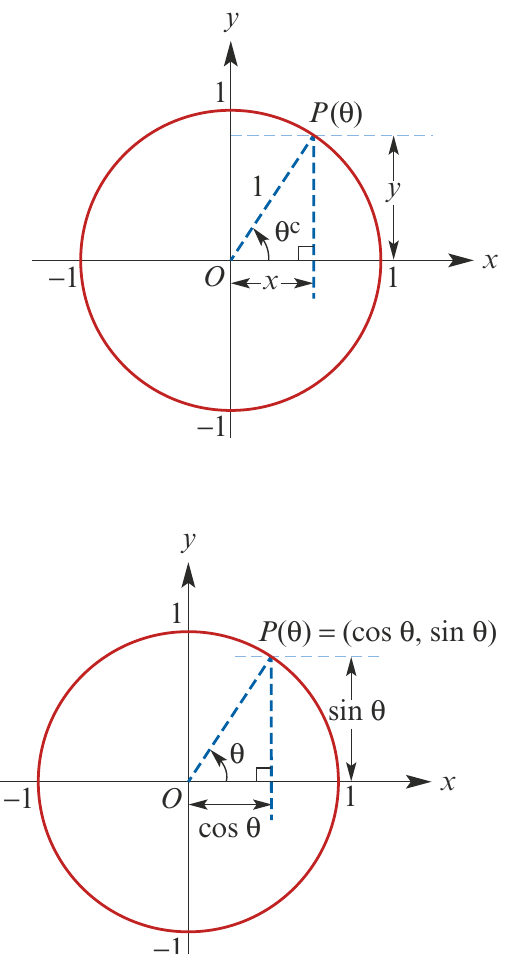
In circular functions, we work with a unit circle, which is a circle with radius 1 centred at the origin of a coordinate plane. Each point on this circle corresponds to an angle measured from the positive -axis in an anticlockwise direction.
The point on the unit circle corresponding to angle is written as . The position of this point is completely determined by the angle, which means both the -coordinate and -coordinate depend on .
Note
The unit circle provides a geometric foundation for understanding trigonometric functions. By working with a circle of radius 1, we eliminate the need to account for scaling factors, making the relationships between angles and coordinates clearer and more direct.
Defining sine and cosine
The coordinates of point on the unit circle give us our definitions of sine and cosine:
The -coordinate of is given by:
The -coordinate of is given by:
This means we can write the coordinates of any point on the unit circle as:
This fundamental relationship shows that cosine gives the horizontal position and sine gives the vertical position of any point on the unit circle.
Periodicity of sine and cosine
An important property of circular functions is their periodicity. When you add to any angle, you complete one full rotation around the circle and return to the same point. This means:
More generally, for any integer :
Important
The period of both sine and cosine is radians (or 360°). This means these functions repeat their values every units, which is essential for simplifying complex angle calculations and understanding their graphs.
Defining tangent
The tangent function is defined differently. If we draw a tangent line to the unit circle at point , and extend the line from the origin through until it intersects this tangent line at point , then the y-coordinate of C is called tangent .
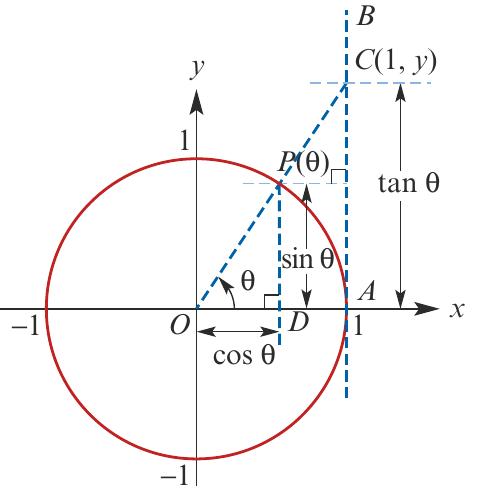
Using similar triangles and , we can show that:
Note
The tangent function gets its name from the geometric construction using a tangent line to the circle. This geometric interpretation helps us understand why tangent behaves differently from sine and cosine, particularly regarding its domain and period.
Domain of tangent
The tangent function is undefined when cosine equals zero. This occurs when:
Important
Common Mistake: Remember that tangent is undefined at odd multiples of (90°, 270°, etc.), not at multiples of . This is because at these angles, , making division by zero in the formula impossible.
Periodicity of tangent
Adding to the angle doesn't change the line , so tangent has a period of π:
For any integer :
Exact values of circular functions
While calculators can find approximate values for most angles, there are special angles where we can determine exact values using geometry.
Exact values for and (0° and 90°)
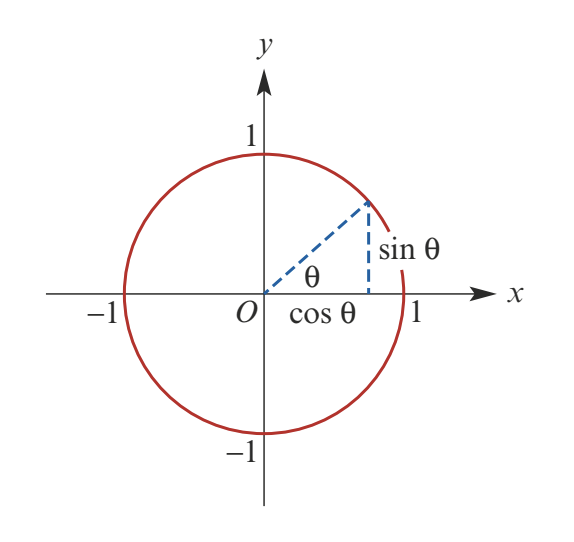
From the unit circle, we can see directly:
-
, ,
-
, , is undefined
Exact values for and (30° and 60°)
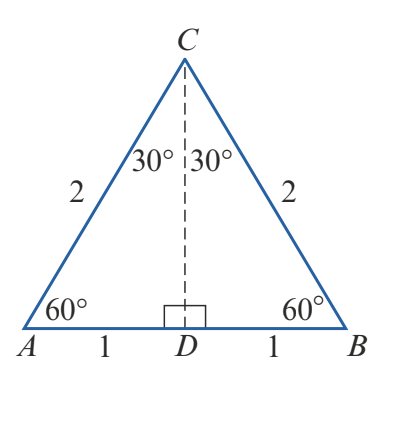
These values come from an equilateral triangle with side length 2 units. When we draw a perpendicular from one vertex to the opposite side, we create two right-angled triangles. Using Pythagoras' theorem, the height is .
From this triangle:
-
, ,
-
, ,
Note
Notice the symmetry: the sine of 30° equals the cosine of 60°, and vice versa. This is because 30° and 60° are complementary angles (they add to 90°), and complementary angles have this special relationship.
Exact values for (45°)
These values come from an isosceles right-angled triangle with legs of length unit. The hypotenuse has length .
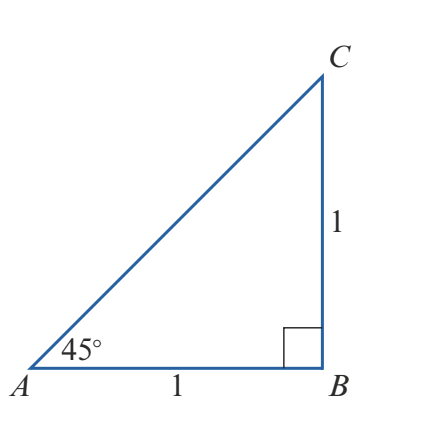
From this triangle:
- , ,
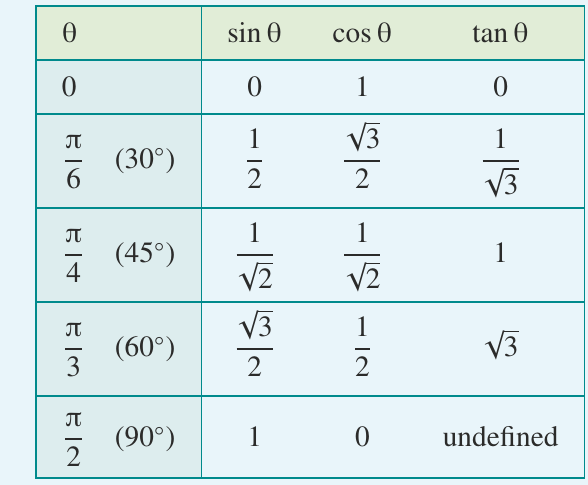
Table of exact values
Important
Exam tip: Memorise these exact values or know how to derive them quickly from the special triangles (30-60-90 and 45-45-90 triangles). They appear frequently in VCE exams, and being able to recall them instantly will save valuable time.
Symmetry properties of circular functions
The coordinate axes divide the unit circle into four quadrants, numbered anticlockwise from the positive -axis:
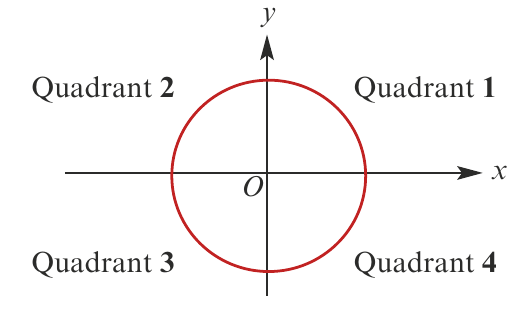
Using symmetry, we can relate the values of circular functions for angles in different quadrants to a reference angle in the first quadrant.
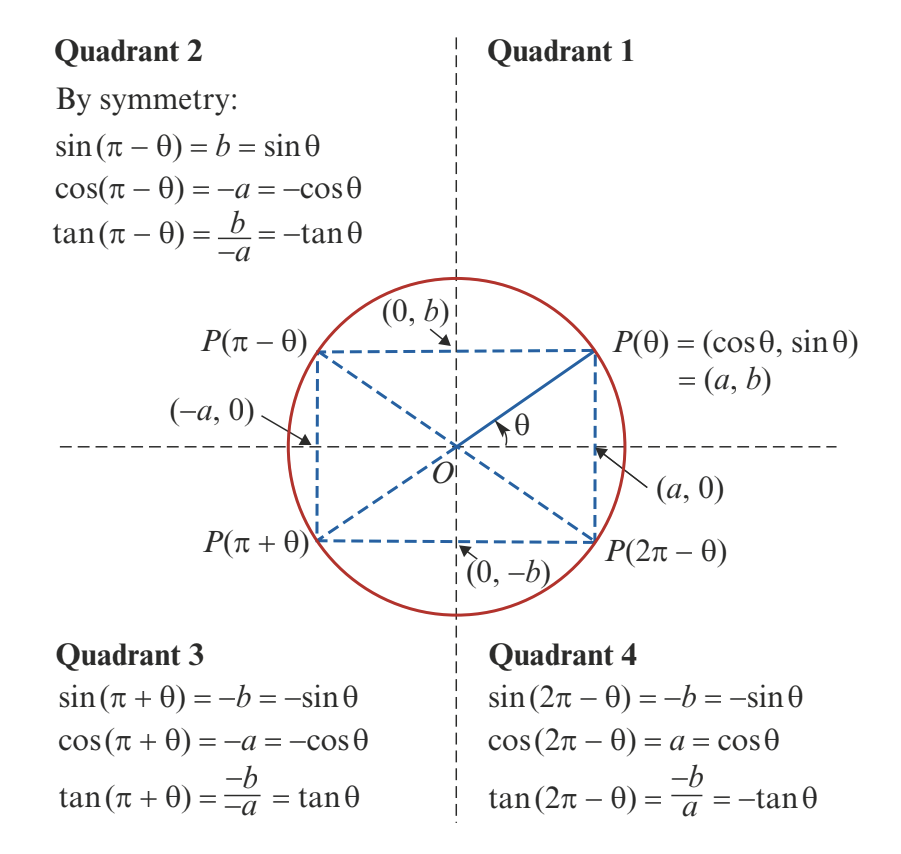
Key symmetry relationships
If is in Quadrant 1, then:
Quadrant 2 ():
Quadrant 3 ():
Quadrant 4 ():
Note
These relationships are true for all values of θ, not just angles in the first quadrant. This makes them powerful tools for evaluating trigonometric functions at any angle by relating them back to familiar first-quadrant angles.
Signs of circular functions: the CAST rule
The symmetry properties tell us which trigonometric functions are positive in each quadrant:
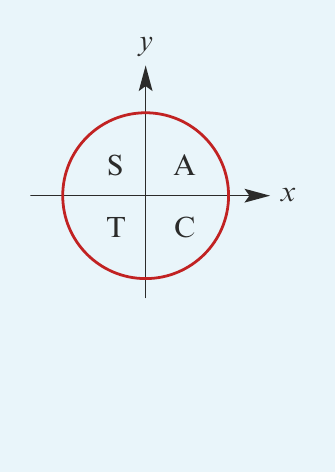
- Quadrant 1: All functions are positive (A)
- Quadrant 2: Sine is positive (S)
- Quadrant 3: Tangent is positive (T)
- Quadrant 4: Cosine is positive (C)
Note
Memory aid: Remember "All Students Take Calculus" or simply the letters CAST going anticlockwise from Quadrant 1. This mnemonic helps you quickly determine which functions are positive in any quadrant without having to derive it from first principles every time.
Negative angles
When we use negative angles (measured clockwise from the positive x-axis), the following relationships hold:
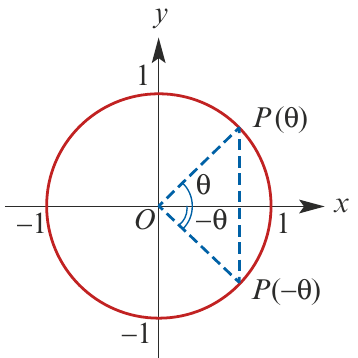
By symmetry across the -axis:
This tells us:
- Sine is an odd function
- Cosine is an even function
- Tangent is an odd function
Note
Understanding function symmetry is crucial for graphing and solving equations. Odd functions have rotational symmetry about the origin (if you rotate the graph 180° it looks the same), while even functions have reflective symmetry about the y-axis (the left and right sides mirror each other).
Worked examples
Example
Worked Example: Evaluating circular functions
Evaluate each of the following:
a)
b)
c)
d)
Strategy: For angles larger than (or for tangent), use periodicity to reduce to an equivalent angle between and . Then use symmetry properties to relate to a known angle in the first quadrant.
Example
Worked Example: Using symmetry properties
If , find the value of:
a)
b)
c)
d)
Example
Worked Example: Cosine symmetry with degrees
If , find the value of:
a)
b)
c)
d)
Summary
Key Points to Remember:
- The coordinates of any point on the unit circle are
- Tangent is defined as and is undefined when
- Sine and cosine have period , while tangent has period
- The CAST rule helps remember which functions are positive in each quadrant: All in Q1, Sine in Q2, Tangent in Q3, Cosine in Q4
- Memorise exact values for common angles: (or in radians)
- Sine and tangent are odd functions (negative angles give negative values), while cosine is an even function (negative angles give the same value)