Determining Rules for Graphs of Circular Functions (VCE SSCE Mathematical Methods): Revision Notes
📚Revision Notes
Determining Rules for Graphs of Circular Functions
This section focuses on finding the rule for a graph when you know it represents a circular function. The general form for these functions is:
where:
- is the amplitude (distance from centreline to peak)
- is the frequency parameter (related to the period)
- (epsilon) is the phase shift (horizontal translation)
- is the vertical shift (height of centreline)
Note
Understanding each parameter in the general form is crucial for determining the complete rule from a graph or given information. Each parameter controls a specific aspect of the function's behavior.
Key formulas
Period formula
The period of a circular function is related to the frequency parameter by:
Rearranging this formula allows us to find when we know the period:
Finding amplitude and centreline from range
When given the range of a circular function:
The amplitude is:
The centreline has equation:
Note
Finding Key Parameters from Range
These formulas allow you to determine both the amplitude and vertical shift without needing to see the graph. The amplitude tells you how far the function oscillates from its centreline, while tells you where that centreline is positioned vertically.
Worked example: Finding A and n from amplitude and period
Example
Worked Example: Finding A and n from amplitude and period
A function has rule . The amplitude is and the period is . Find and , and sketch the graph of for .
Solution:
Finding n from the period:
We know that:
Rearranging to solve for :
Finding A from the amplitude:
Since the amplitude equals , we know that A = 6.
The complete rule:
The function has rule:
Sketch of the graph:
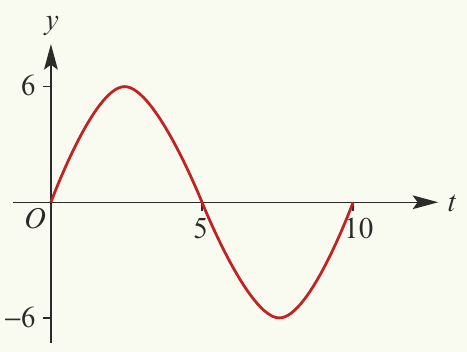
The graph shows one complete cycle from to , with maximum value and minimum value .
Worked example: Finding A, n, and b from a graph
Example
Worked Example: Finding A, n, and b from a graph
The graph shown is that of a function with rule . Find , , and .
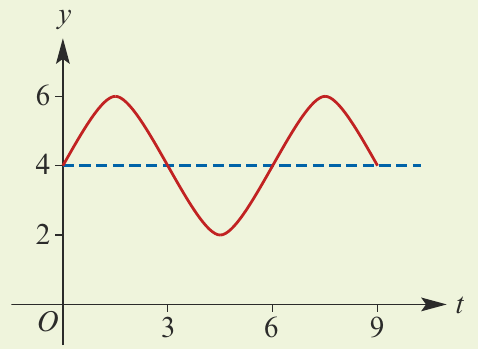
Solution:
Finding the amplitude:
The graph oscillates between a minimum of and a maximum of . The amplitude is the distance from the centreline to either extreme:
Finding the period and n:
From the graph, we can see that one complete cycle occurs over an interval of length . Therefore, the period is 6.
Using the period formula:
Solving for :
Finding the vertical shift:
The centreline runs horizontally through the middle of the oscillation. We can calculate its position:
Therefore, the centreline has equation and b = 4.
The complete rule:
Worked example: Finding A, n, and b from range and period
Example
Worked Example: Finding A, n, and b from range and period
A function with rule has range and period . Find , , and .
Solution:
Finding the amplitude:
Using the range , where the minimum is and the maximum is :
Finding the centreline:
The centreline is positioned at:
Therefore, b = 1 and the centreline has equation .
Finding n from the period:
The period is , so:
The complete rule:
Worked example: Finding A, n, and ε with a phase shift
Example
Worked Example: Finding A, n, and ε with a phase shift
A function with rule has the following properties:
- range =
- period =
- when ,
Find values for , , and .
Solution:
Finding the amplitude:
Since the range is , the amplitude is:
Finding n from the period:
Since the period is :
Setting up the equation:
We now know that:
Finding ε using the given point:
When , we know that . Substituting these values:
Dividing both sides by :
The sine function equals zero when its argument is , , , and so on:
Choosing the simplest solution:
We select the simplest solution, which is:
The complete rule:
This rule satisfies all three given properties.
Important
Common Mistakes to Avoid
When determining rules for circular functions, watch out for these common errors:
- Forgetting that period = , so
- Using negative values for amplitude. The amplitude is always positive: use
- Misidentifying the centreline. It's the horizontal line exactly halfway between the maximum and minimum values
- When finding the phase shift , remember to substitute the given point into your equation and solve for the simplest value
- Not checking your final rule by verifying it satisfies all the given conditions
Summary
Key Points to Remember:
- The general form of a circular function is , where is amplitude, relates to period, is phase shift, and is vertical shift
- The period and frequency parameter are related by: Period = , therefore
- Find amplitude from range using:
- Find the centreline from range using:
- When finding phase shift , substitute a known point into the equation and choose the simplest solution from the infinite family of solutions