General Solution of Trigonometric Equations (VCE SSCE Mathematical Methods): Revision Notes
📚Revision Notes
General Solution of Trigonometric Equations
Introduction
When solving equations involving trigonometric functions, we previously worked with restricted domains. However, trigonometric functions are periodic, meaning they repeat their values in regular cycles. This leads to an important property: if an equation has one solution, it will have infinitely many solutions across the function's complete domain.
A general solution expresses all possible solutions to a trigonometric equation using a formula that includes an integer parameter, typically denoted as , where (meaning can be any integer: ..., -2, -1, 0, 1, 2, ...).
Note
Because trigonometric functions repeat their values periodically, solving a trigonometric equation is fundamentally different from solving algebraic equations. Instead of finding isolated solutions, we find a pattern that generates all possible solutions.
Ranges of inverse trigonometric functions
Before working with general solutions, we need to understand the conventional ranges of inverse trigonometric functions. These ranges are standardized across mathematics:
- has range
- has range
- has range
Note
What this means: When you calculate an inverse trigonometric function, the result will always fall within these specific ranges. This gives us a "principal value" that we can then use to find all other solutions.
For example:
Understanding periodic solutions
Consider the equation for some fixed value where . The cosine function repeats every radians. If we find one solution, the symmetry and periodicity of the cosine function guarantee infinitely many other solutions.
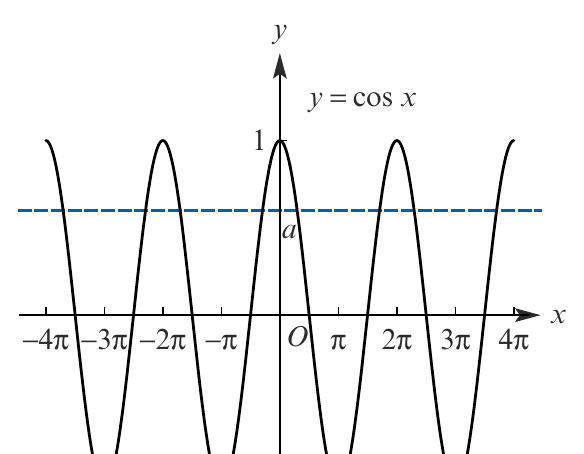
The graph shows that if at one point, there are corresponding solutions in every cycle of the function. The pattern of solutions extends infinitely in both directions along the -axis.
Starting from the principal value in the interval , the symmetry properties of the cosine function give us additional solutions:
General solution formulas
These formulas allow you to express all solutions to basic trigonometric equations:
Important
For cosine equations:
For , the general solution of is:
The symbol indicates that there are two families of solutions, reflecting the symmetry of the cosine function about the vertical axis.
Important
For tangent equations:
For (any real number), the general solution of is:
Note that tangent has a period of , which is why we add multiples of rather than .
Important
For sine equations:
For , the general solution of is:
This formula reflects that sine has two solutions per period, but they follow a different pattern than cosine due to sine's different symmetry properties.
Note
Alternative form for sine: A more concise way to express the general solution of is:
This compact form uses the fact that alternates between 1 and -1 as changes, automatically generating both families of solutions.
Worked example: Finding general solutions
Example
Worked Example: Finding General Solutions
Find the general solution of each equation:
a)
Starting with the general formula for cosine:
This can be written more neatly as:
b)
First, isolate the tangent function:
Apply the general formula for tangent:
Divide by 3 to solve for :
c)
First, simplify:
Apply the general formula for sine:
This simplifies to:
Worked example: Finding specific positive solutions
Example
Worked Example: Finding Specific Positive Solutions
Find the first three positive solutions of each equation from the previous example:
a) For , we have the general solution
When :
When : or
Therefore, the first three positive solutions are:
b) For , we have the general solution
When :
When :
When :
Therefore, the first three positive solutions are:
c) For , we have or
When : or
When : or
Therefore, the first three positive solutions are:
Worked example: Equations with phase shifts
When equations include a phase shift (a constant added to or subtracted from ), follow the same process but remember to isolate the entire expression first.
Example
Worked Example: General Solutions with Phase Shifts
a)
Let , so we solve
This gives: for even, and for odd
b)
Using technology
Note
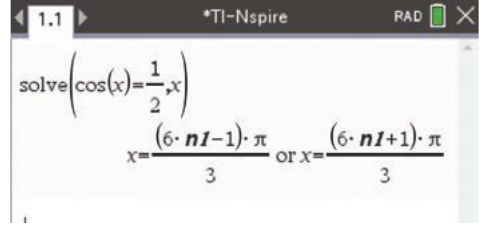
Calculators can verify general solutions. When using a calculator:
- Ensure it is in radian mode
- Use the exact value (e.g., instead of 0.5) for precise answers
- The calculator will display the general solution with a parameter (often shown as different notation)
- Replace the calculator's parameter notation with in your written answer
Exam tips
Important
Key Exam Strategies:
- Always specify that when writing general solutions
- For specific solutions, substitute integer values systematically ()
- Check whether the question asks for solutions in degrees or radians
- Simplify your final answer to the most compact form
- When dealing with composite functions like , solve for the composite expression first, then isolate
Remember!
Summary
Key Points to Remember:
- Trigonometric equations have infinitely many solutions due to their periodic nature
- The general solution formulas are:
- Cosine: , where
- Tangent: , where
- Sine: or , where
- Always include "" to indicate represents any integer
- To find specific solutions, substitute integer values into the general solution formula
- For equations with phase shifts, isolate the complete expression before applying general solution formulas