Measuring Angles in Degrees and Radians (VCE SSCE Mathematical Methods): Revision Notes
📚Revision Notes
Measuring Angles in Degrees and Radians
Understanding the unit circle
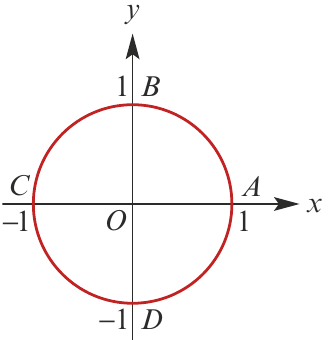
A unit circle is a circle with a radius of exactly unit. This special circle is centered at the origin of a coordinate system and is fundamental to understanding angle measurement.
The circumference of a unit circle can be calculated as:
When we move anticlockwise around the unit circle from point (at coordinates ), we can measure specific arc lengths:
- From to (top of circle): units
- From to (left side): units
- From to (bottom): units
Note
The unit circle is one of the most important concepts in trigonometry and calculus. Its simple radius of 1 unit makes calculations much easier and helps establish fundamental relationships between angles and distances.
Definition of a radian
Understanding radians is crucial for advanced mathematics. A radian is a different way of measuring angles, alternative to degrees.
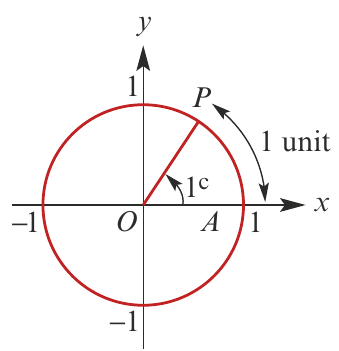
When we move a distance of unit along the circumference of the unit circle from point to point , we create an angle at the center . This angle is defined as one radian.
Important
Key definition: One radian (written ) is the angle created at the centre of the unit circle by an arc of length unit.
This definition directly connects the arc length to the angle measurement, making radians a natural way to measure angles in mathematics.
Angle direction conventions
The direction in which we measure angles matters:
- Positive angles: formed by moving anticlockwise around the unit circle
- Negative angles: formed by moving clockwise around the unit circle
Note
This convention is standard in mathematics and is important for solving problems correctly. Always check the direction of rotation when working with angles.
Relationship between degrees and radians
Both degrees and radians measure angles, but they use different scales. Understanding how they relate is essential for converting between them.
When we complete one full revolution around a circle, we sweep out:
This fundamental relationship tells us that radians equals degrees. We can simplify this:
From this relationship, we can derive the conversion formulas:
Important
The symbol for radians () is often omitted in mathematical writing. For example, the angle can be written as rather than .
When no unit is specified, you should assume the angle is measured in radians.
Converting degrees to radians
To convert an angle from degrees to radians, multiply by .
Example
Worked Example: Converting 30° to radians
We know that
Therefore:
Simplifying by canceling:
Method: Multiply the degree measure by and simplify by canceling common factors.
Converting radians to degrees
To convert an angle from radians to degrees, multiply by .
Example
Worked Example: Converting to degrees
We know that
Therefore:
Simplifying by canceling:
Method: Multiply the radian measure by and simplify by canceling common factors.
Exam tips
Note
Essential tips for working with angle conversions:
- Always check whether an angle is given in degrees or radians before performing calculations
- When converting, write down the conversion formula first to avoid errors
- Remember that radians equals - this is the most useful relationship to memorize
- Simplify fractions involving by canceling before multiplying out
- If no unit is specified, the angle is usually in radians
Remember!
Summary
Key Points to Remember:
- A unit circle has a radius of unit and circumference of units
- One radian is the angle created at the center of a unit circle by an arc of length unit
- Converting degrees to radians: multiply by
- Converting radians to degrees: multiply by
- Key relationships: radians and radians