Distance and Midpoints (VCE SSCE Mathematical Methods): Revision Notes
📚Revision Notes
Distance and Midpoints
In this note, we explore two fundamental techniques in coordinate geometry: finding the midpoint of a line segment and calculating the distance between two points. These skills form the foundation for many coordinate geometry problems you'll encounter.
Midpoint of a line segment
The midpoint of a line segment is the point that lies exactly halfway between the two endpoints. Finding this point involves averaging the coordinates of the endpoints.
Line segments parallel to an axis
When a line segment is parallel to one of the axes (either horizontal or vertical), finding the midpoint becomes straightforward.
Vertical line segments
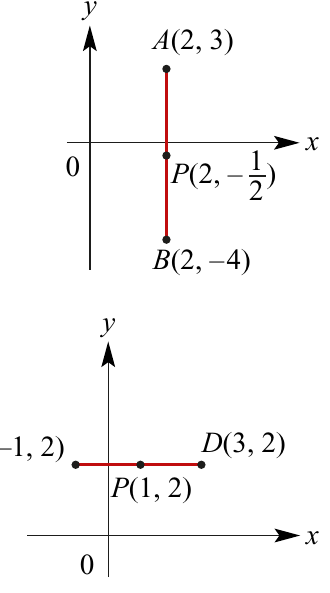
Consider a vertical line segment from down to . Since the line is vertical, the -coordinate remains constant at . The midpoint therefore has coordinates .
Notice that is exactly the average of the -coordinates:
Horizontal line segments
Similarly, for a horizontal line segment from to , the -coordinate stays constant at . The midpoint has coordinates .
Here, is the average of the -coordinates:
Note
For line segments parallel to an axis, only one coordinate changes while the other remains constant. Simply find the average of the changing coordinate!
Line segments not parallel to axes
For a line segment that isn't parallel to either axis, we need a more general approach. Let's find the midpoint of a line segment joining and .
We can construct a clever proof by drawing two right triangles. First, draw horizontal and vertical lines from point to create point , and similarly from point to create point . This creates two triangles: and .
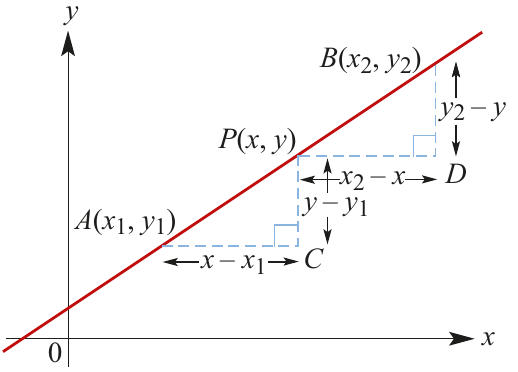
These two triangles are identical in size and shape (congruent). This means their corresponding sides are equal:
In terms of coordinates, this translates to:
Rearranging the first equation:
Rearranging the second equation:
This gives us the general midpoint formula.
Important
Midpoint Formula
The coordinates of the midpoint of the line segment joining and are:
Simply put, to find the midpoint, calculate the average of the x-values and the average of the y-values separately.
Worked example
Example
Worked Example: Finding a Midpoint
Question: Find the midpoint of the line segment joining with .
Solution:
Using the midpoint formula:
Distance between two points
To find the distance between two points on a coordinate plane, we apply Pythagoras' theorem. This theorem states that in a right-angled triangle, the square of the hypotenuse equals the sum of the squares of the other two sides.
Deriving the distance formula
Consider two points and . We can form a right-angled triangle by drawing a horizontal line from and a vertical line from to meet at point .
The horizontal distance (base of triangle) is
The vertical distance (height of triangle) is
The distance is the hypotenuse of this right triangle.
Applying Pythagoras' theorem:
Taking the square root of both sides:
Important
Distance Formula
The distance between two points and is:
Note
When calculating distance, be extra careful with negative coordinates. Remember that subtracting a negative is the same as adding:
Worked example
Example
Worked Example: Calculating Distance
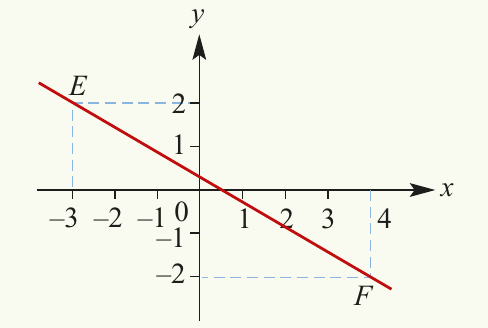
Question: Calculate the distance if is and is .
Solution:
Using the distance formula with and :
Exam tip: Always show your working when calculating distances. Write out the formula first, then substitute the coordinates carefully, paying special attention to negative signs.
Remember!
Summary
Key Points to Remember:
- The midpoint is found by averaging the coordinates:
- The distance formula comes from Pythagoras' theorem:
-
For line segments parallel to an axis, only one coordinate changes; the midpoint has the average of that coordinate
-
When calculating distance, be careful with negative coordinates—remember that subtracting a negative is the same as adding
-
The midpoint gives you a point (ordered pair), while distance gives you a number (length)