Composite and Inverse Functions (VCE SSCE Mathematical Methods): Revision Notes
📚Revision Notes
Composite and Inverse Functions
Composition of functions
When we compose two functions, we apply one function to the output of another function. This creates a new function called a composite function.
The composition of with is written as (read as "composition of followed by "). The rule for the composite function is:
This means we first apply function to , then apply function to the result.
Note
Think of composition as a "function pipeline": the output of one function becomes the input to the next. Reading from right to left helps remember the order: " first, then ".
Domain requirements for composition
For the composition to be defined, the range of must be contained within the domain of . In mathematical notation:
If , then the composition is defined and
This makes sense because every output from needs to be a valid input for .
Example
Worked Example: Expressing Functions as Compositions
Express each of the following as the composition of two functions:
a)
Choose and
Then
We first square the input (), then take the exponential of the result ().
b)
Choose and
Then
We first square the input (), then take the sine of the result ().
c) , where
Choose and
Then
We first compute (), then raise the result to the power ().
Note: These are not the only possible answers, but they represent the most natural choices for breaking down each function.
Inverse functions
An inverse function reverses the action of the original function. If a function takes an input and produces an output , then the inverse function takes back to .
Important
For a function to have an inverse, it must be one-to-one. This means different inputs must produce different outputs. In mathematical terms, a function is one-to-one if implies , for all .
Definition of inverse function
If is a one-to-one function, then the inverse function is defined by:
Note
The domain of is the range of , and the range of is the domain of . Think of the inverse as "swapping" the domain and range of the original function.
Example
Worked Example: Finding Inverses and Compositions
Let and let for . Find:
a)
To find the inverse, we set and solve for :
Taking natural logarithm of both sides:
Therefore, , where
b)
Set and solve for :
Squaring both sides:
Therefore, , where
c)
Domain:
d)
Domain:
e)
To find this inverse, let
Taking natural logarithm:
Squaring both sides:
Therefore, , where
f)
Let
Then:
Taking natural logarithm:
Therefore, , where
Strictly increasing and strictly decreasing functions
Understanding whether a function is increasing or decreasing helps us determine if it has an inverse and understand the behaviour of that inverse.
Definitions
A function is strictly increasing if whenever , we have , for all .
In other words, larger inputs always produce larger outputs. The function consistently goes up as we move from left to right.
A function is strictly decreasing if whenever , we have , for all .
In other words, larger inputs always produce smaller outputs. The function consistently goes down as we move from left to right.
Relationship to one-to-one functions
Both strictly increasing and strictly decreasing functions are always one-to-one. This means they always have inverse functions.
Important
Key Results:
If is strictly increasing, then it is a one-to-one function.
If is strictly decreasing, then it is a one-to-one function.
Proof that strictly increasing functions are one-to-one
Assume is strictly increasing and let with .
Then either or .
If , then since is strictly increasing. Therefore .
If , then since is strictly increasing. Therefore .
In both cases, we have f(a) ≠ f(b).
Hence is a one-to-one function.
Note
The proof for strictly decreasing functions follows similar logic. In that case, if , then , which still gives us , confirming the function is one-to-one.
Behaviour of inverse functions
An important property connects the monotonicity of a function to the monotonicity of its inverse:
Important
Key Results:
If is strictly increasing, then is also strictly increasing.
If is strictly decreasing, then is also strictly decreasing.
Proof that inverse of strictly increasing is strictly increasing
Assume is strictly increasing and let with .
We need to show that .
If , then applying to both sides gives:
This means , which contradicts our assumption that .
If , then since is strictly increasing:
This means , which contradicts our assumption that .
Therefore, we must have f⁻¹(a) > f⁻¹(b), which proves that is strictly increasing.
Example
Worked Example: Inverse Functions and Monotonicity
For each function , find the inverse function , and state whether and are strictly increasing, strictly decreasing or neither.
a) ,
To find the inverse, write and solve for :
Since the domain of is (non-negative numbers), we need the positive solution.
The range of is .
Therefore, ,
Both and are strictly increasing.
b) ,
Write . Then .
Since the domain of is (non-positive numbers), we need the negative solution.
The range of is .
Therefore, ,
Both and are strictly decreasing.
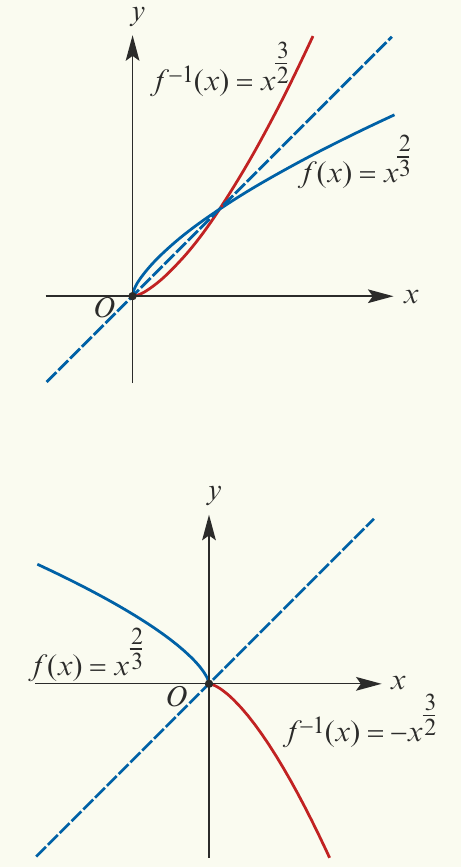
The graphs above illustrate these relationships. The top graph shows the strictly increasing function (defined on non-negative numbers) and its strictly increasing inverse . The bottom graph shows the strictly decreasing function (defined on non-positive numbers) and its strictly decreasing inverse . Notice how the functions and their inverses are reflections of each other across the line (shown as a dashed line).
Summary
Key Points to Remember:
- The composition means "apply first, then apply to the result"
- For composition to be defined, the range of must be contained in the domain of
- A function has an inverse if and only if it is one-to-one (different inputs give different outputs)
- Strictly increasing and strictly decreasing functions are always one-to-one, so they always have inverses
- If is strictly increasing, then is also strictly increasing; if is strictly decreasing, then is also strictly decreasing
- The domain of equals the range of , and the range of equals the domain of