Bernoulli Sequences and the Binomial Probability Distribution (VCE SSCE Mathematical Methods): Revision Notes
📚Revision Notes
Bernoulli Sequences and the Binomial Probability Distribution
Understanding Bernoulli sequences
Many experiments involve repeating the same action multiple times, where each attempt has only two possible outcomes. For example, when you toss a coin, you get either heads or tails. When you roll a die and check for a specific number, you either get that number or you don't.
A Bernoulli sequence describes a sequence of repeated trials that must satisfy three important conditions:
Important
The Three Defining Properties of a Bernoulli Sequence:
-
Binary outcomes: Each trial produces exactly one of two possible outcomes. We typically call these outcomes 'success' (denoted ) and 'failure' (denoted ).
-
Constant probability: The probability of success, , remains the same for every trial. This means the probability of failure is always .
-
Independence: The outcome of any trial does not affect the outcome of any other trial. Each trial is completely independent.
Worked example: Identifying a Bernoulli sequence
Example
Worked Example: Identifying a Bernoulli Sequence
Question: A netball player has a probability of of scoring a goal each time she attempts to shoot. She takes repeated shots at goal. Is this a Bernoulli sequence?
Solution:
Let's check each condition:
Each trial has two outcomes: the player either scores (goal) or misses.
The probability of scoring is constant at for every attempt, and the probability of missing is constant at .
The shots are independent—whether she scores or misses one shot doesn't affect her next attempt.
Since all three conditions are satisfied, the player's shots form a Bernoulli sequence.
The binomial probability distribution
When we count how many successes occur in a Bernoulli sequence, this count becomes a special type of random variable.
A binomial random variable is the number of successes that occur in trials of a Bernoulli sequence. This random variable follows a binomial probability distribution.
Building a binomial distribution: The die rolling example
Let's see how this works with a concrete example. Suppose we roll a fair six-sided die three times and count how many times we roll a 3.
Let represent the number of 3s we observe. We can use the notation:
- = rolling a 3 (success)
- = not rolling a 3 (failure)
For each roll:
Since each roll is independent with constant probabilities, is a binomial random variable.
To find the complete probability distribution, we need to consider all possible outcomes from three rolls:
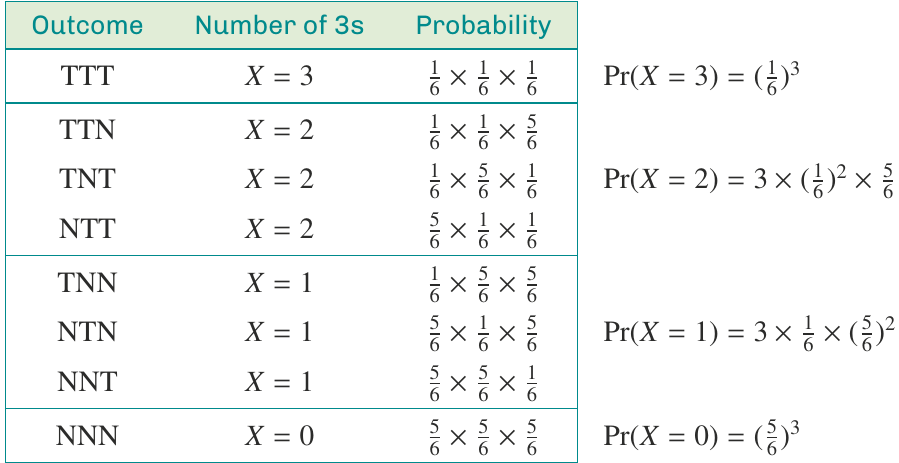
We can consolidate these results into a probability distribution table:

Using combinations to find probabilities
Rather than listing every possible outcome, we can use a more efficient approach. Notice that when exactly one 3 appears, it could occur on the first, second, or third roll. This is equivalent to choosing 1 position from 3 available positions, which can be done in ways.
Similarly, when exactly two 3s appear, they could occur on any two of the three rolls. This can be done in ways.
This leads us to write:
The general binomial formula
This pattern gives us a general formula for any binomial distribution.
If random variable represents the number of successes in independent trials, each with probability of success , then follows a binomial distribution. We write this as .
The probability of exactly successes is:
The binomial coefficient is calculated as:
Note
Understanding the formula:
- counts the number of ways to arrange successes among trials
- represents the probability of getting successes
- represents the probability of getting failures
Calculating binomial probabilities
Worked example: Tossing coins
Example
Worked Example: Tossing Coins
Question: Find the probability of obtaining exactly three heads when a fair coin is tossed seven times, correct to four decimal places.
Solution:
In this problem, obtaining a head is our success, with probability for each of the seven independent tosses.
Let be the number of heads obtained.
The parameters are and .
Note
Exam tip: You can use your calculator's binomial probability function (often called binomPdf) to calculate this directly. Enter the number of trials (), probability of success (), and number of successes ().
Worked example: Cumulative probabilities
Example
Worked Example: Cumulative Probabilities
Question: The probability that a person currently in prison has been imprisoned before is . Find the probability that of five prisoners chosen at random, at least three have been imprisoned before, correct to four decimal places.
Solution:
Let be the number of prisoners who have been imprisoned before.
Then , which means:
We need to find .
This equals .
Note
Exam tip: For cumulative probabilities like at least 3, you can use the binomial cumulative distribution function (binomCdf) on your calculator. Set the lower bound to 3 and upper bound to 5.
The binomial distribution and conditional probability
We can combine the binomial distribution with conditional probability to solve more complex problems.
Worked example: Conditional probability
Example
Worked Example: Conditional Probability
Question: The probability of a netballer scoring a goal is . Find the probability that out of six attempts the netballer scores a goal:
a) four times
b) four times, given that she scores at least one goal
Solution:
Let be the number of goals scored.
Then .
Part a:
Part b:
We need to find .
Using the conditional probability formula:
Since scoring 4 goals automatically means scoring at least 1 goal, .
To find :
Therefore:
Remember!
Summary
Key Points to Remember:
-
A Bernoulli sequence has three key properties: binary outcomes (success/failure), constant probability of success, and independence between trials.
-
A binomial random variable counts the number of successes in a Bernoulli sequence of trials.
-
The binomial probability formula is , where is the number of trials, is the probability of success, and is the number of successes.
-
We write to indicate that follows a binomial distribution with parameters and .
-
Your calculator can compute binomial probabilities directly—use binomPdf for exact probabilities and binomCdf for cumulative probabilities.
-
Binomial distributions can be combined with conditional probability using the formula .