Finding the Sample Size (VCE SSCE Mathematical Methods): Revision Notes
📚Revision Notes
Finding the Sample Size
Introduction to finding sample size
When working with random experiments, we can never be completely certain about what will happen. However, there are times when we want to know how large a sample we need to have a good chance of observing a particular outcome.
For example, you might wonder:
- How many times must I roll a die to have a reasonable chance of getting at least one six?
- How many lottery tickets should I buy to have a strong probability of winning a prize?
These questions involve finding the appropriate sample size () for a binomial distribution to achieve a desired probability.
Note
Finding sample size is a critical skill in statistics and probability, allowing us to plan experiments and make informed decisions about how much data we need to collect to achieve our goals.
The approach to finding sample size
Finding the sample size involves working backwards from a desired probability. Instead of knowing and calculating probabilities, we:
- Set up the probability condition we want to achieve
- Create an inequality involving
- Solve for (either algebraically or using technology)
- Round up to the nearest whole number (since we can't have a fractional number of trials)
The key is recognising that we're dealing with a binomial distribution, where:
- Each trial has the same probability of success ()
- Trials are independent
- We're counting the number of successes in trials
Note
Binomial Distribution Requirements:
Remember that a binomial distribution requires:
- Fixed number of trials ()
- Each trial has only two outcomes (success or failure)
- Constant probability of success () for each trial
- Independent trials
Worked example
Example
Worked Example: Finding Sample Size for Different Success Criteria
A game of chance has a probability of winning of . We want to find:
Part a: What is the smallest number of games needed to ensure the probability of winning at least once is more than ?
Part b: What is the smallest number of games needed to ensure the probability of winning at least twice is more than ?
Solution to part a
Since each game has the same probability of winning (), this follows a binomial distribution. We need to find the smallest value of where:
Using the complement rule, we can rewrite this:
For a binomial distribution, when we have zero successes, all trials must be failures. The probability of failure is , so:
To solve this inequality, we take logarithms of both sides:
Notice that is negative (since ), so when we divide by it, we must reverse the inequality sign:
Since must be a whole number, the game must be played at least 5 times to ensure the probability of winning at least once is more than .
Solution to part b
We need the smallest value of where:
This is equivalent to:
Expanding the left side:
Using the binomial probability formula:
Therefore:
Important
This equation cannot be solved algebraically. Instead, we use a CAS calculator to find that .
Therefore, the game must be played at least 8 times to ensure the probability of winning at least twice is more than . :::
Using technology to find sample size
When inequalities become too complex to solve algebraically, technology provides an efficient alternative. Both the TI-Nspire and Casio ClassPad calculators offer functions specifically designed for finding sample sizes in binomial distributions.
Using the TI-Nspire calculator
To find the smallest value of such that where :
Note
Step-by-step TI-Nspire Process:
-
Rearrange the inequality to the form
-
Access the menu: menu > Probability > Distributions > Inverse Binomial N
-
Enter the following values:
- Cumulative Prob:
- Prob Success, p:
- Successes, x:
-
Use tab or the down arrow to move between cells
-
Select Matrix Form display to confirm that satisfies the condition
The calculator will show that when , (too high), but when , satisfies our requirement.
Using the Casio ClassPad calculator
To find the smallest value of such that where :
Note
Step-by-step Casio ClassPad Process:
-
In the Main menu, go to Interactive > Distribution > Discrete > binomialCDf
-
Enter the parameters:
- Lower:
- Upper: x (this represents the variable)
- Numtrial: x (this is our )
- pos:
-
Highlight and copy the expression binomialCDf(2, x, x, 0.48)
-
Go to the main menu and select the Graph & Table application
-
Paste the expression into y_1
-
Tap the table icon to view the table of values
-
Scroll down until you find where the probability first exceeds
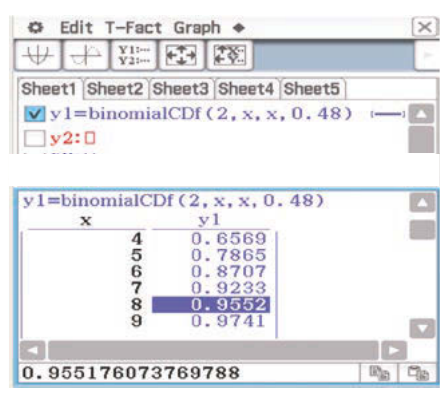
From the table, you can see that when , the cumulative probability is , which first exceeds . Therefore, is the answer.
Note
Tip: To view larger values of in the table, tap the settings icon and increase the End value.
Exam tips
Important
Essential Exam Strategies:
-
Always round up to the next whole number when finding sample size, even if the calculated value is close to a whole number (e.g., if you get , use , not )
-
Remember that "at least one" means you can use the complement:
-
When using logarithms to solve inequalities involving powers, watch out for sign reversal when dividing by a negative logarithm
-
For more complex inequalities that can't be solved algebraically, use your CAS calculator's table function to find the answer
-
Always check your answer makes sense: a larger required probability should need a larger sample size
Key takeaways
Summary
Remember These Core Concepts:
-
Finding sample size means working backwards from a desired probability to find the number of trials needed
-
The sample size must always be a whole number, so round up your calculated value
-
Use the complement rule () for "at least one" problems
-
When the inequality cannot be solved algebraically, use technology (calculator tables or inverse functions)
-
Pay careful attention to inequality signs when taking logarithms or rearranging expressions