The Graph, Expectation, and Variance of a Binomial Distribution (VCE SSCE Mathematical Methods): Revision Notes
📚Revision Notes
The Graph, Expectation, and Variance of a Binomial Distribution
Introduction
Note
Building on our understanding of discrete probability distributions, we now explore specific properties of the binomial distribution. This section focuses on two key aspects:
- Visualizing binomial distributions through graphs
- Calculating expectation and variance using efficient formulas
The graph of a binomial probability distribution
A probability distribution can be represented in several ways: as a rule, a table, or a graph. Let's investigate how the shape of a binomial probability distribution graph changes with different values of the parameters (number of trials) and (probability of success).
How the value of p affects the graph shape
Important
The probability of success, , has a significant impact on the shape of the distribution:
-
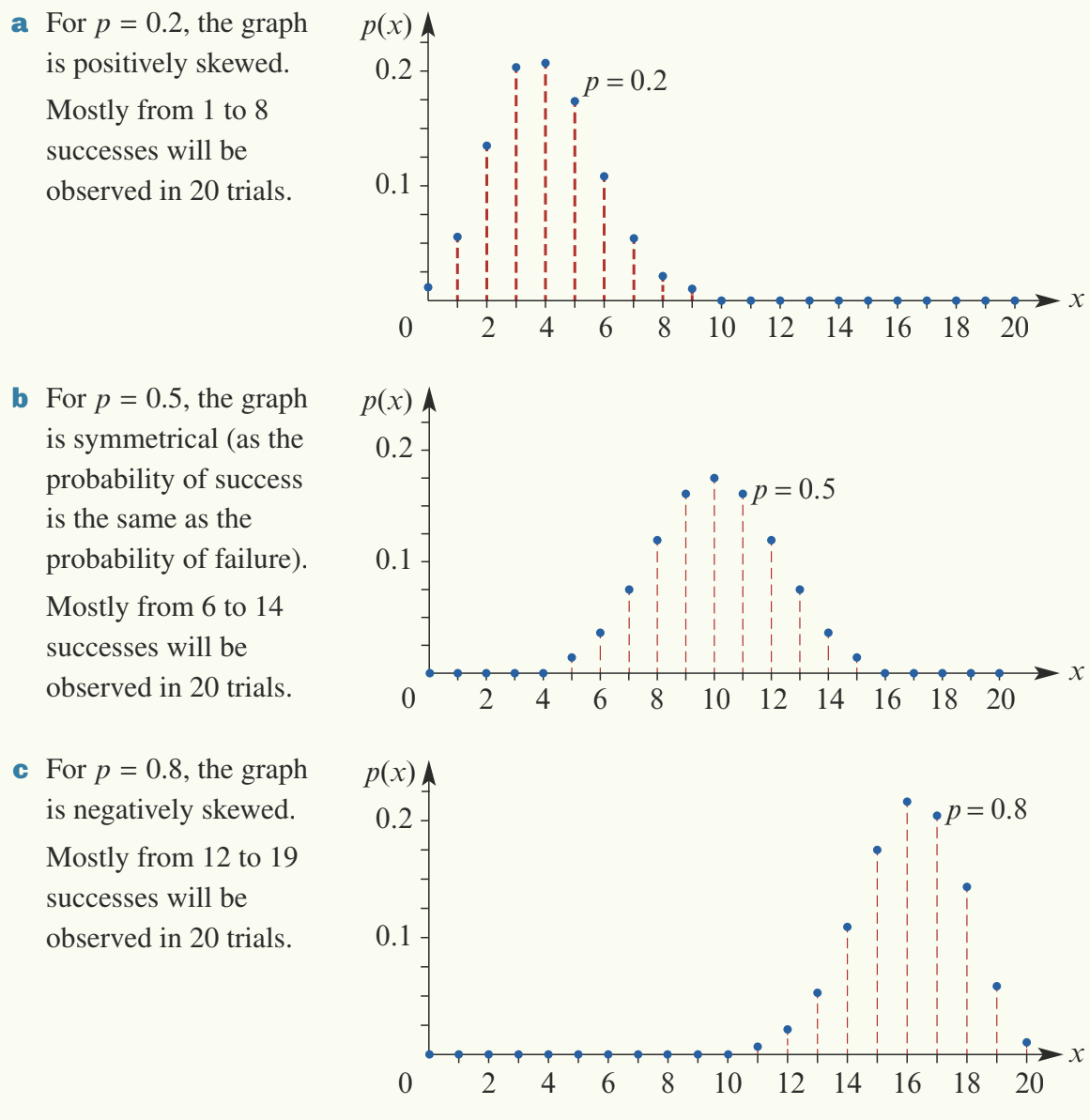
When : The graph is positively skewed (skewed to the right). Most of the probability is concentrated on the lower values, with a tail extending towards higher values.
-
When : The graph is symmetrical. The probability of success equals the probability of failure, creating a balanced distribution.
-
When : The graph is negatively skewed (skewed to the left). Most of the probability is concentrated on the higher values, with a tail extending towards lower values.
Example
Worked Example: Comparing distributions for different p values
Construct and compare the graph of the binomial probability distribution for 20 trials () with probability of success:
a)
b)
c)
Solution:
a) For , the graph is positively skewed.
The distribution shows that mostly between 1 and 8 successes will be observed in 20 trials. The highest probabilities occur for lower numbers of successes, which makes sense because with only a 20% chance of success on each trial, we expect fewer total successes.
b) For , the graph is symmetrical.
The probability of success is the same as the probability of failure, creating a balanced distribution. Mostly between 6 and 14 successes will be observed in 20 trials. The distribution peaks at 10 successes, which is exactly half of the 20 trials.
c) For , the graph is negatively skewed.
With an 80% chance of success on each trial, mostly between 12 and 19 successes will be observed in 20 trials. The distribution is concentrated towards higher numbers of successes.
Key observation: Notice that the graphs for and are mirror images of each other. This symmetry makes sense because succeeding 80% of the time is the opposite of succeeding only 20% of the time.
Expectation and variance
Understanding expectation intuitively
Note
Consider this question: How many heads would you expect to obtain, on average, if a fair coin was tossed 10 times?
While the exact number of heads would vary from trial to trial (and could theoretically be anywhere from 0 to 10), intuition suggests that the long-run average would be 5 heads. This intuition is correct! For a binomial random variable with and :
Formulas for expectation and variance
For any binomial distribution, we can calculate the expected value and variance directly from the parameters and , without needing to work through the full probability distribution.
Important
If is the number of successes in trials, each with probability of success , then:
These formulas provide a quick and efficient way to find the centre and spread of a binomial distribution.
Note
The term represents the probability of failure, often denoted as . So the variance formula can also be written as .
Example
Worked Example: Multiple-choice test
An examination consists of 30 multiple-choice questions, each question having three possible answers. A student guesses the answer to every question. Let be the number of correct answers.
a) How many will she expect to get correct? That is, find .
b) Find .
Solution:
The number of correct answers, , is a binomial random variable with parameters and (since there are three possible answers and only one is correct).
a) Using the formula for expectation:
The student has an expected result of correct answers.
Note: This is not enough to pass if the pass mark is 50% (which would require 15 correct answers).
b) Using the formula for variance:
Example
Worked Example: Influenza spread with standard deviation
The probability of contracting influenza this winter is known to be 0.2. Of the 100 employees at a certain business, how many would the owner expect to get influenza? Find the standard deviation of the number who will get influenza and calculate . Interpret the interval for this example.
Solution:
The number of employees who get influenza is a binomial random variable, , with parameters and .
Finding the expectation:
The owner will expect 20 of the employees to contract influenza.
Finding the variance and standard deviation:
Therefore, the standard deviation is:
Calculating the interval:
This gives us the interval [12, 28].
Interpretation:
The owner of the business knows there is a probability of approximately 0.95 (or 95%) that between 12 and 28 of the employees will contract influenza this winter.
This interpretation uses the empirical rule (also called the 68-95-99.7 rule), which states that for many distributions, approximately 95% of values fall within two standard deviations of the mean.
Exam tips
Note
Essential Tips for Success:
-
Always identify the parameters and clearly before calculating expectation or variance.
-
Remember that represents the probability of failure.
-
The expectation gives the long-run average, not a guarantee of what will happen in any single set of trials.
-
The interval captures approximately 95% of possible outcomes, making it useful for predicting reasonable ranges.
-
When the question asks for standard deviation, don't forget to take the square root of the variance!
Summary
Key Points to Remember:
-
Graph shapes depend on : Positively skewed when , symmetrical when , and negatively skewed when .
-
Expectation formula: gives the expected number of successes in trials.
-
Variance formula: measures how spread out the distribution is.
-
Standard deviation: Remember to take the square root of variance to find .
-
The interval: Contains approximately 95% of all possible outcomes, providing a useful range for predictions.