Mass and Energy Equivalence (VCE SSCE Physics): Revision Notes
📚Revision Notes
Mass and Energy Equivalence
Introduction: Our Sun is losing mass
One of the most remarkable predictions of Einstein's Special Theory of Relativity is that mass and energy are equivalent and can be converted into one another. This phenomenon is constantly occurring in our Sun.
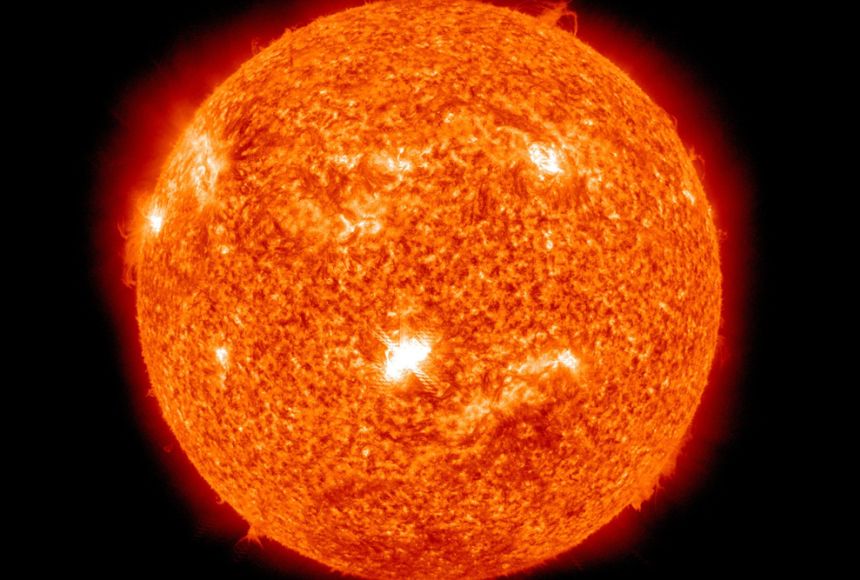
Since the Sun continuously radiates light energy, it must also be continuously losing mass. Every second, the Sun emits approximately J of light energy, which means it is losing approximately four billion kilograms of mass each second.
Note
To put this in perspective, every second the Sun loses mass equivalent to roughly three million cars. Every two minutes, the Sun loses mass equal to the combined mass of the entire human population.
Despite this enormous rate of mass loss, over the Sun's ten-billion-year lifetime, it will only lose approximately 0.07% of its total mass. This demonstrates both the enormous energy released and the vast mass of the Sun.
The relationship between mass and energy
Mass and energy are two forms of the same fundamental quantity. They can be converted into one another, meaning they are equivalent. This equivalence is captured in Einstein's most famous equation.
Understanding equivalence through analogy
A simple toy can help us understand this profound concept. Consider a jack-in-the-box, which uses elastic potential energy. When you compress the spring inside and close the lid, you store energy in the spring. When the mechanism releases the lid, the spring expands and the jack pops out.

Note
If you could measure the mass of the jack-in-the-box with extremely sensitive scales, you would discover something remarkable: the mass is slightly greater when the spring is compressed. This tiny increase in mass comes from the elastic potential energy stored in the compressed spring. When the spring is released and the energy is converted to kinetic energy, the mass decreases back to its original value.
Although the mass change is incredibly small in everyday objects, this simple fact reveals a fundamental truth about our universe: mass and energy can be converted into one another.
Rest mass-energy relationship
The amount of energy equivalent to a given mass can be calculated using Einstein's equation:
Formula: Resting mass-energy relationship
Where:
- = Energy of an object at rest (J)
- = Mass (kg) (or change in mass when considering conversions)
- = Speed of light, m s
Important
The speed of light squared () is an enormous number (approximately m s), which means that even a tiny amount of mass corresponds to a huge amount of energy.
Key Vocabulary:
- Rest energy (): The energy content of an object when it is stationary, given by
Worked example: calculating mass from energy
Example
Worked Example: Calculating Mass from Energy
Question: A muon is found to have a rest energy of 105 MeV. What is the mass of the muon in kilograms?
Solution:
First, convert the energy from electronvolts to joules:
Rearrange the formula to solve for mass:
Total relativistic energy
When an object is moving, its total energy consists of two components: its rest energy and its kinetic energy. At relativistic speeds (significant fractions of the speed of light), we must account for the effects described by the Lorentz factor, (gamma).
Formula: Total relativistic energy
Where:
- = Total (relativistic) energy (J)
- = Total (relativistic) kinetic energy (J)
- = Rest energy given by (J)
- = Rest mass, the mass measured in the stationary frame of reference (kg)
- = Speed (m s)
- = Speed of light, m s
- = Lorentz factor,
Key Vocabulary:
- Lorentz factor (): A factor that appears in all relativistic equations, describing how time, length, and energy change at high speeds. It equals 1 at low speeds and approaches infinity as velocity approaches the speed of light.
Note
When an object is stationary (), the Lorentz factor equals 1, and the total energy simplifies to just the rest energy:
Worked example: total energy of a moving particle
Example
Worked Example: Total Energy of a Moving Particle
Question: Find the total energy of a helium nucleus that has a rest mass of kg and is moving at 0.200.
Solution:
First, calculate the Lorentz factor:
Now substitute this value and the given rest mass into the formula:
Relativistic kinetic energy
The kinetic energy of a moving object can be found by subtracting the rest energy from the total energy. At relativistic speeds, this gives a formula quite different from the classical expression .
Formula: Relativistic kinetic energy
Where:
- = Total (relativistic) kinetic energy (J)
- = Total (relativistic) energy (J)
- = Rest energy given by (J)
- = Rest mass (kg)
- = Speed of light, m s
When to use relativistic formulas
The classical formula only works accurately at speeds much less than the speed of light. At relativistic speeds, it breaks down and gives incorrect results.
Important
Exam Tip: As a practical rule, use relativistic formulas whenever the speed of an object is greater than about 10% of the speed of light, or . Below this threshold, the classical formulas provide good approximations.
Worked example: relativistic kinetic energy of a proton
Example
Worked Example: Relativistic Kinetic Energy of a Proton
Question: A proton that has a rest mass of kg is accelerated to a velocity of 0.999 () inside a linear accelerator. Calculate the kinetic energy of the proton.
Solution:
Since the proton is travelling at relativistic speeds (99.9% of light speed), we must use the relativistic formula:
This is vastly greater than the classical prediction would give, demonstrating the importance of relativistic corrections at high speeds.
Worked example: finding total energy from kinetic energy
Example
Worked Example: Finding Total Energy from Kinetic Energy
Question: An electron is moving at a constant velocity relative to an observer. The electron has a rest mass of kg and a kinetic energy of J. Calculate the total energy of the electron.
Solution:
The total energy is the sum of kinetic energy and rest energy:
Applications of mass-energy equivalence
The mass-energy relationship is not just a theoretical concept; it is clearly demonstrated in three important physical processes: nuclear fusion in stars, nuclear transformations in particle accelerators, and matter-antimatter annihilation.
Nuclear fusion in the Sun
Nuclear fusion is the process of joining together two or more small atomic nuclei to form a larger, more stable nucleus. When this occurs, energy is released. This is the fundamental process that powers our Sun and all stars.
Key Vocabulary:
- Nuclear fusion: The process of joining together two or more small nuclei to form a larger, more stable nucleus
- Strong nuclear force: The fundamental force that binds nucleons (protons and neutrons) together in a nucleus of an atom. It acts only over very short distances ( m)
- Reactant: The substance present before the reaction that is used up to make the products
- Product: A substance formed as a part of a reaction
- Mass defect (): The difference in mass between the products and the reactants of a reaction
Note
The fusion process in stars is complex, but we can understand the principle by examining hydrogen fusion in our Sun. Fusion reactions require extremely high temperatures and pressures. At these extreme conditions, electrons are stripped away from atoms, leaving bare nuclei. The high pressures and temperatures give some pairs of hydrogen nuclei sufficient kinetic energy to overcome the electrostatic repulsion between their positive charges.
When nuclei get close enough, the strong nuclear force binds them together. This force is one of the four fundamental forces of nature and acts only over extremely short distances (about m, roughly the size of a nucleus).
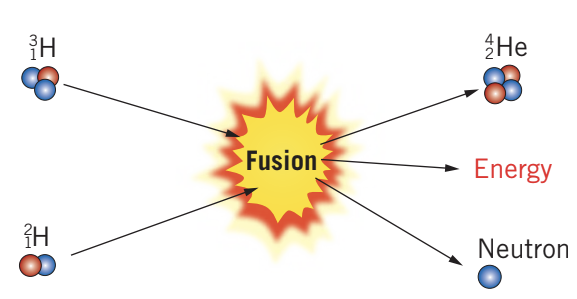
When fusion occurs, the total mass of the products (the particles after the reaction) is less than the total mass of the reactants (the particles before the reaction). This difference is called the mass defect, . The "missing" mass has been converted to energy and released, primarily as electromagnetic radiation and kinetic energy of the particles.
The amount of energy released can be calculated using:
where is the mass defect.
Worked example: energy from fusion
Example
Worked Example: Energy from Fusion
Question: In a simple fusion reaction, a hydrogen-3 isotope collides with a hydrogen-2 isotope to form a helium-4 isotope, a neutron, and a gamma ray. The masses are:
- Hydrogen-3: kg
- Hydrogen-2: kg
- Helium-4: kg
- Neutron: kg
The equation for this fusion reaction is:
a) Calculate the mass defect of this equation. b) Calculate the energy released per fusion reaction.
Solution:
a) The mass defect is the difference between the total mass of reactants and the total mass of products:
b) Use the mass defect to find the energy released:
This enormous amount of energy from such a tiny mass change demonstrates the power of nuclear fusion.
Nuclear transformations in particle accelerators
Particle accelerators work by accelerating charged particles across electric fields. Magnetic fields guide the particles, often keeping them moving in circular paths. When particle beams collide with stationary targets or when two beams collide with each other, the nuclei of atoms can undergo dramatic changes.
During high-energy collisions, nuclei can break apart, merge, or transform in various ways, producing different elements. The process of changing one chemical element into another is called nuclear transmutation.
Key Vocabulary:
- Nuclear transmutation: Turning one chemical element into another
Note
When atoms are transmuted in particle accelerators, the total mass before the collision differs from the total mass after the collision. This mass difference is again called the mass defect. The energy change associated with the collision can be calculated using , where is the mass defect.
Historical context: turning base metals into gold

For centuries, alchemists attempted to transmute "base" metals (cheap metals like lead) into gold. By the 1720s, most people had abandoned this quest, and by the 1800s, alchemy had evolved into the modern science of chemistry.
However, in the 1980s, the dream of nuclear transmutation was finally realised at the Lawrence Berkeley National Laboratory (LBNL) in California. Scientists accelerated beams of carbon and neon atoms to near light speed and fired them into bismuth foil. When these high-energy beams collided with the bismuth atoms, nuclear transformations occurred, changing the atomic nuclei. The team successfully created several gold isotopes, along with other transmuted elements.
Important
However, all the gold produced was radioactive, and the process was extraordinarily expensive—it would cost approximately 35 quadrillion dollars to produce one kilogram of gold! This demonstrates that whilst nuclear transmutation is scientifically possible, it is not economically viable.
Worked example: energy from nuclear transmutation
Example
Worked Example: Energy from Nuclear Transmutation
Question: In a particle accelerator, a beam of carbon atoms is fired at bismuth foil. In one collision, a high-speed carbon atom fragments the bismuth atom, releasing four protons and fifteen neutrons. This produces an unstable gold atom whilst the carbon atom remains intact. The combined mass before the collision is kg, and the mass of products after the collision is kg. Calculate the energy released in this collision.
Solution:
First, find the mass defect:
Now calculate the energy released using the mass defect:
Positron-electron annihilation
A positron, also known as an anti-electron, is made of antimatter and is the antiparticle of the electron. An antiparticle has the same mass as its corresponding particle but has the opposite electric charge. A positron has a charge of C (positive) and exactly the same mass as an electron.
Key Vocabulary:
- Positron: A positively charged antiparticle that has the same mass and magnitude of charge as the electron
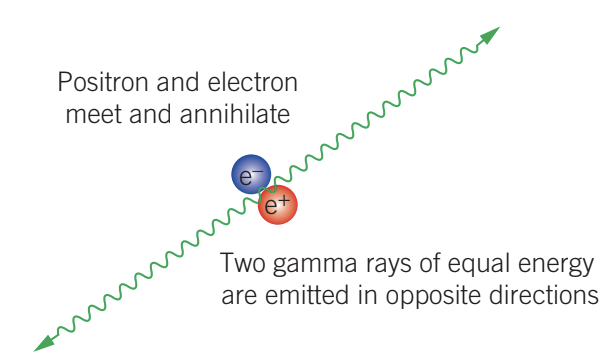
When an antiparticle comes into contact with its corresponding particle, the two annihilate each other. Their mass is completely converted into energy in the form of electromagnetic radiation.
Note
When a positron collides with an electron, the two particles annihilate completely, producing two gamma rays of equal energy that travel in opposite directions. This opposite direction is required to conserve momentum.
During annihilation, all the mass of both particles is converted entirely into energy. Due to conservation of energy, the total energy before annihilation (including the mass-energy) must equal the total energy after (the energy of the gamma rays).
For an electron-positron pair colliding at low speeds, the energy of each gamma ray emitted is given by , where is the rest mass of an electron (and positron).
Worked example: energy from matter-antimatter annihilation
Example
Worked Example: Energy from Matter-Antimatter Annihilation
Question: An electron and positron travelling at low speeds collide with one another. Calculate the total energy released in the annihilation. Use kg for the electron's mass.
Solution:
During annihilation, all mass is converted to energy. Since an electron and positron have the same mass, the total change in mass for the system is:
Substitute this into the mass-energy equation:
This energy is split equally between the two gamma rays produced.
Medical application: Positron Emission Tomography (PET) scans
Positron-electron annihilation has an important medical application in PET scans. A PET scan produces functional (working) images of body parts, particularly the brain.

Note
How PET Scans Work:
During a PET scan, the patient is given a positron-emitting radioactive isotope. When the emitted positrons encounter electrons in the body, they annihilate each other and release two gamma rays.
The patient's head or body part is positioned inside a large ring of gamma ray detectors. Since the gamma rays are emitted with equal energy but in opposite directions, pairs of detectors on opposite sides of the ring can detect both rays. A computer program analyses the timing differences of gamma ray arrivals at different detector pairs to create detailed images of internal structures and their functioning.

The images show a comparison between a healthy brain (left) and a brain affected by Alzheimer's disease (right). The healthy brain shows robust metabolic activity (warm colours), whilst the diseased brain shows dramatically reduced activity (cool colours), indicating significant loss of brain function.
Understanding the Lorentz factor
The Lorentz factor, , appears in all relativistic formulas. Understanding its behaviour helps explain relativistic effects.
The Lorentz factor is given by:
Behaviour at different velocities
Note
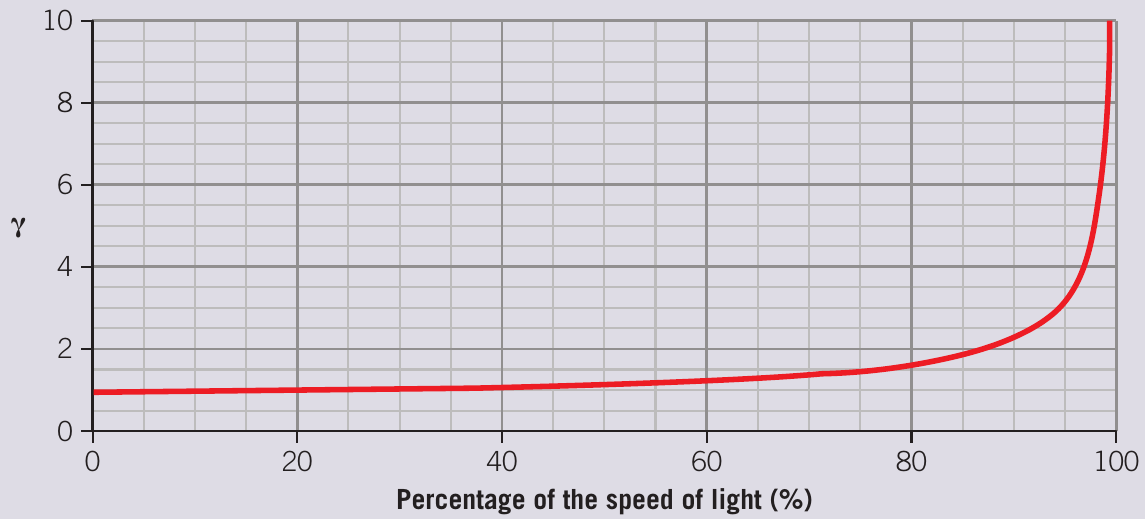
At low velocities, the Lorentz factor is approximately equal to 1. This means:
- Time dilation is negligible ()
- Length contraction is negligible ()
- Total energy equals rest energy ()
- Kinetic energy is approximately zero ()
As velocity increases towards the speed of light, the term approaches 1, which means approaches infinity. This has dramatic consequences:
As an object's velocity increases (relative to an observer):
- Time dilation increases: Time in the moving frame slows down as measured by the stationary observer
- Length contraction increases: The object's length decreases as seen by the stationary observer
- Total energy approaches infinity: The energy required to accelerate the object further increases without limit
- Kinetic energy approaches infinity: This explains why it is impossible to accelerate any massive object to the speed of light
- Relativistic mass approaches infinity: Due to the equivalence of mass and energy (though the rest mass remains constant)
Important
Exam Tip: The graph shows that relativistic effects remain small (γ stays close to 1) until speeds reach about 70% of light speed. Beyond this point, γ increases rapidly. This is why relativistic formulas are essential for accurate calculations at high speeds.
Remember!
Summary
Key Points to Remember:
-
Mass and energy are equivalent: They can be converted into one another according to Einstein's equation . The speed of light squared () is enormous, so even tiny amounts of mass correspond to huge amounts of energy.
-
Three key formulas: Rest energy is , total relativistic energy is , and relativistic kinetic energy is . Use relativistic formulas when .
-
Mass defect releases energy: In nuclear reactions, the mass defect () represents the difference between reactant and product masses. This "missing mass" is converted to energy according to .
-
Three important applications: Nuclear fusion in the Sun converts mass to energy through the strong nuclear force. Particle accelerators can transform elements through nuclear transmutation. Matter-antimatter annihilation converts all mass completely into energy, which is used in medical PET scans.
-
The Lorentz factor determines relativistic effects: At low speeds, and classical physics applies. As speed approaches light speed, approaches infinity, causing time dilation, length contraction, and energy to increase dramatically. This is why nothing with mass can reach the speed of light.