What Is Relativity? (VCE SSCE Physics): Revision Notes
📚Revision Notes
What Is Relativity?
Introduction: Evidence for Einstein's theories
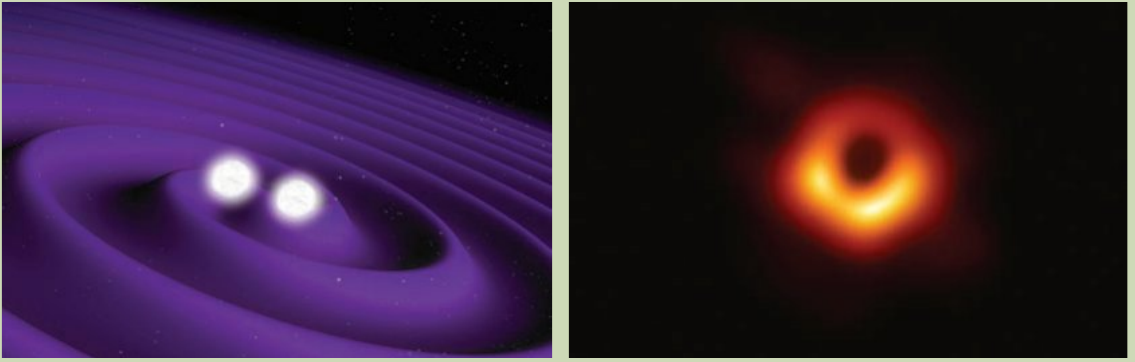
Einstein's theories of relativity revolutionised physics, and modern experiments continue to confirm his predictions. In 2015, the Laser Interferometer Gravitational-wave Observatory (LIGO) made history by detecting gravitational waves for the first time. These waves were produced by two black holes merging approximately billion years ago, exactly as Einstein's theory of general relativity predicted.
In April 2019, scientists achieved another milestone by capturing the first photograph of a black hole. This image shows the supermassive black hole at the centre of the Messier 87 galaxy, located more than million light-years from Earth. The black hole has a mass billion times greater than our Sun. In the photograph, light bends around the black hole creating a bright ring, whilst the black hole itself remains invisible in the centre. The dark region represents the black hole's event horizon, beyond which no light can escape.
Note
These experimental confirmations came more than a century after Einstein first published his theories, demonstrating the remarkable predictive power of relativity. The LIGO detection and black hole photograph represent some of the most significant scientific achievements of the 21st century.
Interestingly, despite these groundbreaking theories, Einstein received his Nobel Prize in 1922 not for relativity, but for his work on the photoelectric effect. In his 1905 paper on this topic, Einstein described light as packets of discrete energy rather than as waves. This concept of quantised light became a crucial stepping stone towards the development of quantum mechanics.
Relativity and reference frames
The concept of relativity in physics has its roots in observations made by the 17th century scientist Galileo Galilei. Sitting on an Italian shoreline watching boats sail past, Galileo considered an interesting thought experiment: if someone dropped a ball from the mast of a moving ship, how would the ball's motion appear to different observers?
Galileo reasoned that a crew member on board the ship would see the ball fall straight down, landing directly beneath the point where it was released. However, from Galileo's viewpoint on the shore, the ball would trace a curved, parabolic path as it fell. This happens because whilst the ball is falling, the ship continues moving forward.

Important
Both observers are correct within their own reference frame. This is the fundamental insight of relativity: observations depend on the observer's frame of reference, and no single perspective is more "correct" than another.
The crucial insight is that the ball obeys the same laws of physics in both situations. The crew on the ship cannot tell from observing the falling ball whether the ship is moving at a constant velocity or is stationary. Newton later built on Galileo's ideas and introduced the term inertial reference frame to describe any frame of reference that is either at a constant velocity or stationary (not accelerating).
Key definitions
Relativity is the dependence of physical phenomena on the relative motion between the thing being observed and the observer. In other words, what we observe depends on how we are moving relative to what we are watching.
A reference frame is a coordinate system whose quantities, such as distances and time, can be measured. It provides the perspective from which observations are made.
An inertial reference frame is a non-accelerating reference frame. This means it is either stationary or moving at a constant velocity. The laws of physics work the same way in all inertial reference frames.
Note
The concept of relativity began with relating the motion of objects to the motion of observers. Einstein extended this idea to consider the nature and behaviour of light, space, time and gravity, creating one of the most revolutionary frameworks in physics.
The Michelson-Morley experiment
Until the late 1800s, scientists believed that light waves, like other waves such as sound or water waves, required a medium to travel through. A medium is a substance that allows waves to travel through it. Scientists theorised that space was filled with an invisible medium called the luminiferous aether, and that electromagnetic waves (including light) travelled through this aether.
In the late 1800s, physicists Albert Michelson and Edward Morley designed an experiment to provide evidence for the existence of the aether. Their experiment used an optical device called an interferometer to detect any changes in the speed of light that would be caused by Earth's motion through the aether.
How the interferometer works
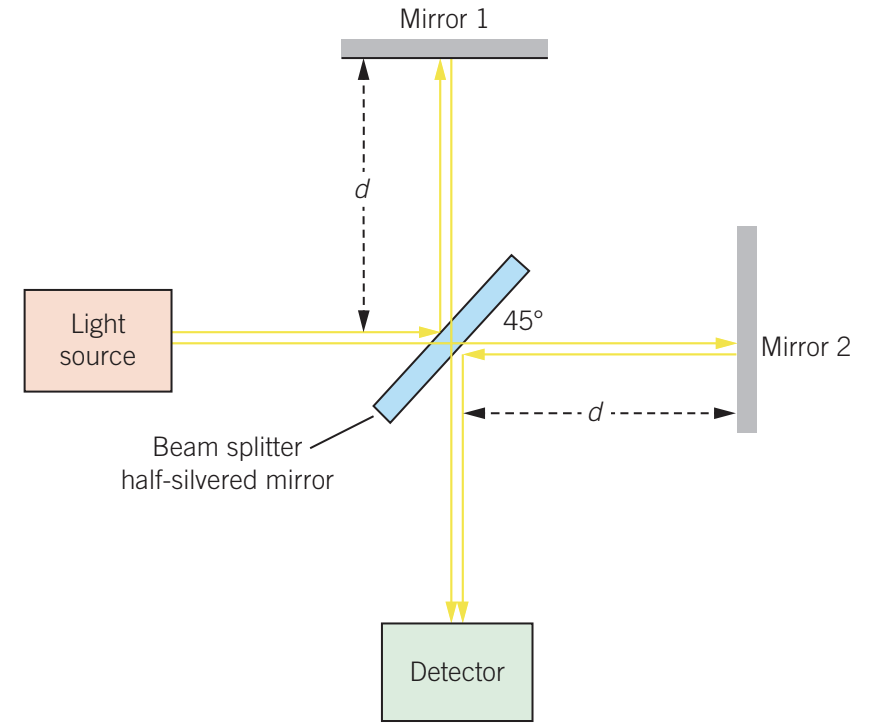
An interferometer operates by splitting a single coherent light beam (light that is monochromatic and in phase) and comparing the two resulting beams. Here's how it works:
- A coherent light beam is sent towards a half-silvered mirror (beam splitter) positioned at
- This beam splitter divides the light equally into two perpendicular beams
- Each beam travels down an arm of equal length towards a mirror
- The light reflects off the mirror at the end of each arm and travels back
- The two beams recombine at the beam splitter
- The recombined light is detected and analysed
Expected results
If the aether existed, the experiment should detect it. Earth moves through space at approximately in its orbit around the Sun. If space contained aether, this motion would create an "aether wind" from Earth's perspective, similar to how driving through still air creates wind for a person in a car.
The two perpendicular beams would have different orientations relative to this aether wind. One beam might travel with and against the aether wind, whilst the other travels across it. Due to the aether wind, the two beams would take different amounts of time to travel to their respective mirrors and back. This time difference would cause the recombined light to be out of phase, meaning the beams would no longer be coherent.
Actual results: the null result
When Michelson and Morley conducted their experiment, they obtained a surprising result. Regardless of:
- The time of day
- The season of the year
- The orientation of the interferometer's arms relative to Earth's motion
The recombined light beams always remained perfectly in phase. This null result (no change detected) was strong evidence that:
- The luminiferous aether does not exist
- Light does not require a medium to travel through
- The speed of light is independent of Earth's motion through space
Important
Significance of the null result: The Michelson-Morley experiment's findings were revolutionary. They demonstrated that the speed of light is constant regardless of the observer's motion, contradicting all expectations based on classical physics. This result became a cornerstone of Einstein's special relativity.
Significance of the experiment
The Michelson-Morley experiment's null result shocked the scientific community. Most physicists at the time began searching for flaws in Maxwell's equations, which predicted that the speed of light was constant for all observers. However, Einstein took a different approach. He accepted Maxwell's equations as correct and began exploring the profound implications if the speed of light truly was constant for all observers, regardless of their motion. This thinking led directly to his special theory of relativity.
Einstein's postulates of special relativity
Einstein's special theory of relativity is built on two fundamental postulates. A postulate is an established fact used as a basis for reasoning. These two postulates form the foundation of special relativity:
The two postulates
Postulate 1: All inertial reference frames are equivalent. The laws of physics are the same in all inertial reference frames.
This means that no inertial reference frame is "special" or "preferred". Whether you are stationary or moving at a constant velocity, you will observe the same laws of physics operating. There is no experiment you can perform within your reference frame to determine if you are moving at constant velocity or stationary.
Postulate 2: The speed of light in a vacuum is constant. Every observer will measure the speed of light in a vacuum as the same constant value.
This postulate states that all observers measure light travelling at in a vacuum, regardless of:
- Their own motion
- The motion of the light source
- The direction of the light
Implications of the postulates
Important
No absolute reference frame exists: These two postulates demonstrate that there is no absolute frame of reference against which position and velocity can be defined. Only relative positions and velocities between objects have physical meaning.
Special relativity explains phenomena that classical physics cannot account for. When two observers are moving relative to each other, they:
- Don't agree about time intervals: The time between two events will be measured differently by different observers
- Don't agree about distances: The spatial separation between two points will be measured differently
- Sometimes don't agree about event order: In certain cases, observers may even disagree about which event happened first
An event is something that happens at a specific time and place. Each reference frame will measure both the location and time of the event, but often these measurements will differ between frames.
Limitations of classical physics
The constancy of light speed cannot be explained by classical physics. Classical mechanics predicts that velocities are additive.
Example
Classical Physics Prediction vs. Reality:
Consider a train travelling at half the speed of light () relative to Earth. When the train turns on its headlights:
Classical physics predicts:
- Velocity of train:
- Velocity of light from headlights:
- Total velocity relative to Earth:
Special relativity (reality):
- All observers, whether on the train or on Earth, will measure the light from the headlights travelling at exactly , not
This demonstrates that classical mechanics breaks down when considering motion approaching the speed of light.
Comparing special relativity with classical physics
Classical physics works excellently for everyday speeds but breaks down as velocities approach the speed of light. The key differences are:
| Classical Physics | Special Relativity |
|---|---|
| Time is absolute - all observers agree on time intervals | Time is relative - observers in different frames measure different time intervals |
| Distance is absolute - all observers agree on spatial measurements | Distance is relative - observers in different frames measure different distances |
| Velocities add together simply | Velocities combine in a more complex way that never exceeds |
| There could be a preferred reference frame | No preferred reference frame exists |
| Light speed depends on observer's motion | Light speed is constant for all observers |
Note
The transition from classical physics to special relativity represents one of the most profound shifts in our understanding of the universe. At everyday speeds (much less than ), the differences are negligible, which is why classical physics works so well for ordinary experiences. However, as speeds approach , the effects of special relativity become dramatic and cannot be ignored.
Identifying events and reference frames
When solving problems in special relativity, it is essential to clearly identify:
- The event being observed (what happens, when, and where)
- The different reference frames (different observers' perspectives)
Understanding these elements helps determine important quantities in relativity calculations.
Example
Worked Example: Galileo's Ship Scenario
Situation: Galileo Galilei sits on an Italian shoreline watching boats sail past at constant speeds. He observes a cannonball being dropped from a ship's mast. The crew on the boat also observe the cannonball being dropped.
Step 1: Identify the reference frames
- Galileo's frame of reference (stationary on the shore)
- The boat crew's frame of reference (moving at constant velocity with the boat)
Step 2: Identify the event
- Event: The cannonball being dropped from the mast and hitting the deck
Analysis: Both observers witness the same event, but from different reference frames, so they observe it differently. Galileo sees a parabolic path whilst the crew see a straight downward path. Both observations are correct within their respective frames.
Remember!
Summary
Key Points to Remember:
-
Relativity describes how observations depend on the relative motion between observer and observed. Different observers in different reference frames can make different but equally valid measurements.
-
Inertial reference frames are frames that are not accelerating (either stationary or moving at constant velocity). The laws of physics are identical in all inertial reference frames.
-
The Michelson-Morley experiment used an interferometer to search for the luminiferous aether. Its null result (beams always stayed in phase) proved that no aether exists and that light's speed is independent of the observer's motion.
-
Einstein's two postulates form the foundation of special relativity:
- The laws of physics are the same in all inertial reference frames
- The speed of light in a vacuum is constant () for all observers
-
Classical physics fails at high speeds because it predicts velocities are additive, which would allow speeds greater than . Special relativity correctly predicts that no observer can measure light travelling at any speed other than , regardless of their motion or the source's motion.