Electric Fields and Forces (VCE SSCE Physics): Revision Notes
📚Revision Notes
Electric Fields and Forces
Introduction: electric fields in nature
Electric fields play a fascinating role in the natural world. Many animals have evolved the ability to detect and use electric fields for survival.
Note
Sharks possess specialised electroreceptors called ampullae of Lorenzini, which appear as tiny pores on their snouts. These receptors allow sharks to detect extremely weak electric fields - less than (one hundredth-millionth of a volt per centimetre). This extraordinary sensitivity helps sharks locate prey in murky water.

The platypus is one of the few mammals with electroreceptors. It has approximately 40,000 electroreceptors located on its bill, compared to only 400-2000 in echidnas. Platypuses can detect electric fields of around (three-tenths of a millivolt per centimetre). This ability allows them to hunt prey in deep, murky water without relying on sight, sound or smell. As prey gets closer, the electric field signal becomes stronger, providing the platypus with information about location and movement.
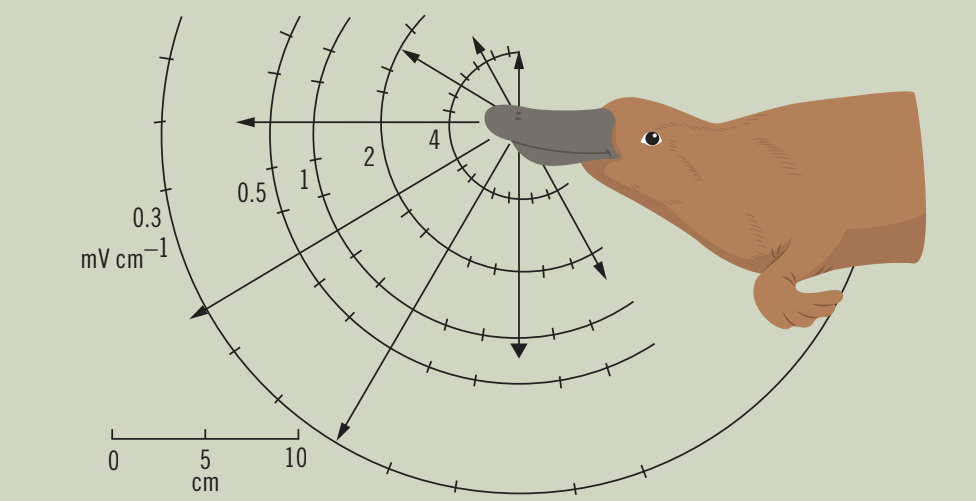
What is an electric field?
An electric field is a physical field that creates a force on all charged particles within it. Electric fields are produced by charged particles and by changing magnetic fields.
The concept of a "field" was proposed by Michael Faraday. In the case of an electric charge, there is an electric field in the space around the charge. If a second charge is placed in that space, it will experience an electric force.
Important
A field can be defined as a region where an object feels a force (such as gravitational, electric or magnetic). More precisely, it is a physical quantity that has a value at each point in space.
Electric field strength
Just as gravitational field strength is the force per unit mass (), electric field strength is the force per unit charge (), where charge is measured in coulombs (C):
This relationship can be rearranged to give the force on a charged particle in an electric field:
Where:
- = force on a charged particle in an electric field (N)
- = charge of the particle (C)
- = strength of the electric field ()
Note
A coulomb (C) is the SI unit for charge. One coulomb is equivalent to the combined charge of protons (or electrons), or the amount of charge that passes a point when a current of 1 A flows for a time of 1 s.
The unit of electric field strength is newtons per coulomb (). An equivalent but more commonly used unit is volts per metre ().
Direction of electric fields
By convention, the direction of an electric field is given by the direction of the force on a small positive unit test charge placed in the field.
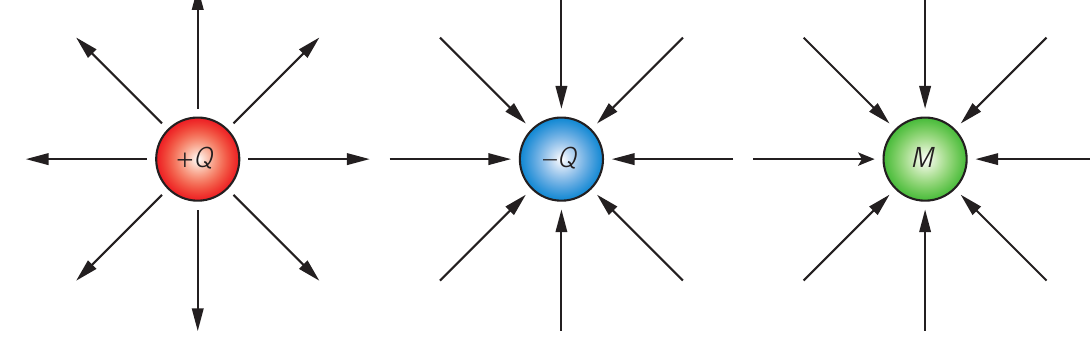
For a positive charge, the electric field lines point radially outward. For a negative charge, the electric field lines point radially inward. For a mass in a gravitational field, the field lines always point inward (toward the mass).
Electric field lines and patterns
Electric fields can be modelled by drawing electric field line diagrams, similar to gravitational field lines.
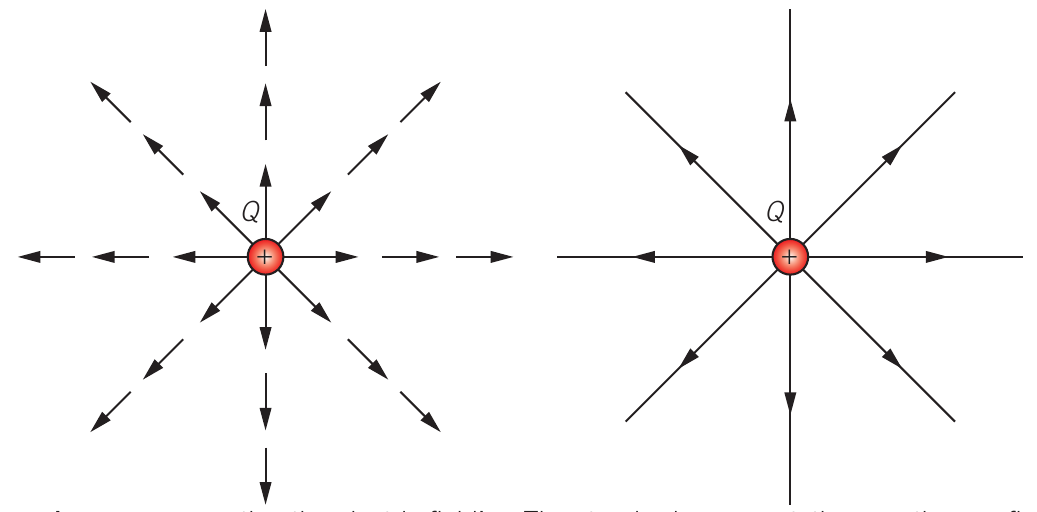
Field lines are lines drawn to represent the strength of a field with arrows to indicate direction. Field lines that are closer together indicate a stronger field.
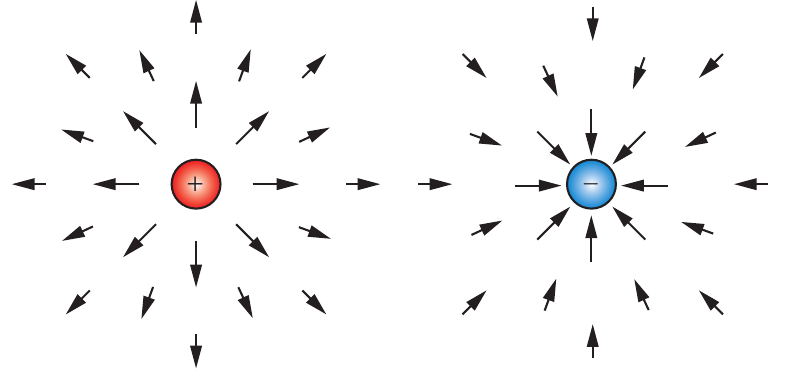
In electric field diagrams, force vectors are formed into continuous lines called lines of force or electric field lines. The arrows indicate the direction of the field. The distance between adjacent field lines indicates the strength of the electric field - field lines closer together represent a stronger field.
Common electric field patterns
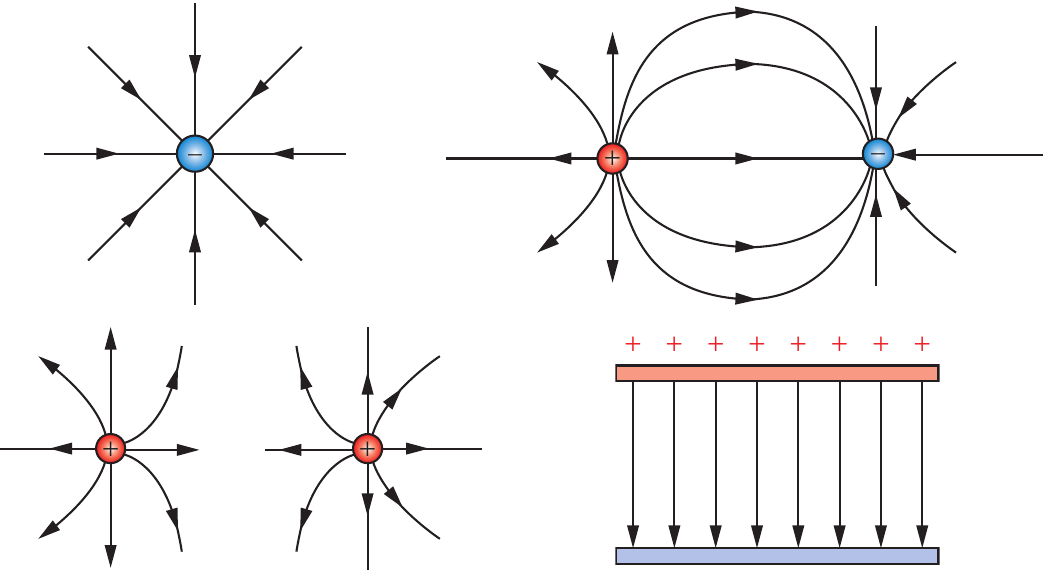
The diagram above shows standard electric field patterns for:
- A single negative charge (top left) - field lines point inward
- A pair of opposite charges or electric dipole (top right) - field lines flow from positive to negative
- A pair of positive charges (bottom left) - field lines repel each other
- Two parallel plates with opposite charges (bottom right) - uniform field between plates
Rules for drawing electric field line patterns
Important
Rules for Drawing Electric Field Lines:
When drawing two-dimensional electric field line patterns around and between charged objects:
- Electric field lines run from positive charges to negative charges
- Electric field lines start and end at 90° to conducting surfaces, with no gap between the lines and the surface
- Field lines can never cross - if they did, it would mean the force is acting in two different directions at that point, which is impossible
- Drawings are usually two-dimensional representations of three-dimensional fields
Uniform electric fields
Between two parallel oppositely charged metal plates, a uniform electric field is established in the central region. A uniform electric field is one in which the value of the field strength remains the same at all points.
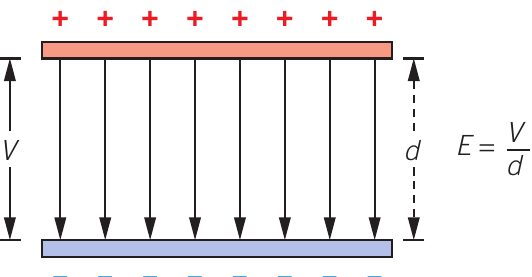
The field strength is constant at all points within the region of the uniform electric field, so the field lines are parallel. The strength of the electric field is given by:
Where:
- = electric field strength for a uniform electric field ()
- = electric potential difference (voltage) between the plates (V)
- = distance between the plates (m)
Example: apparatus demonstration
A common physics laboratory demonstration uses parallel plates with a voltage of 100 V and a distance of 2 cm between them to create a visible electric field using small seeds that align with the field lines.

Example
Worked Example: Calculating Electric Field Strength in Parallel Plates
For this apparatus:
Given:
- Voltage: V
- Distance: cm m
Solution:
Answer: The electric field strength is 5000 V·m⁻¹
Lightning as a natural electric field
Note
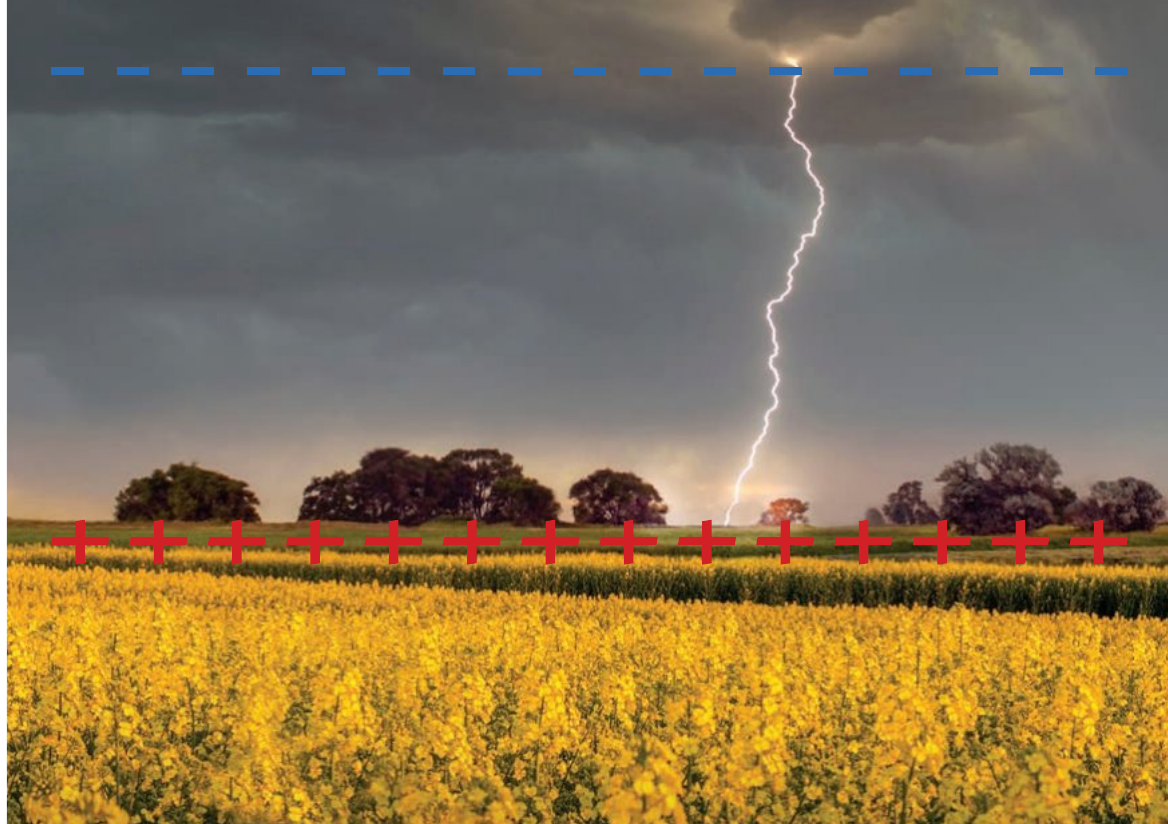
Lightning is a naturally occurring electrostatic discharge. A lightning bolt can have a voltage of approximately V (300 million volts) at a height of 10 km above the ground, creating an electric field of around 30,000 V·m⁻¹. Lightning occurs when the electrical arc overcomes the insulating properties of air.
Electric monopoles and dipoles
Electric charges can exist as both monopoles and dipoles.
An electric monopole is a single electric point charge, such as an electron or proton, in which all field lines point inward (for negative charges) or outward (for positive charges).
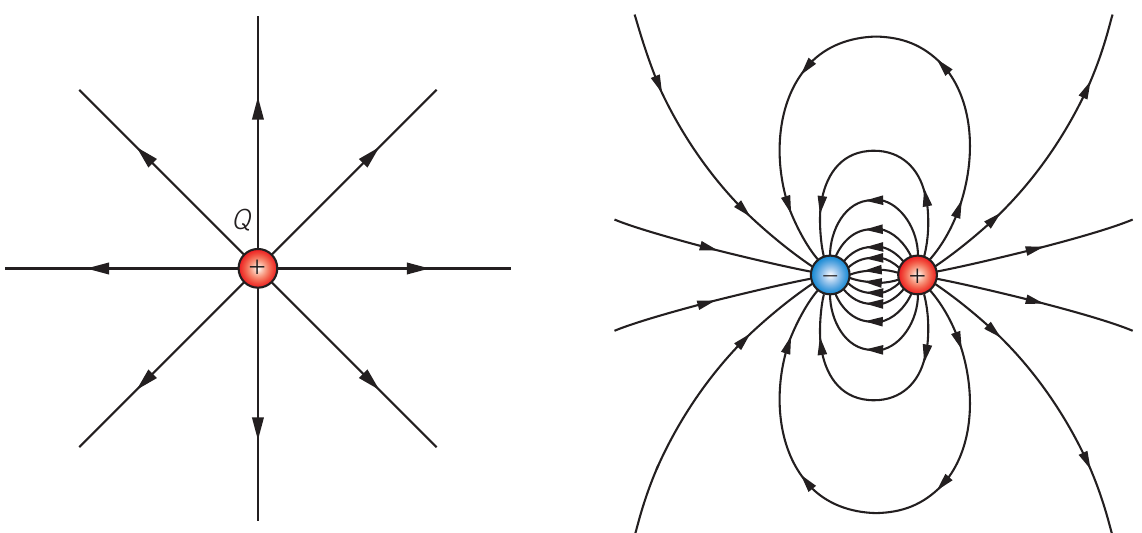
An electric dipole consists of two equal point charges of opposite sign separated by a short distance.
Water as an electric dipole
Electric dipoles occur when electrons are shared unequally in the bonds between atoms in molecules. In a water molecule (), the oxygen atom attracts the shared electrons more strongly than the two hydrogen atoms do. This makes the oxygen end slightly negatively charged and the hydrogen end slightly positively charged. The water molecule is therefore called a dipolar molecule.

When a negatively charged comb is brought near a stream of neutral water, the stream bends toward the comb. This happens because the water molecules are electric dipoles, and their positive charged ends are attracted to the comb's negative charge.
Note
Important Consequences of Water's Dipolar Nature for Life on Earth:
- Water can dissolve more substances than any other liquid
- Water has strong surface tension, allowing insects to walk on it
- Ice is less dense than liquid water, so it floats
- Lakes and rivers freeze from the top down, protecting aquatic life below
Electric field strength near a point charge
A point charge is an idealised situation in which all of the charge on an object is considered to be concentrated at a single point.
The strength of an electric field due to a point charge is given by:
Where:
- = electric field strength due to a point charge ( or )
- = Coulomb's constant ()
- = electric charge generating the field (C)
- = distance from the centre of the charge (m)
The inverse square law
Important
The electric field strength follows an inverse square law, just as gravitational field strength does. An inverse square law describes a relationship between two variables where one is proportional to the reciprocal of the square of the other.
For an electric field: , where the field strength is determined by the charge .
For a gravitational field: , where the field strength is determined by the mass .
Electric field-distance graphs
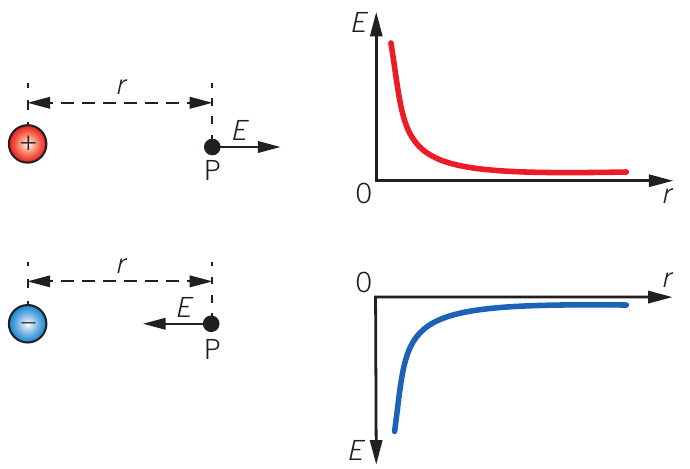
Electric field-distance graphs are similar to gravitational field-distance graphs, having the same shape due to the inverse square law. The main difference is that electric charges come in both positive and negative varieties, while mass comes in only one variety.
- For a positive point charge, the electric field direction is radially outwards (shown as positive values on the graph)
- For a negative point charge, the electric field direction is radially inwards (shown as negative values on the graph)
Example
Worked Example: Electric Field from a Point Charge
Calculate the electric field strength and direction at a distance of 2.0 m from a charge of C.
Given:
- C
- m
Solution:
Answer: The electric field strength is 4.5 × 10⁵ N·C⁻¹, directed radially outwards from the positive point charge.
Electric forces
Electric forces are forces that exist between charged particles and may be attractive (unlike charges) or repulsive (like charges). Electric forces, like gravitational forces, are examples of non-contact forces - forces that act on an object without physically touching it.
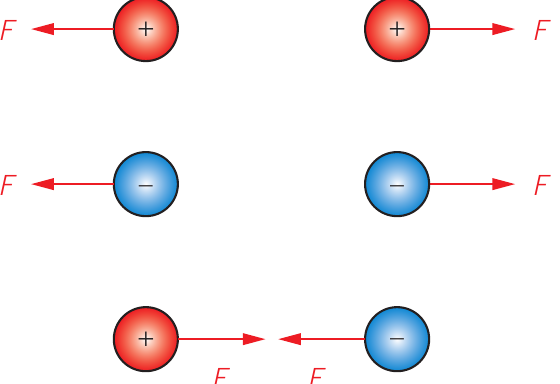
Like and unlike charges
Important
Fundamental Rules of Electric Charges:
- Like charges repel each other
- Unlike charges attract each other
If the charges are the same size (magnitude) and the same distance apart, the attractive and repulsive forces are equal in magnitude but opposite in direction.
Force and charge magnitude
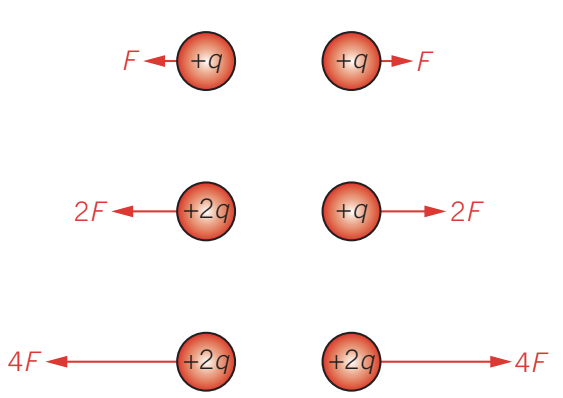
At a given fixed distance between two charges, the size of the force depends on the size of the charges on each object. The force between any two charged objects is directly proportional to the product of the charges:
Changing the charge on one object affects the force acting on both objects (Newton's third law).
Force and distance
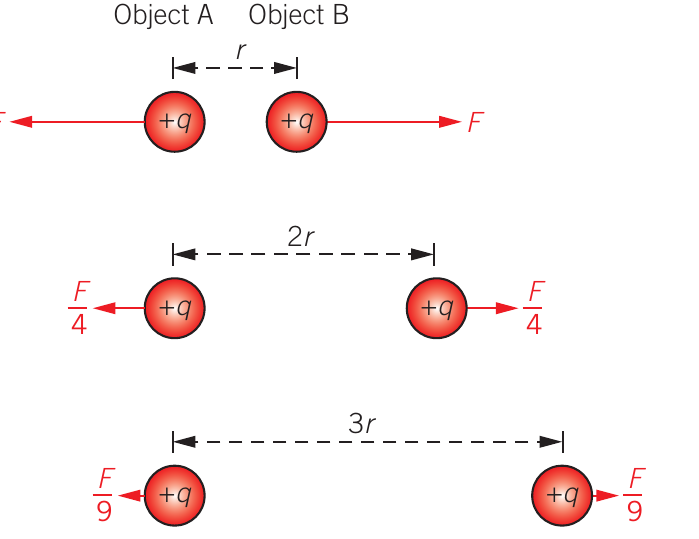
The force between two charged objects follows an inverse square law with distance:
- Doubling the distance reduces the force to one-quarter ()
- Tripling the distance reduces the force to one-ninth ()
Coulomb's law
Coulomb's law states that the force between two charges at rest is directly proportional to the product of the magnitudes of the charges and inversely proportional to the square of the distance between them.
Combining the concepts gives:
Written as an equation:
Where:
- = force between two charged particles (N)
- = Coulomb's constant ()
- , = charge of each particle (C)
- = distance between charged particles (m)
Note
Coulomb's law applies to situations where the charged objects are much smaller in size than the distance between them (point charges).
For calculations to two significant figures, use .
Important: The value of Coulomb's constant depends on the medium between the charges. The value given applies for a vacuum or dry air.
Example: the coulomb is a large charge
Example
Worked Example: Demonstrating the Magnitude of a Coulomb
Calculate the force between two charges each of magnitude 1.0 C that are 3.0 m apart.
Step 1: Calculate the electrostatic force
Step 2: Find the equivalent mass
To put this in perspective, what mass would have the same gravitational force at Earth's surface?
Interpretation: This electrostatic force would be enough to lift a modern ocean cruise liner 3.0 m into the air! This demonstrates that one coulomb is an enormous charge.
Comparison: gravitational and electric forces and fields
There are many similarities between gravitational and electric forces and fields:
| Gravitational force and field | Electric force and field |
|---|---|
Both follow inverse square laws. Both involve the product of two properties (masses or charges). The gravitational field depends on the mass , while the electric field depends on the charge .
Important
Key Differences Between Gravitational and Electric Forces:
- Gravitational forces are always attractive
- Electric forces can be attractive or repulsive
- Mass comes in only one variety (positive)
- Charge comes in two varieties (positive and negative)
Electric potential energy
Electric potential energy is the amount of work needed to move a unit charge from a reference point to a specific point against an electric field. It is a form of energy stored in an electric field.
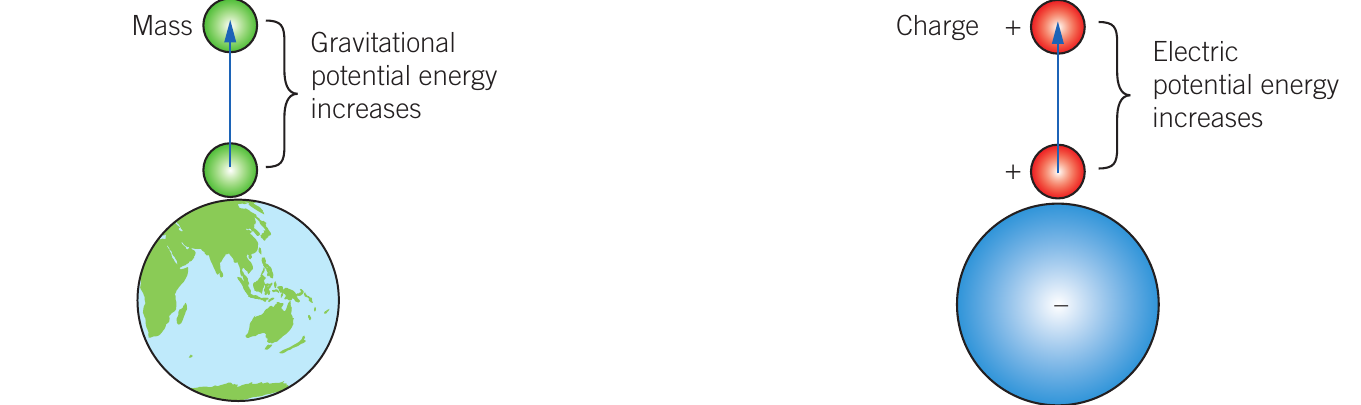
Similar to gravitational potential energy, electric potential energy can be stored in:
- A uniform electric field (between parallel plates)
- A non-uniform field (around a point charge)
Electric potential energy in a non-uniform field
When a charged particle moves in the electric field around a point charge, work is done against the electric force. The area under an electric force-distance graph represents the work done and the change in electric potential energy.
For example, to move a positive charge from point B to point A (closer to another positive charge), work must be done against the repulsive force. This work is stored as electric potential energy. If the charge is released at point A, this potential energy converts to kinetic energy as the charge moves away.
Example
Worked Example: Calculating Electric Potential Energy Changes
If the electrical potential energy at point B is 0.1 J and the shaded area under the force-distance graph (representing work done) is 0.3 J:
Step 1: Calculate potential energy at point A
Step 2: Calculate kinetic energy at point B if released
If the charge is released at point A, the kinetic energy at point B will equal the change in potential energy:
Answer: Electric potential energy at A is 0.4 J, and kinetic energy at B is 0.3 J
Electric potential
The amount of electric potential energy (joules) required to move a coulomb of charge in an electric field is called the electric potential or voltage , measured in volts.
Note
By convention, when considering the electric potential from a point charge, the potential is zero at infinity.
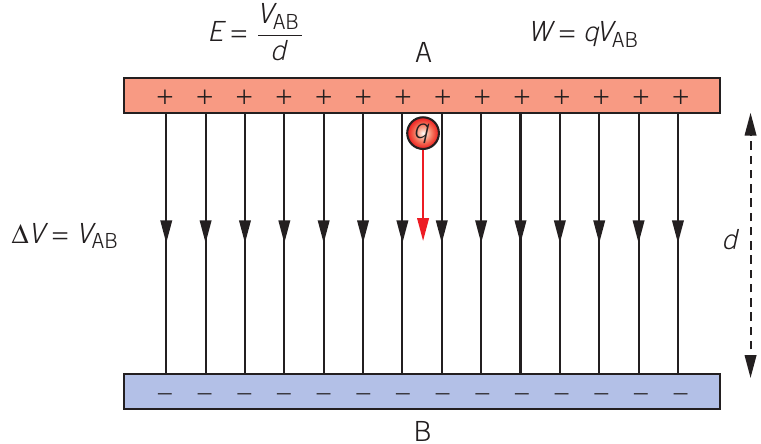
Electric potential energy in a uniform field
In a uniform electric field between parallel plates, electric potential energy can be calculated using:
Where:
- = work done on a charged particle in a uniform electric field (J) by an external force
- = charge of the particle (C)
- = change in electrical potential from the start to the end point (V)
This formula is analogous to gravitational potential energy in a uniform gravitational field:
The electric field strength can be expressed as either or for a uniform electric field.
Equating these and rearranging:
Therefore:
Example
Worked Example: Oil Drop in Electric Field
An oil drop with an excess charge of three electrons is balanced in a uniform electric field of magnitude between two parallel charged plates. Calculate the mass of the oil drop. (Charge on an electron: C; use )
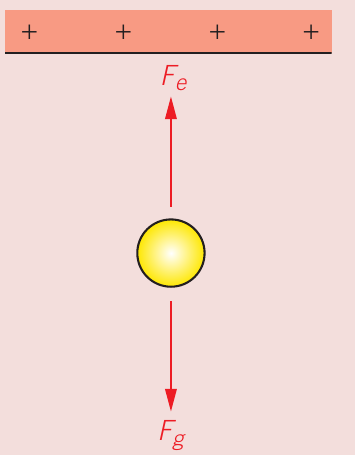
Solution:
The gravitational force downward equals the electric force upward:
Step 1: Identify the charge
Step 2: Convert electric field to base units
Step 3: Solve for mass
Answer: The mass of the oil drop is 4.8 × 10⁻¹⁶ kg
Charged particles in uniform electric fields
When a charged particle enters a uniform electric field at right angles to the field, it experiences a constant force perpendicular to its initial motion. This causes the particle to follow a parabolic path, similar to projectile motion in a gravitational field.
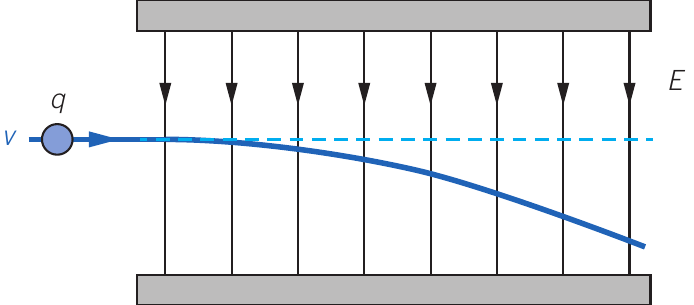
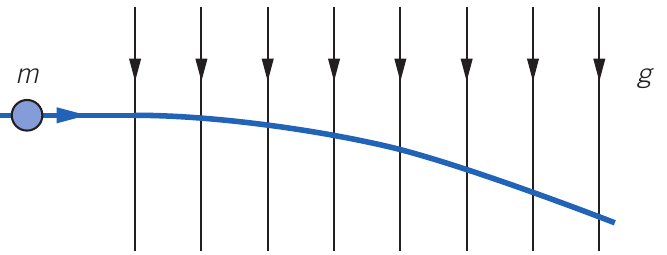
For a positively charged particle entering a uniform electric field with horizontal velocity :
- The force acting on it is constant and straight down:
- The particle follows a parabolic path between the plates
- This is analogous to a mass projected horizontally in a uniform gravitational field
Note
Analogy to Projectile Motion:
The similarity between these situations highlights the parallel nature of gravitational and electric fields. Just as a projectile follows a parabolic path under constant gravitational force, a charged particle follows a parabolic path under constant electric force.
Remember!
Summary
Key Points to Remember:
- Electric fields are created by electric charges and exert forces on other charges within the field.
- Electric field strength is the force per unit charge: .
- Field lines point away from positive charges and toward negative charges; closer field lines indicate stronger fields.
- Coulomb's law: describes the force between two point charges following an inverse square law.
- In uniform electric fields between parallel plates: , where is the potential difference and is the separation.
- Work done moving a charge in a uniform electric field: .
- Like charges repel, unlike charges attract - electric forces can be attractive or repulsive, unlike gravitational forces which are always attractive.
- The motion of a charged particle in a uniform electric field is analogous to projectile motion in a gravitational field.