Magnetic Fields and Forces: Further Exploration (VCE SSCE Physics): Revision Notes
📚Revision Notes
Magnetic Fields and Forces: Further Exploration
Introduction
In earlier studies, we learned that electric currents create magnetic fields. Now we explore the reverse effect: what happens when we place a current-carrying wire or moving charged particle in a magnetic field? This interaction between currents and magnetic fields is fundamental to many modern technologies, from electric motors to particle accelerators.
Forces on current-carrying wires in magnetic fields
The basic principle
When a wire carrying electric current is placed in a magnetic field, the wire experiences a force. This discovery builds on Ørsted's original experiment, which showed that current-carrying wires create magnetic fields that affect compass needles. According to Newton's third law, if the current's magnetic field exerts a force on a compass, then the compass's magnetic field must exert an equal and opposite force on the wire.
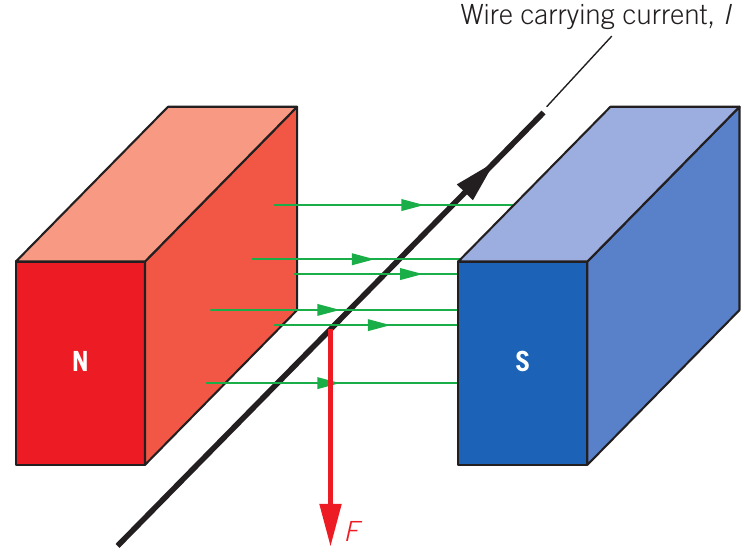
When we place a straight wire between the poles of magnets, we observe a force acting on the wire. This force occurs because the magnetic field from the magnets interacts with the magnetic field produced by the current in the wire.
When does the force occur?
Important
The magnetic force only acts when the wire is perpendicular to the magnetic field. If the wire is parallel or anti-parallel to the field, no magnetic force is produced.
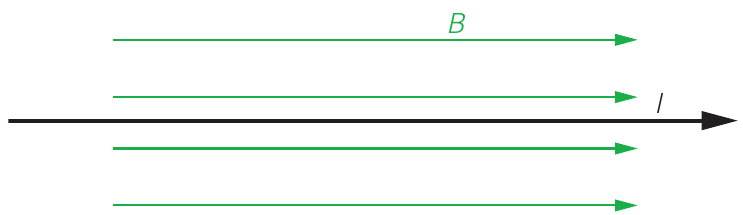
This is an important point to remember: for maximum force, the current direction must be at right angles to the magnetic field direction.
Calculating the magnetic force
Through experimental observations, physicists discovered that the magnetic force on a current-carrying wire increases when:
- The magnetic field becomes stronger
- The current in the wire increases
- A longer section of wire is in the field
- More wires are present in the field
We can express these relationships mathematically:
Where:
- = Force on the wire(s) in newtons (N)
- = Number of wires
- = Current in each wire in amperes (A)
- = Length of each wire in metres (m)
- = Magnetic field strength in tesla (T)
Note
This formula applies only when the wire is perpendicular to the magnetic field.
The right-hand slap rule
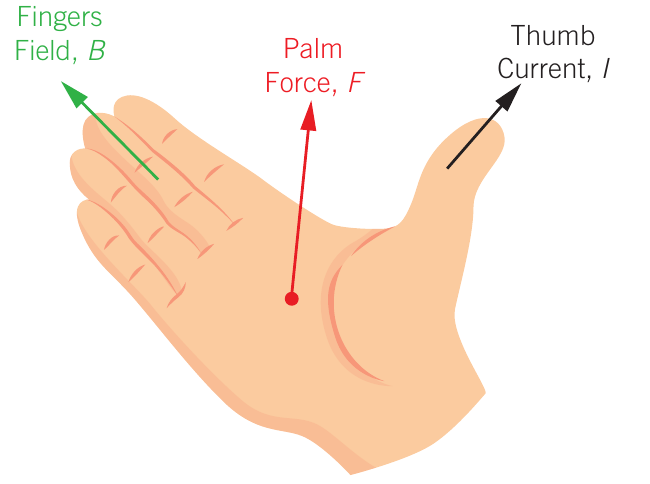
To determine the direction of the force on a current-carrying wire, we use a mnemonic called the right-hand slap rule (also known as the right-hand palm rule).
Note
How to apply the right-hand slap rule:
- Hold your right hand flat with fingers straight
- Point your thumb in the direction of the current (I)
- Point your fingers in the direction of the magnetic field (B)
- Your palm now faces in the direction of the force (F)
This rule works because the force is always perpendicular to both the current and the magnetic field.
Example
Worked Example: Calculating Force on a Wire
Question: A straight wire of length 2.0 m carries a current of 3.0 A perpendicular to a magnetic field of strength 1.5 T. Calculate the force acting on the wire.
Solution:
Since the wire is perpendicular to the field, we can use the formula:
(Note: because there is only one wire)
Substituting values:
Answer: The magnetic force acting on the wire is 9.0 newtons.
DC motors
How DC motors work
The force on current-carrying wires in magnetic fields is the principle behind electric motors. When we place a loop of wire in a magnetic field and pass current through it, forces act on opposite sides of the loop, creating a turning effect.
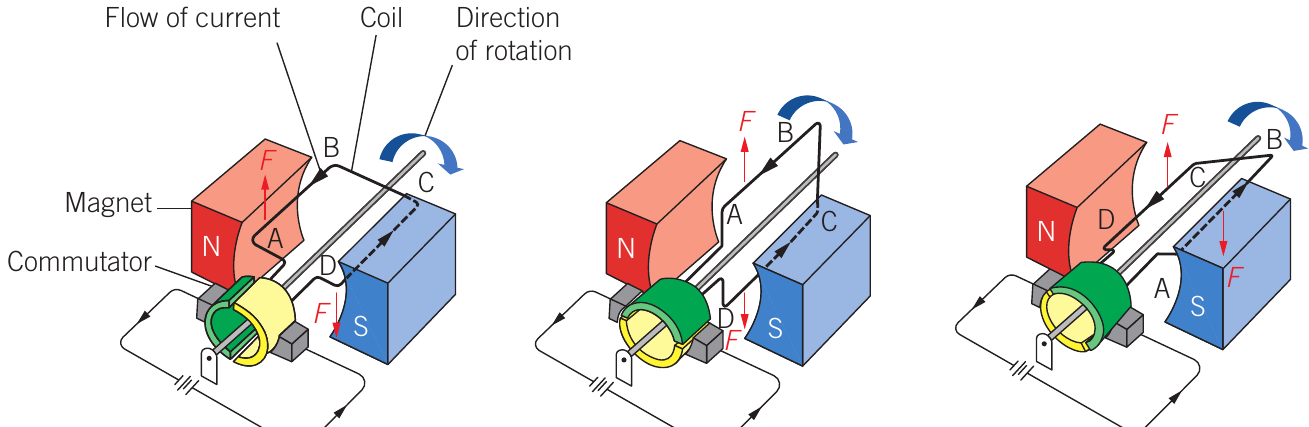
Let's examine what happens:
- Current flows through the loop
- Forces act on both sides of the loop (one upward, one downward)
- These opposing forces create a torque (turning moment) about the central axis
- The loop begins to rotate
The split ring commutator
A critical component of DC motors is the split ring commutator. This device reverses the current direction every half rotation, ensuring the motor continues spinning in the same direction.
Important
Without the commutator, the loop would simply oscillate back and forth. When the loop reaches the vertical position, the commutator reverses the current, maintaining the rotation in one direction.
Practical DC motors
Real motors are more complex than simple loops. A commercial DC motor, such as those in electric drills, contains:
- Many loops of wire (sometimes hundreds or thousands) called armature windings
- Multiple coils wound at various angles on iron strips
- Many copper segments forming the split ring commutator
- Either permanent magnets or electromagnets (called stator coils) to provide the magnetic field
Historical context
Note
In 1821, Michael Faraday created the world's first DC electric motor. His design used a wire suspended in a mercury bath (mercury conducts electricity). When current flowed, the wire's magnetic field interacted with a permanent magnet, causing the wire to rotate around it. This demonstrated the conversion of electrical energy into rotational kinetic energy.
Torque
What is torque?
Torque (also called moment of force) is a measure of the turning effect produced by a force acting on an object that can rotate. The Greek letter tau () represents torque.
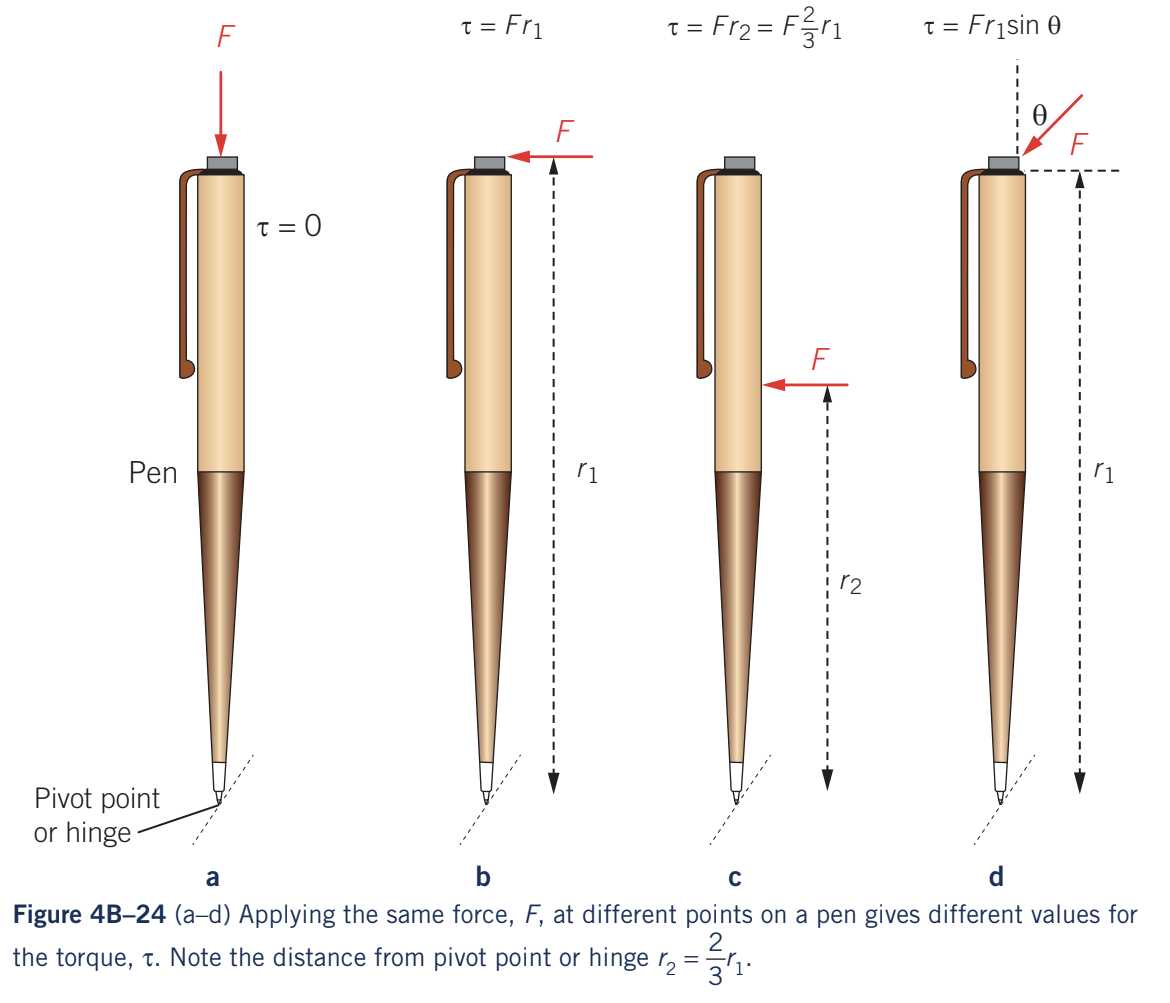
The magnitude of torque depends on:
- The size of the applied force
- The distance from the pivot point where the force is applied
- The angle at which the force is applied
Torque formulas
When the force is perpendicular to the lever arm:
When the force is applied at an angle to the lever arm:
Where:
- = Torque in newton metres (N m)
- = Distance from the pivot point in metres (m)
- = Applied force in newtons (N)
- = Angle between force and lever arm
Important
Key point: Only the component of force perpendicular to the lever arm produces torque.
Torque in electric motors
In electric motors, torque depends on:
- The force on the wire (given by for one loop or for multiple loops)
- The distance from the centre of rotation
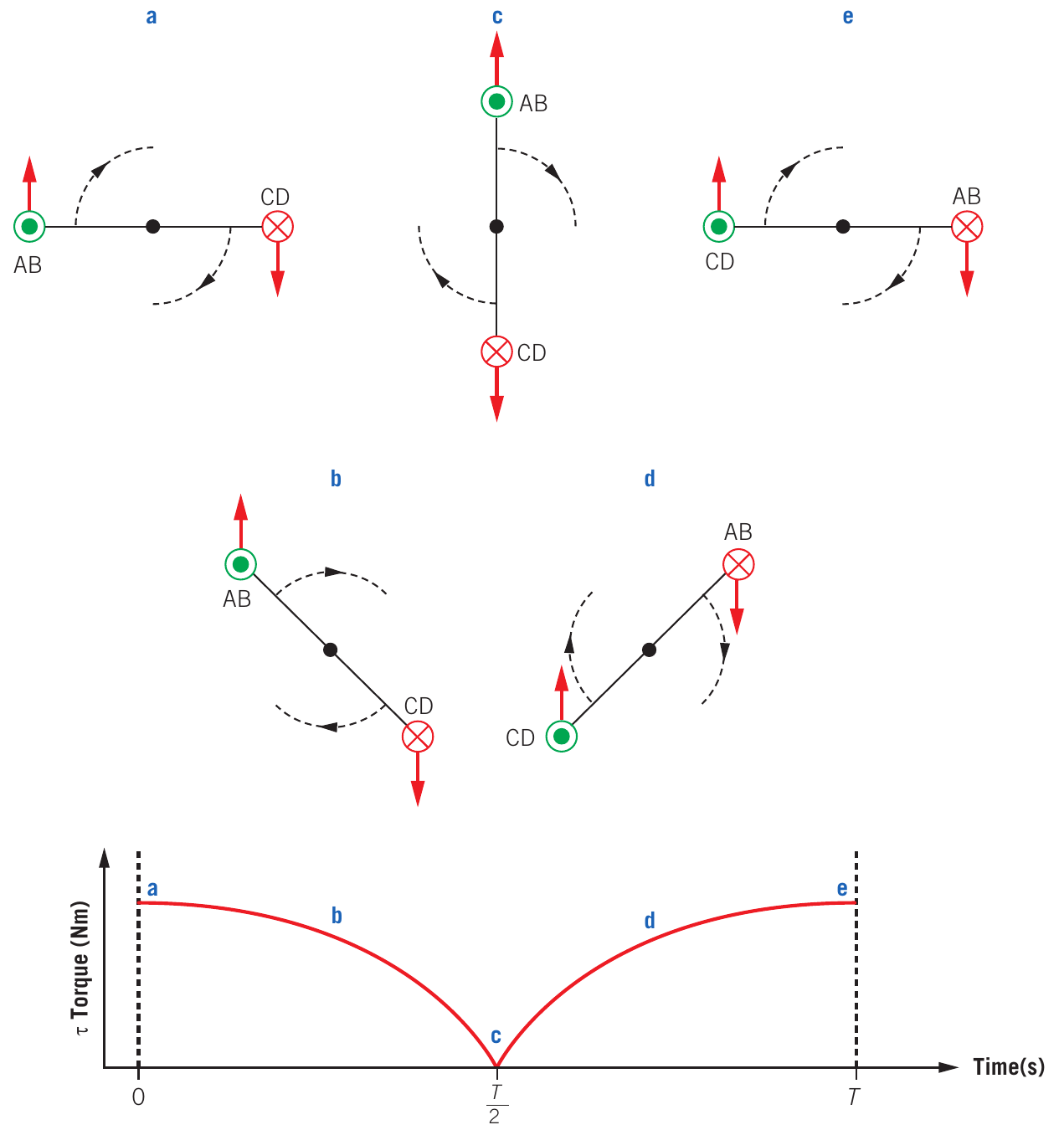
The torque varies as the motor rotates:
- Maximum torque occurs when the loop is parallel to the magnetic field
- Zero torque occurs when the loop is perpendicular to the field
Note
The motor's angular momentum (spinning motion) carries it through the zero-torque positions, preventing it from stalling.
Magnetic force on moving charges
Individual charged particles
Just as current-carrying wires experience forces in magnetic fields, individual moving charged particles also experience these forces. This is because electric current is simply moving charge.
The force on a moving charged particle is:
Where:
- = Magnetic force in newtons (N)
- = Charge of the particle in coulombs (C)
- = Velocity of the particle in metres per second (m·s)
- = Magnetic field strength in tesla (T)
Important
This formula applies when the particle moves perpendicular to the magnetic field. The right-hand slap rule also applies to determine force direction (for positive charges; reverse for negative charges).
Direction and motion of charged particles
When a charged particle moves through a magnetic field, the force it experiences is always perpendicular to both its velocity and the magnetic field direction.
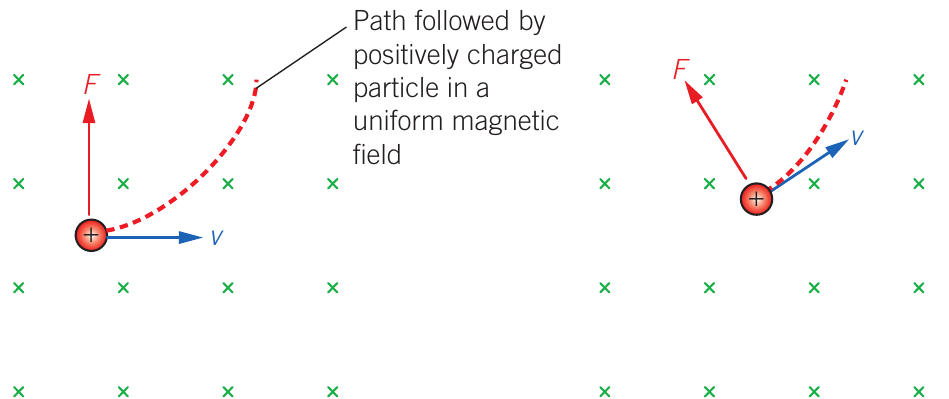
This perpendicular force has an important consequence: it constantly changes the particle's direction but not its speed. This is similar to centripetal force in circular motion.
Note
Direction rules:
- For positive charges: Use the right-hand slap rule as normal
- For negative charges: The force direction is reversed
Remember: A negative charge moving left is equivalent to a positive charge moving right.
Circular motion of charged particles
When a charged particle moves perpendicular to a uniform magnetic field, it follows a circular path.
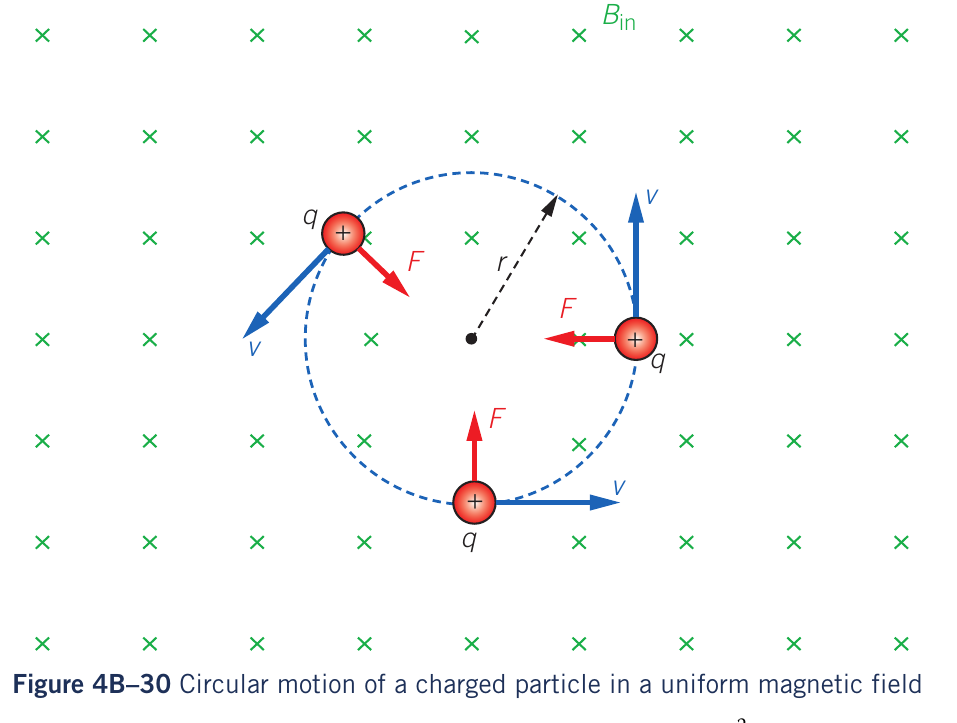
The magnetic force provides the centripetal force needed for circular motion:
Rearranging this equation gives us the radius of the circular path:
This tells us that:
- Heavier particles create larger circles
- Faster particles create larger circles
- Stronger magnetic fields create smaller circles
- Greater charge creates smaller circles
Discovery of the positron
Note
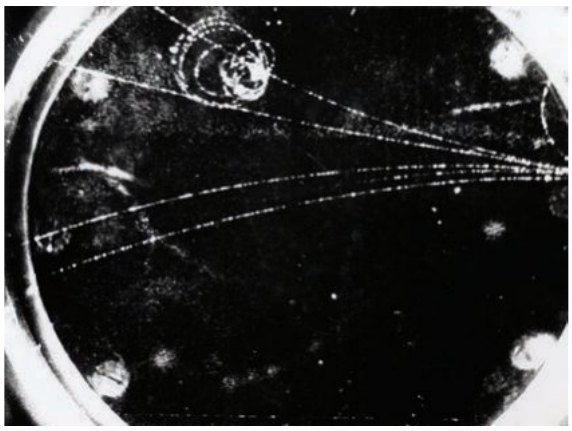
In 1932, Carl Anderson photographed cosmic ray tracks in a cloud chamber and noticed some particles curved opposite to electrons. These particles had the same mass as electrons but opposite charge. Anderson had discovered the positron - the first known antimatter particle. This confirmed theoretical predictions and earned him the Nobel Prize in 1936.
Charged particles and Earth's magnetic field
Earth's magnetosphere
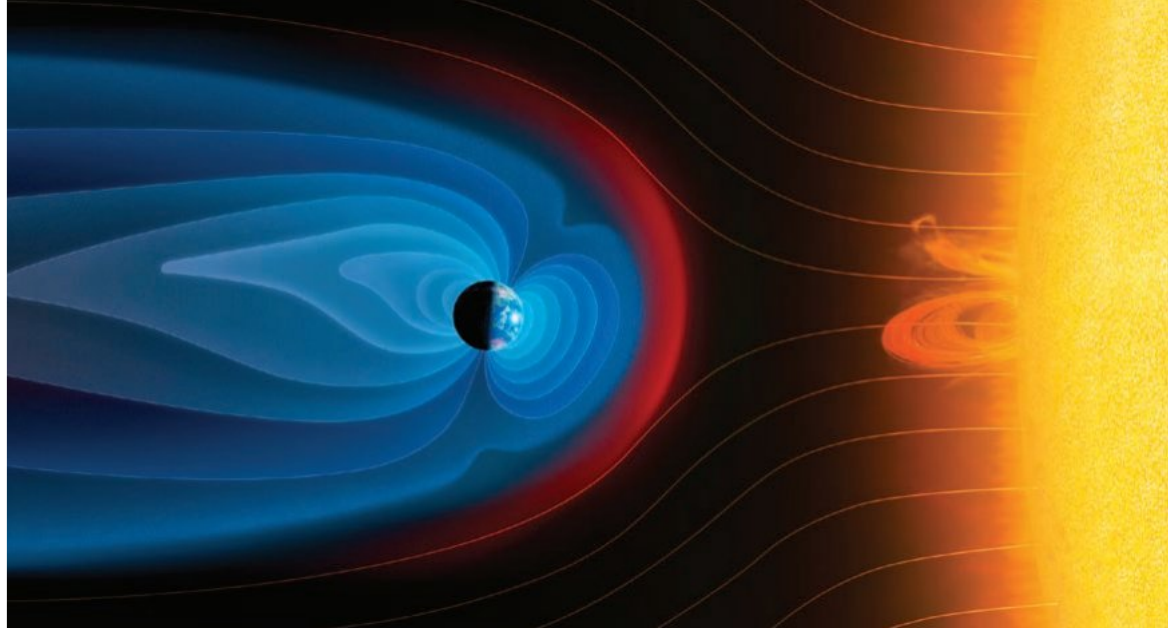
Earth's magnetic field extends far into space, creating a region called the magnetosphere. This field doesn't have the simple bar magnet shape we might expect because it interacts with the solar wind - a stream of charged particles (mainly electrons, protons, and alpha particles) flowing from the Sun.
Important
The magnetosphere is crucial for life on Earth because it deflects most incoming charged particles, protecting us from harmful ionising radiation.
Aurora formation
Some charged particles from the solar wind are directed toward Earth's magnetic poles, where they interact with atmospheric gases. This interaction creates the beautiful displays called aurorae (Aurora Borealis in the northern hemisphere, Aurora Australis in the southern hemisphere).

Note
The colours depend on which atmospheric gases the particles collide with and at what altitude these collisions occur.
Particle accelerators
What are particle accelerators?
Particle accelerators are devices that use electromagnetic fields to propel charged particles to high speeds and direct them along specific paths. They use:
- Electric fields to change particle speed
- Magnetic fields to change particle direction
The electron gun
At the heart of most particle accelerators is an electron gun - a device that produces a beam of electrons.
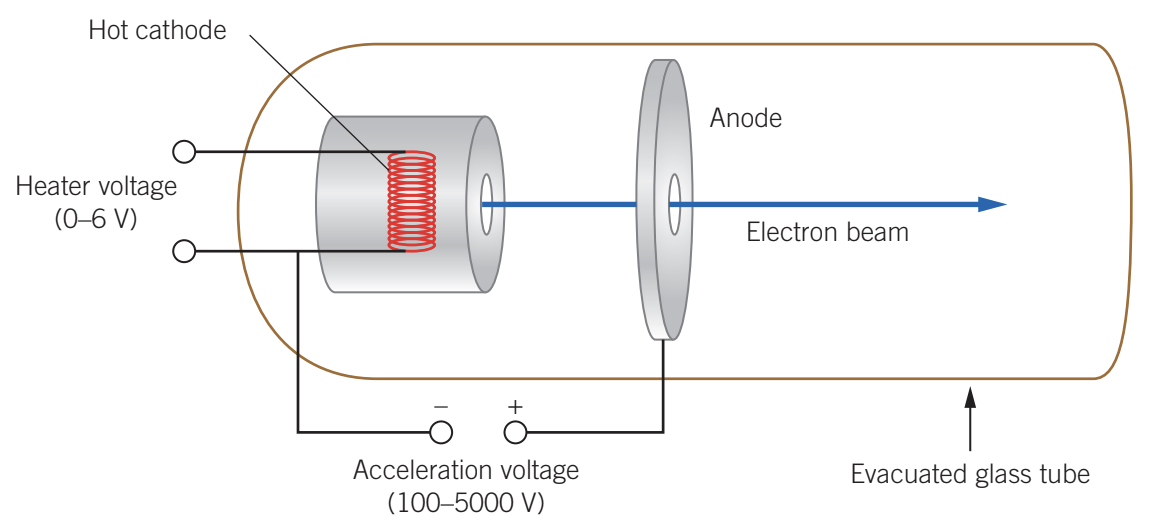
An electron gun consists of:
- A heated cathode that releases electrons
- An anode that attracts the electrons
- An acceleration voltage between them (typically 100-5000 V)
- An evacuated tube to prevent collisions with air molecules
When an electron with charge is accelerated through voltage , it gains kinetic energy:
We can find the final velocity:
Motion in electric fields
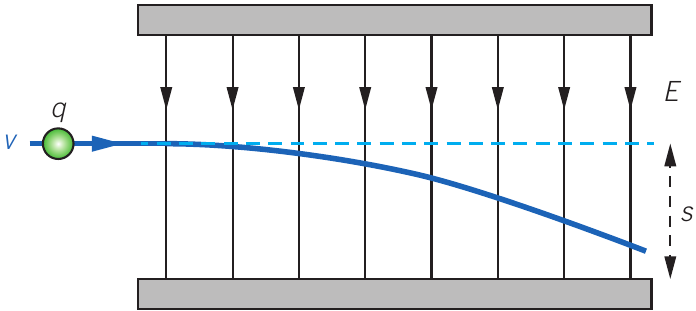
When a charged particle travelling perpendicular to a uniform electric field experiences a constant force:
This causes the particle to follow a parabolic path, similar to projectile motion. The displacement can be calculated using:
Thomson's experiment
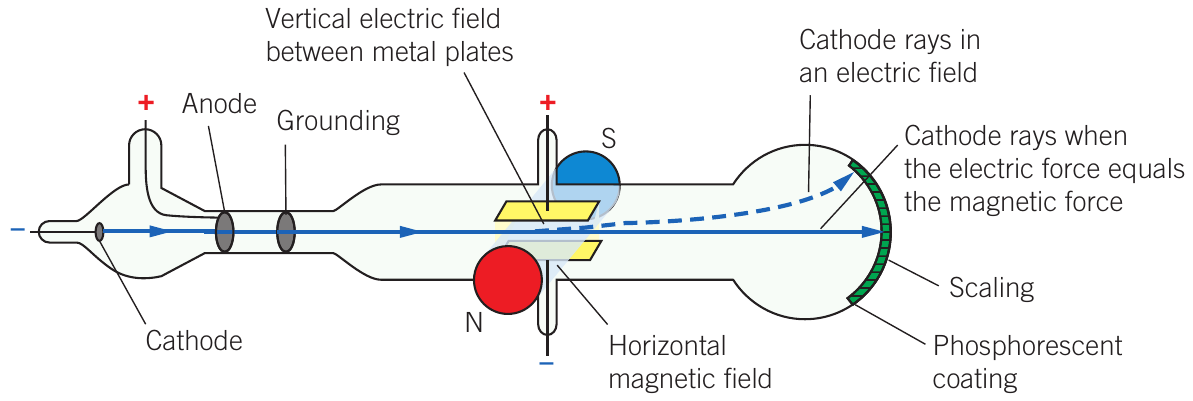
In 1897, J.J. Thomson performed a groundbreaking experiment to determine the charge-to-mass ratio () of electrons (then called cathode rays).
Example
Worked Example: Thomson's Method
Thomson's method involved these key steps:
Step 1: Apply an electric field to deflect the electron beam upward
Step 2: Apply a magnetic field perpendicular to both the electric field and beam
Step 3: Adjust the magnetic field until the beam travels straight (forces balanced)
When the electric and magnetic forces balance:
Therefore:
Step 4: Turn off the electric field and measure the radius of deflection in the magnetic field alone
From circular motion:
Therefore:
Substituting the velocity:
Significance: This revolutionary work earned Thomson the Nobel Prize in 1906 and paved the way for modern particle physics.
Crossed electric and magnetic fields
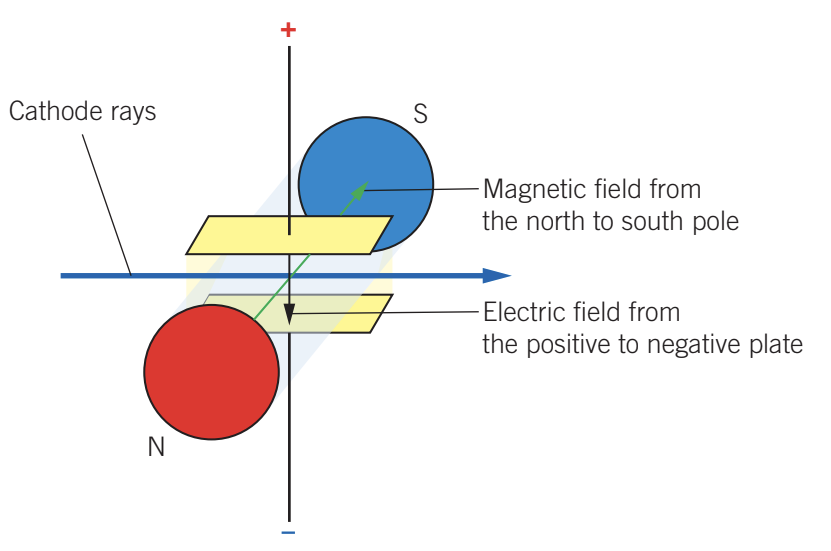
When electric and magnetic fields are perpendicular to each other (crossed fields), they can produce useful effects.
Note
Velocity selector: By adjusting field strengths so that , only particles with velocity travel straight through. Faster or slower particles are deflected. This is useful for selecting particles with specific velocities.
Mass spectrometers
Mass spectrometers use electric and magnetic fields to identify substances by measuring their mass-to-charge ratio.
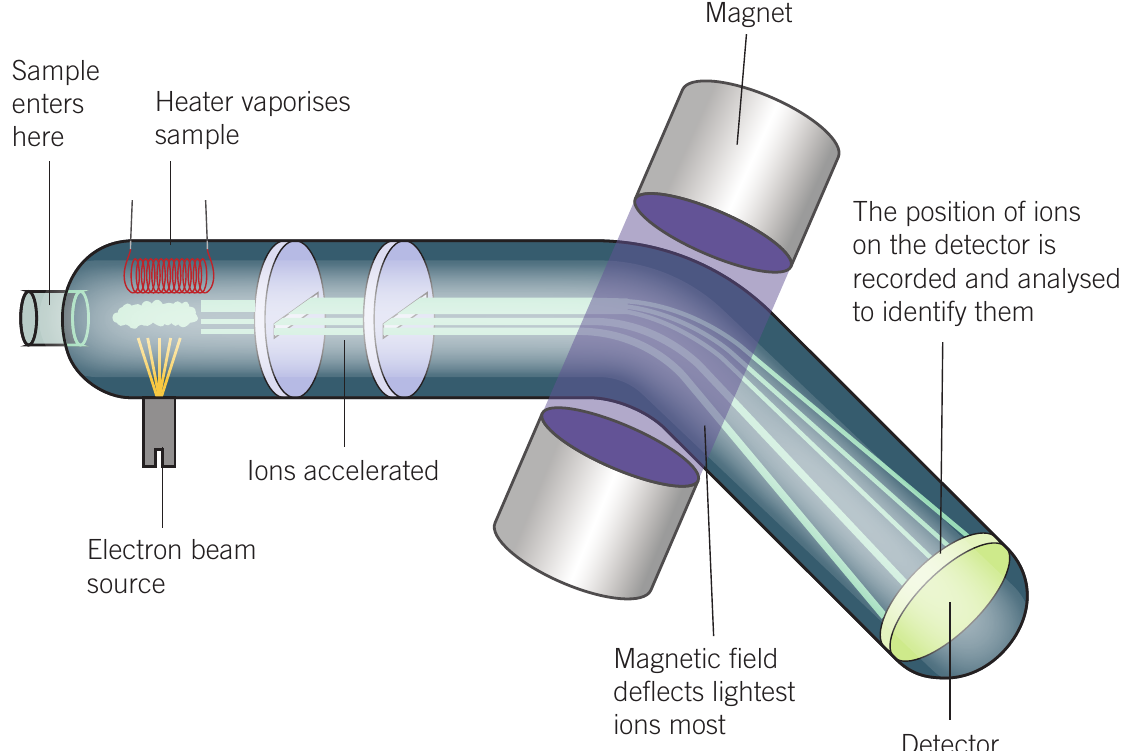
The process involves:
- Ionisation: The sample is heated and ionised by an electron beam
- Acceleration: Ions are accelerated by an electric field
- Deflection: A magnetic field deflects ions into curved paths
- Detection: Lighter ions are deflected more than heavier ones, separating them by mass
Since , particles with different masses follow different paths, allowing identification of sample components.
Note
Applications:
- Identifying unknown compounds
- Determining molecular structures
- Detecting trace amounts of substances (e.g., recent use for detecting COVID-19 from gargle samples)
Synchrotrons
Synchrotrons are circular particle accelerators that accelerate particles to near light speed. The Australian Synchrotron in Melbourne accelerates electrons through an equivalent of 3 billion volts (3.0 GeV).
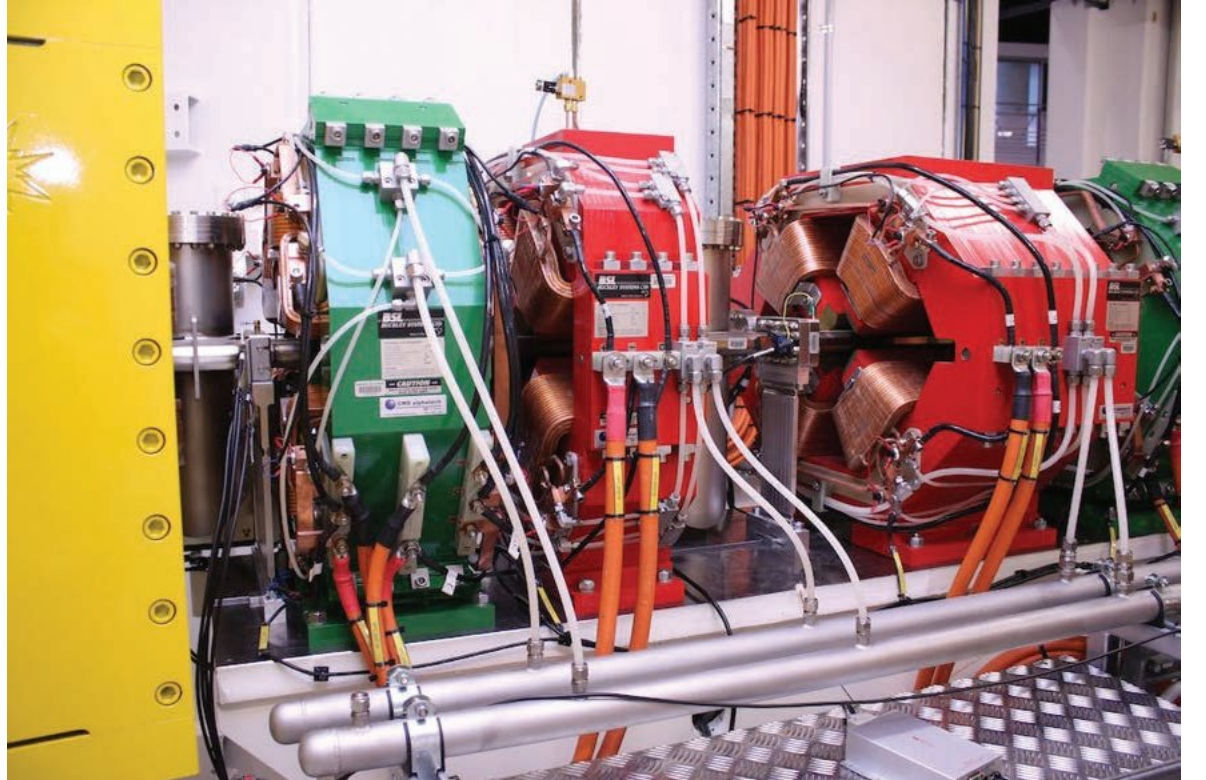
At these extreme energies:
- Electrons travel at 99.99999% of the speed of light
- Relativistic effects become significant (their effective mass increases ~6000 times)
- As they accelerate around the 70 m diameter circle, they emit electromagnetic radiation from infrared to X-rays
Note
This radiation is used for various research purposes, from medical imaging to materials science.
Example
Worked Example: Electron Acceleration
Question: An electron initially at rest is accelerated through 1000 V in an electron gun. Calculate:
- a) The kinetic energy gained
- b) The final speed
Given:
- Electron charge: C
- Electron mass: kg
Solution:
a) Kinetic energy gained:
b) Final speed:
Answers:
- a) Kinetic energy gained: 1.60 × 10⁻¹⁶ J
- b) Final speed: 1.87 × 10⁷ m·s⁻¹
Summary
Summary
Key Points to Remember:
-
Force on current-carrying wires: (when perpendicular to field); use the right-hand slap rule for direction
-
No force exists when wires are parallel to the magnetic field
-
DC motors convert electrical energy to rotational kinetic energy using forces on current-carrying loops; the split ring commutator reverses current every half cycle
-
Torque () represents the turning effect; it varies with motor position, reaching maximum when the loop is parallel to the field
-
Force on moving charges: determines the force on charged particles moving through magnetic fields
-
Circular motion: Charged particles moving perpendicular to uniform magnetic fields follow circular paths with radius
-
Particle accelerators use electric fields to accelerate charges and magnetic fields to direct them, enabling technologies from electron microscopes to cancer treatment
-
Crossed fields (perpendicular electric and magnetic fields) allow velocity selection and are fundamental to mass spectrometers and Thomson's experiment