Magnetic Fields and Forces: The Basics (VCE SSCE Physics): Revision Notes
📚Revision Notes
Magnetic Fields and Forces: The Basics
Introduction to magnetism
A permanent magnet is an object that attracts certain metals like iron, nickel, and cobalt. You have probably noticed how a magnet can pick up paper clips or stick to a refrigerator door. This attractive force is an example of magnetism in action.
All magnets share several important properties. Regardless of their shape (whether they are bar-shaped, horseshoe-shaped, or cylindrical), every magnet has two regions where the magnetic effect is strongest. These regions are called poles. By convention, we label these poles as the north pole and the south pole.
Note
Key Properties of All Magnets:
- Every magnet has two poles (north and south)
- The magnetic effect is strongest at the poles
- Poles can be identified by convention (north and south)
- This pattern holds regardless of the magnet's shape
Magnetic dipoles
The combination of a north pole and a south pole is known as a magnetic dipole. This is a fundamental characteristic of magnetism. If you break a magnet in half, you do not get a separate north pole and south pole. Instead, each piece becomes a smaller magnet with its own north and south poles. This process continues no matter how many times you break the magnet - even down to the atomic level.
Important
You Cannot Isolate a Single Magnetic Pole
No matter how many times you break a magnet, each piece will always have both a north pole and a south pole. This demonstrates that magnetic poles always exist in pairs (dipoles), never alone. Even at the subatomic level, magnetic dipoles persist.
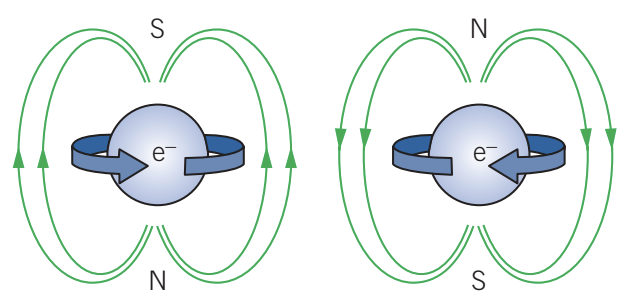
Electrons and protons are subatomic particles that each possess their own magnetic dipoles. This demonstrates that magnetic dipoles exist at the smallest scales in nature.
What is a magnetic field?
The space around a magnet where magnetic forces can be detected is called a magnetic field. We cannot see magnetic fields directly, but we can visualise them using iron filings. When iron filings are sprinkled around a magnet, they align themselves along invisible lines, revealing the pattern of the magnetic field.
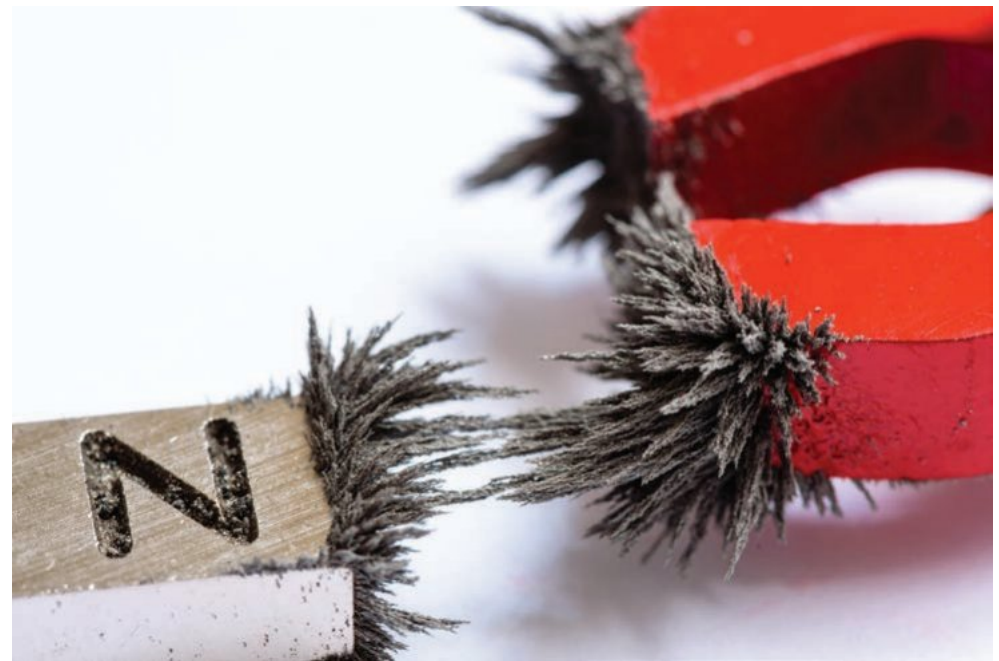
The magnetic field is represented by the symbol and is a vector quantity - it has both magnitude (strength) and direction. The SI unit for measuring magnetic field strength is the tesla, symbol .
Direction of magnetic field lines
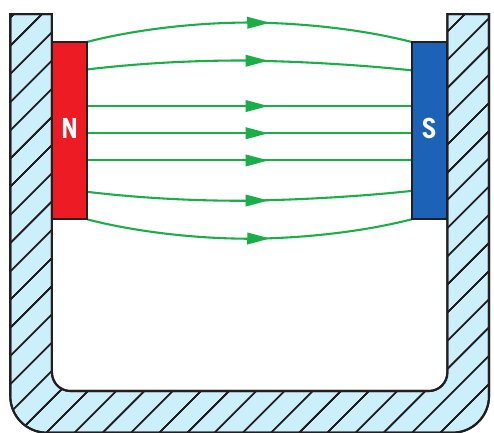
The direction of the magnetic field at any point is defined as the direction of the force that would act on a north pole placed at that point. We represent this using arrows on field line diagrams. The arrows point away from north poles and toward south poles.
Note
Magnetic Field Line Directions:
In diagrams, magnetic field lines follow a consistent pattern:
- Flow from the north pole to the south pole outside the magnet
- Flow from the south pole to the north pole inside the magnet
- Form continuous closed loops that never have endpoints
Measuring magnetic fields
The strength of a magnetic field is measured in tesla (). Different sources of magnetism produce fields of varying strengths:
Note
Typical Magnetic Field Strengths:
- Earth's magnetic field at the surface: approximately (one ten-thousandth of a tesla)
- Typical fridge magnet: approximately
- School bar magnet: approximately
- Strong laboratory magnet: approximately
Scientists have developed extremely sensitive instruments that can detect magnetic fields as weak as . This capability allows them to measure the very weak magnetic fields generated by the human heart and brain.
Faraday's rules for magnetic field lines
In 1846, Michael Faraday introduced the concept of magnetic field lines to explain how magnets interact. He established three fundamental rules that apply to all magnetic field lines:
Important
Faraday's Three Rules for Magnetic Field Lines:
-
Each magnetic field line is a continuous loop - Field lines leave the north pole of the magnet, enter at the south pole, and pass through the magnet back to the north pole.
-
Field lines never intersect - Two magnetic field lines cannot cross each other at any point.
-
The spacing between field lines indicates field strength - Where field lines are close together, the magnetic field is strong. Where they are spread apart, the field is weaker.
These rules help us understand and predict how magnetic fields behave in different situations.
Uniform magnetic fields
In some configurations, magnetic fields can be uniform - meaning the field strength remains constant across a region. A U-shaped magnet creates a region of approximately uniform magnetic field between its poles. In this region, the field lines run parallel to each other with equal spacing.
When a magnetic field is not changing with time, we call it a static field.
Magnetic dipoles versus monopoles
An important distinction exists between different types of fields in physics. We can classify field sources as either monopoles (single poles) or dipoles (pairs of opposite poles).
| Field type | Only monopoles | Only dipoles | Monopoles and dipoles |
|---|---|---|---|
| Gravitation | ✔ | ||
| Magnetism | ✔ | ||
| Electricity | ✔ |
Gravitation involves only monopoles because mass comes in only one variety. All masses attract each other.
Magnetism involves only dipoles. North and south magnetic poles always exist together in pairs. Despite extensive searching, physicists have never found an isolated magnetic pole (a magnetic monopole).
Electricity involves both monopoles and dipoles. Electric charge comes in two varieties (positive and negative) that can exist separately as monopoles or together in pairs as dipoles.
Representing magnetic fields in three dimensions
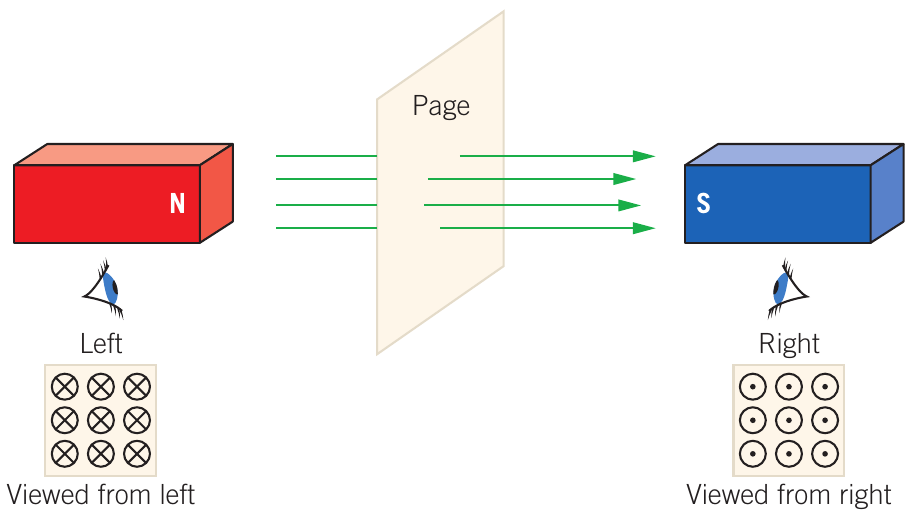
Magnetic fields exist in three-dimensional space. To represent three-dimensional field patterns on a flat page, we use a convention called the arrow convention:
Note
Arrow Convention for 3D Field Representation:
- Circle with a dot (or just a dot): Represents a magnetic field coming out of the page toward you - imagine seeing the point of an arrow
- Circle with a cross (or just a cross): Represents a magnetic field going into the page away from you - imagine seeing the tail feathers of an arrow
This notation allows us to show field components that point perpendicular to the page, giving a complete three-dimensional picture of the magnetic field.
Electromagnetism
In 1820, Danish physicist Hans Christian Ørsted made a crucial discovery while demonstrating electrical circuits to students. He noticed that when he placed a compass near a wire carrying electric current, the compass needle deflected and turned perpendicular to the wire.
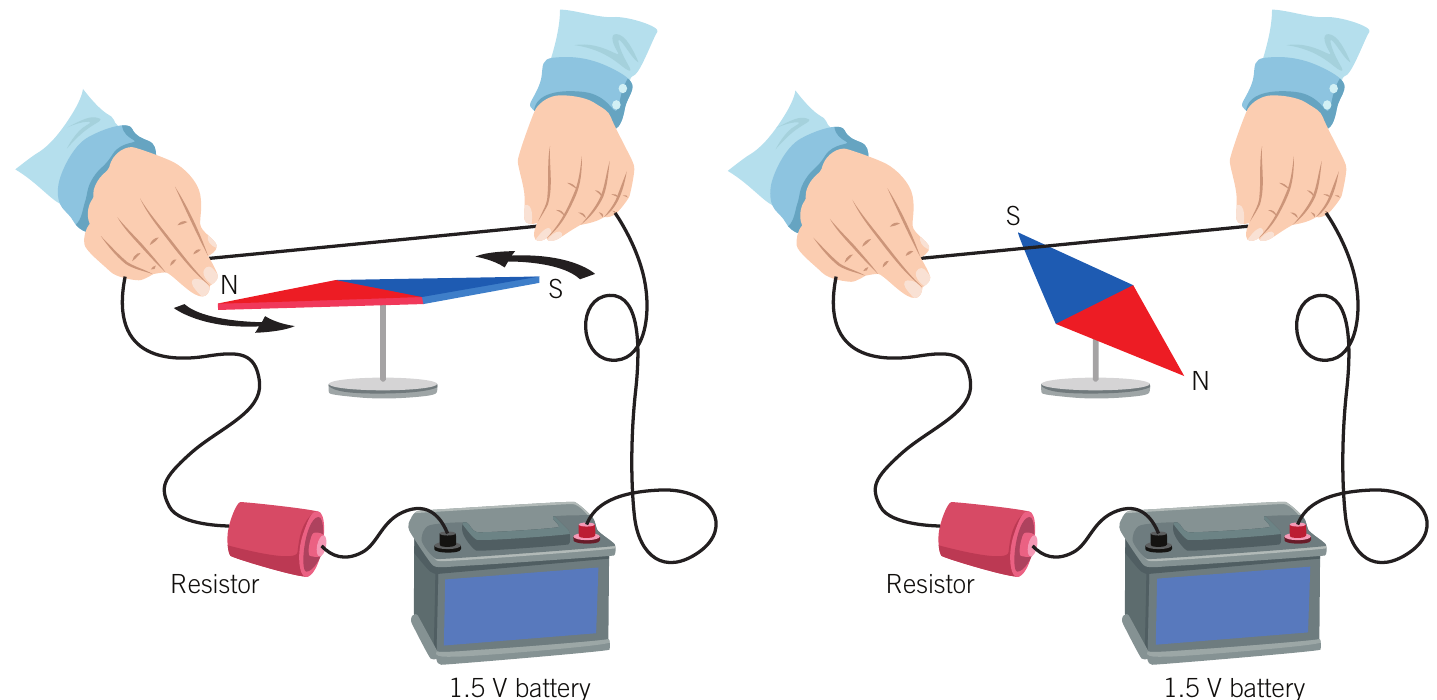
This experiment revealed a fundamental connection between electricity and magnetism - a phenomenon we now call electromagnetism. Ørsted had discovered that electric current creates its own magnetic field.
Magnetic field around a straight wire
When electric current flows through a straight wire, it produces a circular magnetic field around the wire. The field lines form concentric circles centred on the wire. The strength of this magnetic field:
- Is proportional to the magnitude of the current
- Decreases as you move farther from the wire
The right-hand grip rule
To determine the direction of the magnetic field around a current-carrying wire, physicists use a mnemonic called the right-hand grip rule:
Important
The Right-Hand Grip Rule:
- Point your thumb in the direction of conventional current flow (from positive to negative terminal)
- Curl your fingers around the wire
- Your curled fingers point in the direction of the magnetic field lines
Memory aid: "Thumb points where current flows, fingers curl where field goes"
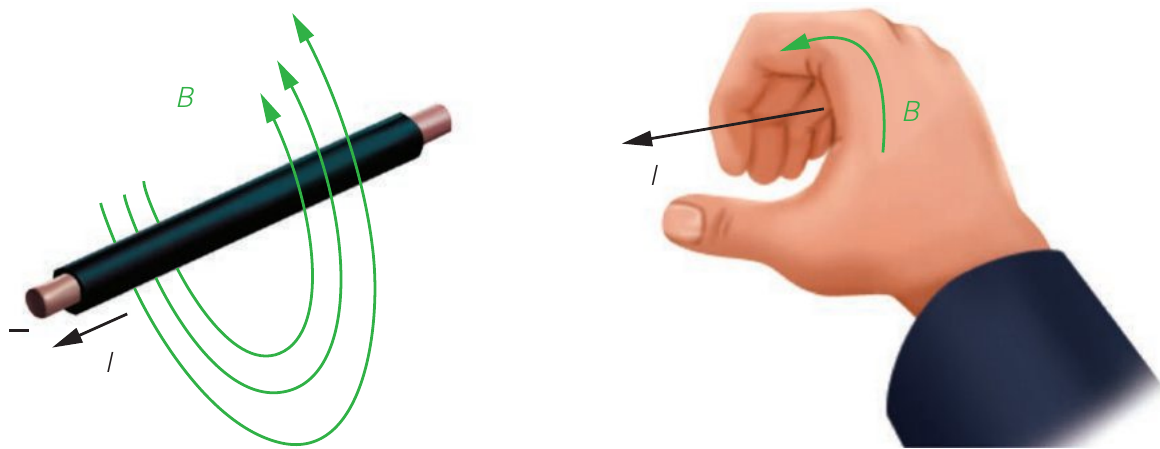
This rule works for any straight current-carrying wire and helps predict the field pattern.
Applying the arrow convention to current
We can also apply the arrow convention to show current direction:
- Dot: Current coming out of the page
- Cross: Current going into the page
When we combine this with the right-hand grip rule, we can determine the magnetic field pattern around wires oriented perpendicular to the page.
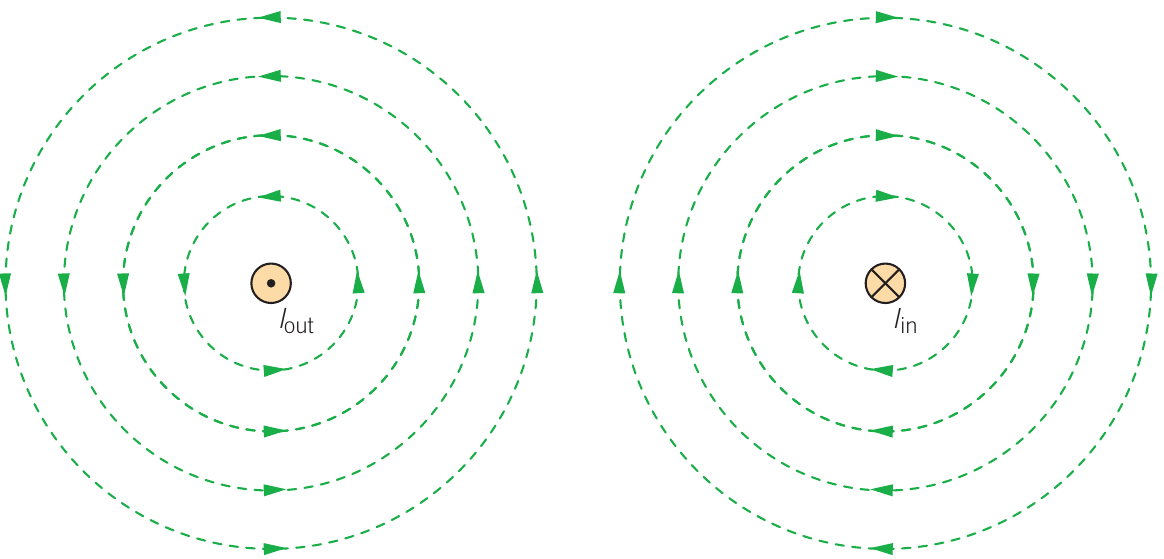
Note
For current coming out of the page, the magnetic field circles anticlockwise (when viewed from the front).
For current going into the page, the magnetic field circles clockwise (when viewed from the front).
Magnetic fields from current-carrying wires
Different configurations of current-carrying wires produce different magnetic field patterns.
Parallel wires
When two current-carrying wires run parallel to each other, they exert forces on one another due to their magnetic fields:
- If currents flow in the same direction, the wires attract each other
- If currents flow in opposite directions, the wires repel each other
This interaction occurs because each wire produces its own magnetic field, and these fields interact with the current in the neighbouring wire.
Current loops
When a wire is formed into a loop and current flows through it, the magnetic field becomes concentrated in the centre of the loop. The field lines pass through the loop and circle back around the outside.
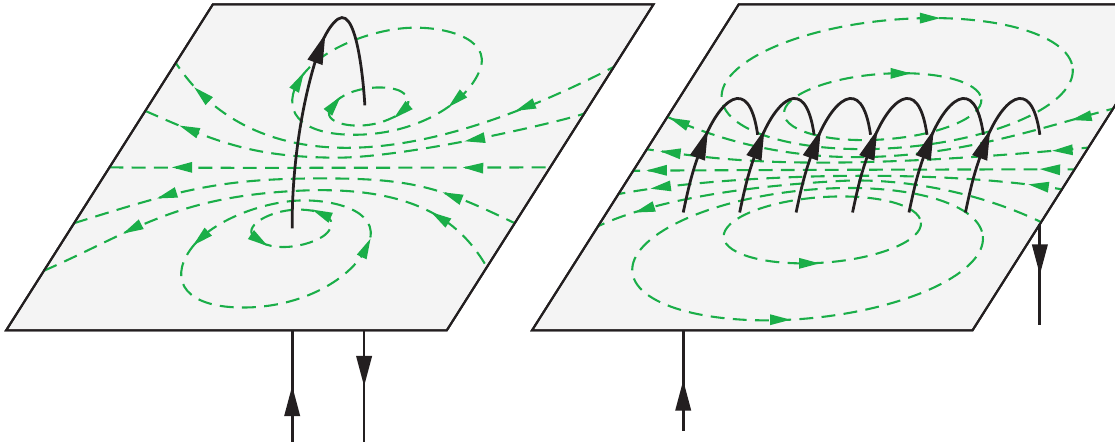
This configuration creates a stronger, more concentrated magnetic field than a straight wire carrying the same current.
Solenoids
A solenoid is a coil of wire with many loops wound closely together. When electric current flows through a solenoid, it creates a magnetic field pattern very similar to that of a bar magnet - with a north pole at one end and a south pole at the other.
Note
Magnetic Field Properties of Solenoids:
The magnetic field produced by a solenoid:
- Is strong and uniform inside the solenoid
- Resembles a bar magnet's field outside the solenoid
- Can be made stronger by increasing the current or adding more loops
The direction of the magnetic field can be determined using the right-hand grip rule applied to the coil.
Electromagnets
In 1823, William Sturgeon discovered that placing an iron rod inside a solenoid dramatically increased the magnetic field strength. This invention is called an electromagnet.
An electromagnet consists of:
- A coil of wire (solenoid)
- An iron or steel core inside the coil
- An electric current flowing through the wire
The iron core can increase the magnetic field strength by up to 1000 times compared to the same solenoid without the core. This makes electromagnets extremely powerful and useful.
Advantages of electromagnets
Important
Why Electromagnets Are So Useful:
Electromagnets have several advantages over permanent magnets:
- They can be switched on and off by controlling the current
- Their strength can be adjusted by changing the current magnitude
- They can be constructed in various sizes and configurations
- They can be made very strong for industrial applications
Electromagnets are used extensively in industry, for example in lifting and moving large masses of ferromagnetic materials.
Remember!
Summary
Key Points to Remember:
- All magnets have both a north pole and a south pole (magnetic dipoles) - you cannot isolate a single magnetic pole
- Magnetic field () is the region around a magnet where magnetic forces are experienced, measured in tesla ()
- Faraday's three rules: field lines are continuous loops, never intersect, and their spacing indicates field strength
- Electric current creates a magnetic field around the wire - this is electromagnetism
- Use the right-hand grip rule to determine magnetic field direction: thumb = current direction, fingers = field direction
- Solenoids (wire coils) produce strong magnetic fields similar to bar magnets
- Electromagnets (solenoids with iron cores) can be 1000 times stronger than solenoids alone and can be switched on and off