Dispersion (VCE SSCE Physics): Revision Notes
📚Revision Notes
Dispersion
What is colour dispersion?
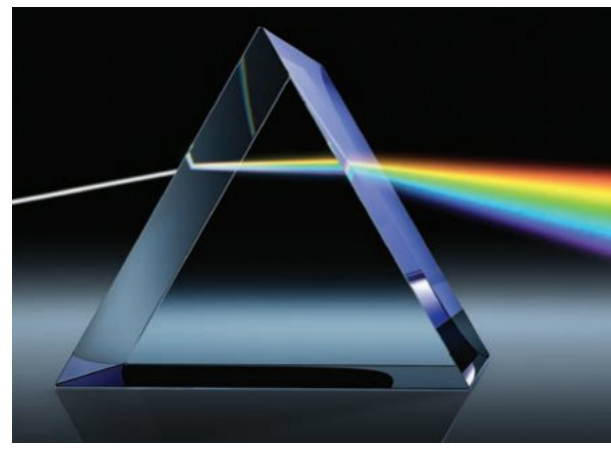
Colour dispersion is the phenomenon in which white light separates into different colour components as it moves from air (or a vacuum) into a medium such as glass. This occurs because different wavelengths of light travel at different speeds within the medium and therefore have slightly different refractive indices.
Newton's prism experiment
In a famous experiment, Isaac Newton passed a beam of sunlight through a triangular glass prism to produce a spectrum of colours. He originally identified seven distinct colours: red, orange, yellow, green, blue, indigo, and violet. However, we now understand that the spectrum is actually continuous, with colours blending smoothly into each other. Newton attempted to further disperse these individual colours into more colours, but found this was not possible, proving that each colour was a fundamental component of white light.
Note
Newton's experiment was revolutionary because it demonstrated that white light is composed of multiple colours, not that the prism was adding colour to the light. This was a major breakthrough in understanding the nature of light.
Why does dispersion occur?
The separation of colours occurs at both surfaces of the prism through a two-stage process. Different wavelengths of light travel at different speeds within the glass medium, which means they have slightly different refractive indices. This difference in speed causes each colour to refract by a different amount when entering the prism. A second refraction occurs when each colour exits the glass surface. Together, these two refractions create the spectacular colour dispersion effect visible in a glass prism.
The visible spectrum
The spectrum produced by dispersion contains all the colours visible to the human eye. Different colours correspond to different wavelengths of light, and each wavelength has a specific refractive index in a given medium.
Wavelengths and refractive indices
The table below shows typical wavelengths and refractive indices for different colours of light in glass:
| Colour | Wavelength (nm) | Refractive index |
|---|---|---|
| Red | 640 | 1.509 |
| Yellow | 589 | 1.511 |
| Green | 509 | 1.515 |
| Blue | 486 | 1.517 |
| Violet | 434 | 1.521 |
Notice that shorter wavelengths (violet and blue) have higher refractive indices than longer wavelengths (red and yellow). This means violet light bends more than red light when passing through glass, which is why violet appears at one end of the spectrum and red at the other.
Important
Remember: Violet bends more than red! Shorter wavelengths always have higher refractive indices in glass, causing them to refract more. This is the key to understanding dispersion.
A helpful memory aid: ROY G BIV - Red, Orange, Yellow, Green, Blue, Indigo, Violet (the order of spectrum colours from longest to shortest wavelength).
Chromatic distortion in lenses
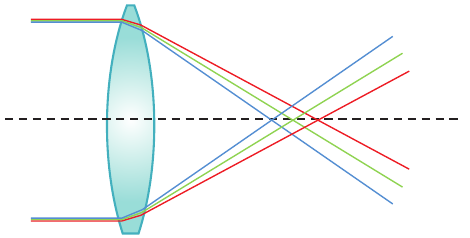
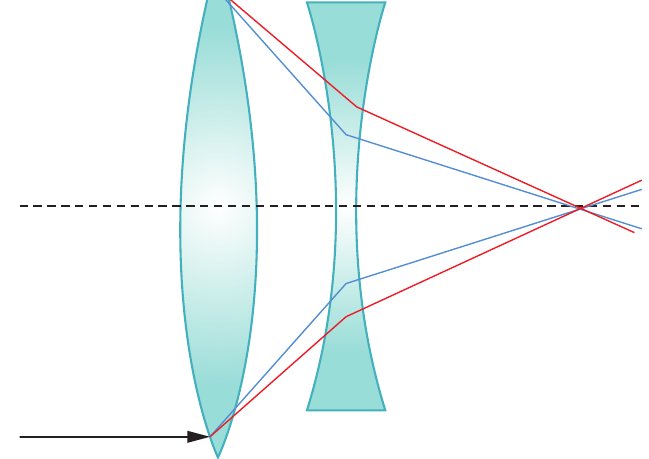
Dispersion can create problems when lenses are used to form images. This issue is called chromatic distortion - image distortion caused by light of different colours focusing at different points.
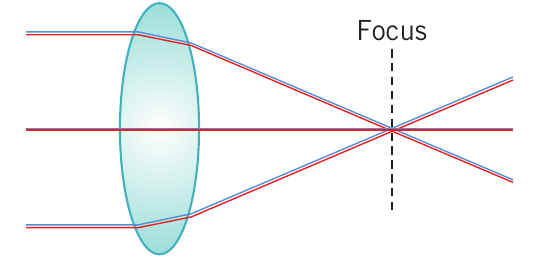
Perfect lenses
For sharp, accurate images, all colours need to come to a focus at the same distance from the lens. In an ideal "perfect" lens, the blue and red light rays (and all colours in between) focus at exactly the same point.
The problem with real lenses
However, most real lenses have different refractive indices for different colours, which means each colour focuses at a slightly different distance from the lens. This creates blurred or colour-fringed images.
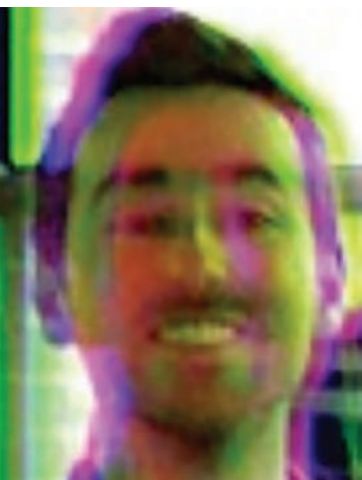
The result of severe chromatic distortion can be dramatic, producing images with coloured halos or fringes around objects.
Note
Chromatic distortion is particularly noticeable in high-contrast situations, such as photographing dark objects against bright backgrounds. The different colours fail to align perfectly, creating visible colour fringing around edges.
Correcting chromatic distortion
High-quality cameras and optical instruments use combinations of lenses to reduce chromatic distortion. By combining two lenses made from materials with different refractive indices, the dispersion effects can be made to cancel each other out, bringing all colours to focus at approximately the same point.
Mirages
A mirage is an optical illusion caused by the refraction of light through layers of air at different temperatures. The temperature differences create variations in the refractive index of the air, bending light rays and creating false images.
Inferior mirages (hot surfaces)
The most common type of mirage occurs on hot road surfaces. On a hot day, you might see what appears to be water on the road ahead, with reflections of vehicles visible in it.
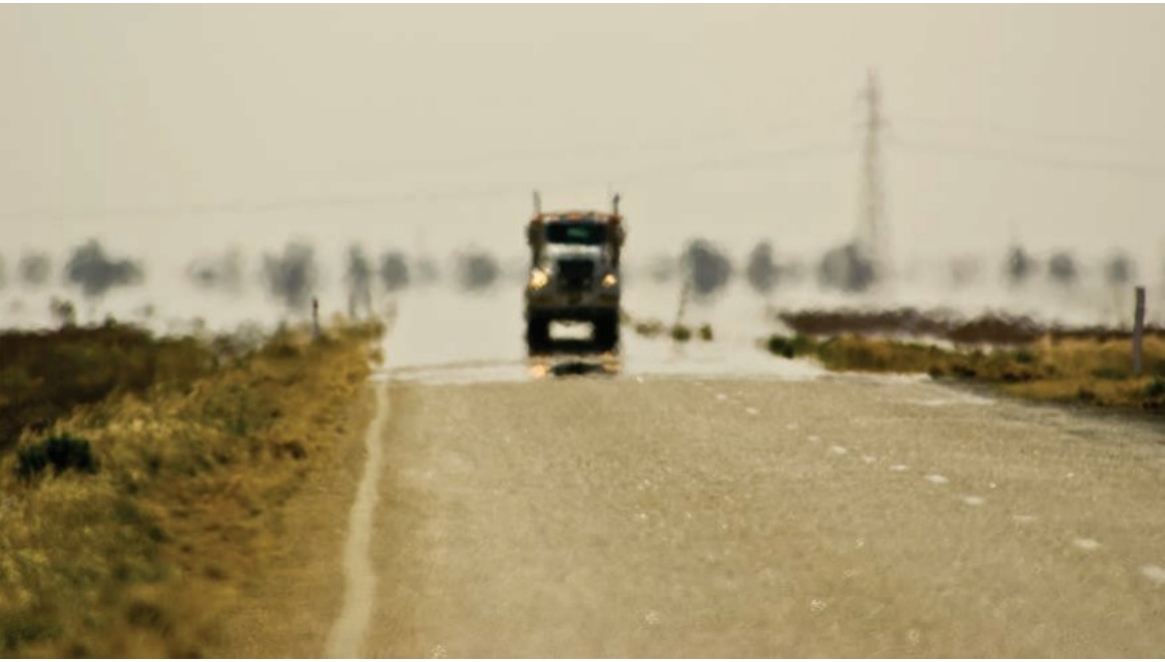
This illusion occurs because layers of air near the hot road surface are much hotter than the layers above them. Hot air has a lower refractive index than cool air. When light rays travel downward from a vehicle toward the hot road surface, they gradually bend away from the normal as they enter progressively hotter (lower refractive index) layers of air. Eventually, the light undergoes total internal reflection and travels back upward.
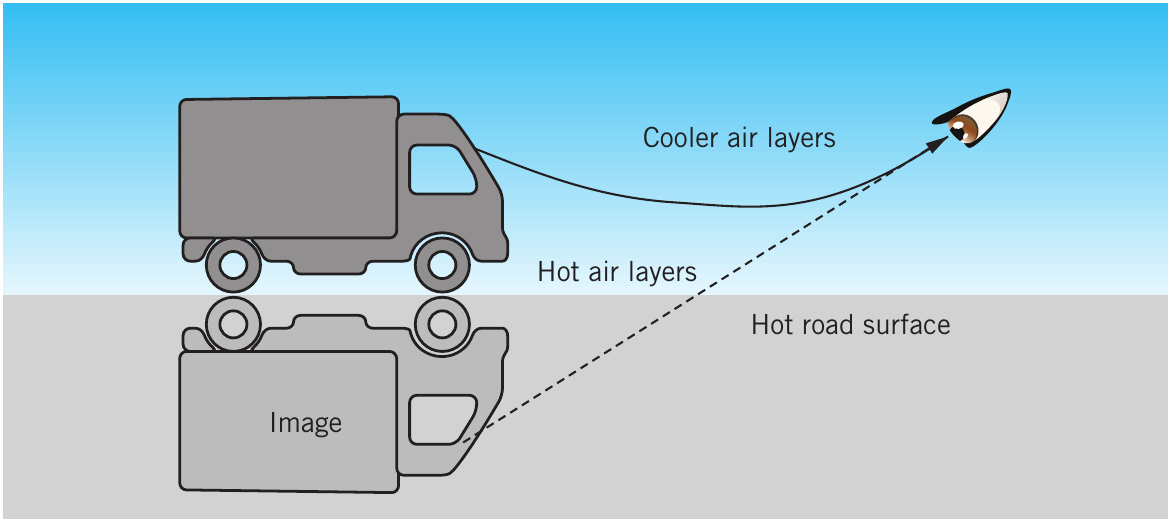
When this reflected light reaches an observer's eye, the brain traces the rays backward in straight lines, creating the impression of an inverted image of the vehicle below the actual vehicle - exactly where a reflection in water would appear. This is why we perceive the mirage as water on the road.
Note
The key to understanding inferior mirages: hot air below creates downward-bending light that reflects back up, producing inverted images that appear below the actual object - just like reflections in water!
Superior mirages (cool surfaces)
A different type of mirage forms over cool surfaces such as the ocean. Here, the air temperature pattern is reversed - layers near the water surface are cooler, while layers higher up are warmer.
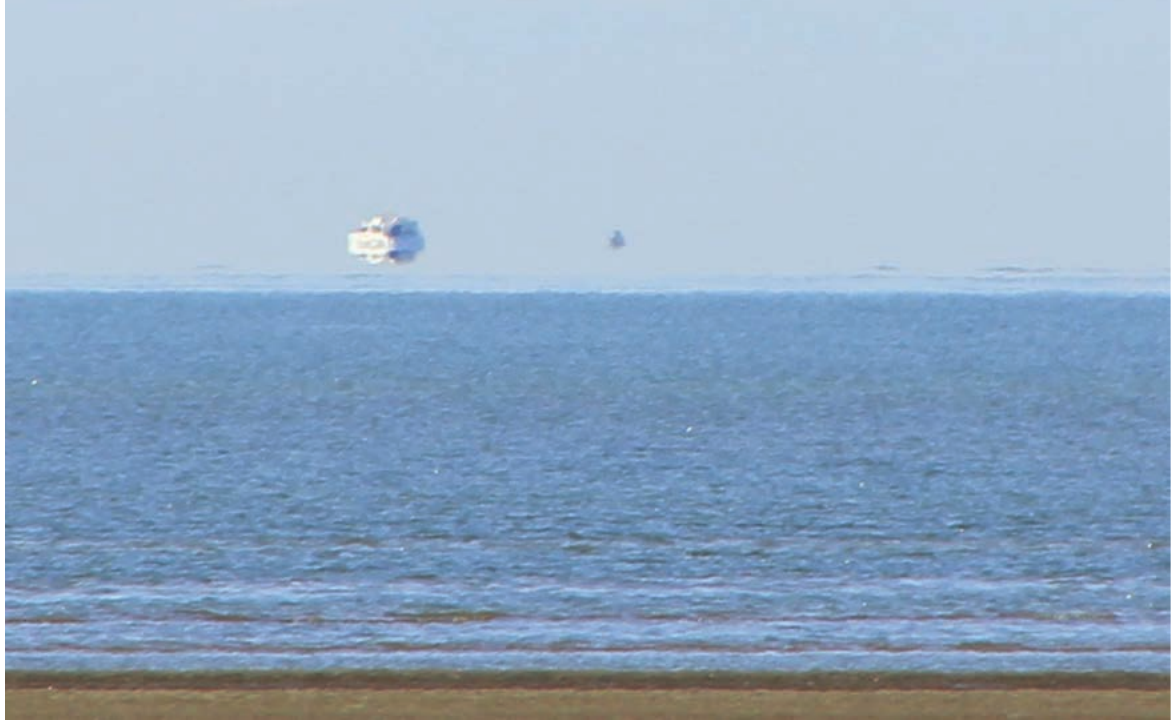
In this case, light rays from objects below the horizon (such as a distant boat) bend downward as they travel through the temperature gradient. After internal reflection in the warmer upper layers, these rays refract back down to reach an observer's eye. The observer traces the rays backward and sees an image of the boat appearing to float in the sky above the horizon.
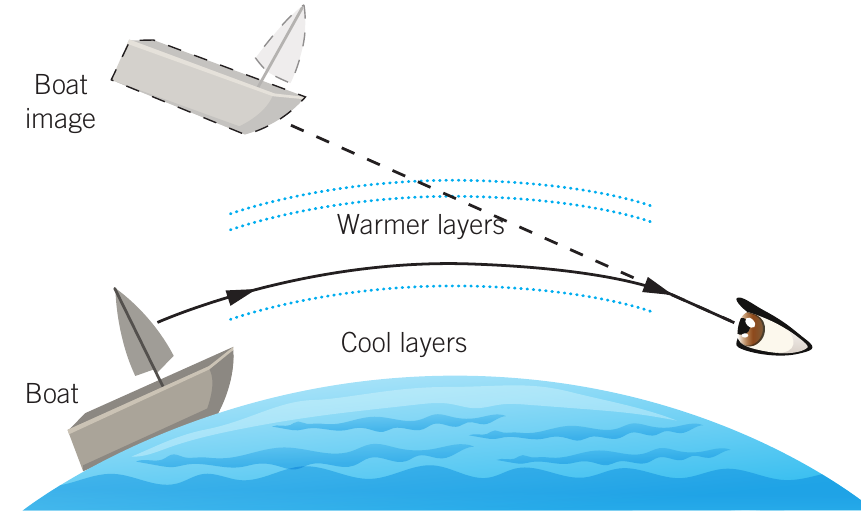
This type of mirage can make ships appear to hover above the water or can allow observers to see objects that are actually beyond the horizon.
Important
Memory aid for mirages:
- Hot below → inferior mirage → inverted image appears below the object
- Cool below → superior mirage → elevated image appears above the object
The temperature gradient determines the direction of light bending and the position of the mirage!
Optical fibres
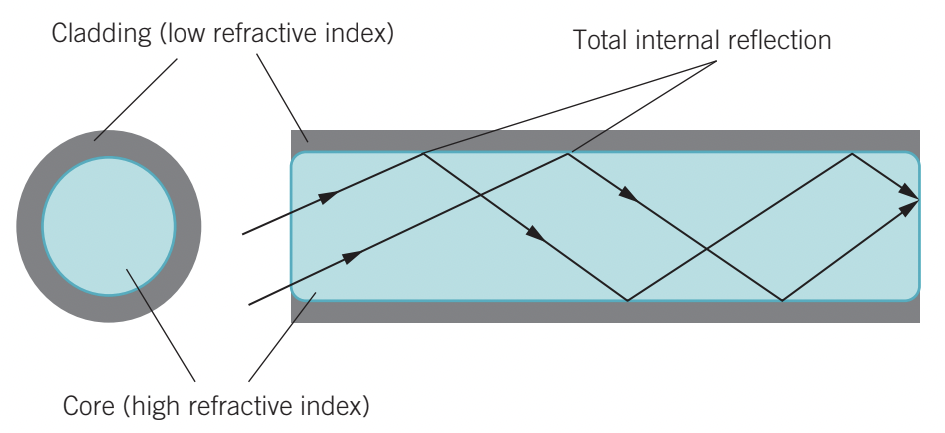
Optical fibres are flexible transparent fibres made from glass or plastic that can carry digital signals using the phenomenon of total internal reflection. They are a crucial technology for modern telecommunications.
Structure of optical fibres
An optical fibre consists of two main parts:
- Core - the central region with a high refractive index through which light travels
- Cladding - the outer layer with a lower refractive index that surrounds the core
How optical fibres work
Light rays enter the optical fibre at one end and are kept within the core by successive total internal reflections at the boundary between the core and cladding. The light rays are limited to a narrow range of angles when entering the fibre. Rays outside this acceptable range would be rapidly attenuated (weakened) and lost from the core.
Because total internal reflections are almost perfect with minimal energy loss, the intensity of the light signal is maintained over many kilometres. There are some losses due to absorption in the glass fibre, but these are very small. For example, the Australian National Broadband Network (NBN) uses 'repeaters' every 40-50 km to boost signal intensity and maintain data transmission quality.
Note
The key requirement for optical fibres to work is that the core must have a higher refractive index than the cladding. This ensures that light undergoes total internal reflection at the boundary, keeping the signal contained within the core.
Worked example: optical fibre design
Example
Worked Example: Calculating Cladding Refractive Index
Consider an optical fibre where monochromatic (single frequency) laser light enters the core. The critical angle must be to maintain total internal reflection within the core. If the core material has a refractive index of , what should the refractive index of the cladding be?
Solution:
For the fibre to work properly, the refractive index of the cladding must be less than the refractive index of the core. Using the formula for total internal reflection:
Substituting the given values:
Answer: For the fibre to operate as designed, the cladding must have a refractive index of .
This value is less than the core's refractive index (), which satisfies the requirement for total internal reflection to occur at the core-cladding boundary.
Rainbows
Rainbows are one of nature's most beautiful demonstrations of dispersion. They form through a combination of dispersion and partial internal reflection of the Sun's rays inside water droplets suspended in the atmosphere.
Primary rainbow formation
The brightest and most commonly observed rainbow - called the primary rainbow - forms when sunlight undergoes just one partial internal reflection inside rain droplets. The formation process involves three key steps:
- Refraction on entry - sunlight enters the water droplet and refracts, with different colours bending by different amounts (dispersion occurs here)
- Internal reflection - the light reflects off the back inner surface of the droplet
- Refraction on exit - the light refracts again as it leaves the droplet, enhancing the colour separation
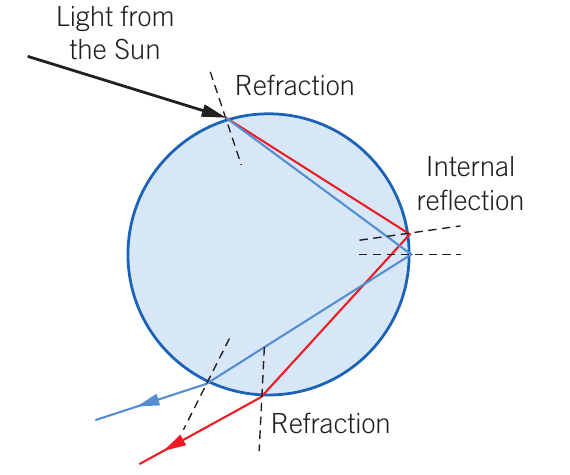
Rainbows are most easily seen when you stand with your back to the Sun. Different colours reach your eye from droplets at different positions. The eye traces blue light back to water droplets at the bottom of the rainbow's arc, and red light to the top. The other colours (violet, blue, green, yellow, orange) appear in order between these extremes.
Note
Viewing rainbows: You must have your back to the Sun to see a rainbow. The rainbow always appears in the opposite direction from the Sun, at a specific angle (approximately 42° for primary rainbows).
Secondary rainbow formation
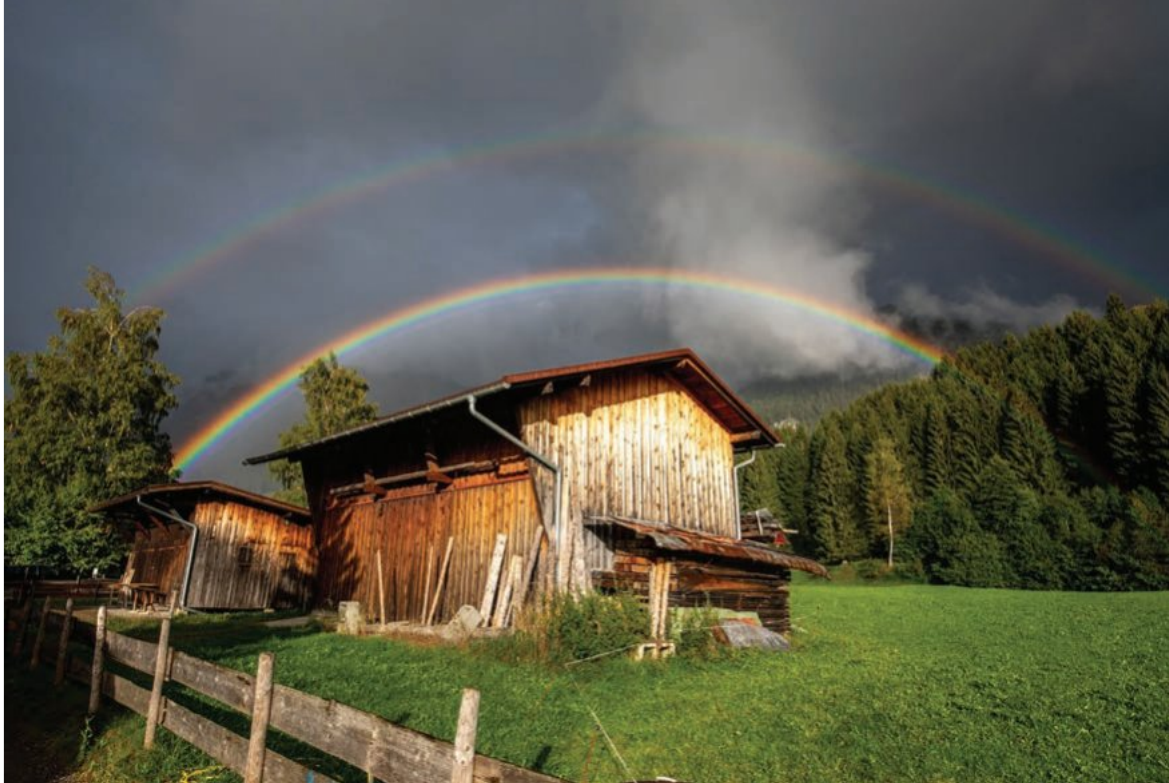
A fainter secondary rainbow sometimes appears above the primary rainbow. This forms when sunlight undergoes two partial internal reflections inside the water droplets before exiting.
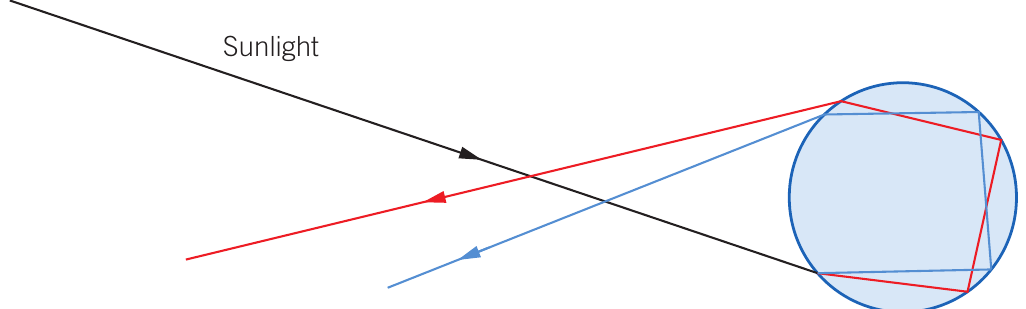
The secondary rainbow is fainter than the primary rainbow because the light is partially reflected twice, reducing its intensity with each reflection. Additionally, the colours in a secondary rainbow appear in reverse order compared to the primary rainbow - red appears on the bottom and violet on the top.
Both primary and secondary rainbows involve two refractions (one when light enters the droplet and one when it exits), but differ in the number of internal reflections - one for primary rainbows and two for secondary rainbows.
Important
Key differences between rainbow types:
Primary rainbow:
- One internal reflection
- Brighter appearance
- Red on top, violet on bottom
Secondary rainbow:
- Two internal reflections
- Fainter appearance
- Violet on top, red on bottom (reversed colours)
Remember: More reflections = fainter rainbow with reversed colours!
Summary
Summary
Key Points to Remember:
-
Colour dispersion occurs because different wavelengths of light have different refractive indices in a medium like glass, causing them to refract by different amounts. Shorter wavelengths (violet) bend more than longer wavelengths (red).
-
Chromatic distortion in lenses happens because different colours focus at different distances, but can be corrected using combinations of lenses with different refractive indices.
-
Mirages are optical illusions caused by light refraction through air layers at different temperatures:
- Hot surfaces create inferior mirages (inverted images below objects)
- Cool surfaces create superior mirages (elevated images above objects)
-
Optical fibres use total internal reflection between a high-refractive-index core and low-refractive-index cladding to transmit light signals over long distances with minimal loss.
-
Rainbows form through dispersion and internal reflection in water droplets:
- Primary rainbows: one internal reflection (red on top, violet on bottom)
- Secondary rainbows: two internal reflections (colours reversed, fainter appearance)
Useful memory aids:
- ROY G BIV - the order of spectrum colours
- Violet bends more - shorter wavelengths have higher refractive indices
- Hot below, cool above - for predicting mirage types
- One reflection = primary, two reflections = secondary - for rainbow formation