Reflection and Refraction (VCE SSCE Physics): Revision Notes
📚Revision Notes
Reflection and Refraction
Introduction
Understanding how light behaves is essential for explaining many natural phenomena and technological applications. This note explores three key behaviours of light: reflection, refraction, and the special case of total internal reflection. These principles explain everyday observations like rainbows, mirages, bent pencils in water, and enable technologies such as optical fibres for communication.

Note
The principles of light behaviour have practical applications in numerous fields:
- Optical technologies: Fibre optic cables for internet and telecommunications
- Natural phenomena: Rainbows, mirages, and atmospheric effects
- Everyday observations: Objects appearing bent or displaced underwater
- Optical instruments: Binoculars, periscopes, and camera lenses
Visualising light paths
Light consists of vibrating electric and magnetic fields oscillating at extremely high frequencies. For green light with wavelength nm ( m), the frequency is approximately 5.45 × 10¹⁴ Hz. These vibrations are too fast and small to represent accurately in diagrams.
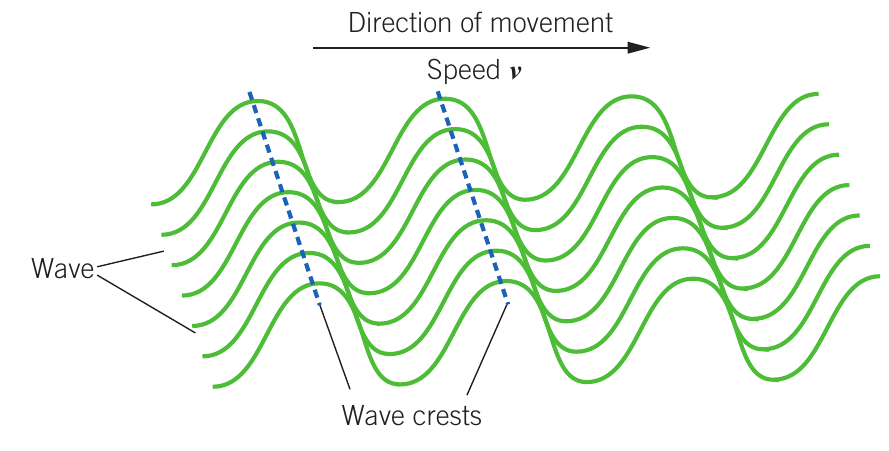
Physicists use two main methods to represent light:
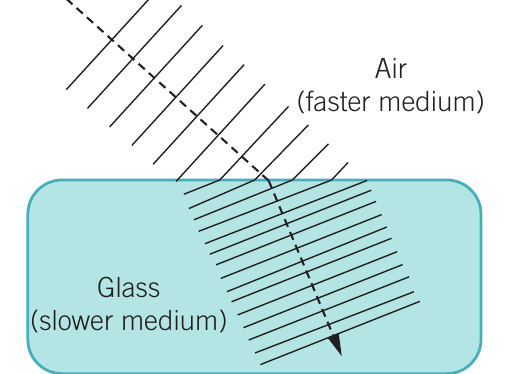
Wave crest diagrams: These show the wavelength and direction of light travel. Parallel lines represent successive wave crests moving together.
Ray diagrams: These use simple arrows to show only the direction of light travel. Rays are easier to draw and work with for many problems.
Note
Choosing the right representation:
- Use wave diagrams when you need to explain the physical mechanism of refraction or show wavelength changes
- Use ray diagrams for simplifying calculations, tracing light paths, and solving practical problems
Both representations are useful. Wave diagrams help explain why refraction occurs, while ray diagrams simplify calculations and predictions.
Reflection of light
When light encounters a boundary between two different media, it reflects. Reflection can be total or partial, depending on the situation. For smooth surfaces, the reflected beam emerges at the same angle as the incoming beam.
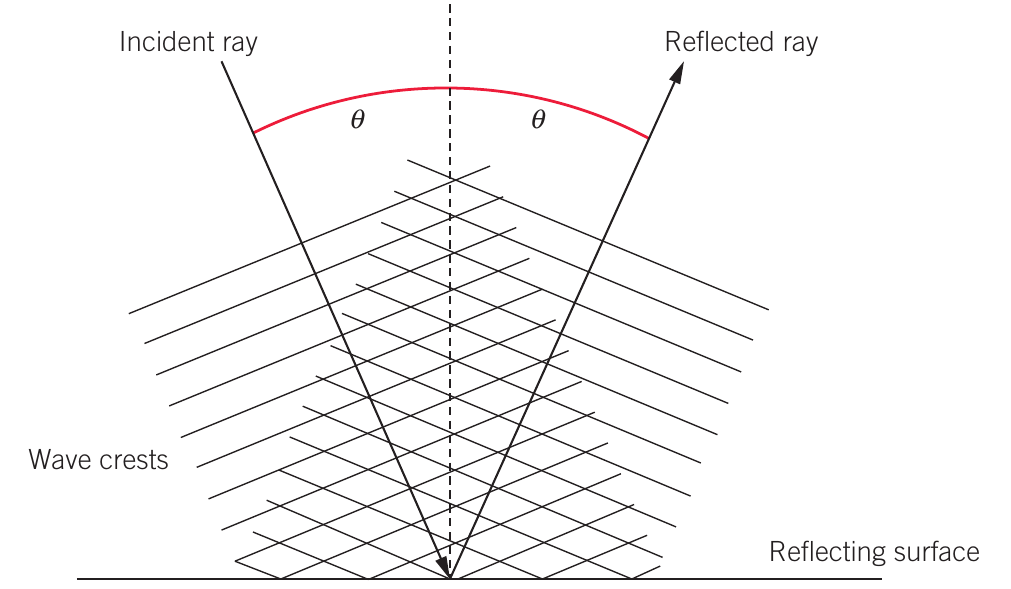
Reflection is the change in direction of a wave when it meets a surface between two media, causing the wave to travel back into the medium it came from.
The normal is an imaginary line perpendicular to the surface at the point where light strikes. Angles are always measured from this normal line, not from the surface itself.
Important
Law of reflection: The angle of incidence equals the angle of reflection (both measured from the normal).
Remember: Always measure angles from the normal line, never from the surface itself!
Speed of light in transparent materials
Light travels at different speeds through different materials. In a vacuum (or air, which is very similar), light travels at its maximum speed of m/s. In other transparent materials, light slows down.
The table below shows light speeds in various media:
| Medium | Speed of light (m/s) |
|---|---|
| Air | |
| Water | |
| Typical plate glass | |
| Plastic spectacle lens | |
| Diamond |
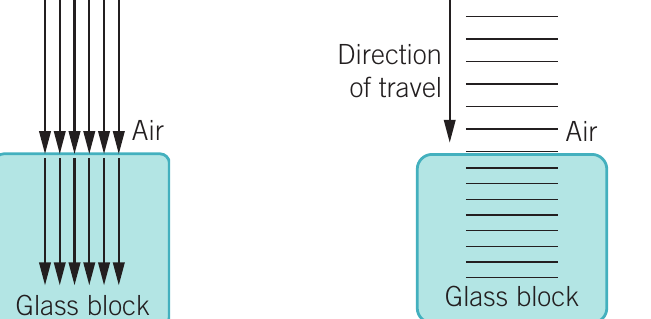
When light enters a new medium at right angles to the surface, its direction doesn't change, but its wavelength does change because the speed changes. However, the frequency remains constant because it depends only on the source.
Note
Why frequency stays constant: The frequency of light is determined by the source (e.g., a laser or light bulb) and doesn't change when light enters a new medium. Only the speed and wavelength adjust to maintain the relationship .
At a medium boundary, the frequency stays constant:
Where:
- = frequency of the wave (Hz)
- = speed in first medium (m/s)
- = wavelength in first medium (m)
- = speed in second medium (m/s)
- = wavelength in second medium (m)
Example
Worked Example: Wavelength in Different Media
A ray of light has frequency Hz. In air, light travels at m/s. In a type of glass, light travels at m/s.
Calculate the wavelength in air and in glass:
Step 1: Calculate wavelength in air using :
Step 2: Calculate wavelength in glass using :
Conclusion: The wavelength decreases in the glass because light travels more slowly there, but the frequency remains Hz in both media.
Refraction of light
Most light rays don't strike surfaces at right angles. When they enter a new medium at an angle, the light beam changes direction. This phenomenon is called refraction.
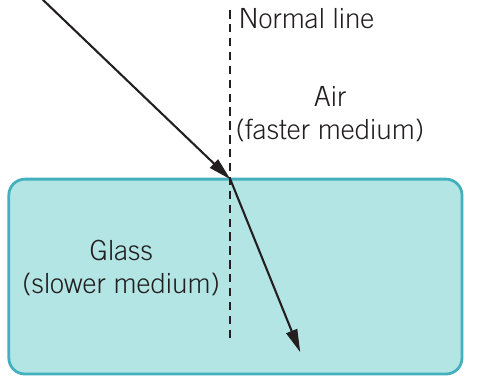
Refraction is the change in direction of a wave moving from one medium to another, caused by the wave changing speed.
The wave properties of light explain why refraction occurs. When wave crests reach a slower medium, they slow down and bunch together (shorter wavelength). This bunching causes the wave direction to change.
Important
Key rule for refraction:
- Light entering a slower medium (higher refractive index) bends toward the normal
- Light entering a faster medium (lower refractive index) bends away from the normal
Memory aid: "Fast to Slow, Bend to Normal; Slow to Fast, Bend Away"
Refractive index
To compare how much different materials refract light, physicists define the refractive index.
The refractive index () measures how much slower light travels through a medium compared to a vacuum.
Formula for refractive index:
Where:
- = refractive index (no units)
- = speed of light in vacuum ( m/s)
- = speed of light in the medium (m/s)
Note
Important properties of refractive index:
- It has no units (it's a ratio)
- The minimum value is n = 1 (for air or vacuum)
- Higher values mean light travels more slowly
- Denser materials generally have higher refractive indices
Example: Plate glass has , meaning light travels 1.5 times slower in glass than in air.
Memory aid: "Higher n means Slower speed"
Important
Exam tip: Always check whether you're given speed or refractive index in a problem. You can convert between them using .
Snell's law
Snell's law provides the mathematical relationship between angles and refractive indices when light crosses a boundary between two media.
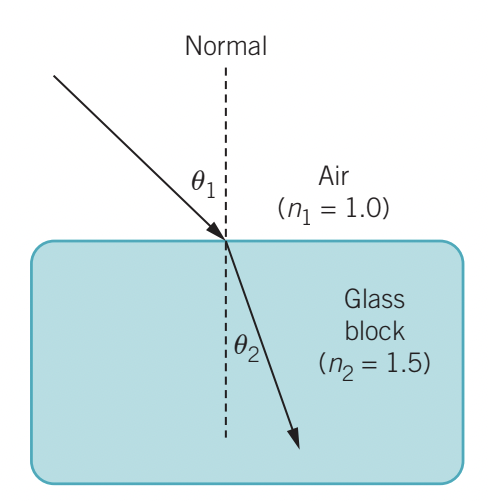
Snell's law describes the mathematical link between the angle of refraction, angle of incidence, and refractive indices of each medium.
Snell's law formulas:
Where:
- = refractive index of first medium
- = angle of incidence (from normal)
- = speed of light in first medium (m/s)
- = refractive index of second medium
- = angle of refraction (from normal)
- = speed of light in second medium (m/s)
Note
Important notes about Snell's law:
- It doesn't matter which medium you label as "1" or "2"
- The law works the same if you reverse the light ray direction
- Angles are always measured from the normal, not the surface
Example
Worked Example: Applying Snell's Law
A light ray shines on a glass block (refractive index ) immersed in oil (refractive index ). The ray strikes the boundary at to the normal. Find the angle of refraction in the glass.
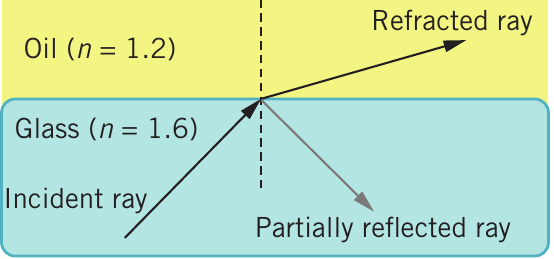
Step 1: Write Snell's law with as the subject:
Step 2: Substitute the known values:
Step 3: Calculate:
Step 4: Find the angle:
Conclusion: The ray bends toward the normal (from to ) because it enters a medium with higher refractive index (slower light speed).
Optical illusions due to refraction
Refraction causes objects underwater to appear in different positions than they actually are. Understanding these illusions has practical applications in fishing, diving, and understanding visual perception.
The bent pencil illusion
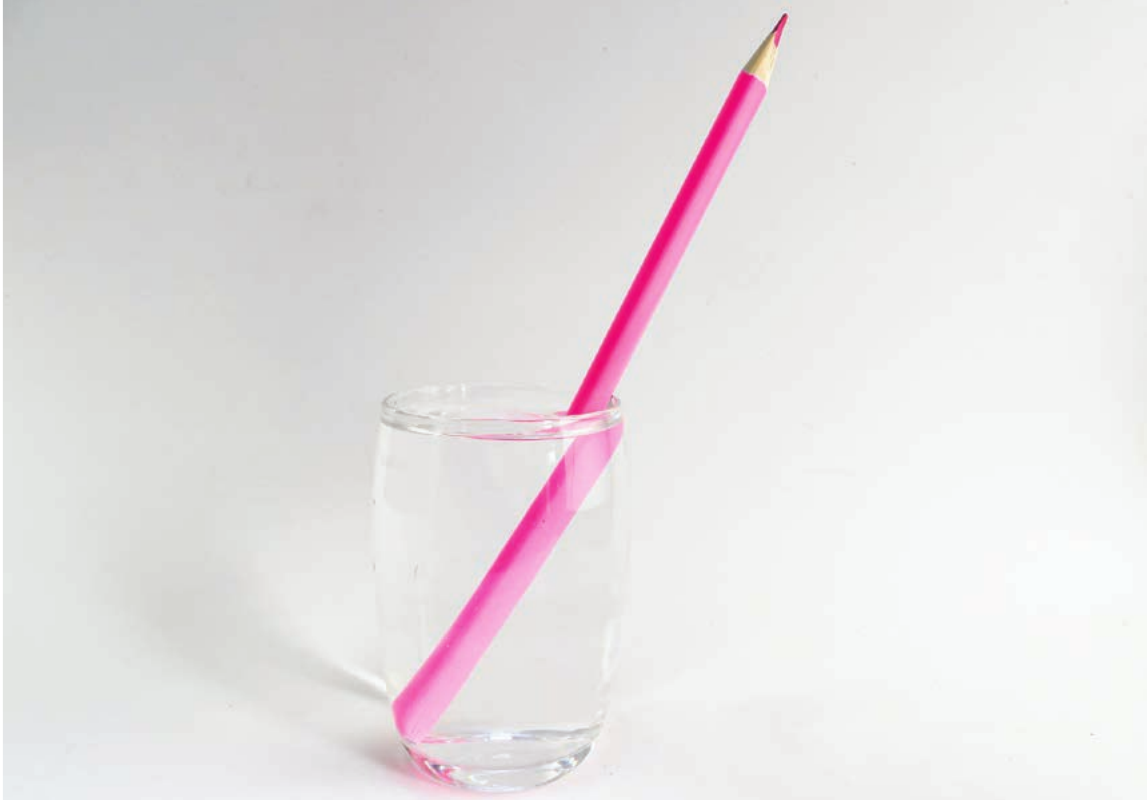
A pencil partially submerged in water appears bent at the water surface.
Note
Explanation of the bent pencil effect:
Light rays from the underwater part of the pencil bend away from the normal as they exit the water (entering air, which is faster). To our eyes, these bent rays appear to come from a point closer to the surface than the actual pencil position. The image we see is displaced upward, creating the appearance of a bent pencil.
The floating coin illusion
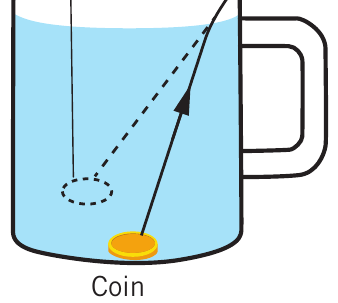
Place a coin in an empty mug. Position your eye so the coin is just hidden by the mug's edge. When someone fills the mug with water, the coin appears to float into view.
Note
Explanation of the floating coin:
Light rays from the coin refract away from the normal when leaving the water. These refracted rays can now reach your eye at positions where straight-line rays couldn't. You see an image of the coin at a shallower position than the actual coin, making it appear to "float" upward into view.
Spear fishing application
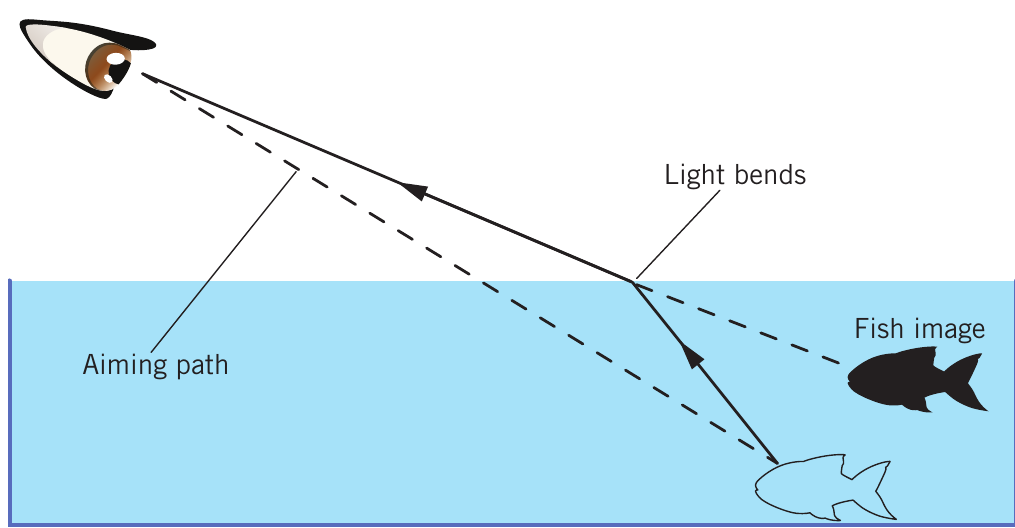
Aboriginal and Torres Strait Islander peoples have understood light refraction for over 60,000 years, enabling accurate spear fishing in water.

Note
The spear fishing challenge:
Fish underwater appear closer to the surface than their actual position because light bends when leaving the water. This creates a displaced image above the true fish location.
The solution: Spear fishers must aim lower than the apparent fish position to account for refraction. This requires understanding the path light takes through water and air, combined with allowing for gravity's effect on the spear.
Partial internal reflection
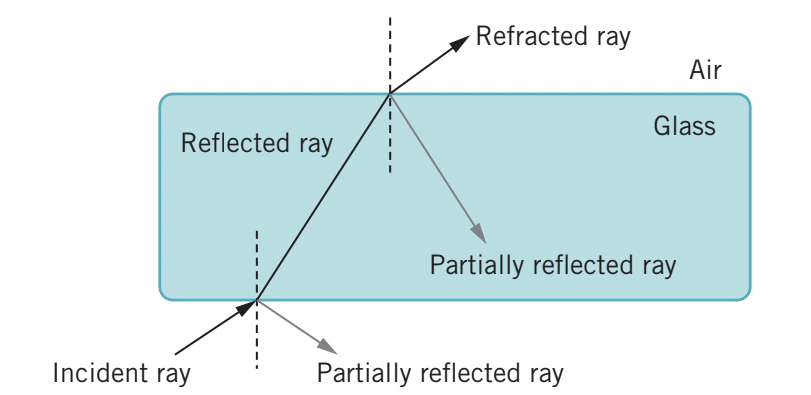
Every time light crosses a boundary between different media, some reflection occurs. Even when most light passes through (refracts), a small portion always reflects back into the first medium.
Partial internal reflection occurs when light at an interface splits into two parts: some refracts across the surface and some reflects back internally.
Note
About 4% of light reflects at an air-glass boundary, even when the ray is perpendicular to the surface. This percentage increases as the angle of incidence increases. This explains why windows sometimes act as mirrors, especially when it's dark outside – the reflected light becomes visible compared to the transmitted light.
Total internal reflection
When light travels from a material with high refractive index to one with lower refractive index, something special can happen at large angles of incidence.
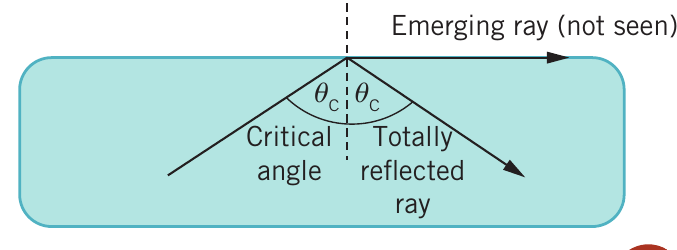
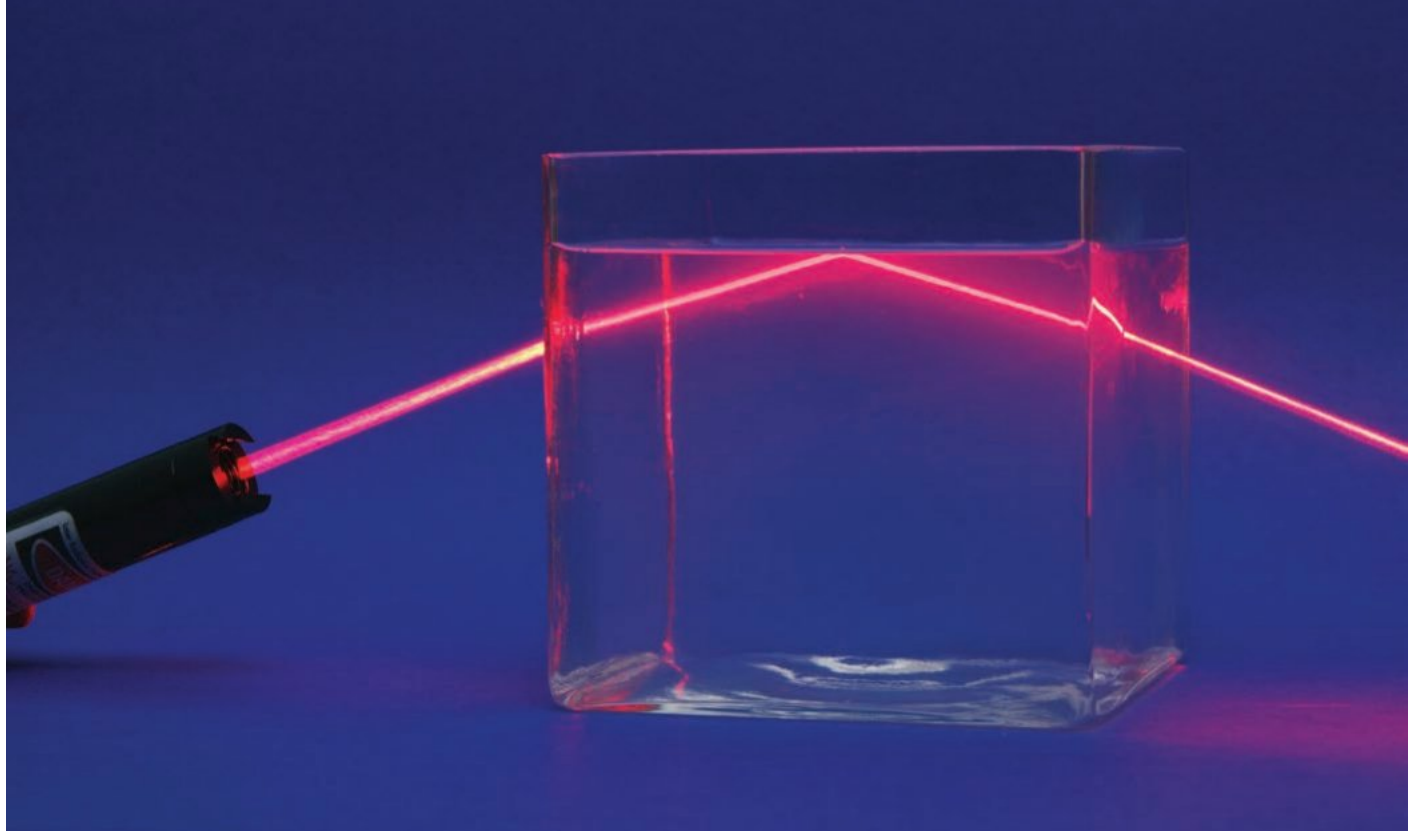
The refracted ray always bends away from the normal. As the incident angle increases, the refracted ray angle approaches (parallel to the surface). At a specific incident angle, called the critical angle, the refracted ray disappears completely and all light reflects internally.
The critical angle () is the angle of incidence at which an incident ray will fully reflect at the surface of a medium. It depends on the refractive indices of both media.
Total internal reflection occurs when all light at a surface reflects with no refraction. This happens when light moves from higher to lower refractive index at an angle of incidence greater than or equal to the critical angle.
Important
Conditions for total internal reflection:
Total internal reflection only occurs when BOTH conditions are met:
- Light must travel from higher refractive index to lower refractive index (slower medium to faster medium)
- Angle of incidence must be greater than or equal to the critical angle
Memory aid: "TIR needs: High to Low, Big angle"
Formula for critical angle:
Simplifying (since ):
Where:
- = refractive index of the first medium (higher)
- = refractive index of the second medium (lower)
- = critical angle
Example
Worked Example: Critical Angle Calculation
Calculate the critical angle when light moves from a medium with to a medium with .
Step 1: Write the critical angle formula:
Step 2: Substitute the values:
Step 3: Calculate the angle:
Conclusion: For angles of incidence greater than 48.6°, total internal reflection occurs.
Observing total internal reflection
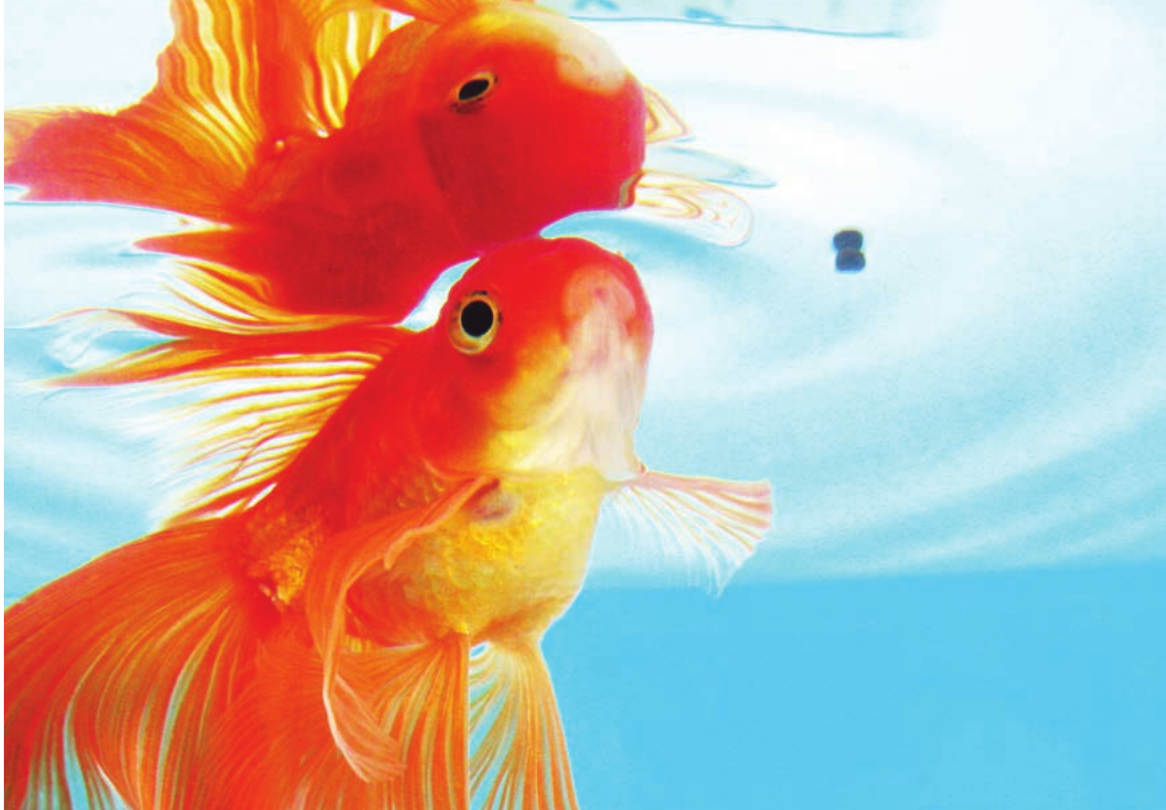
You can observe total internal reflection when swimming underwater or looking at a fish tank from below. The water surface acts like a perfect mirror for light hitting it at shallow angles (large angles from the normal).
Note
Applications of total internal reflection:
- Optical fibres for telecommunications and internet connections
- Binoculars and periscopes (using prisms to redirect light)
- Diamonds (high refractive index creates sparkle and brilliance)
- Fibre optic lighting and decorations
Important
Exam tip: Remember that total internal reflection only occurs when light travels from a slower medium (higher ) to a faster medium (lower ). It cannot occur when light enters a slower medium – in that case, the light always refracts toward the normal.
Summary
Key Points to Remember:
-
Reflection occurs when light bounces off a surface between two media; the angle of incidence equals the angle of reflection (measured from the normal)
-
Refraction is the bending of light when it passes between media with different properties; light bends toward the normal when entering a slower medium and away from the normal when entering a faster medium
-
Refractive index () measures how much slower light travels in a medium compared to vacuum; higher values mean slower light speed
-
Snell's law () mathematically relates angles and refractive indices at a boundary between two media
-
Total internal reflection occurs only when light travels from higher to lower refractive index at an angle greater than or equal to the critical angle ()
-
Memory aids:
- "Fast to Slow, Bend to Normal; Slow to Fast, Bend Away"
- "Higher n means Slower speed"
- "TIR needs: High to Low, Big angle"
- "Critical angle = 90° emergence"