Energy, Power, and Energy Efficiency (VCE SSCE Physics): Revision Notes
📚Revision Notes
Energy, Power, and Energy Efficiency
What is energy?
Energy is defined as the measurable property of a body or system that gives it the ability to do work. This fundamental concept appears throughout physics and everyday life. Understanding energy helps us analyse everything from falling objects to running engines.
Three key principles about energy are essential:
- Energy can be transformed from one form into another
- Energy can be transferred from one object to another
- Energy cannot be created or destroyed (law of conservation of energy)
Note
A dramatic example of energy transformation occurs during land diving in Vanuatu, where people jump from towers up to 30 metres tall with only jungle vines attached to their feet. As divers climb the tower, they store gravitational potential energy. At the top, a diver has roughly the same energy as a 1-tonne car moving at 25 km h⁻¹. When jumping, this stored energy transforms into kinetic energy, with the diver reaching speeds approaching 85 km h⁻¹ before the vines arrest the fall.
Gravitational potential energy
Gravitational potential energy is the amount of energy an object has stored due to its position in a gravitational field. The higher an object sits above a reference point, the more gravitational potential energy it possesses. When an object falls, this stored energy transforms into other forms, particularly kinetic energy.
For objects near Earth's surface, we assume the gravitational field strength is constant at 9.8 N kg⁻¹. This simplification makes calculations straightforward for everyday situations.
Formula for gravitational potential energy
Important
Formula: Gravitational Potential Energy
Where:
- = Gravitational potential energy (J)
- = Mass (kg)
- = Gravitational field strength (9.8 N kg⁻¹ on Earth's surface)
- = Change in height (m)

The image above shows a diver at the top of a cliff. This person has significant gravitational potential energy because they have done work against the gravitational field to reach that height. When they jump, the gravitational field does work on them, pulling them downward and transforming that potential energy into kinetic energy.
Example
Worked Example: Elevator Lifting a Person
Problem: An elevator moves a person with mass 76.5 kg from the fifth floor (18 m above ground) to the 26th floor (112 m above ground). Calculate the work done on the person by the elevator.
Solution:
The work done by the elevator equals the change in gravitational potential energy:
The elevator does 70,500 J of work to lift the person through this height difference.
Kinetic energy
Kinetic energy is the energy of motion. Any moving object possesses kinetic energy, whether it's a car on a highway, a thrown ball, or a flowing river. The faster an object moves or the more massive it is, the greater its kinetic energy.
Formula for kinetic energy
Important
Formula: Kinetic Energy
Where:
- = Kinetic energy (J)
- = Mass (kg)
- = Velocity (m s⁻¹)
The relationship between work and kinetic energy
When work is done on an object and no other energy forms are involved, the work equals the change in kinetic energy. We can prove this using kinematic equations:
Starting with:
Rearranging for displacement:
Work done is:
Since force and displacement are in the same direction, :
This proves that the work done on an object equals its change in kinetic energy.
Example
Worked Example: Kinetic Energy of a Car
Problem: Calculate the kinetic energy of a 1000 kg car travelling at 60 km h⁻¹ along the Great Ocean Road.
Solution:
First, convert velocity to SI units:
Now calculate kinetic energy:
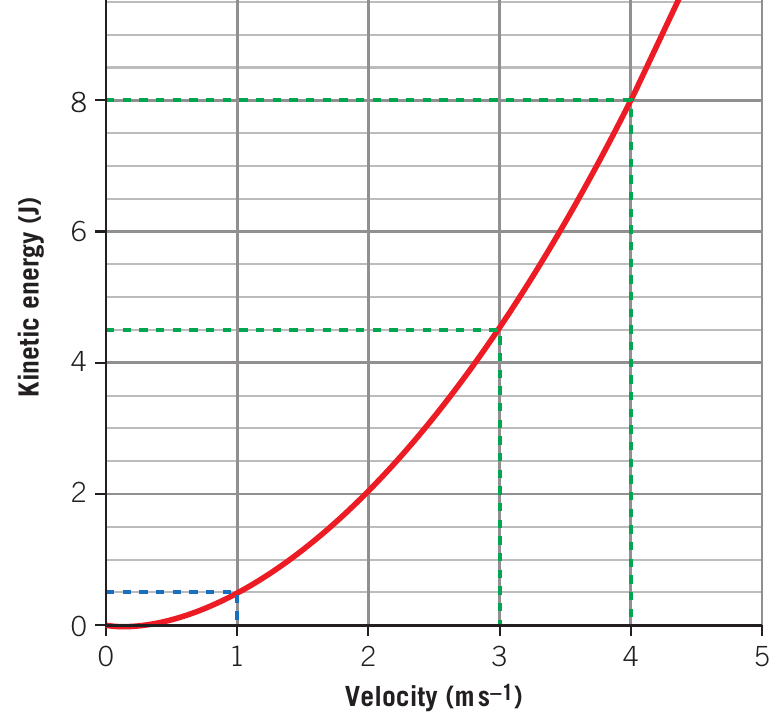
The non-linear relationship between kinetic energy and velocity
An important feature of kinetic energy is that it's directly proportional to the square of the velocity, not just the velocity itself. This creates a non-linear relationship with significant practical consequences.
Note
The graph above shows how kinetic energy increases with velocity for a 1 kg object. Notice how the curve becomes steeper at higher velocities. To increase velocity from 0 m s⁻¹ to 1 m s⁻¹ requires only 0.5 J, but increasing from 3 m s⁻¹ to 4 m s⁻¹ requires 3.5 J. This is why it becomes progressively harder to accelerate an object as it goes faster.
Example
Worked Example: Work Done by Car Brakes
Problem: A 1050 kg car travelling at 72 km h⁻¹ slows to 45 km h⁻¹. Calculate the work done by the brakes.
Solution:
Convert velocities to SI units:
Work equals the change in kinetic energy:
The negative sign indicates energy is removed from the car. The brakes dissipate this energy as heat.
Energy transfers, transformations and conservation
Transfers versus transformations
Energy transfer occurs when energy moves from one object to another. For example, when you hit a golf ball with a club, kinetic energy transfers from the club to the ball.
Energy transformation occurs when energy changes from one form to another within a system. For example, when a ball falls, gravitational potential energy transforms into kinetic energy.
Systems
A system is a collection of objects that can interact with each other. When analysing energy, we must carefully define what's included in our system.
A closed system does not allow transfer of mass or energy to the surrounding environment. In a closed system, the total energy remains constant.
An open system allows transfer of mass or energy to the surrounding environment. Energy can enter or leave an open system.
Note
In most physics problems involving mechanical energy (gravitational potential and kinetic), we treat the system as closed. However, collisions are typically treated as open systems because energy is often lost to the surroundings as heat and sound.
The law of conservation of energy
Important
The Law of Conservation of Energy
The total energy in a closed system remains constant. Energy can transform between different types, but the sum never changes. For systems involving gravitational potential and kinetic energy:
Or written in full:
Energy transformations on a roller coaster
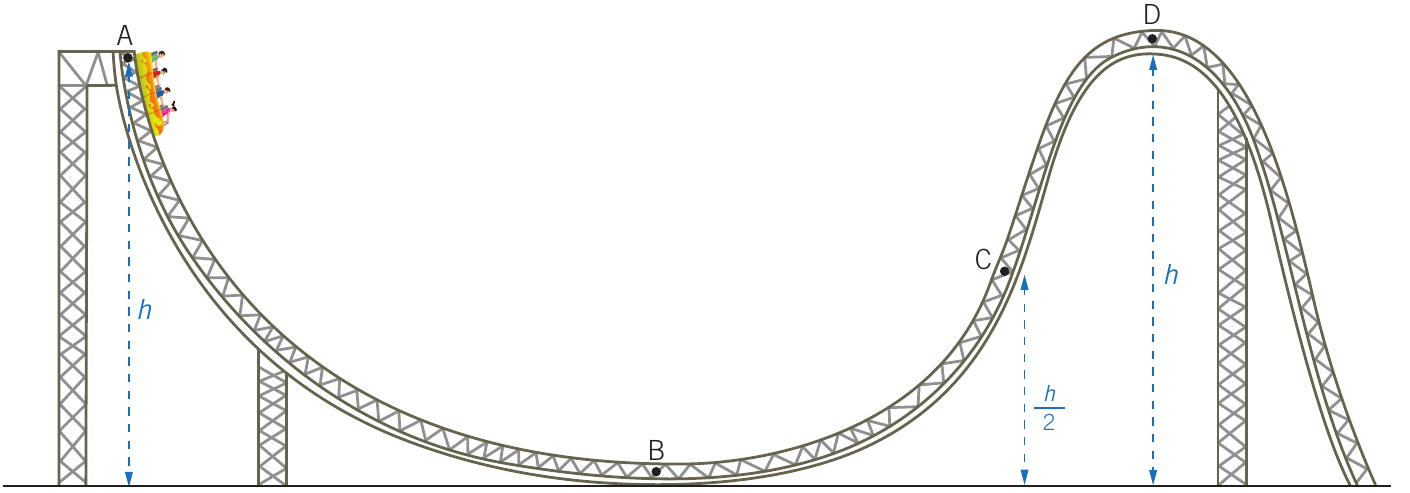
The roller coaster above provides an excellent illustration of energy conservation. Let's analyse the energy at each labelled point, assuming friction and air resistance are negligible:
- Point A: Maximum gravitational potential energy, minimum kinetic energy (just starting to move)
- Point B: Minimum gravitational potential energy (lowest point), maximum kinetic energy - nearly all the initial potential energy has transformed into kinetic energy
- Point C: At half the original height (h/2), so the energy is split equally - half gravitational potential, half kinetic
- Point D: Same height as point A, so if friction is ignored, the total energy is the same. The car would have the same gravitational potential energy as at point A, and minimal kinetic energy
Note
At every point on the track, the sum of gravitational potential energy and kinetic energy equals the same total value.
Example
Worked Example: Kinetic Energy from Gravity
Problem: A woman skis down a slope starting 50 m vertically above the end point. She starts from rest. Calculate her speed when she's 30 m vertically above the end point. Ignore air resistance and friction.

Solution:
Some gravitational potential energy converts to kinetic energy. Using conservation:
Since she starts from rest, :
Notice that the final speed doesn't depend on the skier's mass - any object falling through the same height difference reaches the same speed (ignoring air resistance).
Power
Power measures how quickly energy is transferred or work is done. Two devices might do the same amount of work, but the one that does it faster has greater power.

Note
Consider the two cars shown above. A Mazda 3 and a V8 supercar have approximately the same mass. Ignoring friction and drag, both need the same kinetic energy to reach 100 km h⁻¹ from rest. However, the Mazda 3 takes about 7.9 seconds while the V8 supercar takes only 3.6 seconds. The supercar can increase the car's kinetic energy much more quickly - it has much greater power.
Formula for power
Important
Formula: Power
Where:
- = Power (W or J s⁻¹)
- = Energy or work (J)
- = Time (s)
Power is measured in watts (W), named after James Watt who invented the steam engine. One watt equals one joule per second:
Example
Worked Example: Power and Gravity
Problem: A diver with mass 63 kg climbs from ground level to a 10-metre platform in 95 seconds. After jumping, it takes 1.43 seconds to hit the water.
a) Calculate the gravitational potential energy at the top of the platform b) Calculate the kinetic energy when hitting the water c) Calculate the power of the diver while climbing d) Calculate the average power of the gravitational field while pulling the diver down
Solution:
a)
b) All gravitational potential energy converts to kinetic energy, so
c)
d)
The gravitational field transfers energy much more rapidly than the diver, showing why falling is so much faster than climbing!
Power with friction
When a vehicle moves at constant velocity, the engine continuously does work to overcome friction and air resistance. Even though the kinetic energy remains constant, energy is still being used.
Note
The power required to maintain constant velocity against a resistance force is:
Where is the resistance force and is the average velocity.
Example
Worked Example: Power of a Car
Problem: Calculate the power of a car maintaining a constant velocity of 63 km h⁻¹ against a resistance force of 577 N.
Solution:
Convert velocity to SI units:
Calculate power:
The car's engine must continuously supply about 10 kilowatts to overcome resistance at this speed.
Energy efficiency
Everything we do requires energy input - driving cars, running computers, heating homes. But not all the input energy becomes useful output. Energy efficiency measures what fraction of the input energy serves our intended purpose.
Formula for energy efficiency
Important
Formula: Energy Efficiency
Where (Greek letter eta) represents energy efficiency.
Efficiency is often expressed as a percentage by multiplying by 100.
Most real devices have efficiency well below 100% because some energy always transforms into unwanted forms like heat or sound.
Note
For example, a combustion engine car is typically about 30% efficient. This means only 30% of the chemical energy in petrol converts to useful kinetic energy of the car. The remaining 70% becomes heat (lost through the exhaust and cooling system) and sound.
Example
Worked Example: Efficiency of an Appliance
Problem: An electric toothbrush has a power rating of 6 W and runs for 2 minutes. If 194 J transforms into useful kinetic energy of the brush, calculate the energy efficiency.
Solution:
Convert time to SI units:
Calculate total energy input by rearranging the power formula:
Calculate efficiency:
The toothbrush is about 27% efficient. The remaining ~73% of electrical energy converts to heat and sound rather than useful motion of the bristles.
Understanding variable relationships in formulas
When working with physics formulas, it's essential to understand how variables relate to each other. This helps predict what happens when one quantity changes.
Direct proportionality
When one variable is directly proportional to another, their ratio remains constant. We write this as (A is proportional to B).
For the kinetic energy formula :
- Kinetic energy is directly proportional to mass:
- Kinetic energy is directly proportional to velocity squared:
Note
If mass doubles, kinetic energy doubles. If velocity doubles, kinetic energy quadruples (because ).
When variables are directly proportional, a graph of one versus the other produces a straight line through the origin:
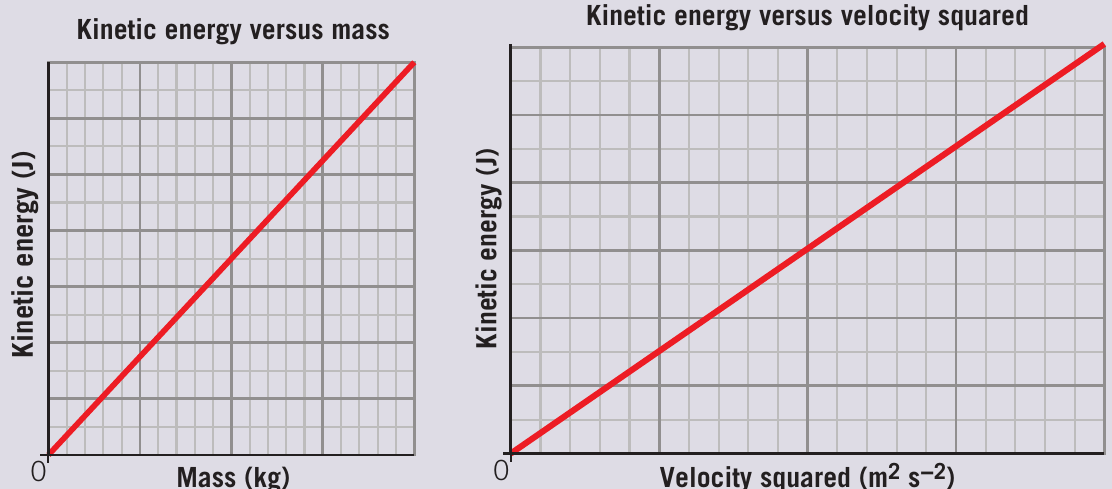
The left graph shows kinetic energy versus mass - a straight line showing direct proportionality. The right graph shows kinetic energy versus velocity squared - also a straight line, confirming .
Inverse proportionality
When one variable is inversely proportional to another, as one increases, the other decreases. We can write this as .
For the power formula :
- Power is directly proportional to energy:
- Power is inversely proportional to time:
Note
If the time taken doubles, the power halves. If the time taken is reduced to one-third, the power triples.
Using proportionality to solve problems
Example
Worked Example: Using Proportionality
Problem: A cyclist's velocity increases from 5 m s⁻¹ to 15 m s⁻¹. If the original kinetic energy is , what is the new kinetic energy?
Solution:
The velocity has tripled (15 ÷ 5 = 3). Since kinetic energy is proportional to velocity squared:
We can write:
Therefore:
The kinetic energy has increased by a factor of 9, not just 3, because of the squared relationship.
Remember!
Summary
Key Points to Remember:
-
Energy is the measurable property of a body or system with the ability to do work. It can be transformed or transferred but never created or destroyed.
-
Gravitational potential energy () is energy stored due to position in a gravitational field. It increases linearly with height.
-
Kinetic energy () is energy of motion. It's proportional to velocity squared, meaning doubling velocity quadruples kinetic energy.
-
Conservation of energy: In a closed system, total energy remains constant. Gravitational potential and kinetic energy interconvert:
-
Power () measures the rate of energy transfer or work done. Greater power means energy is transferred more quickly. For constant velocity against friction:
-
Efficiency () indicates what fraction of input energy becomes useful output. Most real devices are less than 100% efficient due to energy losses to heat and sound.
-
Understanding proportionality helps predict effects of changes: direct proportionality () means they increase together; inverse proportionality () means as one increases, the other decreases.