Work (VCE SSCE Physics): Revision Notes
📚Revision Notes
Work
Introduction to work
Work is a fundamental concept in physics that describes energy transfer. When a force acts on an object and causes it to move, work is done. Understanding work is essential for analysing energy efficiency in everything from simple machines to complex systems like vehicles and power plants.
Work represents the amount of energy transferred by a force from one object or system to another. It is a scalar quantity, meaning it has magnitude but no direction. However, work can be either positive or negative, depending on whether energy is being added to or removed from an object.
Note
Understanding work is crucial for real-world applications like improving vehicle efficiency, designing better machines, and addressing energy consumption challenges in our modern world.
Calculating work
The work done by a constant force is calculated using the formula:
Where:
- = Work done by the force (J, joules)
- = Magnitude of the force (N, newtons)
- = Displacement of the object (m, metres)
- = Angle between the force and the direction of displacement (degrees)
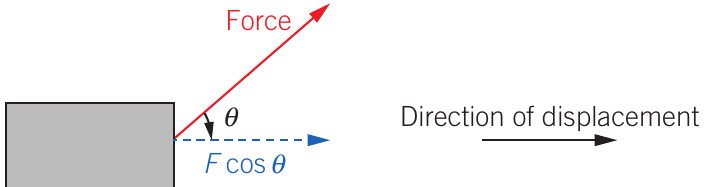
The cosine term () is crucial because it determines how much of the force acts in the direction of motion. Only the component of force parallel to the displacement does work.
Understanding the angle
Important
The angle in the work formula dramatically affects the result:
- When (force parallel to motion): , so (maximum work)
- When (force perpendicular to motion): , so (no work)
- When (force opposite to motion): , so (negative work)
This relationship means that the same force can do different amounts of work depending on its direction relative to motion!
Positive and negative work
Although work is a scalar quantity, it can be positive or negative:
- Positive work occurs when energy is transferred to an object. For example, when you throw a bowling ball, your hand does positive work on the ball, increasing its kinetic energy.
- Negative work occurs when energy is removed from an object. For example, friction does negative work on a rolling bowling ball, decreasing its kinetic energy.
When a force performs no work
It is possible to apply a constant force on an object without doing any work. This happens when:
- There is no displacement: If you hold an object stationary, you apply a force but do no work because . Using the formula , when displacement is zero, work is also zero.
- The force is perpendicular to the motion: When , the cosine term becomes zero, so no work is done. For example, when you carry a box horizontally, the upward force you apply does no work in the horizontal direction.
Note
This explains why you get tired holding a heavy box even though you're doing no work in the physics sense - your muscles are working internally, but no energy is being transferred to the box!
Worked examples
Example
Worked Example 1: Pushing a Box with Friction
A man pushes a box of mass 46 kg horizontally along the ground with a force of 500 N. The box encounters a frictional force of 50 N. Calculate the work done to push the box 32 m.
Part a: Work done by the pushing force
The pushing force acts in the direction of motion, so :
This is positive work - energy is being transferred to the box.
Part b: Work done by the friction force
The friction force acts opposite to the direction of motion, so :
The negative sign indicates that friction removes energy from the box.
Part c: Total energy given to the box
The net work represents the actual energy gained by the box.
Example
Worked Example 2: Towing at an Angle
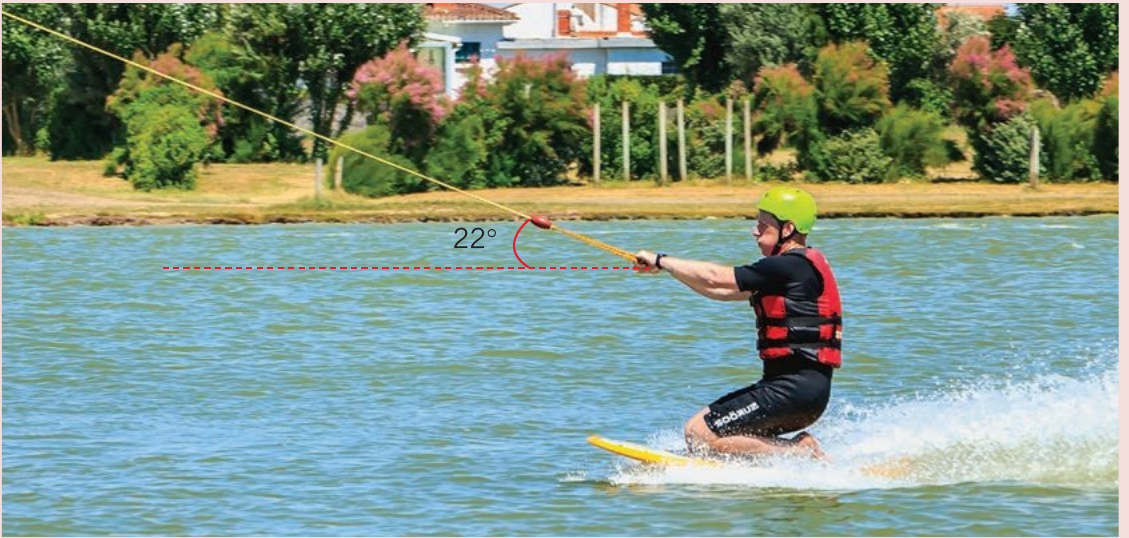
A cable-towed kneeboarder is being pulled with a force of 250 N. The towing cable makes an angle of 22° to the horizontal. If the kneeboarder travels 163 m in a straight line, calculate the work done by the cable.
Solution:
The force acts at 22° to the direction of travel:
Note that the work done is less than it would be if the cable were horizontal (which would give J) because only the horizontal component of the force contributes to the work.
Force-distance graphs
Work can also be determined by analysing a force-distance graph. In these graphs:
- The vertical axis shows the force component (in newtons)
- The horizontal axis shows distance (in metres)
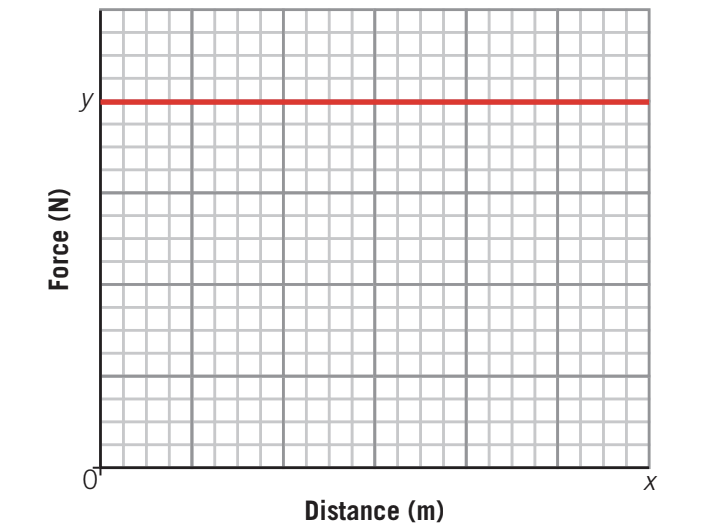
The work done equals the area under the force-distance graph. This method is particularly useful when the force is not constant.
To calculate work from the graph:
- Identify the shape(s) under the curve (rectangles, triangles, etc.)
- Calculate the area of each shape
- Sum the areas to find the total work
- Remember: Area = Work, and the units will be joules (N × m = J)
Note
The area method works because we're essentially summing up all the small amounts of work () done over each tiny displacement. This is why: Area under graph = Force × Distance = Work
Example
Worked Example 3: Car Being Pushed with Changing Force
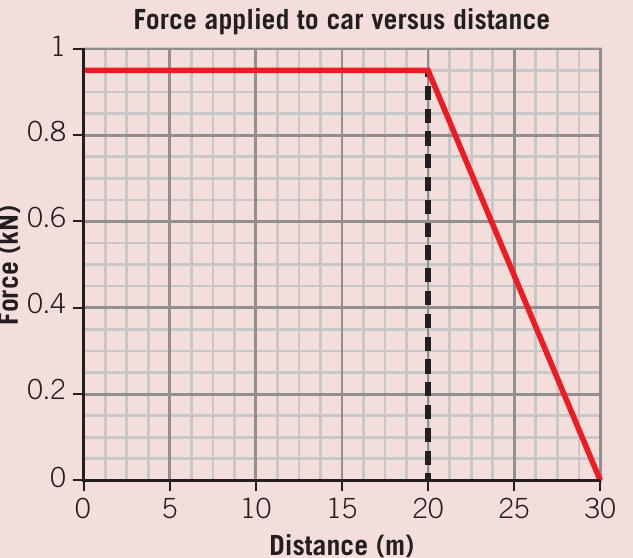
A broken-down car is pushed with a force of 0.95 kN in the direction of displacement for 20 m. The person pushing then tires, and their force reduces at a constant rate to zero over the next 10 m.
Solution:
First, convert kN to N:
The graph consists of two shapes:
- A rectangle from 0 to 20 m
- A triangle from 20 to 30 m
Calculate the area of each:
Rectangle area:
Triangle area:
Total work:
This shows how the area method handles changing forces elegantly - each geometric shape corresponds to a different phase of the push.
Resolving force components
To calculate work correctly when a force acts at an angle, you must find the component of the force that acts parallel to the direction of motion. This requires trigonometry.
Important
Critical Concept: Only Parallel Components Do Work
When a force acts at an angle, you cannot use the full force magnitude in the work formula. You must first resolve it into components and use only the component parallel to the displacement. This is why the term appears in the work formula!
Step-by-step approach
Example
Worked Example 4: Pulling a Toy Cart
A child pulls a toy cart with a string. The tension in the string is 150 N and the string forms an angle of 30° to the horizontal. Calculate the work done if the child pulls the toy for 122 m.
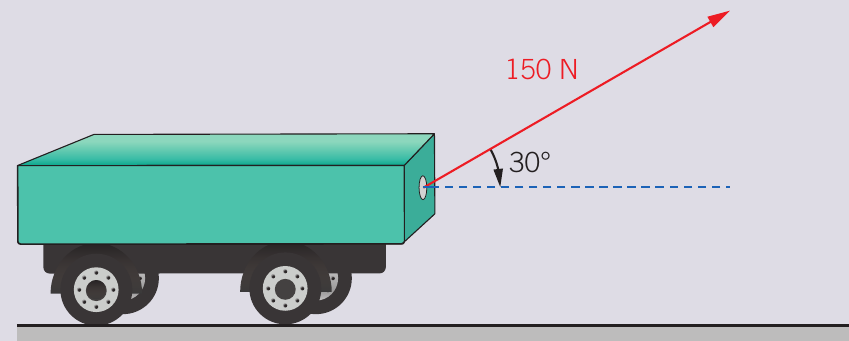
Step 1: Resolve the force into components
Break the force into horizontal and vertical components using trigonometry:
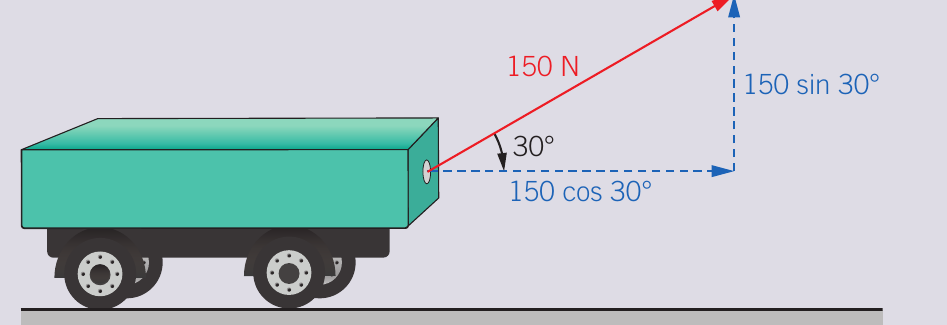
- Horizontal component:
- Vertical component:
Step 2: Identify the component needed
Since the cart moves horizontally, we need the horizontal component.
Step 3: Calculate the work
Notice that this gives the same result as if we had calculated the horizontal component first ( N) and then multiplied by displacement: J.
Key trigonometry reminder
For a force at angle to the horizontal:
- Component parallel to horizontal motion: (use cosine)
- Component perpendicular to horizontal motion: (use sine)
Note
Remember SOHCAHTOA from trigonometry:
- Cosine = Adjacent/Hypotenuse
The adjacent side is parallel to the direction we care about, which is why we use cosine to find the component that does work!
This skill applies throughout physics, including projectile motion, torque calculations, and analysing forces on slopes.
Remember!
Summary
Key Points to Remember:
- Work is the energy transferred by a force and is measured in joules (J)
- The formula is , where is the angle between force and displacement
- Work is a scalar quantity but can be positive (energy added) or negative (energy removed)
- When force is perpendicular to motion () or when displacement is zero, no work is done
- On force-distance graphs, work equals the area under the curve
- Always resolve forces into components parallel to the direction of motion when calculating work
- The cosine term in the formula automatically accounts for the angle - only the parallel component of force does work