Momentum (VCE SSCE Physics): Revision Notes
📚Revision Notes
Momentum
Introduction to momentum
Momentum is a fundamental concept in physics that helps us understand how objects move and interact during collisions. When objects collide, momentum is transferred between them, and understanding this transfer is crucial in many real-world applications, from car safety to sports injuries.
Note
Real-World Application: Concussions in Contact Sports
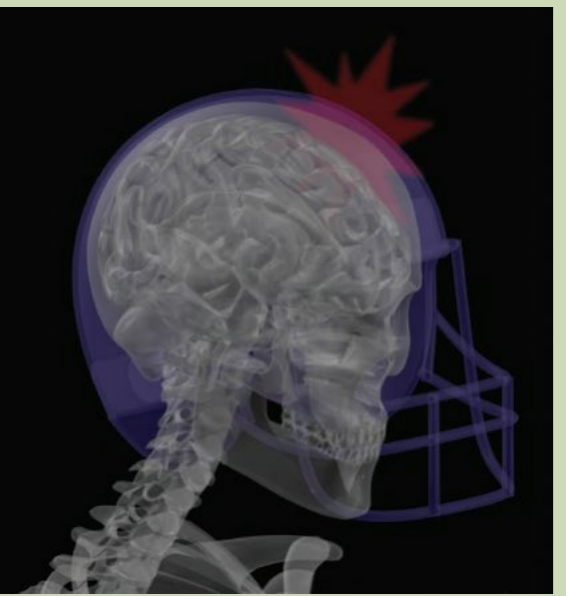
Consider what happens during a concussion in contact sports. When a player's head experiences a sudden impact, their brain continues moving inside the skull due to momentum. The brain is normally protected by cerebrospinal fluid, which acts as a shock absorber. However, if the impact is severe enough, the brain's momentum cannot be fully absorbed by this fluid, causing the brain to strike the skull wall. This creates dangerous forces on delicate neural structures and blood vessels, potentially causing neurological damage.

Important
The severity of injuries often depends on how quickly momentum changes, which relates directly to the forces involved. This is why understanding momentum is crucial for designing safety equipment and preventing injuries.
What is momentum?
Momentum describes the quantity of motion an object possesses. It combines two key properties: how much mass the object has and how fast it's moving. A heavy object moving at the same speed as a lighter object has more momentum, making it harder to stop.
Momentum is defined as the product of an object's mass and its velocity. It is represented by the symbol and calculated using:
Where:
- = momentum (measured in )
- = mass (measured in )
- = velocity (measured in )
Key characteristics of momentum
Important
Momentum is a vector quantity, which means it has both magnitude (size) and direction. The direction of an object's momentum is always the same as the direction of its velocity. This directional property becomes particularly important when analyzing collisions.
An important principle to remember is that momentum can only be changed when a net external force acts on an object. Without such a force, an object's momentum remains constant.
Example
Worked Example: Calculating Momentum
Let's calculate the momentum of a kg car driving north at km h.
Step 1: Convert the speed from km h to m s:
Step 2: Substitute values into the momentum equation:
Therefore, the momentum of the car is kg m s north.
Momentum and inertia
While momentum and inertia are related concepts, they are fundamentally different and should not be confused.
Inertia is a body's tendency to resist changes in its state of motion. This concept links directly to Newton's first law of motion. The key difference is that inertia depends only on mass - the greater the mass, the greater the inertia. A stationary object has inertia but has zero momentum.
Mass is the measure of a body's resistance to acceleration when a force is applied. It determines both the object's inertia and contributes to its momentum when the object is moving.
Note
Key Differences:
- Inertia exists whether an object is moving or stationary
- Momentum only exists when an object is moving
- Both depend on mass, but momentum also depends on velocity
Law of conservation of momentum
One of the most fundamental principles in physics is the law of conservation of momentum. This law states that in a closed system (one where no external forces act), the total momentum before a collision equals the total momentum after the collision.
A closed system is one that does not allow the transfer of mass or energy to the surrounding environment. In practical terms, this means we're considering all the objects involved in a collision without external interference.
The law of conservation of momentum can be expressed mathematically as:
For two objects colliding, this becomes:
Where:
- = mass of the first object (kg)
- = mass of the second object (kg)
- = initial velocity of the first object (m s)
- = initial velocity of the second object (m s)
- = final velocity of the first object (m s)
- = final velocity of the second object (m s)
Important note about direction
Important
Critical: Handling Direction
For one-dimensional collisions, it is essential to use positive and negative signs to indicate direction. Choose one direction as positive (for example, right or north) and the opposite direction as negative. Be consistent throughout your calculations.
Example
Worked Example: Head-On Collision
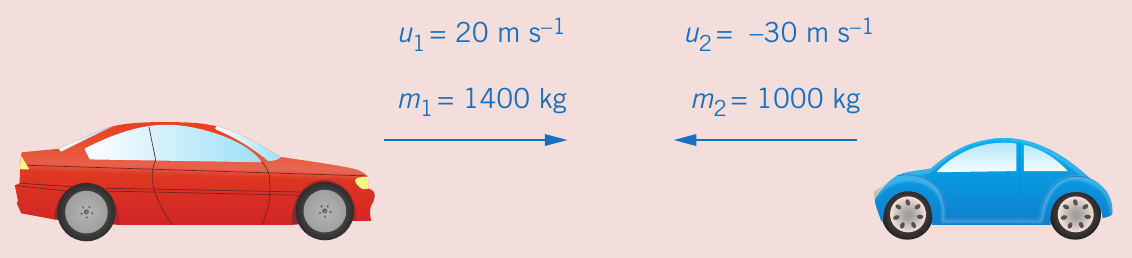
A car of mass kg is moving to the right at m s. It collides with a car of mass kg moving at m s to the left. After the collision, the kg car moves to the left with a velocity of m s. Calculate the velocity of the kg car after the collision.
Solution:
Let moving to the right be the positive direction.
Before the collision:
- kg with m s
- kg with m s (negative because it's moving left)
After the collision:
- m s (negative because it's moving left)
Rearrange the conservation of momentum formula to find :
Therefore, the kg car will be moving to the right at m s after the collision.
Two objects colliding and combining
In some collision scenarios, two or more objects collide and then stick together, moving as a single combined object afterward. This is common in car crashes where vehicles become entangled. The law of conservation of momentum still applies, but the final state consists of one combined mass.
For objects that combine after collision, the equation becomes:
where (the combined mass of both objects).
Example
Worked Example: Rear-End Collision
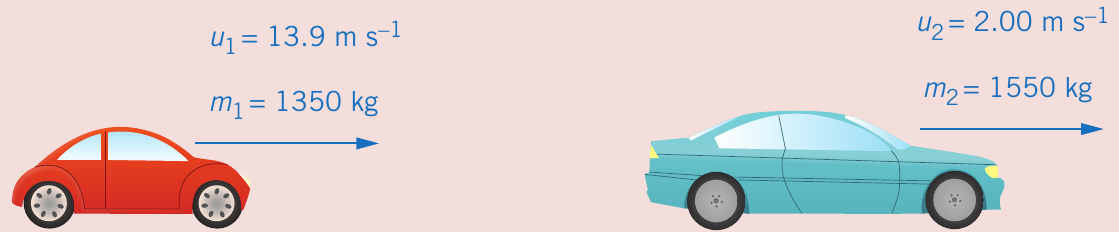
A car with mass kg is moving in traffic at m s north. The driver rear-ends a kg car in front that was moving at m s north. The two cars stick together and move as one. Calculate the velocity of the combined cars after the collision.
Solution:
Let moving to the right be the positive direction.
Before the collision:
- kg with m s
- kg with m s
After the collision:
- kg
Apply conservation of momentum:
Therefore, the two cars will be moving to the right at m s after the collision.
Single object breaking apart
The conservation of momentum also applies when a single object breaks apart into two or more pieces. This is known as an explosive collision. Examples include a person throwing a ball while standing on ice, or an explosion fragmenting an object.
For a single object splitting into multiple objects, the equation is:
Example
Worked Example: Throwing a Ball on Ice
A person of mass kg is skating on a frozen lake holding a g ball. The person stops and then throws the ball south with a velocity of m s. Calculate the velocity of the person after throwing the ball. Assume friction between the skater and ice is negligible.
Solution:
Let south be the positive direction.
Before throwing:
- kg (person + ball)
- m s (initially at rest)
After throwing:
- kg (ball) with m s
- kg (person) with
Apply conservation of momentum:
Therefore, the person will be moving north at m s after throwing the ball.
Elastic and inelastic collisions
Collisions can be classified based on what happens to kinetic energy during the collision. Understanding the difference between elastic and inelastic collisions is crucial for predicting collision outcomes.
Kinetic energy
Before discussing collision types, we need to understand kinetic energy. Kinetic energy is the energy an object possesses due to its motion. It is a scalar quantity (has magnitude but no direction) and is measured in joules (J).
The kinetic energy of an object is calculated using:
Where:
- = kinetic energy (J)
- = mass (kg)
- = velocity (m s)
Defining elastic and inelastic collisions
Elastic collision: A collision in which the total kinetic energy before the collision equals the total kinetic energy after the collision. In elastic collisions, no kinetic energy is converted to other forms of energy. Completely elastic collisions are rare in everyday life but occur between gas particles and container walls.
Inelastic collision: A collision in which the total kinetic energy after the collision is less than before the collision. The "missing" kinetic energy has been converted into other forms such as thermal energy, sound energy, or deformation energy. Most real-world collisions are inelastic.
Note
A collision that is 100% inelastic converts all kinetic energy into other forms, leaving both objects stationary after the collision.
Determining collision type
Important
Steps to Determine Collision Type:
- Calculate the total kinetic energy before the collision
- Calculate the total kinetic energy after the collision
- Compare the values:
- If , the collision is elastic
- If , the collision is inelastic
Example
Worked Example: Inelastic Collision
Two pool balls, each with mass kg and moving at constant speed of m s, collide head-on. After the collision, the balls separate, each moving at m s.
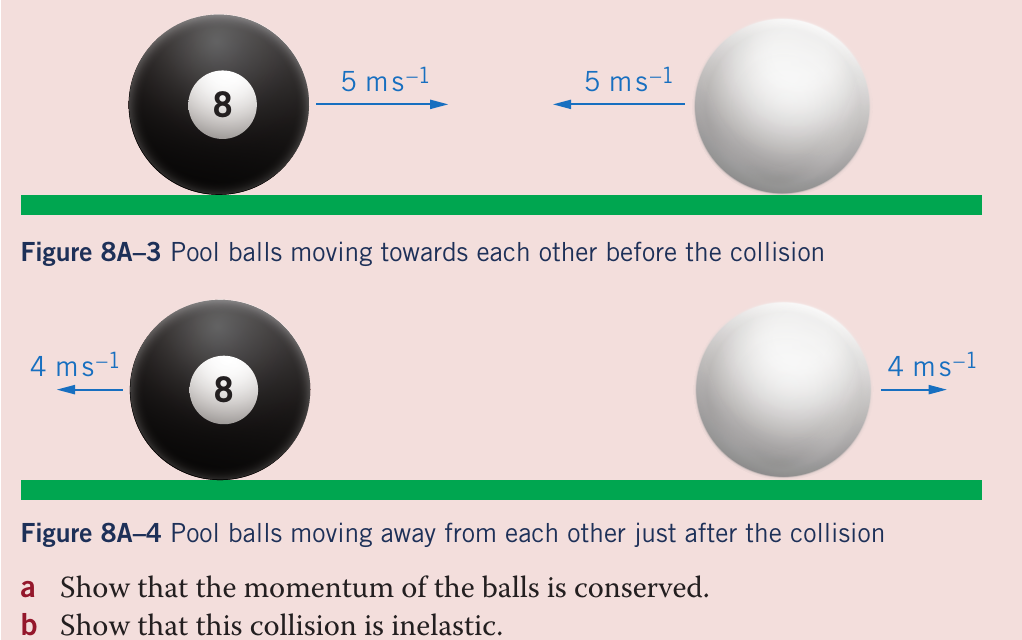
a) Show that momentum is conserved
Calculate total momentum before collision:
Note: one ball must have negative velocity as they move in opposite directions.
Calculate total momentum after collision:
Since , momentum is conserved.
b) Show that the collision is inelastic
Calculate total kinetic energy before collision:
Calculate total kinetic energy after collision:
Since , the collision is inelastic. Some kinetic energy was converted to other forms (heat, sound, deformation).
Change in momentum (impulse)
When we consider all objects in a collision, momentum is conserved in a closed system. However, when we focus on just one object, its momentum can change significantly. This change in momentum is called impulse.
Impulse is defined as the change in momentum of an object, caused by a force acting for a certain amount of time. When an object's velocity changes, its momentum changes. An increase in velocity produces an increase in momentum, while a decrease in velocity produces a decrease in momentum.
The impulse equation
The relationship between force, time, and change in momentum is expressed by:
Where:
- = change in momentum (kg m s or N s)
- = impulse (kg m s or N s)
- = mass (kg)
- = final velocity (m s)
- = initial velocity (m s)
- = average net force applied (N)
- = time that the force is applied (s)
Deriving the impulse relationship
The impulse equation connects Newton's second law with momentum. Starting with Newton's second law for average net force:
Since average acceleration equals change in velocity over time:
Recognizing that is the change in momentum:
Rearranging gives the impulse equation:
Note
Key Insights:
- The change in momentum over time equals the average net force
- A larger force or longer time produces a greater change in momentum
- Impulse is a vector quantity requiring both magnitude and direction
Example
Worked Example: Applying Impulse
A person is travelling south in a car at km h when they see an object on the road. They brake and come to a complete stop in seconds. The driver has mass kg and the car has mass kg.
a) Calculate the change in momentum of the car and driver
Let south be the positive direction.
Convert the initial speed from km h to m s:
Find the change in momentum (final velocity is zero):
Therefore, the change in momentum is kg m s north (the negative sign indicates the direction opposite to initial motion).
b) Calculate the average force that the road applies to the car
Use the definition of impulse:
Therefore, the average force applied by the road is N north (in the direction opposite to the car's initial motion).
Graphing impulse: force-time graphs
The relationship between force, time, and impulse can be visualized using force-time graphs. An important principle is that the area under a force-time graph equals the impulse.
Constant force
For a constant force applied over time, the force-time graph is a horizontal line. The impulse equals the area of the rectangle formed.
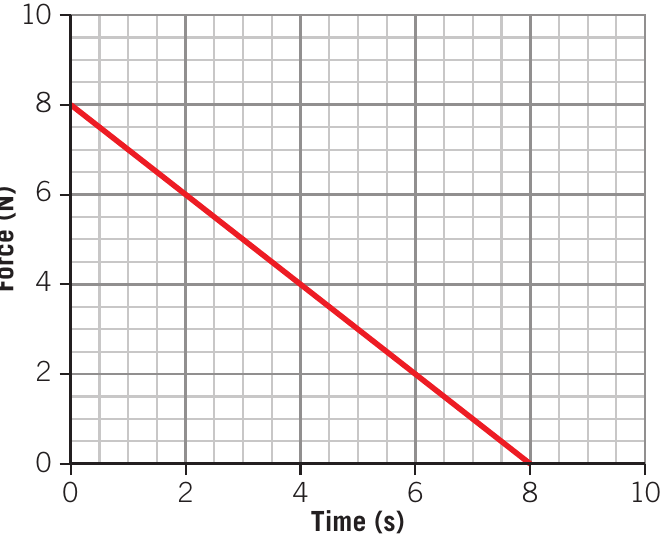
For the constant force shown:
Linearly changing force
When the force changes linearly (constant gradient), the area under the graph forms a triangle. Use the triangle area formula: .
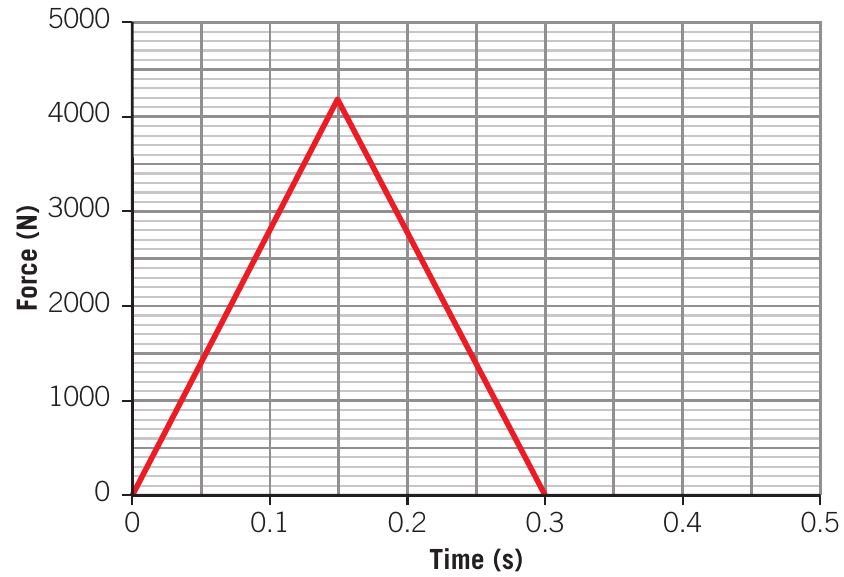
For the triangular force profile shown:
Complex force profiles
Some force-time graphs require breaking the area into multiple shapes (rectangles, triangles, trapezoids) and adding them together.
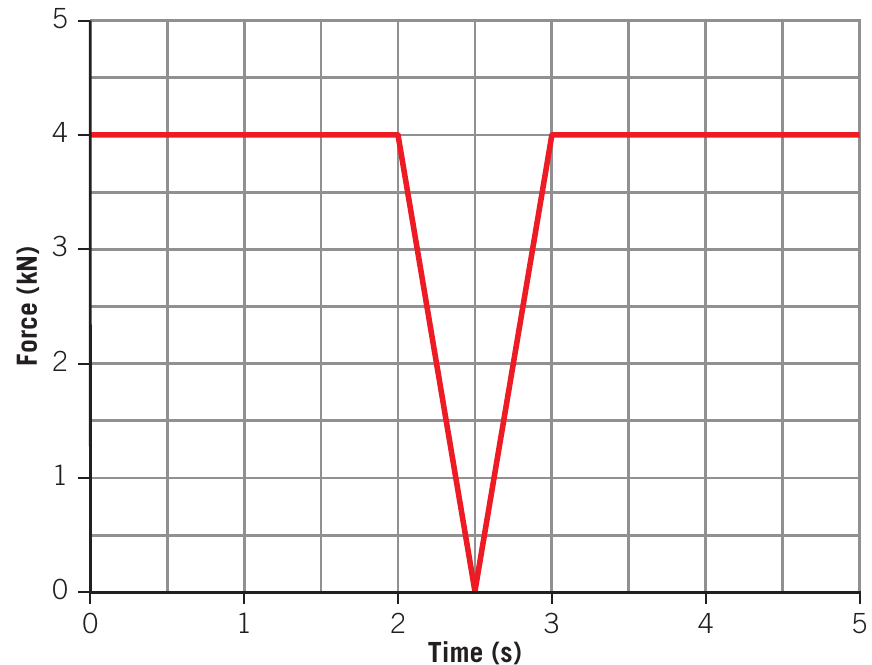
For complex profiles:
- Identify the geometric shapes that make up the area
- Calculate the area of each shape separately
- Add all areas together to find the total impulse
Practical applications
Note
Safety Engineering Application
Comparing force-time graphs helps engineers design safer equipment. For example, consider two materials tested for impact protection:
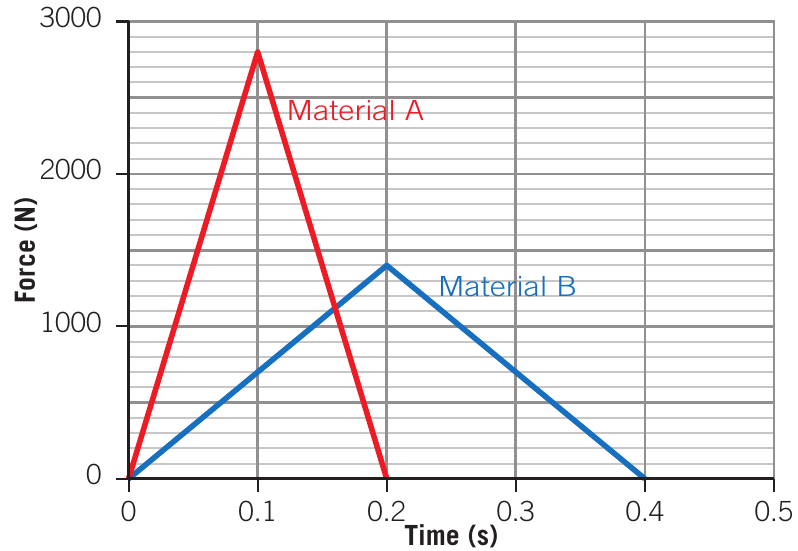
Material A produces a higher peak force but shorter duration, while Material B produces a lower peak force but longer duration. If both materials produce the same total impulse (same area under the curve), Material B may be preferable as it reduces peak forces on the body, even though the impact lasts longer.
This principle is used in designing airbags, helmets, and protective padding.
Using direction in equations
When working with vector quantities like momentum and velocity, correctly handling direction is crucial for accurate calculations. For one-dimensional motion, direction is incorporated using positive and negative signs.
Key steps for handling direction
Important
Critical Steps for Handling Direction:
Step 1: Choose a positive direction
At the start of any problem involving vectors, decide which direction will be positive. Common choices include:
- Right as positive, left as negative
- North as positive, south as negative
- East as positive, west as negative
Step 2: Write down your choice
Always write your chosen positive direction on your page. This helps you keep track of what positive and negative values mean in your answer.
Step 3: Apply signs consistently
Once you've chosen a positive direction, apply it consistently throughout all calculations. Velocities, momenta, and forces in the positive direction are positive numbers, while those in the opposite direction are negative.
Step 4: Interpret your answer
The sign of your final answer indicates direction:
- A positive result means motion in your chosen positive direction
- A negative result means motion in the opposite direction
Note
Your choice of positive direction doesn't affect the final physical answer. Choosing north as positive or south as positive will give the same magnitude, just with opposite signs. What matters is being consistent with your choice.
Example
Worked Example: Problem with Direction
Two balls, A and B, slide towards each other on a frictionless surface. Ball A has mass kg and travels at m s east. Ball B has mass kg and travels at m s west. After the collision, ball B travels at m s east. Find the velocity of ball A after the collision.
Solution:
Let east be positive (and therefore west is negative).
Apply conservation of momentum:
Before collision:
- Ball A: m s (east, so positive)
- Ball B: m s (west, so negative)
After collision:
- Ball B: m s (east, so positive)
- Ball A:
Rearrange to find :
The negative answer indicates ball A moves west at m s after the collision.
Key exam tips
Important
Essential Exam Tips:
1. Always include direction
Momentum is a vector. Always state the direction in your final answer (e.g., "north" or "to the right").
2. Convert units carefully
Watch for speeds given in km h - convert to m s by dividing by .
3. Check momentum conservation
In collision problems, verify that total momentum before equals total momentum after as a check on your working.
4. Energy is a scalar
When calculating kinetic energy to determine collision type, don't use negative signs for velocity - square the magnitude only.
5. Show all working
In calculations involving impulse or collisions, clearly show:
- Your chosen positive direction
- All substitutions into formulas
- Each step of algebraic rearrangement
- Units in your final answer
Remember!
Summary
Key Points to Remember:
-
Momentum is the product of mass and velocity: . It is a vector quantity measured in kg m s.
-
Conservation of momentum: In a closed system with no external forces, total momentum before a collision equals total momentum after: .
-
Elastic collisions conserve both momentum and kinetic energy. Inelastic collisions conserve momentum but lose kinetic energy to other forms like heat and sound.
-
Impulse is the change in momentum caused by a force acting for a certain time: . The area under a force-time graph equals the impulse.
-
Always use positive and negative signs to represent direction in one-dimensional collision problems. Choose a positive direction at the start and apply it consistently throughout your calculations.