Newton’s Laws of Motion (VCE SSCE Physics): Revision Notes
📚Revision Notes
Newton's Laws of Motion
Newton's three laws of motion form the foundation of classical mechanics. These laws describe how objects move when forces act upon them and explain the relationship between force, mass, and acceleration.
Newton's first law
Newton's first law states that an object will maintain its current state of motion (whether at rest or moving at constant velocity) unless acted upon by an unbalanced net force.
Note
This law describes the property of inertia - the tendency of objects to resist changes in their motion. The more massive an object, the greater its inertia and the more force required to change its motion.
Understanding the first law
Consider a vehicle travelling on a road. Two scenarios illustrate the first law:
Vehicle at rest: When a car is stationary, the net force is zero. The normal force from the ground balances the gravitational force pulling downward. Without an unbalanced force, the car remains at rest.
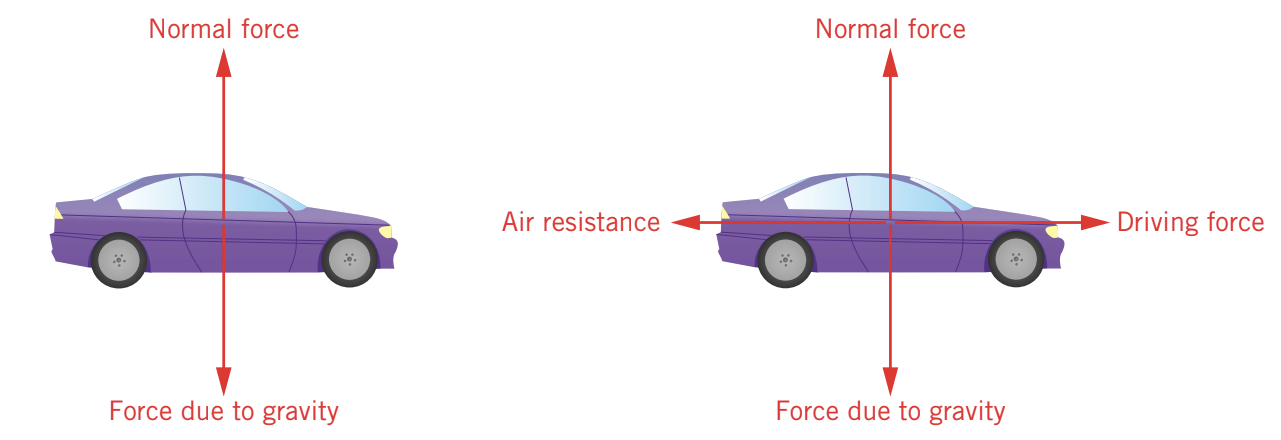
Vehicle at constant velocity: When a car moves at constant velocity on a straight road, the net force is still zero. The driving force balances air resistance and friction, while the normal force balances gravity. The car continues at constant velocity.
The role of friction
In everyday experience, moving objects eventually come to rest. This appears to contradict the first law, but actually demonstrates it. Friction provides an unbalanced force opposing motion, causing objects to slow down. Without friction, objects would continue moving indefinitely at constant velocity.
Important
A common misconception is that objects naturally slow down. In reality, objects only slow down because friction applies an unbalanced force. In the vacuum of space, where friction is negligible, objects continue moving at constant velocity indefinitely.
Newton's second law
Newton's second law states that the acceleration of an object is directly proportional to the net force acting on it and inversely proportional to its mass.
Mathematical expression
Where:
- = net force acting on the object (N)
- = mass of the object (kg)
- = acceleration of the object (m s)
Force diagrams
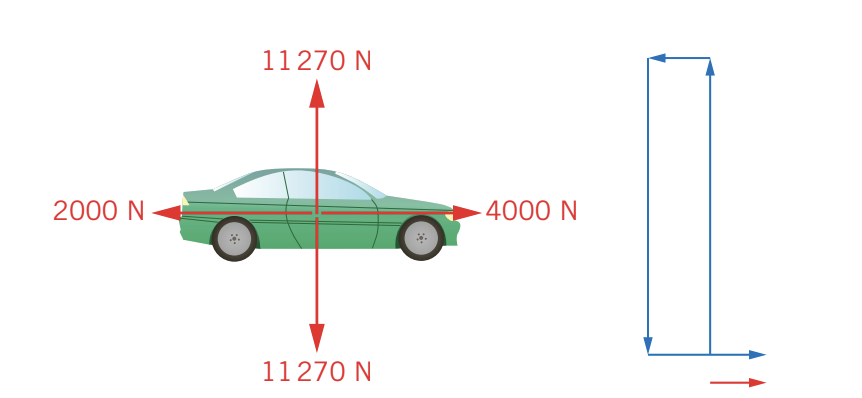
A force diagram shows all forces acting on an object, with arrows indicating the magnitude and direction of each force. These diagrams help visualize the net force.
Example
Worked Example: Calculating Car Acceleration
A car experiences:
- Upward normal force: 11,270 N
- Downward gravitational force: 11,270 N (these balance)
- Forward driving force: 4000 N
- Backward air resistance: 2000 N
The net horizontal force is: N forward
Using Newton's second law with mass kg:
Different masses, same acceleration
When multiple objects experience the same acceleration, they don't necessarily experience the same force. The force depends on the mass.
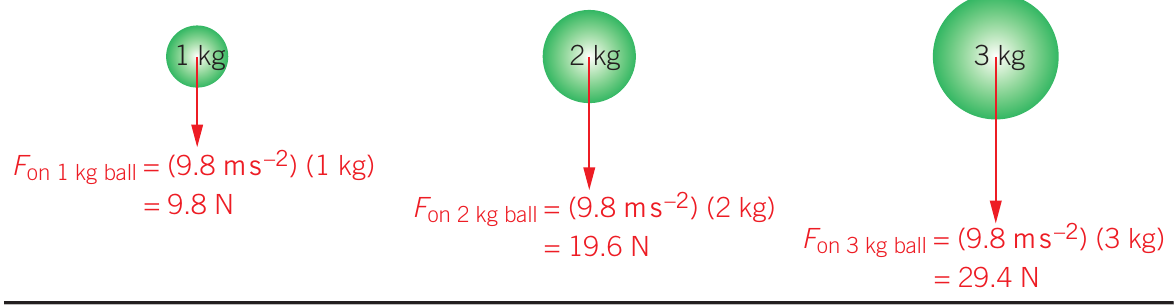
Consider three balls dropped from the same height. They all accelerate at m s toward Earth, but experience different gravitational forces:
- 1 kg ball: N
- 2 kg ball: N
- 3 kg ball: N
Acceleration versus velocity direction
Important
Critical Concept: Acceleration direction and velocity direction are independent. The net force determines acceleration direction, not velocity direction.
Example 1 - Braking car: A car approaching a red light has forward velocity but backward acceleration (and backward net force) as it slows down.
Example 2 - Projectile motion: A ball thrown vertically upward has upward velocity but downward acceleration (due to gravity) throughout its flight. The upward velocity decreases until the ball momentarily stops at maximum height, then falls with increasing downward velocity.
Newton's third law
Newton's third law states that forces always occur in equal and opposite pairs. Every action force has an equal magnitude reaction force in the opposite direction.
Mathematical expression
This equation shows that when object A exerts a force on object B, object B simultaneously exerts an equal magnitude force on object A in the opposite direction.
Note
Important points about force pairs:
- Force pairs act on different objects (one on A, one on B)
- Force pairs are equal in magnitude regardless of object size
- Force pairs are opposite in direction
- Force pairs occur for all types of forces (contact, gravitational, magnetic, electrostatic)
Examples of action-reaction pairs
Touching blocks
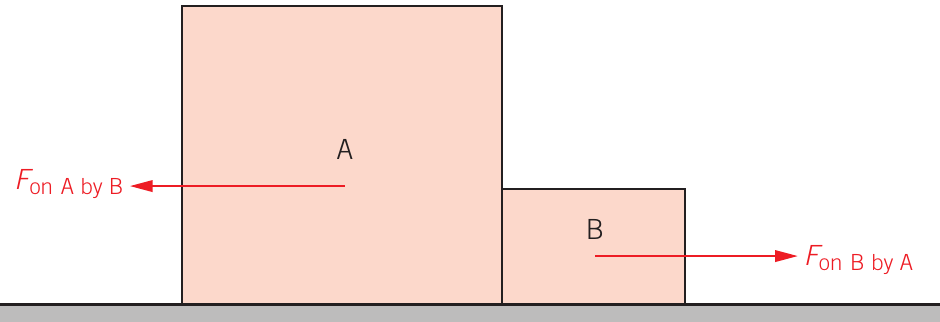
When two blocks A and B are in contact, block A pushes on block B with some force. Simultaneously, block B pushes back on block A with equal magnitude force in the opposite direction.
Aircraft wings

Aircraft wings are designed to push air downward. The air responds by pushing upward on the wings with equal force, providing lift.
Vehicle motion
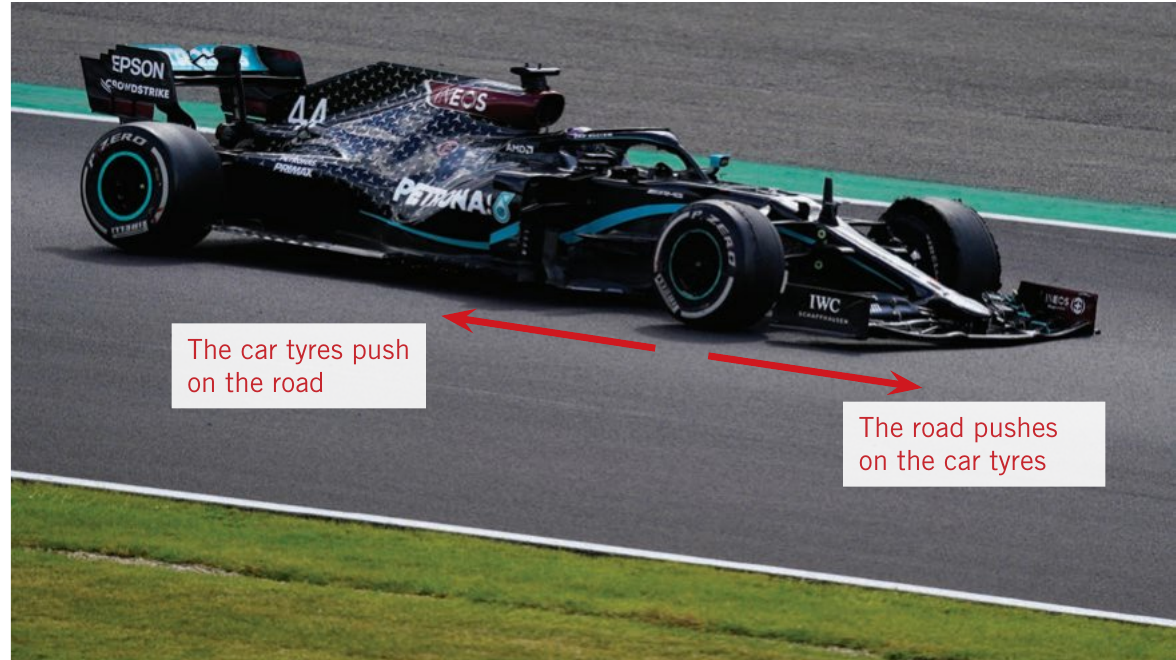
When a car's tyres push backward on the road, the road pushes forward on the tyres with equal force, propelling the car forward.
Rocket propulsion
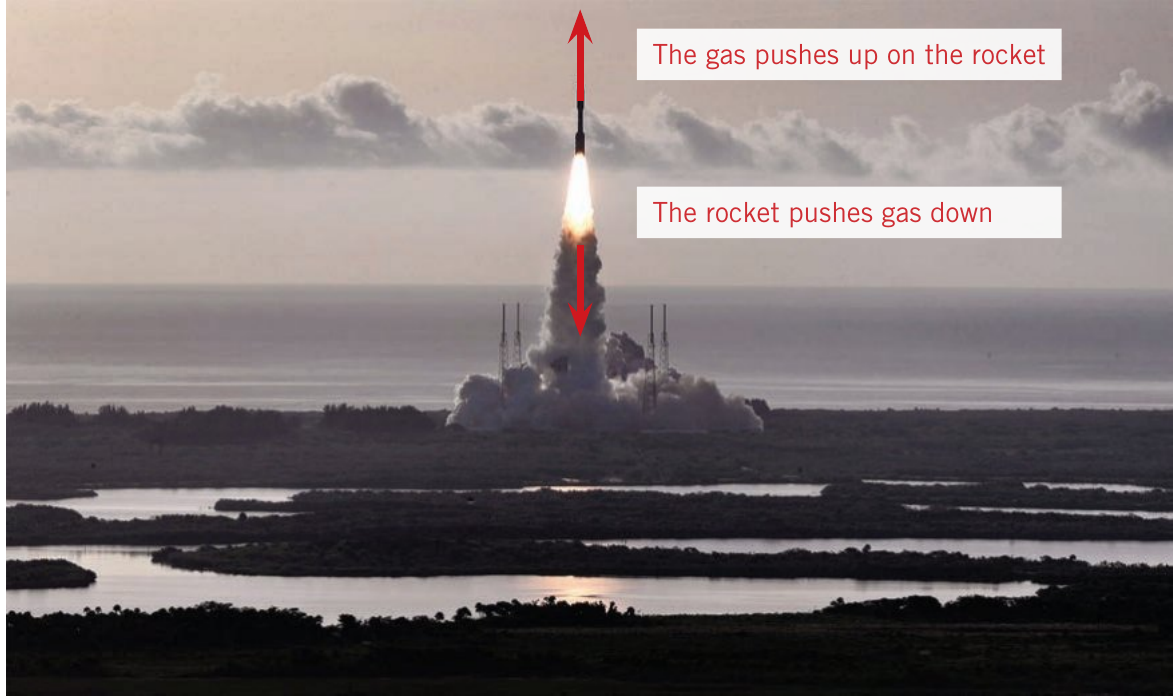
A rocket pushes hot gases downward through its nozzle. The gases push upward on the rocket with equal force, accelerating the rocket upward.
Normal force
The normal force is the perpendicular contact force that a surface exerts on an object resting on it. This force prevents objects from falling through surfaces.
Understanding normal force
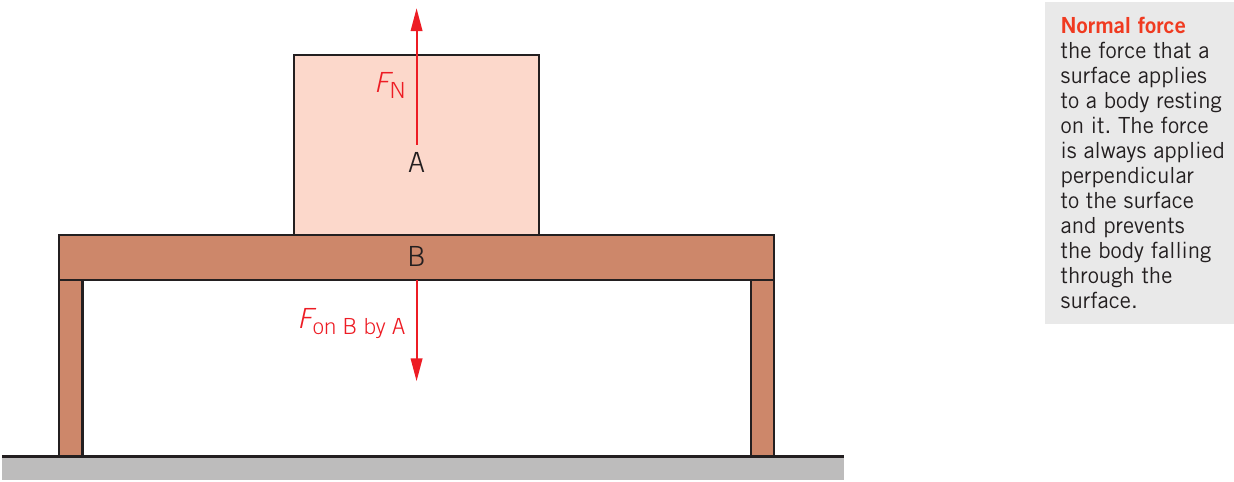
Consider a box A resting on table B:
- The gravitational force pulls box A downward
- Box A pushes down on table B (force on B by A)
- Table B pushes upward on box A - this is the normal force
Important
Common Misconception Alert
A common misconception is that normal force always equals the gravitational force. While they're often equal in magnitude, they are not an action-reaction pair because:
- They act on the same object (both on box A)
- Action-reaction pairs must act on different objects
Normal force is not always equal to weight
The normal force adjusts based on other forces:
- If you push down on the box, the normal force increases
- If you pull up on the box, the normal force decreases
Changing normal forces in lifts
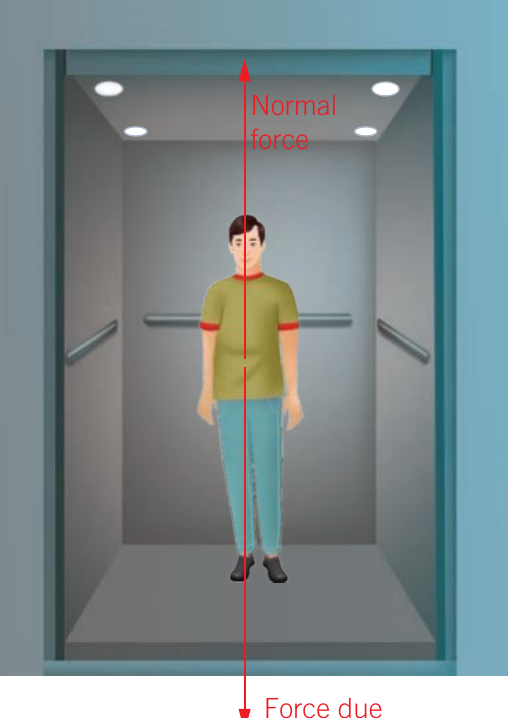
When standing in a lift (elevator), you experience only two vertical forces:
- Gravitational force (downward)
- Normal force (upward)
The normal force changes with the lift's acceleration.
Summing vertical forces:
Since :
Rearranging:
Where:
- = normal force (N)
- = mass (kg)
- = vertical acceleration (m s), positive upward
- = gravitational field strength, N kg (m s)
Note
Cases:
- Stationary or constant velocity: , so (normal equals weight)
- Accelerating upward: , so (you feel heavier)
- Accelerating downward: , so (you feel lighter)
- Free fall: m s, so (weightlessness)
Weightlessness in orbit

Astronauts in space stations experience apparent weightlessness because they're in continuous free fall around Earth. The gravitational field strength at orbital altitude is still significant (approximately N kg), but there's no normal force from a surface, creating the sensation of floating.
Force due to gravity
Every object with mass experiences gravitational attraction toward Earth. This force acts at the object's centre of mass and always points toward Earth's centre.
Gravitational force formula
Where:
- = force due to gravity (N)
- = mass (kg)
- = gravitational field strength = N kg near Earth's surface (m s or N kg)
Understanding gravity's action-reaction pair
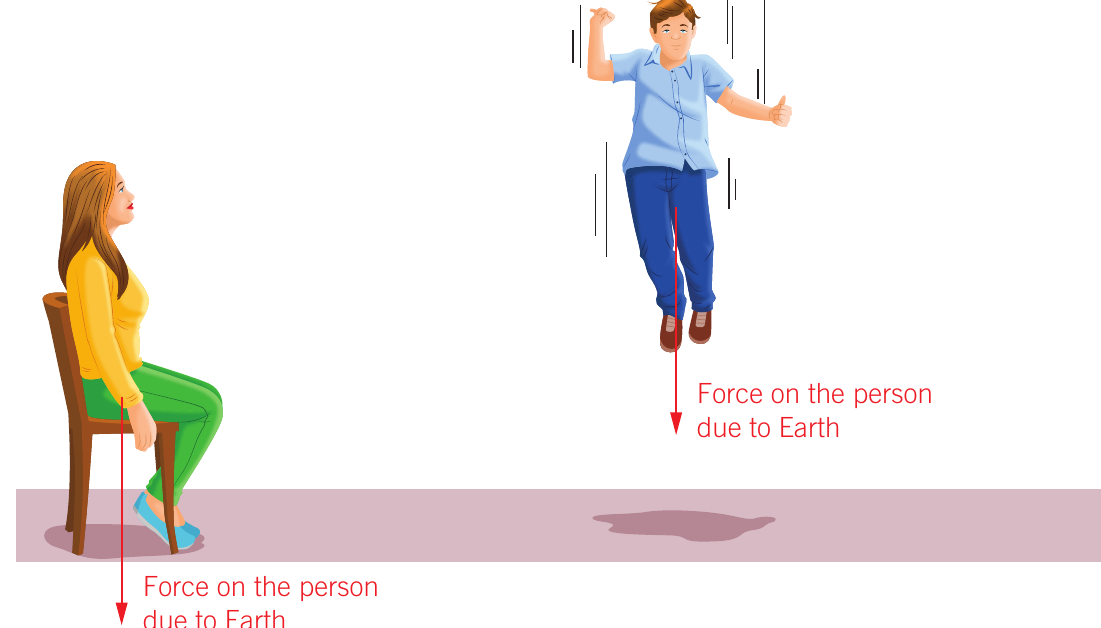
A common mistake is identifying the wrong force pair for gravity. Consider a person sitting in a chair:
Incorrect: The force pair is the normal force from the chair.
Correct: The force pair is Earth being gravitationally attracted to the person.
Important
Newton's third law describes interactions between two objects. When sitting, the gravitational interaction is between the person and Earth:
- Earth pulls the person downward
- The person pulls Earth upward (with equal magnitude)
This is true whether the person is sitting or falling - gravity is a non-contact force that always acts.
Gravitational field strength
The gravitational field strength represents the gravitational force per unit mass. Near Earth's surface, N kg, which is numerically equivalent to the acceleration due to gravity, m s.
This value changes with location:
- Lower on other celestial bodies (e.g., Moon: approximately N kg)
- Changes with altitude above Earth's surface
Mass versus weight
Note
Critical Distinction:
- Mass (): measure of matter in an object; resistance to acceleration; constant everywhere (kg)
- Weight (): gravitational force on an object; varies with gravitational field strength (N)
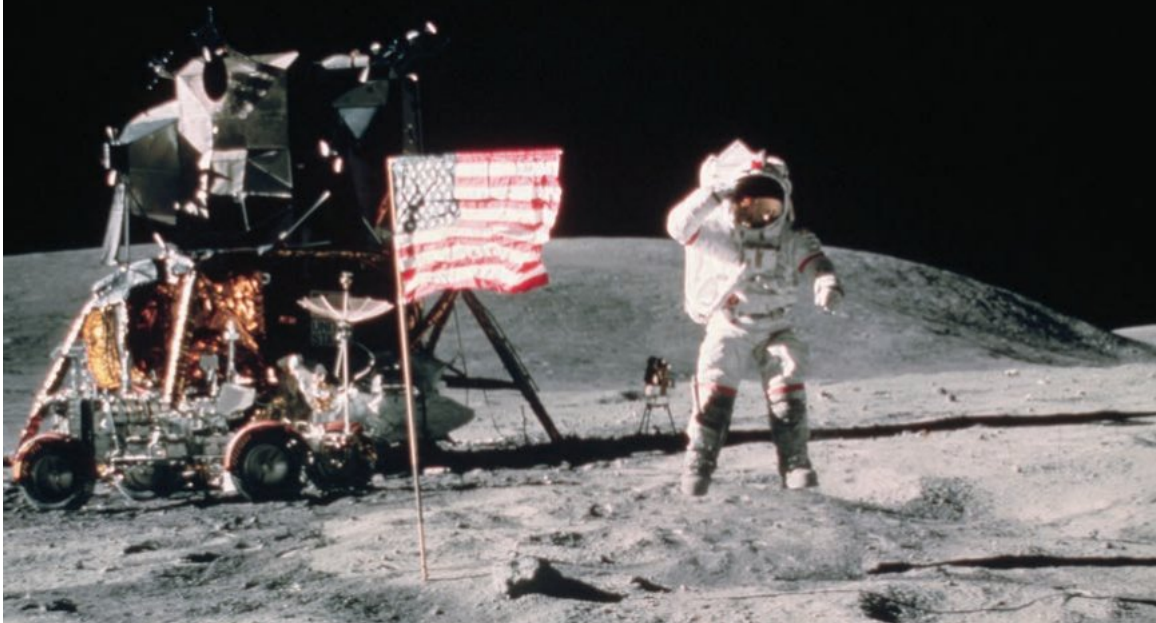
An astronaut with mass kg has:
- Mass on Moon: kg (unchanged)
- Weight on Moon: N (about 16.5% of Earth weight)
- Weight on Earth: N
Applying Newton's laws
Worked example: Forces between touching blocks
Two blocks move together on a frictionless surface. Block A has mass kg and block B has mass kg. A force of N pushes them to the right.
Example
Worked Example: Forces Between Touching Blocks
Calculate:
a) The acceleration of the blocks
b) The force on block B by block A
c) The force on block A by block B
Solution:
a) Since the blocks move as one system, add the masses:
b) Block B accelerates at m s due to the force from block A:
c) By Newton's third law, block B exerts an equal and opposite force on block A:
Worked example: Pulley system
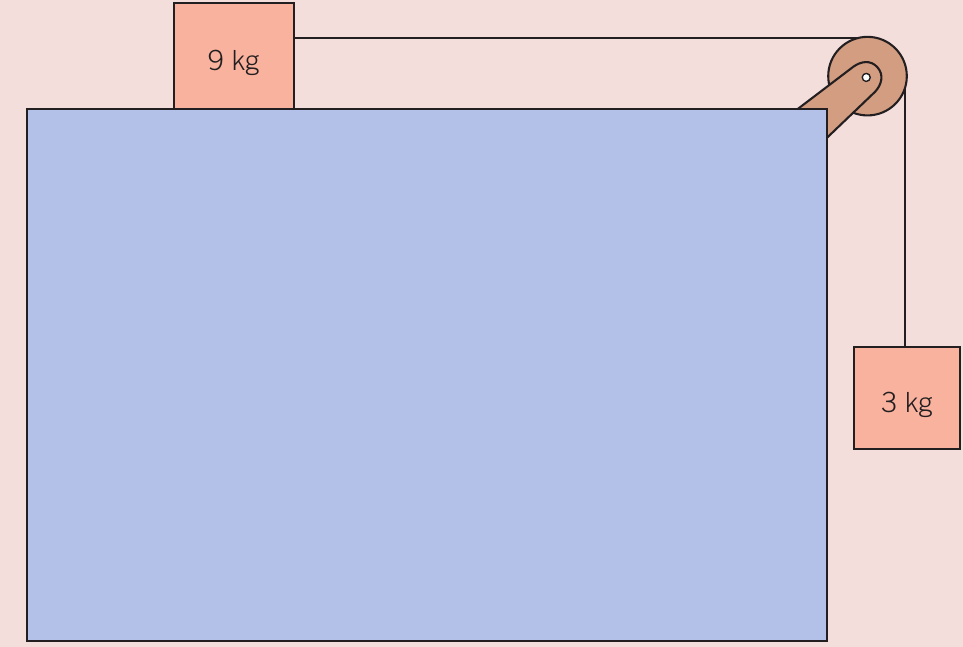
A kg mass rests on a frictionless table, connected by a string over a frictionless pulley to a hanging kg mass.
Example
Worked Example: Pulley System Analysis
Calculate: a) The acceleration of the system b) The tension in the string
Solution:
a) The hanging mass creates a downward force due to gravity. This is the net force on the entire system:
The total mass of the system is kg:
b) The tension accelerates the kg block at m s:
Therefore, the tension is N.
Worked example: Train system

A steam engine (mass kg) tows two carriages (each kg) connected by cables X and Y. The engine produces a driving force of N.
Example
Worked Example: Train System with Multiple Connections
Calculate: a) The system's acceleration b) Tension in cable X c) Tension in cable Y
Solution:
a) Total mass = kg:
b) Cable X tows both carriages (total mass kg):
c) Cable Y tows one carriage (mass kg):
Inclined planes
Objects on slopes experience three forces: gravity (vertically downward), normal force (perpendicular to surface), and friction (parallel to surface).
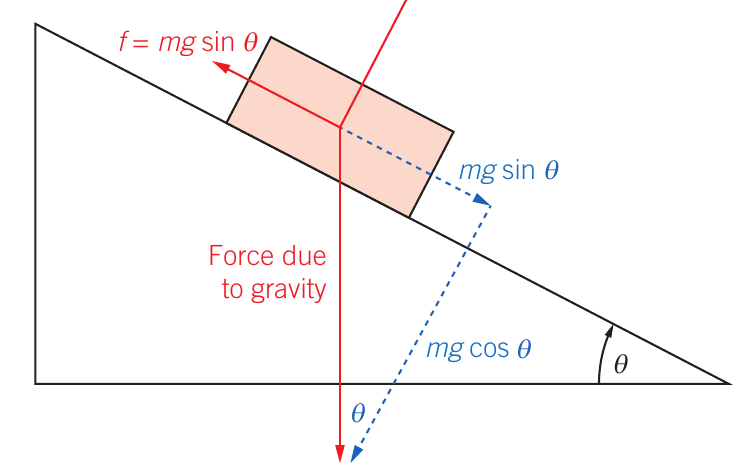
Force components on a slope
The gravitational force can be resolved into two components:
- Perpendicular to slope:
- Parallel to slope:
When an object is stationary on a slope, forces balance:
- Normal force:
- Friction force:
Frictionless slope
On a frictionless slope, the object accelerates down the slope with force :
Where:
- = acceleration down the slope (m s)
- = gravitational field strength = N kg
- = angle of slope (degrees)
Important
Key Insight: The acceleration on a frictionless slope is independent of mass. A heavy object and a light object will accelerate down a frictionless incline at the same rate (assuming no air resistance).
Worked example: Car on inclined driveway
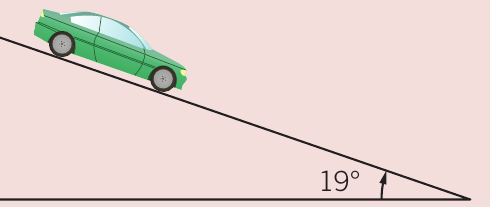
A kg car is parked on a driveway inclined at .
Example
Worked Example: Forces on an Inclined Plane
Calculate: a) Normal force on the car b) Friction force on the car c) Acceleration if friction becomes zero (icy conditions)
Solution:
a) Normal force (perpendicular component):
b) Friction force (parallel component):
c) Acceleration on frictionless icy slope:
Application: The physics of car safety
Understanding Newton's laws has dramatically improved vehicle safety over the past 50 years. Australian road deaths decreased from 3,798 in 1970 to 1,195 in 2019, despite increased vehicle numbers.
Seatbelts and the first law
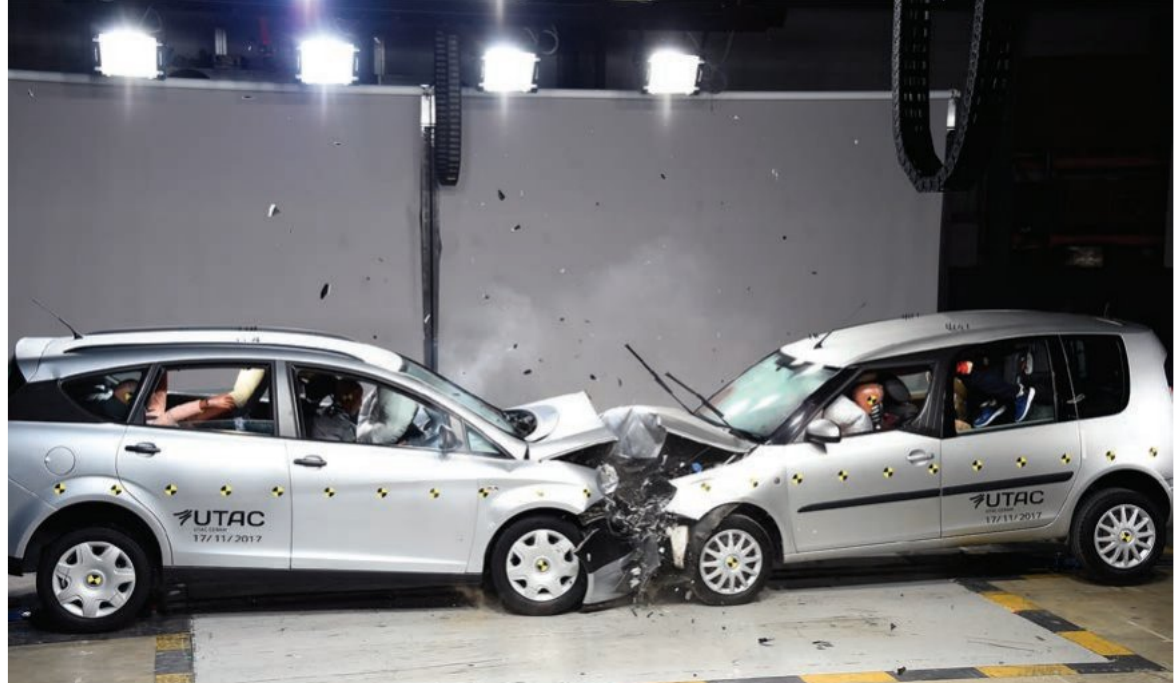
Before seatbelt requirements (1972 in Australia), passengers in crashes demonstrated Newton's first law dramatically. When a vehicle crashes at km h:
- The car experiences an unbalanced force and decelerates
- Unrestrained passengers continue at 90 km·h⁻¹ (first law)
- They collide with the dashboard, steering wheel, or windscreen
Note
Seatbelts apply an unbalanced force across the shoulders and hips (strong body parts), causing passengers to decelerate with the vehicle, preventing dangerous collisions with interior surfaces.
Airbags and impulse
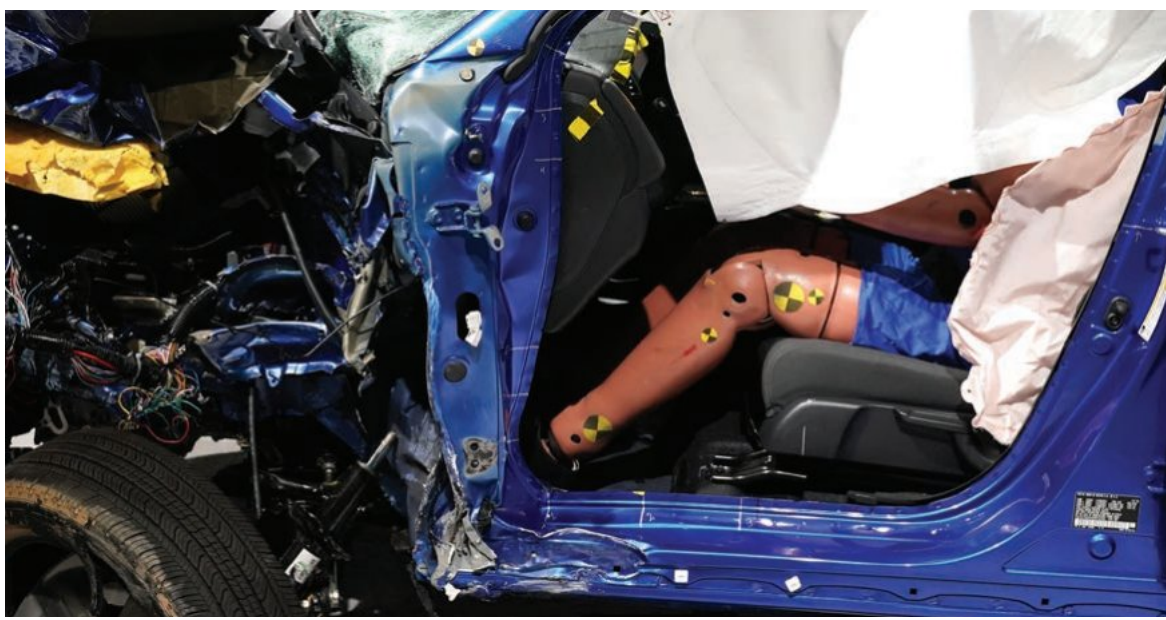
While seatbelts restrain the body, heads can still strike the steering wheel. Airbags (introduced around 1980) address this by:
- Inflating rapidly during a crash
- Spreading the impact force over a larger area (reducing pressure)
- Extending the collision time
From the impulse-momentum relationship:
Important
For the same momentum change (impulse), increasing collision time decreases the average force on the occupant. This is why airbags are so effective at preventing injury.
Crumple zones
Early vehicles were designed to be rigid, which seemed protective. Modern vehicles have crumple zones - designated areas (front, rear, sometimes sides) designed to deform during collisions.
Benefits:
- Increase collision duration
- Reduce average force on occupants (by impulse relationship)
- Absorb collision energy through deformation
The passenger compartment remains rigid to prevent crushing, while surrounding zones absorb impact energy.
Electric vehicles and safety

Electric vehicles offer additional safety advantages:
Enhanced crumple zones: Without a combustion engine, the entire front can act as a crumple zone, further extending collision time.
Lower centre of mass: Heavy batteries positioned at the vehicle base reduce rollover risk.
Active safety systems: Many electric vehicles incorporate:
- Forward collision warning with automatic emergency braking
- Blind spot monitoring
- Lane departure warning and keeping assistance
- Autopilot and self-driving capabilities
These technologies, grounded in physics understanding, continue reducing road casualties and may eventually eliminate traffic deaths through autonomous driving.
Summary
Key Points to Remember:
-
Newton's First Law: Objects maintain constant velocity (including zero) unless acted upon by an unbalanced net force. This property is called inertia.
-
Newton's Second Law: - acceleration is proportional to net force and inversely proportional to mass. The direction of acceleration matches the direction of net force, which may differ from velocity direction.
-
Newton's Third Law: - forces always occur in equal and opposite pairs acting on different objects.
-
Normal force is the perpendicular contact force from a surface. It varies with acceleration ( in lifts) and is not always equal to weight.
-
Gravitational force acts at an object's centre of mass. Weight (force) varies with gravitational field strength, but mass remains constant everywhere.
-
On inclined planes, gravity components are: perpendicular (balanced by normal force) and parallel (balanced by friction when stationary; causes acceleration when frictionless).
-
Car safety features (seatbelts, airbags, crumple zones) reduce injury by spreading forces and extending collision time, thereby reducing average force for the same momentum change.