Gravity and Gravitational Fields (VCE SSCE Physics): Revision Notes
📚Revision Notes
Gravity and Gravitational Fields
Introduction: The nature of gravity
Gravity is one of the fundamental forces in physics. It is the gravitational force that holds you to Earth, keeps the Moon in orbit around Earth, and holds Earth in orbit around the Sun. This same force extends throughout our Milky Way Galaxy, holding together billions of stars. In our Local Group, three large galaxies (the Triangulum Galaxy, the Milky Way, and the Andromeda Galaxy) are all held together by gravity.
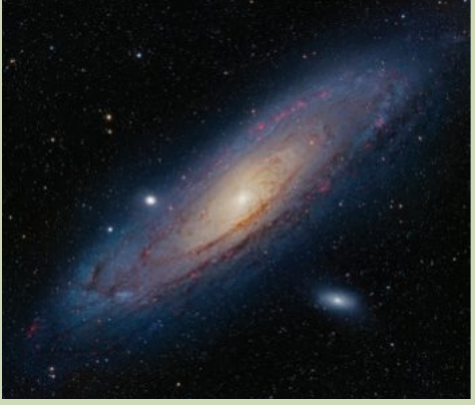
At the centre of our galaxy sits a supermassive black hole containing the mass of 4.3 million suns, where gravity is so strong that even light cannot escape. Throughout the known universe, approximately galaxies are all governed by gravity.
Historical understanding of gravity
The study of gravity has a rich history spanning cultures and millennia:
- Ancient Greece (400 BC): The philosopher Aristotle wrote early discussions about gravitation
- 7th century: The Indian astronomer Brahmagupta described gravity as an attractive force
- Early 17th century: Galileo Galilei discovered that all objects accelerate equally in free fall under gravity's influence
- Mid-17th century: Isaac Newton formulated his law of universal gravitation
Aboriginal and Torres Strait Islander knowledge
Note
Aboriginal and Torres Strait Islander peoples have held a practical understanding of gravity for approximately 50,000 years. The physics of throwing spears and boomerangs demonstrates mastery of both contact and non-contact forces, including a sophisticated understanding of projectile motion.

The Yolngu people of the Northern Territory developed detailed knowledge of the Moon's influence on tides. Their stories explain the Moon's phases and accurately link the Moon with changing tides. This knowledge allowed them to predict ocean phenomena such as the time and height of the next tide. This represents a deep practical understanding that contrasts with even the great astronomer Galileo Galilei, who did not believe the Moon was connected to tidal phenomena.
What are gravitational fields?
Masses attract each other even when they are not touching - this is called action at a distance. In 1849, the English scientist Michael Faraday proposed the concept of a field while studying electromagnetism. Faraday's field referred to "a region in the vicinity of a magnet affected by some force."
Field: A region where an object feels a force, such as gravitational, electric, or magnetic force. More precisely, a field is a physical quantity that has a value at each point in space.
Types of fields: Scalar and vector fields
Fields can be classified into two main types:
Scalar fields
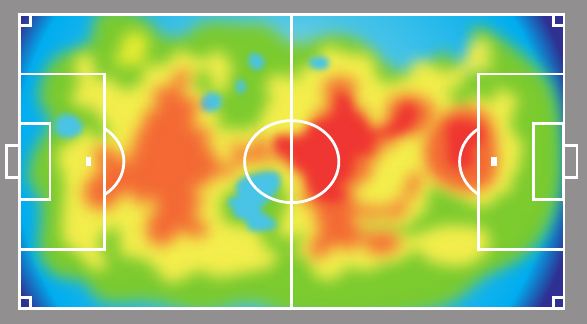
A scalar field assigns a single numerical value to each point in space. An example is a heat map used in sports analytics to show a player's movement during a game. These maps indicate the frequency and range of movement but do not show direction.
Vector fields
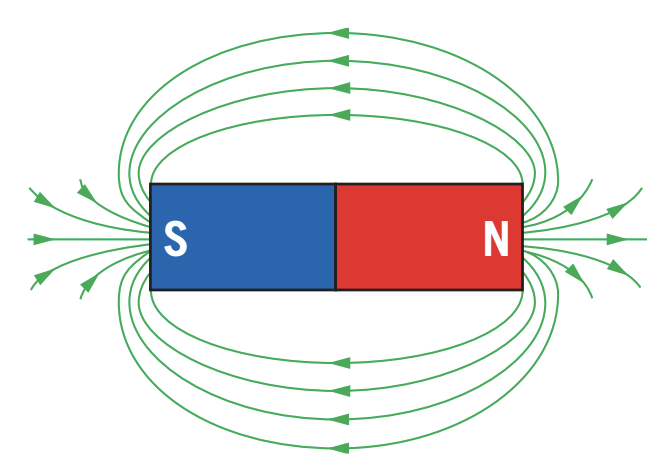
Gravitational, electric, and magnetic fields are all vector fields. They provide both:
- The magnitude (strength) of the field at each point
- The direction of the field at that point
Note
The key difference: scalar fields only tell you "how much" at each point, while vector fields tell you both "how much" and "which way". Temperature is scalar (only has magnitude), but wind is a vector field (has both speed and direction).
Field line conventions
Important
Field lines are drawn to represent vector fields with specific conventions:
- Arrows indicate the direction of the field
- Closer field lines indicate a stronger field
- Wider spacing indicates a weaker field
- Field lines never intersect - if they did, it would indicate a point where the field points in two different directions simultaneously
Monopoles and dipoles
Monopole
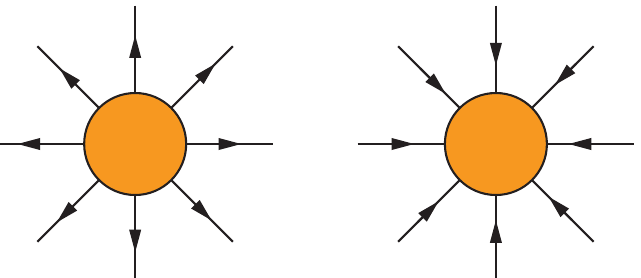
A monopole is an object that is either:
- A source of a field (field lines point away from it), OR
- A sink of a field (field lines point towards it)
But not both.
Dipole
A dipole describes a source and a sink paired together, like the north and south poles of a bar magnet.
Gravitational monopole
Mass is a gravitational monopole. Since gravity is always an attractive force, mass always acts as a sink - field lines always point towards it (right diagram above).
Gravitational field properties
A gravitational field is the region around an object where other objects will experience a gravitational force. This field:
- Exists in the space around every mass or group of masses
- Extends out in all directions
- Decreases in magnitude as distance from the object increases
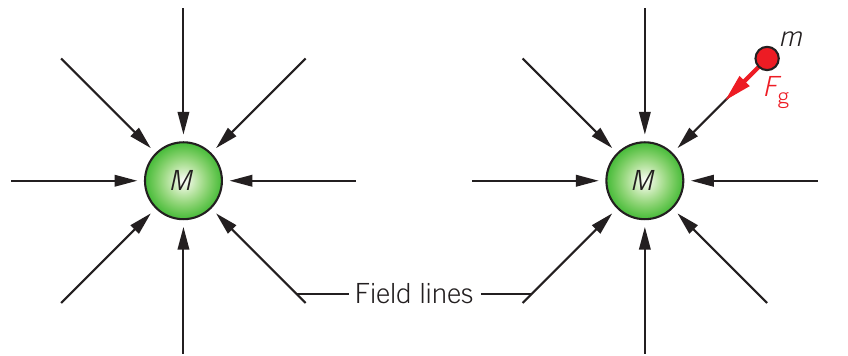
Because the gravitational field gets weaker the further out it is from the mass, it is described as a non-uniform gravitational field.
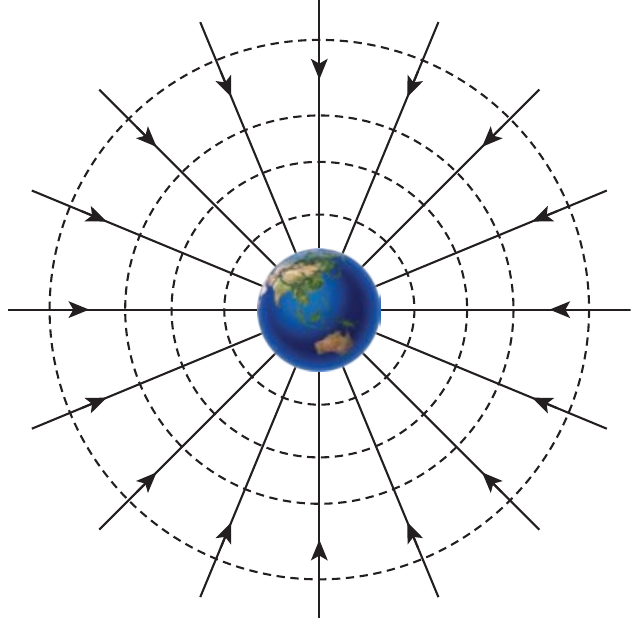
Gravitational field strength
Gravitational field strength () is measured in newtons per kilogram (Nkg⁻¹). It tells us the force acting on each kilogram of mass at that point in the field.
The diagram above shows circles of equal gravitational field strength encircling Earth, with arrows indicating the direction of the gravitational force.
Uniform gravitational fields
Close to Earth's surface, the gravitational field can be approximated as uniform. A uniform gravitational field has:
- Constant strength at all points
- The same direction at all points
When representing a uniform field, all field lines are:
- Evenly spaced
- Parallel to each other
Note
In reality, the field lines point very slightly towards each other (converging at Earth's centre), but this can be ignored for most practical purposes near Earth's surface. This approximation makes calculations much simpler for everyday problems.
Gravitational field strength values
The average magnitude of the uniform gravitational field strength measured across Earth's surface is 9.81 Nkg⁻¹. On the Moon's surface, this value is only 1.61 Nkg⁻¹ (approximately one-sixth of Earth's value).
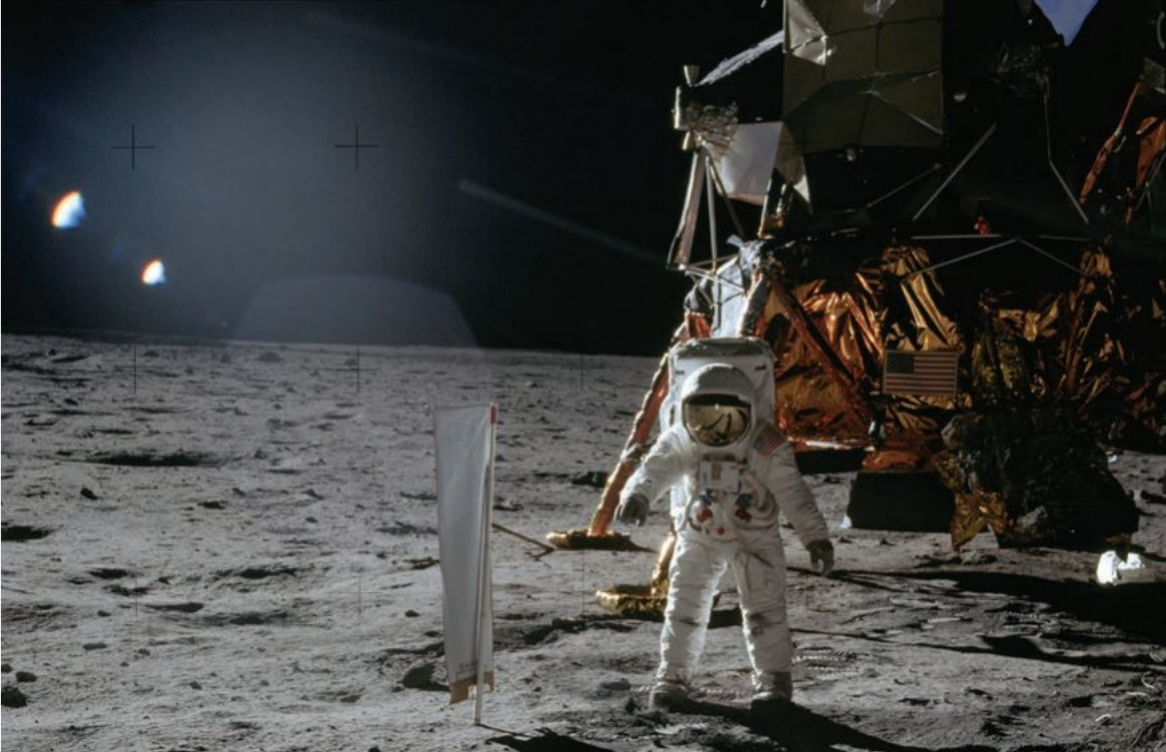
The table below shows surface gravitational field strength for planets, our Moon, and the Sun in our solar system, in ascending order:
| Body | (Nkg⁻¹) |
|---|---|
| Moon | 1.6 |
| Mercury | 3.6 |
| Mars | 3.7 |
| Uranus | 8.7 |
| Venus | 8.9 |
| Saturn | 9.0 |
| Earth | 9.8 |
| Neptune | 11.0 |
| Jupiter | 23.1 |
| Sun | 274 |
Variations in Earth's gravitational field
The gravitational field varies by about 0.5% depending on location on Earth's surface:
- At the top of Mount Everest: 9.77 Nkg⁻¹
- At the poles: 9.83 Nkg⁻¹
Note
Local variations of a few parts per million are caused by variations in the density of Earth's crust. For example:
- The field is slightly stronger over substantial underground lead deposits
- Large caverns filled with natural gas have a slightly weaker gravitational field
Gravimeter: A device used by geologists and prospectors to make extremely precise measurements of Earth's gravitational field, helping predict what may be beneath the surface. Used for petroleum and mineral prospecting, seismology, and geodesy.
Application: Using gravity mapping to study climate change
NASA has mapped Earth's gravity using the GRACE (Gravity Recovery and Climate Experiment) twin spacecraft. These satellites flew in tandem for 15 years in a polar orbit with a period of 99 minutes, completing almost 80,000 orbits.
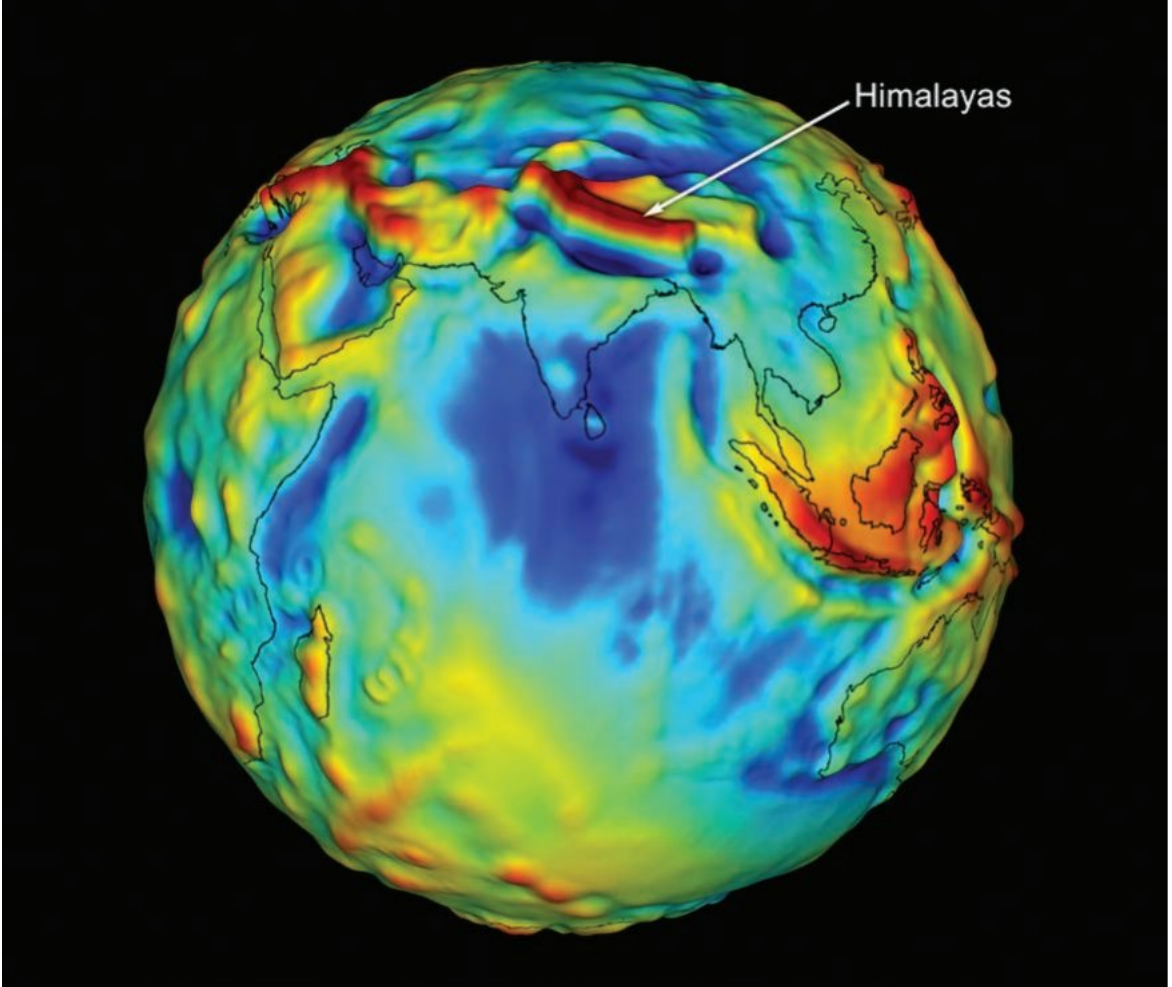
GRACE measured changes in the local pull of gravity as water shifts around Earth due to changing seasons, weather, and climate processes. The mission:
- Monitored ice mass loss from Earth's ice sheets
- Improved understanding of sea level rise and ocean circulation
- Provided insights into shrinking or growing groundwater resources
- Monitored dry soils contributing to drought
- Tracked changes in the solid Earth
Mountain ranges like the Himalayas have high concentrations of mass and therefore stronger gravitational fields (shown in warm colours on the map).
The inverse square law
Important
In three-dimensional space, point source radiators of energy (like light from the Sun) that spread uniformly in all directions follow an inverse square law. Gravity is no exception.
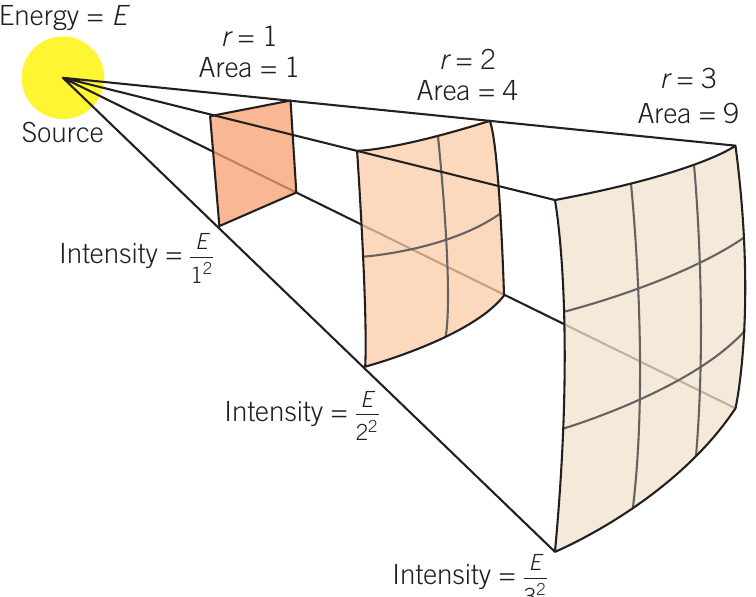
The diagram shows light radiating from a source passing through frames at single, double, and triple distances. Each frame is the same size, representing a unit of area. Close to the source, at radius , the light energy intensity is . Further away, at , the light energy intensity is now one-ninth as strong: .
Gravitational field strength formula
The strength of a gravitational field, , decreases with the square of the distance, , from the mass, , creating the field. Isaac Newton demonstrated this in 1666 by analysing Johannes Kepler's data concerning planetary orbits around the Sun.
Formula 3A-1: Gravitational field strength
Where:
- = Gravitational field strength (Nkg⁻¹ or ms⁻²)
- = Universal gravitational constant = 6.67 × 10⁻¹¹ Nm²kg⁻²
- = Mass (kg)
- = Distance from the centre of the mass (m)
Gravitational constant (): The universal gravitational constant has a value of Nm²kg⁻².
Calculating Earth's surface gravity
Substituting Earth's data into the formula:
- Radius of Earth, m
- Mass of Earth, kg
This matches the average gravitational field strength measured at Earth's surface.
Using the point mass approximation
When we treat Earth's mass as a point mass (all mass concentrated at the centre), we can calculate field strength at different distances:
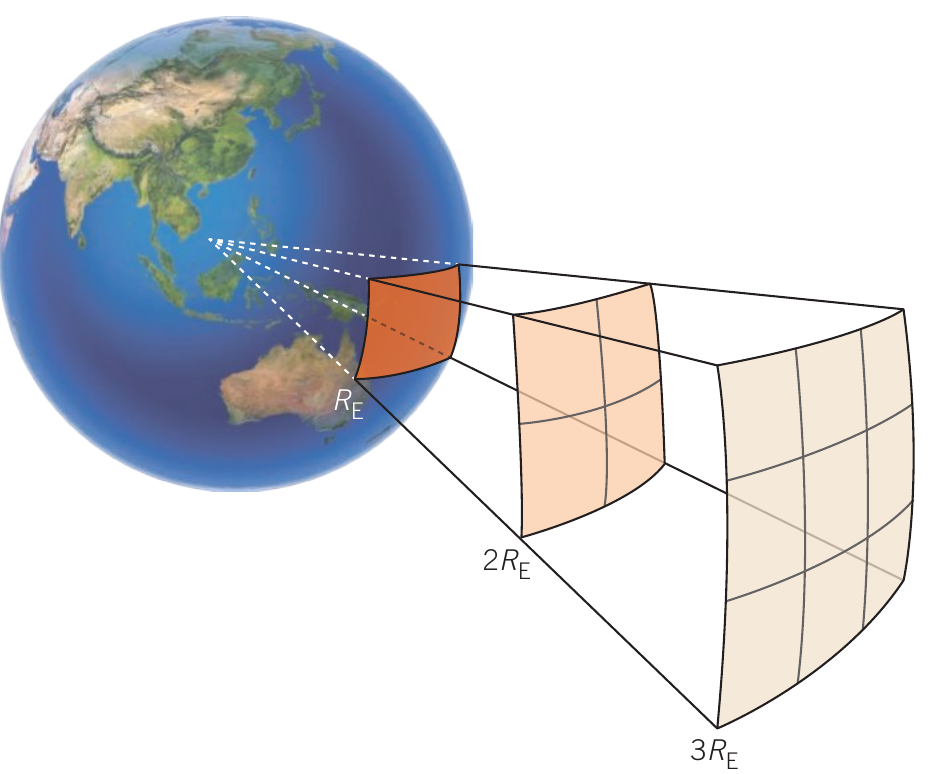
- At Earth's surface (): Nkg⁻¹
- At two Earth radii (): Nkg⁻¹
- At three Earth radii (): Nkg⁻¹
Note
Point mass: An idealisation in which all of the mass of an object is considered to be concentrated at a single point (usually the centre of mass). This approximation works well when the distance from the object is much larger than the object's size.
Worked example: International Space Station
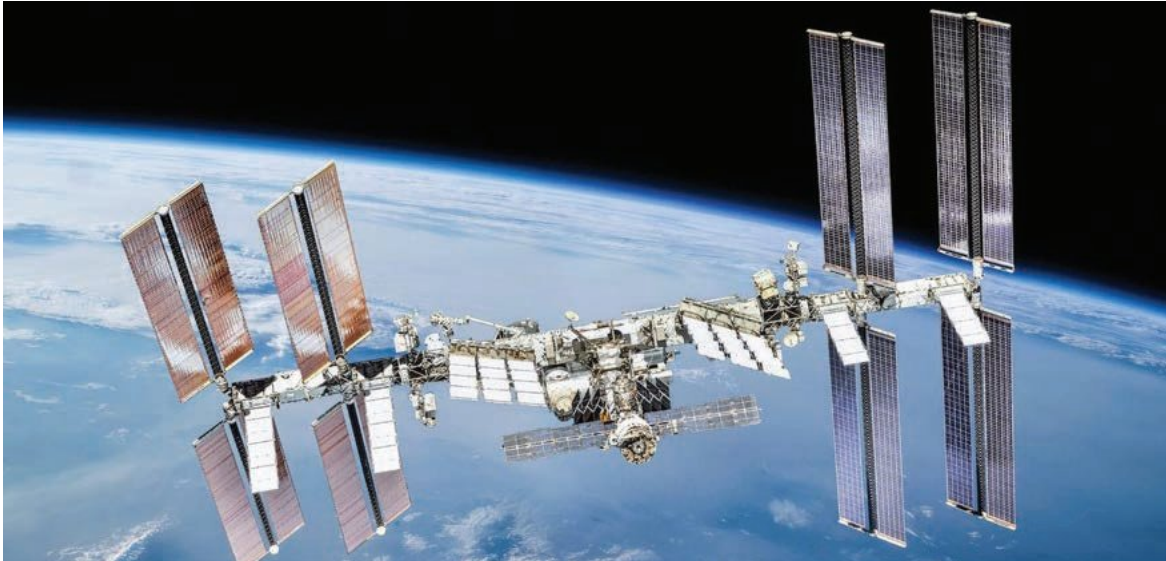
The International Space Station (ISS) orbits at a height of 408 km above Earth's surface, in a weaker gravitational field than at Earth's surface.
Example
Worked Example: Calculating gravitational field strength at the ISS
Given:
- Radius of Earth, m
- Mass of Earth, kg
- Nm²kg⁻²
Solution:
First, determine the orbital radius (distance from Earth's centre):
orbital radius of ISS = m
Then substitute into the gravitational field strength equation:
Orbital radius: The distance that a satellite is from the centre of mass of the body it is orbiting.
Graph of gravitational field strength vs distance
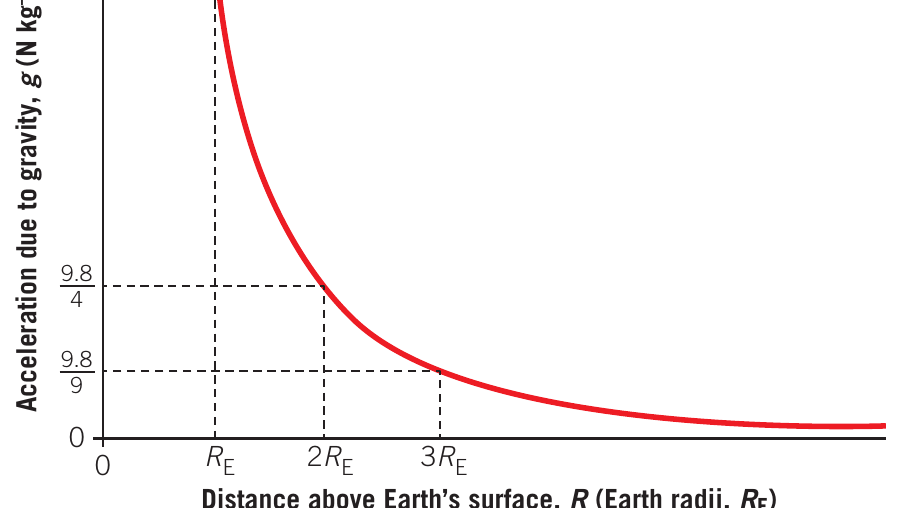
This graph shows how gravitational field strength decreases with distance above Earth's surface (measured in Earth radii, ). Note the characteristic inverse square relationship - the field strength drops rapidly at first, then more gradually at greater distances.
Force due to gravity
The gravitational force acting on an object can be determined by multiplying the mass of the object by the gravitational field strength at that point:
Where:
- = Gravitational force (N)
- = Mass of object (kg)
- = Gravitational field strength (Nkg⁻¹)
Example
Worked Example: Gravitational force on a student
Calculate the gravitational force acting on a 60.0 kg physics student close to Earth's surface.
Solution:
Acceleration due to gravity
If the gravitational force is the only force acting on an object (), then:
Important
This means that g = a - the gravitational field strength and the acceleration are equivalent.
For this reason, also gives the size of the acceleration due to gravity. The unit ms⁻² is considered equivalent to Nkg⁻¹.
Acceleration due to gravity: The rate at which a falling object will accelerate in a gravitational field. Equivalent to the gravitational field strength; measured in ms⁻².
All objects fall at the same rate
If no other forces such as air resistance are acting, all objects close to Earth's surface will fall at the same acceleration rate, regardless of their mass. Galileo originally discovered this in the mid-17th century.
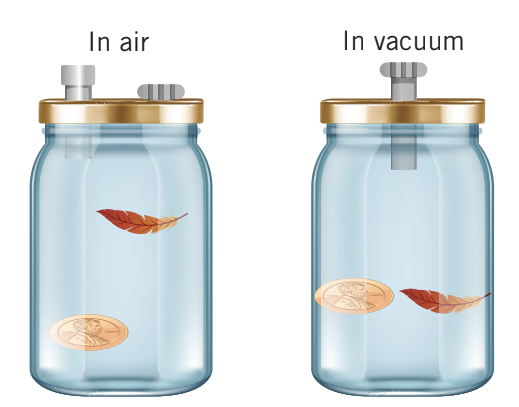
This is easily demonstrated by dropping a coin and a feather:
- In air: The coin beats the feather because of air resistance acting on the feather
- In a vacuum: When virtually all the air is removed, both land at the same time
Astronaut David Scott famously demonstrated this on the airless Moon by dropping a feather and a hammer simultaneously. Both fell at the same rate and landed on the Moon's surface at the same time.
Important
Common Misconception Alert
Aristotle's teaching that heavier objects always fall faster than lighter ones was accepted for almost 2000 years and is still a common misconception today. In reality, it is only the effects of air resistance that produce variation in the rate at which objects accelerate towards Earth.
The normal force in gravitational fields
We do not directly feel the force of gravity, . Instead, we feel normal forces that give us a sense of gravity.
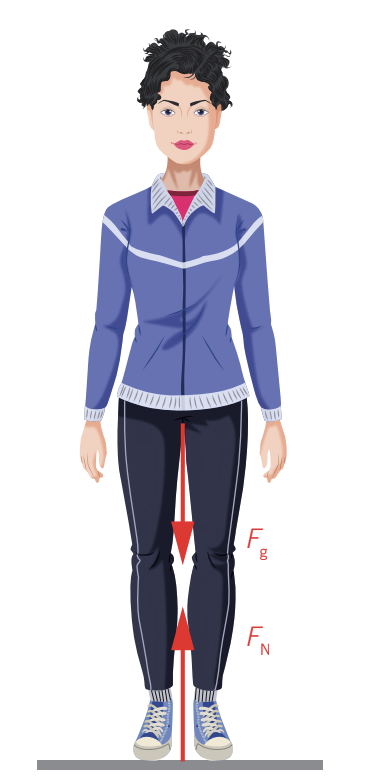
The normal force, , is what keeps us from sinking into the ground. When standing on firm ground, the surface provides an equal but opposite force on our feet:
Note
Normal force: The force that a surface applies to a body in contact with it. The force is always applied perpendicular to the surface and prevents the body from falling through the surface.
This is why we don't fall through a strong solid floor - the normal force balances the gravitational force acting downwards.
Newton's law of universal gravitation
Combining the gravitational field strength formula () with the gravitational force formula () gives us Newton's law of universal gravitation.
Formula 3A-2: Newton's law of universal gravitation
Where:
- = Force due to gravity (N)
- = Universal gravitational constant = 6.67 × 10⁻¹¹ Nm²kg⁻²
- = Mass of the first object (kg)
- = Mass of the second object (kg)
- = Distance between the centres of mass of and (m)
Newton's law of universal gravitation: The attractive gravitational force between two masses, whose centres of mass are a distance apart, is directly proportional to the product of their masses and inversely proportional to the square of the distance between them.
Newton's third law and gravity
Important
Note that the forces acting on both masses are exactly the same magnitude but in opposite directions. This is a consequence of Newton's third law: when object A exerts a force on object B, object B exerts an equal and opposite reaction force on object A.
Newton's discovery was not just that Earth's gravity creates a force on an apple pulling it down to Earth, but that the apple's gravity creates an equal force on Earth pulling it up!
- The apple accelerates down to Earth at 9.81 ms⁻²
- Earth accelerates up towards the apple at ms⁻² (not practically detectable)
However, the interaction between the Moon and Earth is more noticeable:
- Earth's force on the Moon causes it to orbit Earth
- The Moon's equal force on Earth is observable in the tides
The Moon's orbit and circular motion
Newton believed that the force of attraction between Earth and the apple, and between Earth and the Moon, was the same kind of force. He reasoned that the Moon continuously "falls" towards Earth instead of travelling off into space.
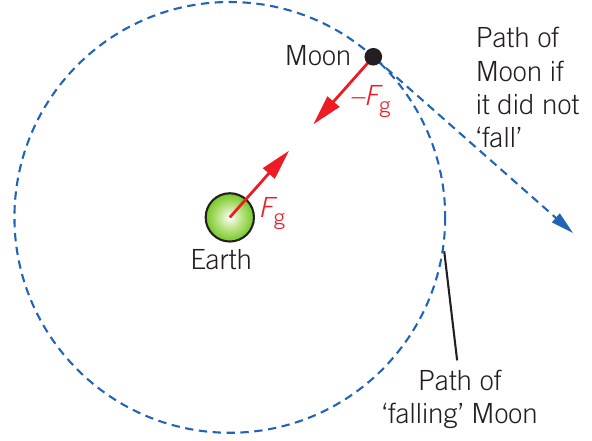
Earth's gravity provides a centripetal force on the Moon that maintains its circular path around Earth. This centripetal force causes a centripetal acceleration towards Earth.
Centripetal force: A net force directed towards the centre of the circular path of an object.
Centripetal acceleration: Acceleration directed towards the centre of the circular path of an object.
Newton's calculation for the Moon
Newton calculated the centripetal acceleration of the Moon from observation:
- Ratio of Moon's orbital radius to Earth's radius: 60
- Moon's orbital radius: m
- Moon's orbital period: s (27 days, 7 hours, 43 minutes)
Using the formula for centripetal acceleration:
This calculation helped Newton demonstrate that gravity follows an inverse square law:
The Moon experiences of the gravitational field strength because it is 60 times further from Earth's centre than an apple on the surface.
Applications of Newton's law
Planetary motion
The motion of planets around the Sun, and the interaction of planets on each other, can be understood using Newton's law of universal gravitation. The gravitational attractions of the Sun on the planets and the planets on each other explain almost all features of their motions.
Discovery of Neptune
Note
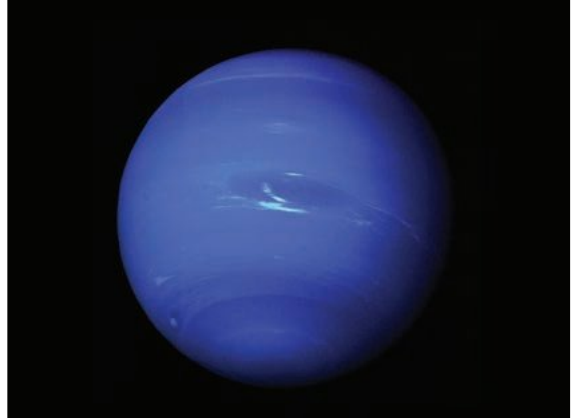
The motion of Uranus could not be fully explained by gravitational interactions with Saturn, Jupiter, and other known planets. Two 19th-century astronomers, John Couch Adams and Urbain-Jean-Joseph Le Verrier, independently deduced the existence of an unseen eighth planet.
Using Newton's law of universal gravitation, they independently calculated the position of this "new" planet. The planet, visible only through telescopes, was found in 1846 in almost exactly the predicted position and was named Neptune.
Solar system data
The table below provides modern values for various bodies in our solar system:
| Body | Mass (kg) | Radius (m) | Mean orbital radius (m) | Orbital period (s) |
|---|---|---|---|---|
| Sun | – | – | ||
| Mercury | ||||
| Venus | ||||
| Earth | ||||
| Mars | ||||
| Jupiter | ||||
| Saturn | ||||
| Uranus | ||||
| Neptune | ||||
| Pluto |
Newton's gravitational discoveries gave theoretical support to Kepler's detailed planetary observations.
Limitations and refinements
Precise measurements of Mercury's motion showed it "wobbled" faster than could be accounted for by gravitational interactions with other known planets. Astronomers searched in vain for other bodies to explain this discrepancy.
Note
The issue was only resolved in 1915 with Einstein's publication of his theory of general relativity. Einstein's theory precisely predicted Mercury's observed behaviour and refined Newton's law of universal gravitation.
Skills: Using the inverse square law for gravity
The inverse square law is useful for determining gravitational field strength at different locations when you know the field strength at one location, even if you don't know the mass creating the field.
Example
Worked Example: Satellite orbiting Mars
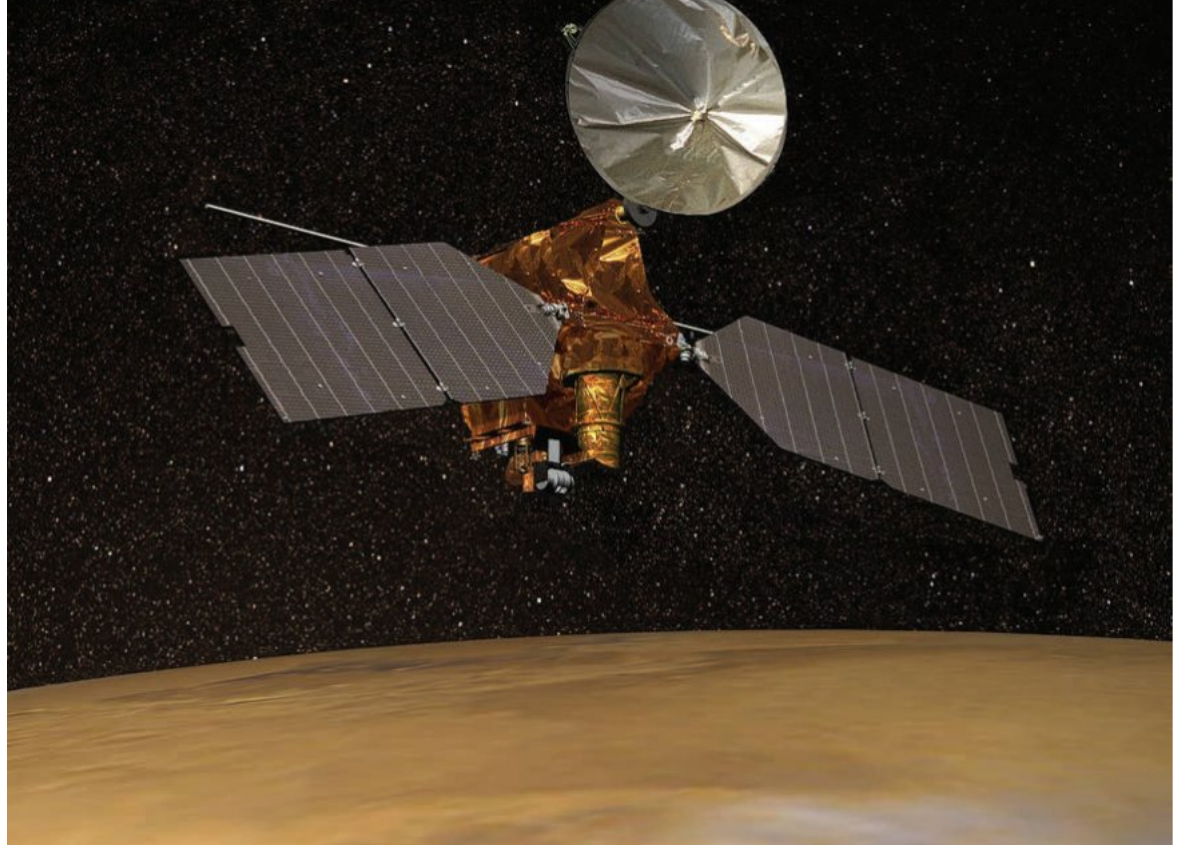
A satellite is launched into orbit around Mars at an altitude of 300 km above the surface.
Given:
- Mars' surface gravitational field strength: 3.72 Nkg⁻¹
- Radius of Mars: 3390 km
Solution:
Since , we can use the ratio method.
First, find the orbital radius:
Using the radius of Mars () and the orbital radius ():
Note: The mass of Mars, , cancels out in this equation.
Therefore, the gravitational field strength at orbital radius is:
This method is particularly useful when the mass of the planet is unknown but the surface gravity has been measured.
Remember!
Summary
Key Points to Remember:
- Gravitational fields are vector fields that exist around all masses, showing both strength and direction at each point
- Field lines closer together indicate stronger fields; they never intersect and always point towards mass (gravity is always attractive)
- Gravitational field strength () is measured in Nkg⁻¹ or ms⁻² and equals 9.81 Nkg⁻¹ at Earth's surface
- The inverse square law means gravitational field strength decreases with the square of distance:
- Newton's law of universal gravitation states that the force between two masses is , where Nm²kg⁻²
- All objects fall at the same rate in a gravitational field (when air resistance is negligible) because
- We don't feel gravity directly - we feel the normal force from surfaces pushing back against gravity