Matter as Particles or Waves (VCE SSCE Physics): Revision Notes
📚Revision Notes
Matter as Particles or Waves
Introduction to de Broglie's revolutionary idea
In 1924, French physicist Louis de Broglie proposed a groundbreaking concept that would fundamentally change our understanding of matter. He suggested that particles of matter, particularly electrons, possess wave-like properties. This revolutionary idea earned him the Nobel Prize in Physics in 1929.
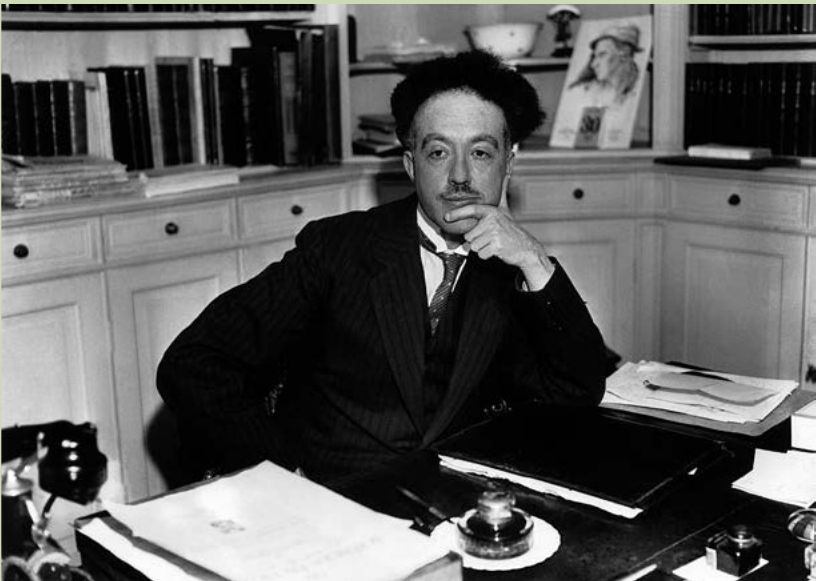
De Broglie initially described these as 'guiding waves' or 'pilot waves' for electrons. Shortly after his proposal, physicist Erwin Schrödinger developed a mathematical framework for these waves, interpreting them as representing the probability of finding an electron at a specific location. This interpretation has become the foundation of modern quantum mechanics.
Note
De Broglie's proposal was initially met with skepticism, but experimental confirmation came remarkably quickly - just three years later in 1927. This rapid verification highlighted the revolutionary nature of his insight.
Understanding wave-particle duality
The dual nature of light
Before exploring matter waves, we need to understand the dual nature of light itself. Light can be successfully modelled in two different ways:
Wave model: Light consists of transverse electromagnetic waves with oscillating electric and magnetic fields, travelling at the speed of light ( m s). This model explains phenomena such as diffraction and interference patterns.
Particle model: Light transfers energy in discrete packets called quanta or photons. Each photon carries energy , where is Planck's constant and is frequency. This model successfully explains the photoelectric effect, where light releases electrons from metal surfaces.
Important
These two models appear contradictory, but both are valid. This is known as wave-particle duality - the concept that light exhibits both wave-like and particle-like properties depending on the experimental situation. Remarkably, photons also carry momentum despite having zero mass.
The momentum of a photon is given by:
where is momentum, is Planck's constant ( J s), and is wavelength.
Diffraction of photons
Single slit diffraction with visible light
Diffraction is the spreading of waves when they pass through a narrow opening or around small objects. When a laser beam passes through a narrow slit, it produces a characteristic pattern on a screen.
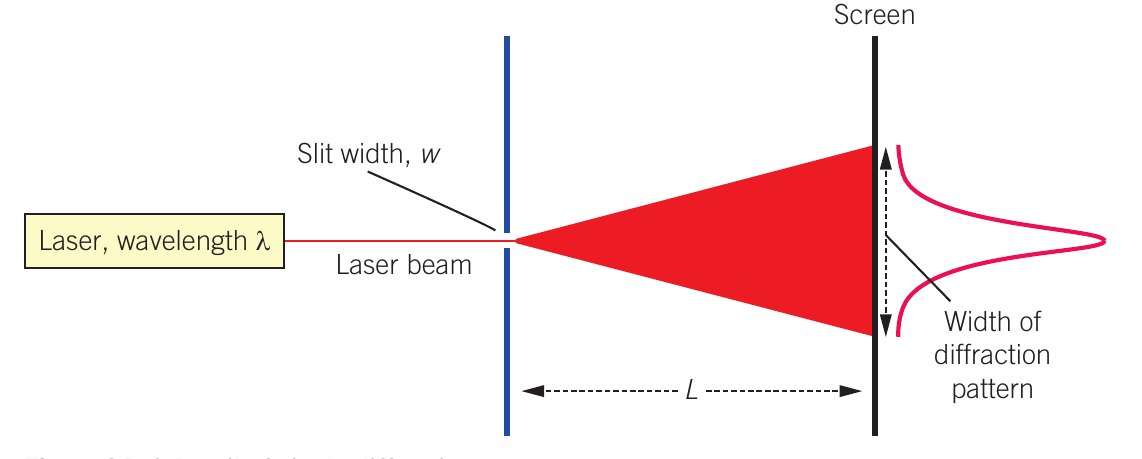
The diffraction pattern consists of a bright central maximum with weaker bright and dark bands on either side. These side bands result from interference effects.
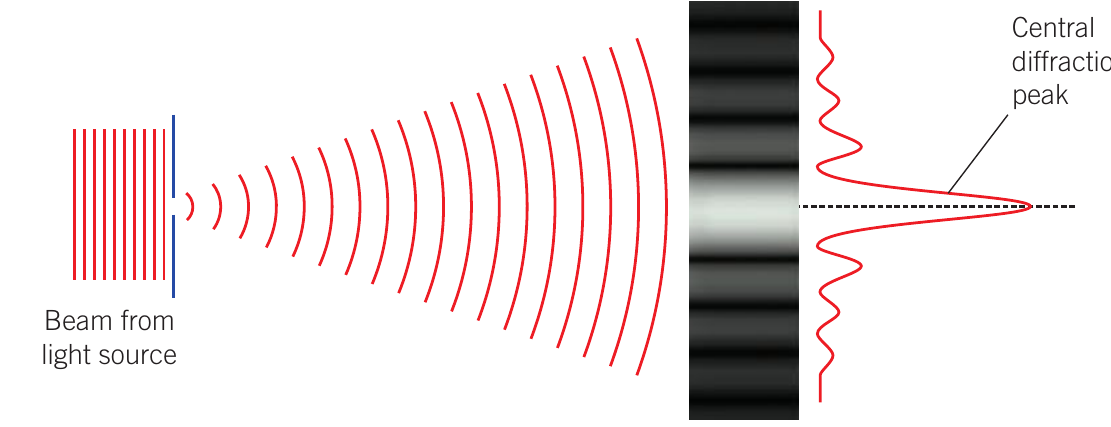
The dark regions represent destructive interference, where waves are out of phase and cancel each other. The bright regions show constructive interference, where waves are in phase and reinforce each other.
Circular aperture diffraction
When light passes through a small circular aperture rather than a slit, the diffraction pattern becomes circular. A bright central spot is surrounded by concentric bright and dark rings.
X-ray diffraction through crystals
X-rays are electromagnetic radiation with very short wavelengths (typically around 0.15 nm), positioned in the electromagnetic spectrum between ultraviolet and gamma rays. When X-rays pass through polycrystalline materials (solids consisting of many small crystal grains), they produce circular diffraction patterns remarkably similar to visible light through circular apertures.
Note
The angular spread of any diffraction pattern depends on the ratio , where is wavelength and is the width of the diffracting aperture or spacing. For diffraction to be measurable, this ratio must typically be 0.01 or greater.
For X-ray diffraction through graphite (a crystalline form of carbon), typical values are:
- X-ray wavelength: nm
- Atomic layer spacing in graphite: nm
- Ratio:
Since the wavelength is less than the spacing () but the ratio is substantial, a clear diffraction pattern forms. This is why X-rays are ideal for studying crystal structures - their wavelengths match atomic spacing dimensions.
de Broglie's prediction for matter
In 1909, Einstein established that photons carry momentum according to . Building on this, de Broglie made a bold suggestion in 1924: if light (traditionally considered a wave) has particle properties, then perhaps matter particles have wave properties.
De Broglie proposed that particles of matter, such as electrons, have an associated wavelength given by the same relationship:
This became known as the de Broglie wavelength. Since momentum (mass × velocity), we can also write:
Experimental confirmation
De Broglie's prediction was experimentally verified in 1927 by two independent research groups:
- Clinton Davisson and Lester Germer observed electron diffraction patterns
- George Thomson also demonstrated electron diffraction
Their experiments confirmed both the wave-like behaviour of electrons and the accuracy of de Broglie's formula. Davisson and Thomson shared the 1937 Nobel Prize in Physics for this work.
Note
The rapid experimental confirmation of de Broglie's theory - within just three years of his proposal - was remarkable in the history of physics. It demonstrated the power of theoretical prediction and opened the door to quantum mechanics.
Electron diffraction patterns
When electrons are fired through a small aperture, they produce diffraction patterns strikingly similar to those created by photons.
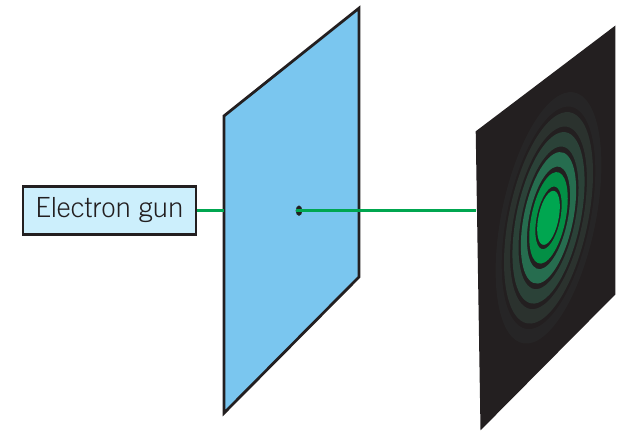
The pattern shows concentric circular rings of bright and dark bands, demonstrating that electrons behave as waves. This is direct evidence for the wave nature of matter.
Comparing electron and photon diffraction:
- Similarities: Both produce circular interference patterns with central maxima and concentric rings
- Key difference: Electrons have mass and charge, while photons have neither
- Pattern formation: Both result from wave interference (constructive and destructive)
Note
For an electron travelling at m s:
- Momentum: kg m s
- de Broglie wavelength: nm
This wavelength matches typical X-ray wavelengths used in diffraction experiments, explaining why electrons produce similar diffraction patterns when passing through crystal lattices.
de Broglie wavelengths of everyday objects
The de Broglie wavelength applies to all matter, but it only produces observable effects for very small particles. The wavelength must be comparable to the size of obstacles or apertures for diffraction to be measurable.

Consider a cricket ball as an example:
- Mass: g kg
- Velocity: m s
- Momentum: kg m s
- de Broglie wavelength: m
This wavelength is extraordinarily small - even smaller than a proton (diameter m). For diffraction to be measurable, the ratio must typically be 0.01 or greater. For a cricket ball, this ratio is negligibly small, making wave effects completely undetectable.
Important
General rule: Matter waves are only significant for particles at the atomic or subatomic scale (atoms: m; protons: m).
This explains why we don't observe quantum wave effects in everyday life - macroscopic objects have de Broglie wavelengths far too small to produce measurable diffraction patterns.
Key formulas
Photon momentum
Where:
- = photon momentum (kg m s)
- = Planck's constant ( J s)
- = photon wavelength (m)
de Broglie wavelength
Where:
- = de Broglie wavelength (m)
- = Planck's constant ( J s)
- = momentum of matter particle (kg m s)
- = mass of matter particle (kg)
- = speed of matter particle (m s)
Worked example: calculating de Broglie wavelength
Example
Worked Example: Finding the de Broglie wavelength of a neutron
Question: Find the de Broglie wavelength of a neutron with mass kg travelling at m s.
Solution:
Step 1: Calculate the momentum:
Step 2: Calculate the de Broglie wavelength:
Conclusion: This wavelength is comparable to X-ray wavelengths and atomic spacings, making neutron diffraction a useful technique for studying crystal structures.
Important exam tip: Planck's constant values
Important
Planck's constant has two commonly used values:
- J s (use for matter particles and momentum calculations)
- eV s (use for photon energy calculations when energy is in eV)
For de Broglie wavelength calculations, always use the J s value.
Relationship between wavelength and momentum
An important consequence of the de Broglie relationship is the inverse relationship between wavelength and momentum:
This means:
- Higher momentum → shorter wavelength
- Lower momentum → longer wavelength
For diffraction to be observable, the wavelength must be comparable to the aperture size. This is why:
- High-energy (high momentum) electrons produce small-scale diffraction patterns
- Low-energy (low momentum) electrons produce larger-scale patterns
- Macroscopic objects have negligible wavelengths and show no wave behaviour
Note
This inverse relationship is fundamental to understanding quantum behaviour. Particles with higher momentum (like fast-moving electrons) have shorter wavelengths and require smaller apertures to show diffraction, while slower particles have longer wavelengths and can diffract through larger openings.
Summary
Key Points to Remember:
-
Wave-particle duality applies to both light and matter - photons can behave as particles, and particles like electrons can behave as waves
-
De Broglie wavelength is given by , where J s
-
Electron diffraction patterns are similar to photon diffraction patterns, providing direct evidence for matter waves
-
Matter waves are only significant for particles at atomic or subatomic scales - macroscopic objects have wavelengths too small to observe
-
Diffraction requires the ratio to be approximately 0.01 or greater for observable patterns
-
The relationship between wavelength and momentum is inverse - higher momentum means shorter wavelength, and vice versa