Similarities Between Light and Matter (VCE SSCE Physics): Revision Notes
📚Revision Notes
Similarities Between Light and Matter
Introduction to quantum physics
Quantum physics is the physics of the very small - the physics of atoms, photons, electrons, and other fundamental particles. Before the early 20th century, humanity had no understanding of quantum physics, but today around 35% of the economy in modern countries relies on quantum technology.

Everyday applications of quantum physics include:
- MRI scans in medical diagnosis
- GPS navigation systems
- Digital photography
- Mobile phones and internet
- Laser scanners at checkouts
At the heart of quantum physics is the concept of quantisation - the idea that physical quantities such as charge, mass, energy, and momentum can only have certain discrete values. These quantities cannot take values between the allowed values. This is fundamentally different from classical physics, where quantities can vary continuously.
Note
Quantisation means that physical quantities come in discrete "packets" rather than varying smoothly. Think of it like climbing stairs versus walking up a ramp - you can only stand on specific steps, not between them.
The momentum of photons
Photons carry momentum
Although photons have no mass, they do carry momentum. This seems impossible according to classical physics, where momentum is a property of moving masses. However, Maxwell predicted that electromagnetic waves carried momentum, and Einstein showed that Planck's law of blackbody radiation required light quanta (photons) to carry momentum.
The momentum of a photon is given by:
where:
- = momentum (kg m s)
- = Planck's constant ( J·s)
- = wavelength (m)
Important
Despite having zero mass, photons carry momentum. This counterintuitive fact is a fundamental prediction of quantum physics and has been confirmed by countless experiments.
Real-world examples of photon momentum
Comet tails:
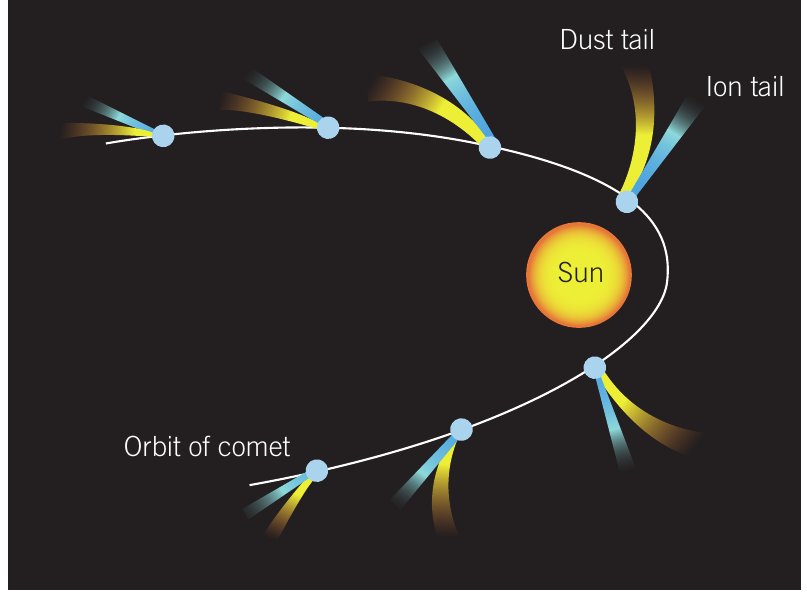
Comets have two tails as they orbit the Sun:
- The ion tail is caused by the stream of charged particles from the Sun transferring momentum to the comet's gases
- The dust tail is caused by photons from the Sun transferring their momentum to the dust and gas released from the comet
Both tails point away from the Sun due to momentum transfer.
Space sails:
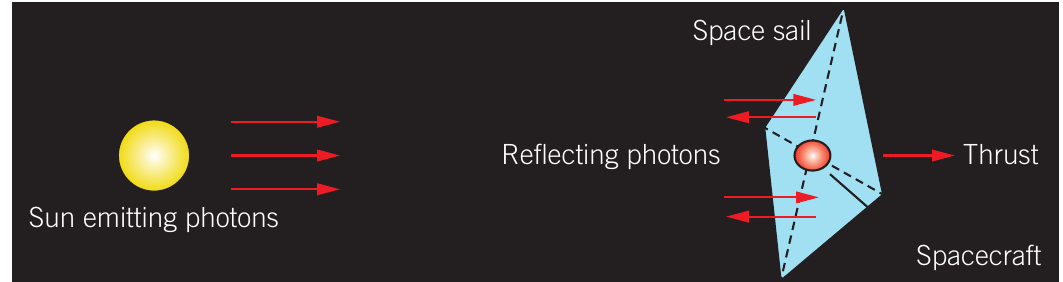
Some spacecraft use 'space sails' for propulsion. The mechanism works as follows:
- Photons from the Sun hit the sail and reflect
- Before reflection, a photon has momentum (to the right)
- After reflection, it has momentum (to the left)
- Each reflecting photon transfers momentum to the sail
- If photons reflect per second, the force on the sail is
Note
The factor of 2 in the momentum transfer arises because the photon's momentum changes from to , giving a total change of . This is similar to a ball bouncing off a wall - the wall experiences twice the momentum of the ball.
Conservation of momentum
Momentum is conserved in all interactions between photons and other particles, including electrons. This principle is fundamental to understanding photon behaviour.
Example
Worked Example: Calculating thrust on a space sail
A large space sail reflects photons per second, each with wavelength 550 nm. The thrust can be calculated as:
Although this force is extremely small, in the vacuum of space with no friction, even tiny forces can accelerate spacecraft over long periods.
Compton scattering
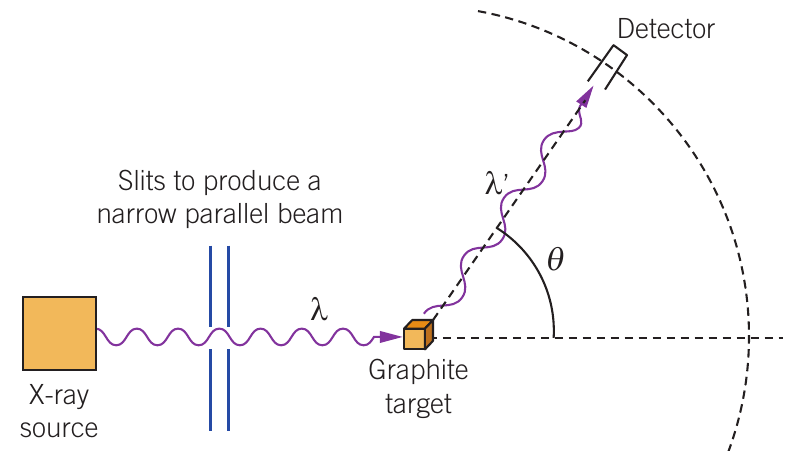
In 1923, Compton investigated collisions between X-ray photons and electrons in graphite. He found that:
- The scattered photons had longer wavelengths (less energy)
- The collisions were inelastic
- Conservation of energy and momentum could only be satisfied if photons had momentum given by
This provided strong experimental evidence that photons carry momentum.
Important
Compton scattering was a landmark experiment that conclusively demonstrated the particle nature of light. It showed that photons collide with electrons like billiard balls, exchanging both energy and momentum according to the laws of conservation.
Example
Worked Example: Photon-electron collision
An X-ray photon with momentum kg m s collides head-on with a stationary electron. The electron gains momentum of kg m s in the same direction. Using conservation of momentum:
The negative sign indicates the photon bounces back in the opposite direction.
Emission spectra
Continuous vs. line spectra
All objects above absolute zero (0 K) emit electromagnetic radiation. The type of spectrum emitted depends on the nature of the source.
Continuous spectrum:
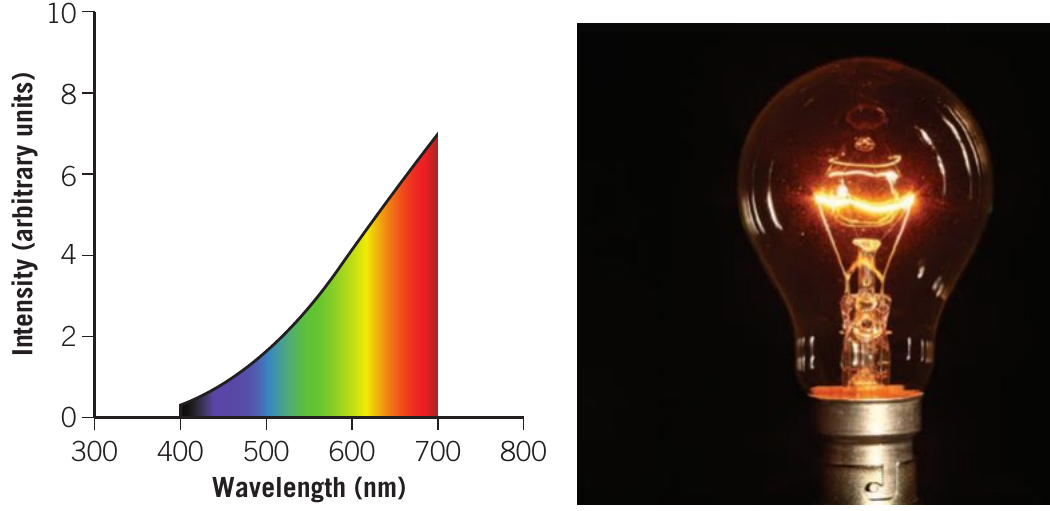
A tungsten filament incandescent light globe produces a continuous spectrum:
- All wavelengths are present with no gaps
- The spectrum is close to the blackbody spectrum of a perfect emitter
- Only wavelengths from approximately 400 nm to 700 nm are visible to the human eye
- Infrared wavelengths (> 700 nm) can be felt but not seen
- Ultraviolet wavelengths (< 400 nm) are also invisible
The continuous spectrum can be observed using a spectroscope, which separates wavelengths using a prism or diffraction grating.
Emission line spectrum:

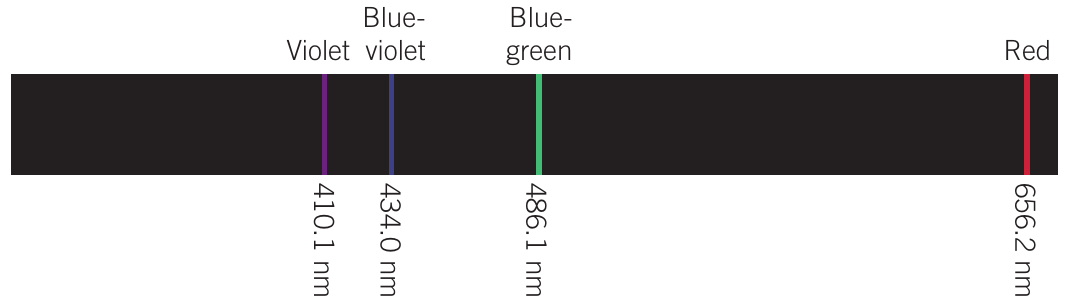
When an electric current passes through a gas discharge tube containing hydrogen, a completely different spectrum is observed:
- Only specific wavelengths are present
- The spectrum consists of discrete lines, not a continuous range
- The visible part of the hydrogen spectrum (called the Balmer series) shows lines at:
- 656.2 nm (red)
- 486.1 nm (blue-green)
- 434.0 nm (blue-violet)
- 410.1 nm (violet)
The energies of these photons are related to their wavelengths by:
where:
- = photon energy (J or eV)
- = Planck's constant
- = frequency (Hz)
- = speed of light ( m s)
- = wavelength (m)
Note
Unlike continuous spectra, the energies emitted in line spectra do not depend on the temperature of the gas. This is because line spectra arise from specific energy transitions within atoms, not from thermal vibrations.
Unique spectra for each element
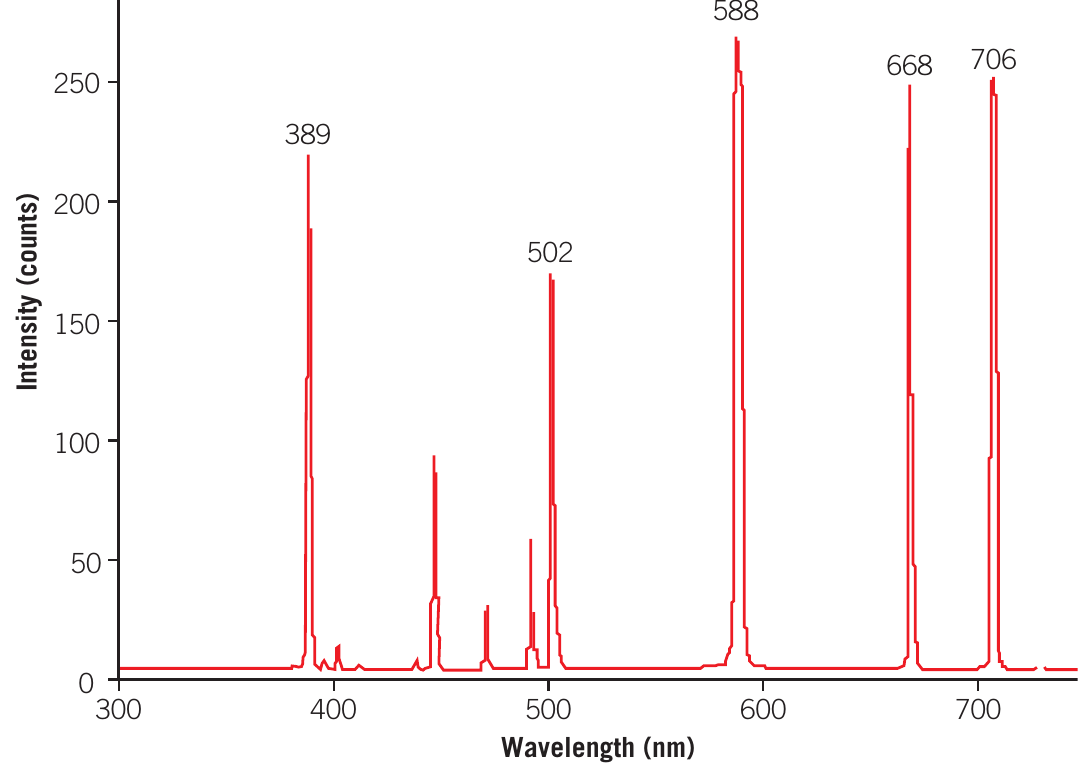
Different elements produce different emission line spectra. For example, helium produces a spectrum with major peaks at wavelengths including 389 nm, 502 nm, 588 nm, 668 nm, and 706 nm.
Each element has its own unique 'fingerprint' spectrum. This allows us to:
- Identify elements present in a sample
- Detect elements in stars and comets
- Analyse the atmospheres of exoplanets
Note
In fact, helium was first discovered in the Sun's atmosphere (during a solar eclipse) before it was found on Earth. The element is named after "Helios," the Greek word for Sun!
Metal vapour lamps
Metals are not gases at room temperature, so they must be vaporised to observe their spectra. Metal vapour lamps (such as mercury and sodium lamps) work by:
- Creating a hot electric arc
- Vaporising the metal
- Exciting atoms into higher energy states
- Producing photons as atoms return to lower energy states
Polar auroras

Polar auroras (aurora borealis in the northern hemisphere and aurora australis in the southern hemisphere) are natural examples of emission spectra. The process involves:
- High-speed charged particles from the solar wind are channelled by Earth's magnetic fields near the poles
- These particles strike atoms in the upper atmosphere
- The atoms are excited into high energy states
- As they decay, they emit photons
- Different colours correspond to different atoms - mainly oxygen and nitrogen
Note
The spectacular colours of auroras are emission line spectra in action. Green and red auroras come from oxygen atoms, while blue and purple come from nitrogen. The specific colours depend on which energy transitions occur in these atoms.
Energy states of atoms
Quantisation of energy states
In 1913, Niels Bohr proposed that electrons in atoms can only occupy certain fixed energy states. Light is emitted when an electron moves from one state to a lower state. This is another example of quantisation - a phenomenon that cannot be explained by classical physics.
The energy difference between states is given by:
where is the energy difference between the two states.
Energy state diagrams
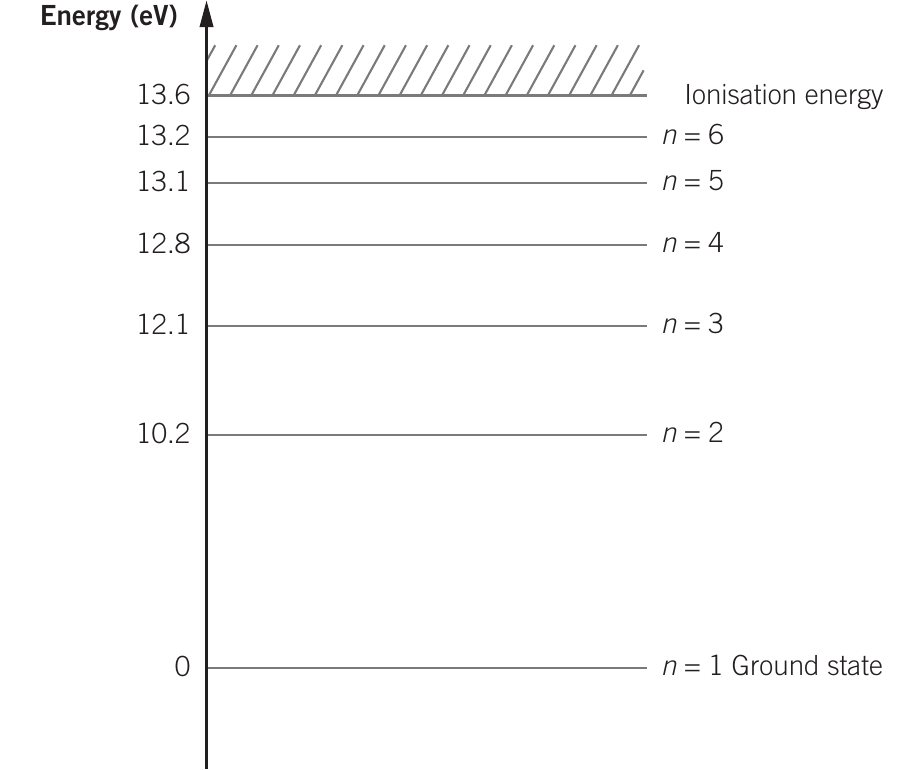
Energy states of atoms are represented using energy level diagrams. For hydrogen:
- The vertical axis shows energy in electron volts (eV)
- Horizontal lines represent the allowed energy states
- Each state is labelled with a quantum number
- The ground state (lowest energy) has quantum number
- Higher energy states have , etc.
- The ionisation energy (13.6 eV for hydrogen) represents the energy needed to completely remove an electron
When an atom receives enough energy, an electron can transition to a higher energy state. If the atom receives 13.6 eV or more (for hydrogen), it loses an electron and becomes an ion (a charged atom).
Important
The ground state is the most stable configuration of an atom. All higher energy states are unstable and will eventually decay back to the ground state, emitting photons in the process.
Transitions and photon emission
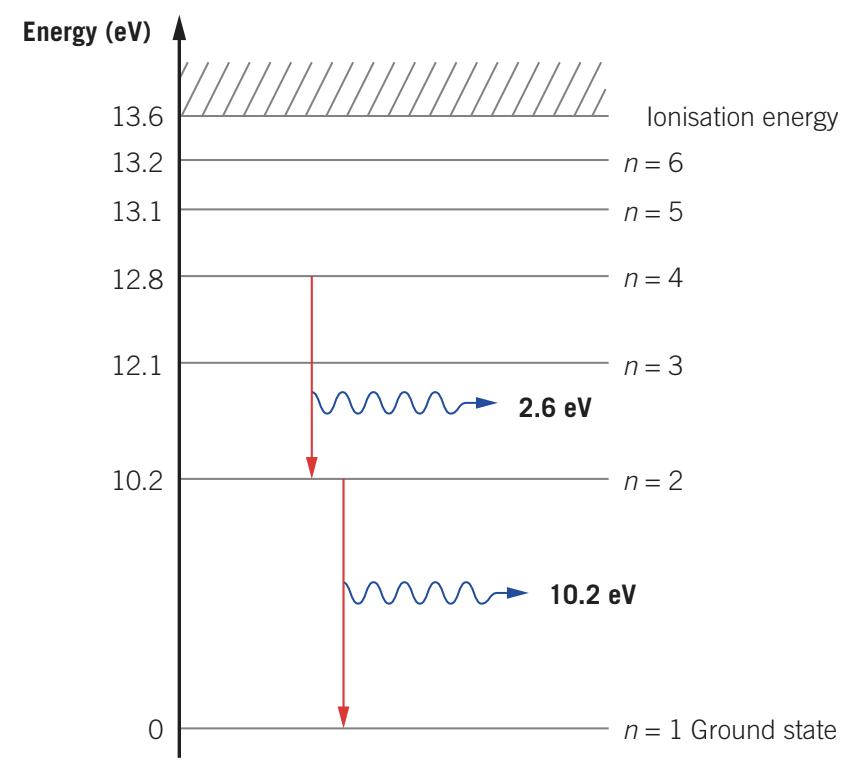
States above the ground state are unstable. Electrons in these excited states decay to lower energy states until reaching the ground state. Each transition involves:
- A loss of energy equal to the energy difference between states
- Emission of a photon with energy
The diagram shows an example where a hydrogen atom in the state:
- First decays to , emitting a 2.6 eV photon
- Then decays to (ground state), emitting a 10.2 eV photon
Multiple decay paths
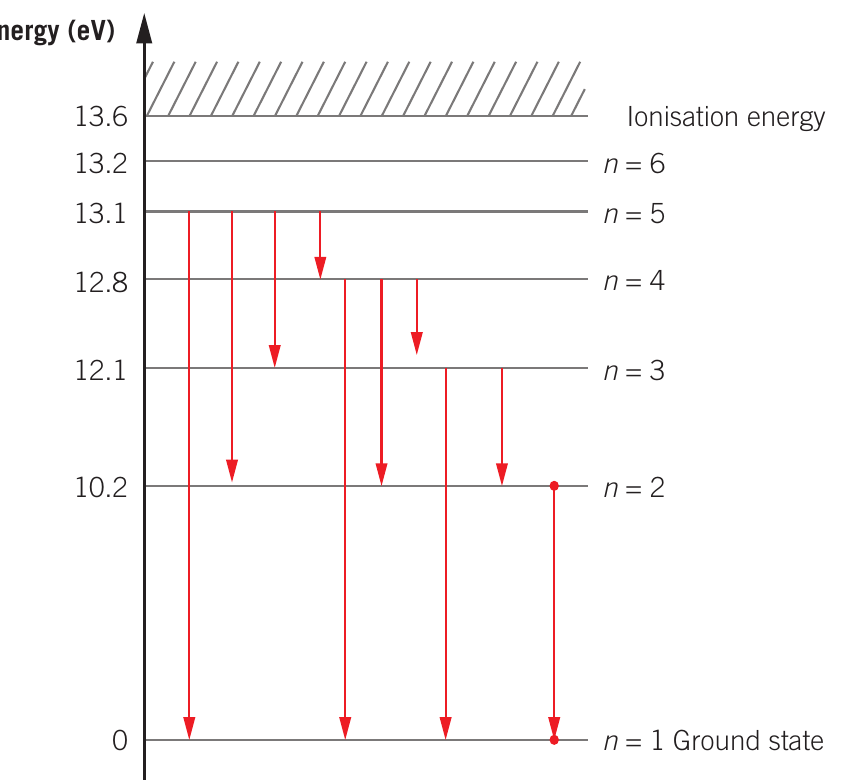
An atom in an excited state can decay through different paths. For example, an atom in the state could:
- Decay directly to (emitting one high-energy photon)
- Decay via , then , then , then (emitting four lower-energy photons)
- Follow any other combination of paths
All possible transitions produce the complete line spectrum we observe from a gas discharge tube. The wavelengths present in the spectrum correspond to all possible energy differences between states.
Note
This explains why emission spectra contain multiple lines. Each line corresponds to a different possible transition between energy states. The more complex the atom, the more possible transitions, and the more lines in its spectrum.
Calculating photon energies
Example
Worked Example: Finding photon energy from wavelength
Using the helium emission spectrum, what is the energy of the 389 nm photon?
The greatest energy corresponds to the smallest wavelength. Using:
(since 1 J = eV)
Using energy state diagrams
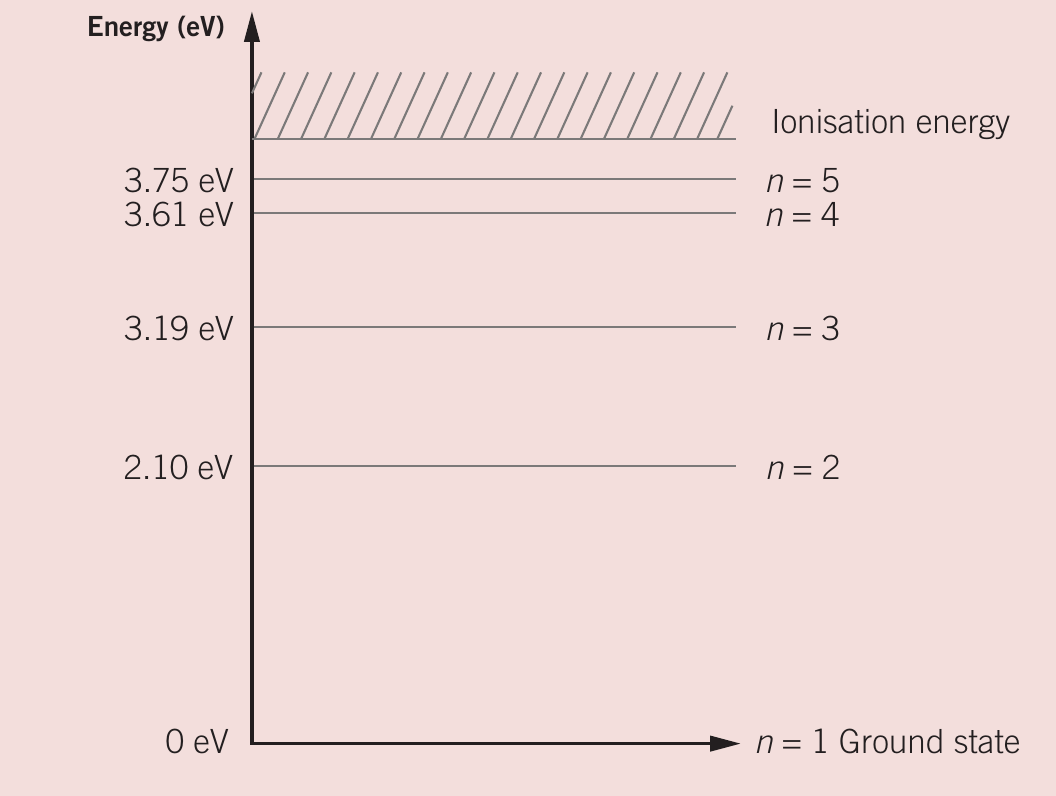
Energy state diagrams can be used to:
- Identify which transitions produce specific photon energies
- Calculate the highest or lowest energy photons that can be emitted
- Determine whether absorption of photons at specific wavelengths is possible
Example
Worked Example: Sodium energy states
For the sodium energy level diagram shown:
a) Finding the transition for a 1.51 eV photon:
A 1.51 eV photon corresponds to the energy gap between (3.61 eV) and (2.10 eV), since eV.
b) Calculating the highest frequency photon:
The highest frequency photon from to ground state has energy 3.61 eV:
c) Determining if a 591 nm photon can be absorbed:
This matches the energy gap from ground state to , so absorption is possible.
Absorption spectra
What are absorption spectra?
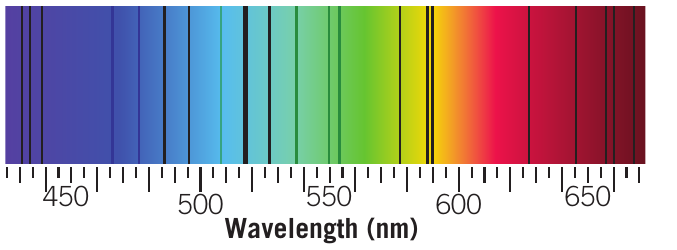
Absorption line spectra occur when photons with specific energies are absorbed from an otherwise continuous spectrum. They appear as dark lines against a coloured background.
A well-known example is the Sun's spectrum, which contains dark lines called Fraunhofer lines. These occur when:
- The Sun emits a continuous spectrum of light
- The light passes through the cooler gases in the Sun's atmosphere and Earth's atmosphere
- Atoms in these atmospheres absorb photons at specific wavelengths
- These absorbed photons match energy gaps between atomic energy states
- Dark lines appear in the spectrum at these wavelengths
How absorption creates dark lines
When a photon is absorbed:
- Its energy must exactly match an energy gap between states
- The electron transitions to a higher energy state
- The photon is absorbed and then re-emitted in a random direction
- Since almost all random directions are not in the original direction, the photon appears to be 'missing' from that wavelength
- This creates a dark line in the spectrum
Important
For absorption to occur, the photon energy must exactly match an energy gap between states. If the energy is even slightly different, the photon will not be absorbed. This is why absorption spectra have the same pattern as emission spectra for a given element.
Example: The 656 nm absorption line
This dark line in the solar spectrum is caused by hydrogen atoms in the state:
- They absorb photons of energy 1.9 eV (wavelength 656 nm)
- Electrons transition from to
- This matches the energy gap between these states
Alternative energy state representation
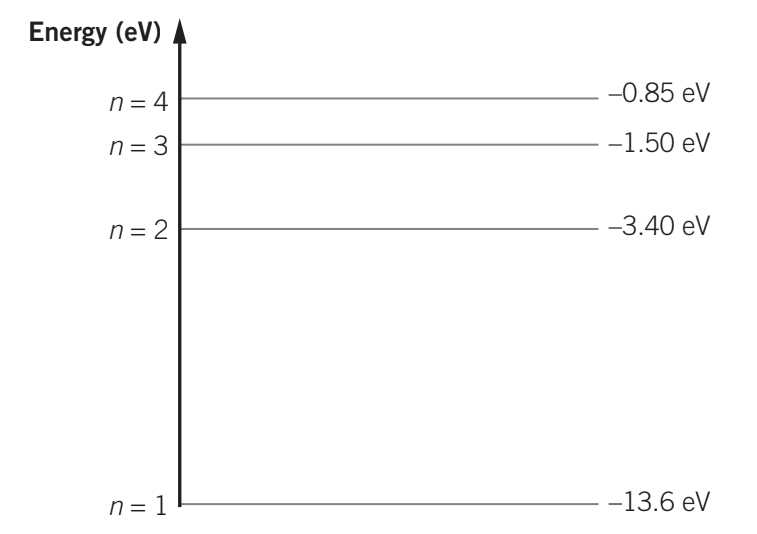
Energy state diagrams can also be drawn with the ground state as a negative value:
- Ground state (): -13.6 eV
- First excited state (): -3.40 eV
- Second excited state (): -1.50 eV
- Third excited state (): -0.85 eV
The negative values indicate that electrons are bound to the atom. To ionise the atom (remove an electron completely), enough energy must be added to reach 0 eV:
- From ground state: needs 13.6 eV
- From state: needs 3.4 eV
- From state: needs 1.5 eV
Note
The spacing between states is identical to the other representation - only the reference point has changed. Both representations are valid and useful in different contexts. The negative value representation makes it clear that energy must be added to remove an electron.
Why are atomic energy states stable?
Problems with the classical model
The classical 'planetary' model pictures electrons orbiting the nucleus like planets orbiting the Sun. In this model, the electrostatic force between the positive proton and negative electron keeps the electron in orbit.
However, this classical model has two major problems:
1. Continuous vs. quantised orbits: Classical physics predicts electron orbits could have any energy, like satellites orbiting Earth at different altitudes. But experimental evidence shows electron energies are quantised - only specific values are allowed.
2. Orbital collapse: According to classical electromagnetic theory, accelerating charged particles (like electrons in orbit) should continuously emit radiation and lose energy. This would cause orbits to collapse within a fraction of a second. But atoms are stable - they don't collapse.
Important
The classical model cannot explain why atoms are stable or why energy states are quantised. These phenomena require quantum mechanics to understand properly. The stability of atoms is one of the most fundamental predictions of quantum physics.
The quantum explanation
To explain stable atomic energy states, we must use the wave properties of electrons:
- Electrons behave as matter waves, not just as particles
- Only certain 'standing wave' patterns fit around the nucleus
- These allowed patterns correspond to the quantised energy states
- The wave nature prevents orbital collapse
This explanation requires quantum mechanics and cannot be understood using classical physics alone.
Wave-particle duality
Building images photon by photon
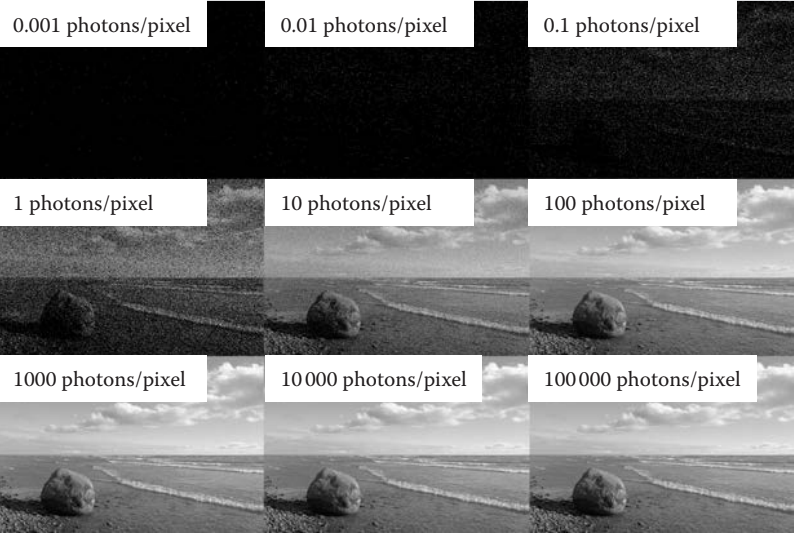
When we take photographs, we don't normally think about individual photons. However, images can be built up photon by photon. The figure shows how an image develops from just a few photons per pixel to many thousands. This demonstrates that:
- Light is composed of individual photons (particle-like)
- Each photon can be detected individually
- Large numbers of photons produce the continuous images we're familiar with
Double slit experiments with photons
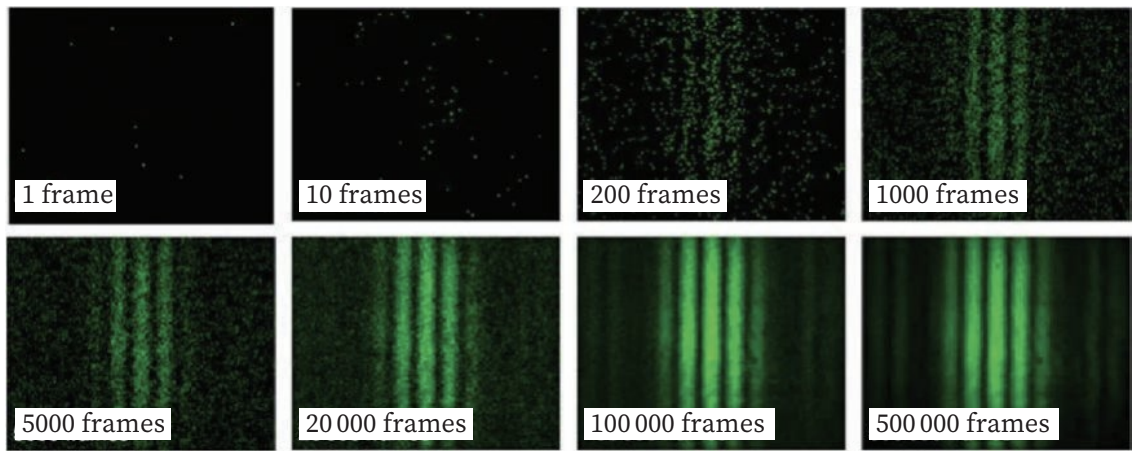
The double slit experiment has been crucial in understanding the nature of light. When performed at very low light intensities:
With many photons:
- A clear interference pattern forms
- This is explained by wave superposition
- Waves from one slit interfere with waves from the other
With single photons (one at a time):
- Individual photons appear to hit random locations
- As more photons accumulate, the interference pattern emerges
- Each photon seems to 'interfere with itself'
- The photon cannot be split - it's detected at one location only
Important
The key observation: Even when only one photon passes through the slits at a time, the interference pattern still appears. This suggests each photon somehow 'knows' about both slits. This is one of the most mysterious and counterintuitive aspects of quantum physics.
When detectors are placed at the slits:
- The photon is detected passing through one slit or the other (never both)
- The interference pattern disappears
- This is particle-like behaviour
Without detection at the slits:
- The photon maintains wave-like behaviour
- It travels to the screen avoiding dark regions
- The interference pattern appears
This demonstrates the dual nature of light - it exhibits both wave-like and particle-like behaviour depending on how it's observed.
Note
The act of measurement fundamentally changes the behaviour of photons. This is not because our measuring devices are crude or disturb the photons - it's a fundamental feature of quantum mechanics. The universe itself seems to behave differently depending on whether or not we observe it.
Double slit experiments with electrons
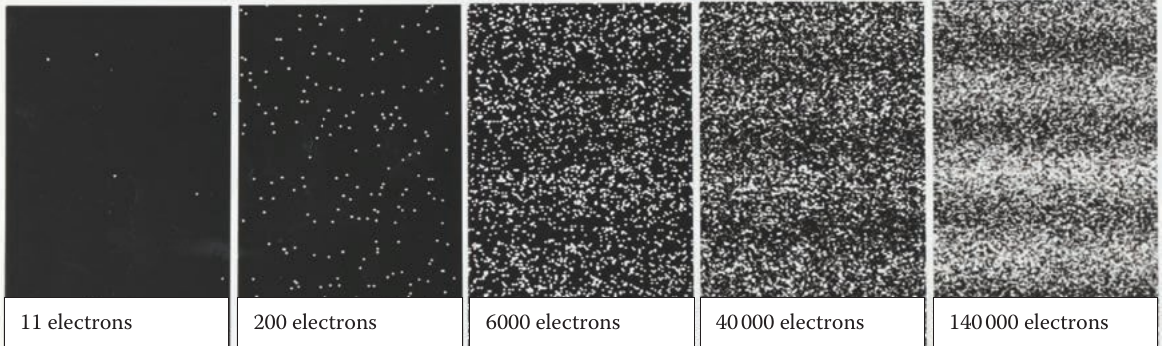
In 1961, Claus Jönsson performed double slit experiments with electrons. In 2013, Roger Bach and his team reduced the electron beam to one electron at a time. The results were identical to single-photon experiments:
- Individual electrons created spots on the detector
- As more electrons accumulated, an interference pattern emerged
- The pattern only formed when electrons were not detected at the slits
- When detected at the slits, electrons behaved like particles and no interference pattern formed
This proves electrons also have a dual nature:
- Particle-like behaviour when detected/measured
- Wave-like behaviour when not detected, showing interference
Important
The double slit experiment with electrons proves that wave-particle duality is not just a property of light - it's a fundamental feature of all matter. Electrons, atoms, and even molecules have been shown to exhibit this dual nature.
Quantisation and light
Einstein's explanation of the photoelectric effect challenged the prevailing wave theory of light and provided an early example of quantisation. He proposed that light consists of discrete packets of energy (quanta, now called photons).
However, this doesn't mean we can ignore wave properties. Single photon diffraction and interference experiments show that until a photon is detected, it retains wave properties. We must describe its position using probabilities, not definite locations.
Note
Key point: Light exhibits both particle properties (when detected) and wave properties (when propagating). This is the principle of wave-particle duality.
Quantisation and the nature of atoms
What quantities are quantised?
Several quantities in atoms can only have discrete values:
- Electric charge on the nucleus (always a whole number of proton charges)
- Number of nucleons (protons and neutrons) in the nucleus
- Number of electrons in the atom
- Charge on electrons ( C) and protons ( C)
- Energy states of electrons in atoms
Why quantisation matters
The quantisation of energy states is particularly important because:
- It arises from the wave properties of electrons
- It explains the stable structure of atoms
- It accounts for emission and absorption line spectra
- It shows that each element has a unique spectral fingerprint
- It enables us to identify elements in distant stars and exoplanets
Note
The Schrödinger equation of quantum mechanics provides the most accurate explanation of quantised energy states. While simplified models (like electrons as standing waves around nuclei) can help us visualise the concept, they're not completely accurate representations of the complex reality described by quantum mechanics.
Key formulas for photons and matter
It's essential to use the correct formulas when solving problems:
| Property | Matter | Photons |
|---|---|---|
| Wavelength | ||
| Momentum | ||
| Energy/Momentum relation | ||
| Kinetic Energy |
Important
Important notes on Planck's constant:
- For calculations in Joules: J·s
- For calculations in electron volts: eV·s
- Use the eV·s value only for when you want energy in eV
Remember!
Summary
Key Points to Remember:
-
Photons carry momentum given by , even though they have no mass. Momentum is conserved in all photon interactions.
-
Emission line spectra consist of discrete wavelengths emitted by excited atoms. Each element has a unique spectrum determined by its energy states. Continuous spectra (like from incandescent bulbs) contain all wavelengths.
-
Energy states in atoms are quantised - electrons can only exist in specific energy levels. Transitions between states involve emission or absorption of photons with energy .
-
Absorption spectra show dark lines where photons with specific energies have been absorbed by atoms, causing upward transitions. The absorbed photons match energy gaps between states.
-
Wave-particle duality is fundamental to quantum physics. Both light and matter exhibit wave-like behaviour (interference) and particle-like behaviour (discrete detection), depending on how they're measured. Single photon and single electron double slit experiments provide strong evidence for this dual nature.