Questions, Variables, and Predictions (VCE SSCE Physics): Revision Notes
📚Revision Notes
Questions, Variables, and Predictions
Introduction
Science is fundamentally about asking questions and seeking explanations for how the universe works. Physics focuses on the most basic features of our universe: matter and energy. Through systematic investigation, scientists develop testable explanations that help us make accurate predictions about natural phenomena.

Note
This topic explores how we conduct scientific investigations by identifying different types of variables, collecting and classifying data, and following the scientific method to test our predictions. Understanding these fundamental concepts is essential for all experimental work in physics.
Variables in scientific experiments
When conducting an experiment, we investigate relationships between different factors called variables. Understanding how to classify and control these variables is essential for designing valid experiments.
Types of variables
There are three main types of variables in any scientific investigation:
Independent variable: This is the factor that you deliberately change or manipulate during an experiment. The experimenter has direct control over this variable and adjusts it systematically to observe its effects. For example, if you wanted to test how temperature affects the rate of a chemical reaction, temperature would be your independent variable because you control and change it intentionally.
Dependent variable: This is what you observe or measure in response to changes in the independent variable. The dependent variable "depends on" the independent variable - it's the outcome you're interested in studying. Using the previous example, the rate of reaction would be your dependent variable because it's what you measure to see how it responds to temperature changes.
Controlled variables: These are all other factors that might affect your results but that you keep constant throughout the experiment. By holding these variables steady, you ensure that any changes in the dependent variable are truly caused by changes in the independent variable, not by some other factor. In the reaction example, you would need to control things like the concentration of reactants, the volume of solution, and the pressure.
Example
Worked Example: The Inclined Plane Experiment
Consider an experiment investigating how the angle of an inclined plane affects how quickly a ball rolls down it. Here's how we would classify the variables:
In this experiment:
- The independent variable is the angle of inclination of the plane (what we deliberately change)
- The dependent variable is the final speed of the ball (what we measure)
- The controlled variables include the rolling length, size of ball, material of the ramp, material of the ball, and air temperature/density (what we keep constant)
By controlling everything except the angle, we can be confident that any changes in ball speed are due to the angle change, not other factors.
Important
Exam tip: When identifying variables in a question, ask yourself: What is being deliberately changed? (independent), What is being measured? (dependent), and What should be kept the same? (controlled).
Types and characteristics of data
Scientists collect and analyse data to support or refute their hypotheses. Understanding different types of data helps us choose appropriate collection methods and interpret results correctly.
Primary versus secondary data
Data can be classified based on its source:
Primary data refers to original information that you collect firsthand through your own experiments or observations. When you personally conduct an investigation and record measurements, you are generating primary data. This type of data is sometimes called "first-hand" data because you are the first person to gather it. Primary data is valuable because you know exactly how it was collected and can be confident about its reliability.
Secondary data is information that someone else has already collected and made available for others to use. When you research a topic by reading scientific papers, textbooks, or online sources, you are accessing secondary data. This is sometimes called "second-hand" data. Secondary data is useful for:
- Building background knowledge before conducting your own experiments
- Comparing your results with those of other researchers
- Investigating topics where you cannot collect primary data yourself
Quantitative versus qualitative data
Data can also be classified by its nature:
Quantitative data consists of numerical values that can be measured and counted. This type of data answers questions like "how much?" or "how many?" Examples include:
- The length of a ruler:
- The time taken for a ball to roll down a ramp:
- The temperature of a liquid:
- The mass of an object:
Quantitative data is particularly useful because it can be analysed mathematically, graphed, and used to identify precise relationships between variables.
Qualitative data consists of non-numerical information that describes qualities or characteristics. This type of data answers questions like "what type?" or "what kind?" Examples include:
- The material a container is made from: silicone
- The colour of a solution: dark blue
- The texture of a surface: rough
- The type of ball used: basketball, soccer ball, tennis ball
Note
Both types of data play important roles in scientific investigations. Most experiments involve collecting both quantitative and qualitative data to provide a complete picture of the phenomenon being studied.
The scientific method
The scientific method is a systematic approach to investigating questions about the natural world. It provides a framework for conducting rigorous investigations that produce reliable, reproducible results.
Overview and purpose
Important
The scientific method begins with an important principle: we should consider all possible explanations for an observation to be potentially true until evidence proves them wrong. Through this method, we attempt to disprove hypotheses rather than prove them correct. If a hypothesis withstands multiple attempts to disprove it, we gain increasing confidence that it represents a valid explanation.
This approach involves testing predictions by systematically varying different factors (variables) and carefully observing the results. The goal is to eliminate incorrect explanations and identify relationships between variables that help us understand and predict natural phenomena.
The five-step process
The scientific method consists of five key steps that guide us from initial observation to sharing results with the scientific community:
Step 1: Observe and question
Science begins with curiosity. We observe something in the natural world and ask questions about why it happens or what factors influence it.
In our example, we might observe that when we roll a ball down a steep ramp, it reaches the bottom more quickly than when we roll it down a shallow ramp. This leads us to ask: what factors determine how long it takes a ball to roll down an inclined plane?
Step 2: Formulate an aim and hypothesis
Next, we clearly state the purpose of our investigation (the aim) and make a testable prediction (the hypothesis).
The aim is a statement describing what we want to investigate. It should be specific and focused. For example: "To investigate the relationship between the angle of inclination of a plane and the time it takes a ball to reach the bottom."
Important
The hypothesis is a proposed explanation that predicts how one variable will affect another. A well-constructed hypothesis follows this structure:
"It is predicted that [increasing/decreasing] [independent variable] will [increase/decrease/not affect] [dependent variable] because [scientific reasoning]."
For our example: "It is predicted that increasing the angle of inclination of the plane will decrease the time it takes the ball to reach the bottom, because larger angles of inclination correspond to a larger component of the gravitational force acting parallel to the plane."
Step 3: Experiment - test the hypothesis
Now we design and conduct an experiment to test our prediction. Key principles include:
- Only the independent variable should be deliberately changed
- All controlled variables should be kept constant
- Multiple measurements should be taken at regular intervals
- Both quantitative and qualitative observations should be recorded
- The method should be documented in detail so others can repeat it
In our inclined plane experiment, we would:
- Measure the time taken for the ball to reach the bottom at eight different angles of inclination
- Keep everything else constant (rolling distance, ball size, ball material, ramp material, etc.)
- Take five measurements at each angle to account for variability
- Calculate the average time for each angle
Note
Taking multiple measurements and using many different values of the independent variable gives us greater confidence in any patterns we observe.
Step 4: Analyse and conclude
After collecting data, we analyse it to identify any relationships between variables. This typically involves:
- Presenting data clearly using graphs or tables
- Looking for patterns or trends
- Determining whether the results support or contradict the hypothesis
- Acknowledging limitations and sources of uncertainty
For our experiment, we would create a graph with the angle of inclination on the horizontal axis and the average time on the vertical axis. If we observe that the time decreases as the angle increases, this supports our hypothesis.
However, we must acknowledge that we can never have complete certainty. There may be variables we failed to control properly, or systematic errors in our measuring equipment that affected results.
Step 5: Share the results
The final step is making our findings public by sharing both our results and our method. This allows other scientists to:
- Review our work critically
- Attempt to reproduce our results
- Build on our findings in their own research
If multiple independent researchers conduct similar experiments and obtain similar results, the scientific community gains increasing confidence that the conclusion is valid. This process of replication and verification is fundamental to how scientific knowledge develops.
Important
Exam tip: Remember that the scientific method is about attempting to disprove hypotheses, not prove them. We gain confidence in explanations that have resisted multiple attempts at disproof.
Scientific theories, models, and laws
As scientific knowledge develops through repeated application of the scientific method, we organise and communicate our understanding using theories, models, and laws.
Scientific theories
When a hypothesis has been tested extensively by many different researchers and the results consistently support it, the scientific community begins to accept it with high confidence. At this point, the explanation becomes recognised as a scientific theory.
A scientific theory is an explanation of a physical phenomenon that has been repeatedly confirmed through experimental evidence and observation. Theories help us understand why things happen the way they do. Important characteristics of scientific theories include:
- They are based on substantial evidence from multiple sources
- They have withstood rigorous testing and attempts to disprove them
- They can explain existing observations and predict future outcomes
- They can be refined or replaced if new evidence emerges
Despite being called "theories," these explanations represent our best understanding of natural phenomena based on all available evidence. Examples in physics include atomic theory, the theory of relativity, and electromagnetic theory.
Scientific laws
A scientific law is a statement, based on repeated experiments or observations, that describes or predicts a phenomenon. Laws tell us what happens in nature, but they don't explain why it happens.
For example, Newton's First Law of Motion states that an object will remain at rest or continue moving at constant velocity unless acted upon by an external force. This law describes the behaviour of objects but doesn't explain the underlying reasons for this behaviour - that's what theories are for.
Important
The key distinction is: Laws describe what happens; theories explain why it happens.
Scientific models
We use scientific models to simplify and represent complex phenomena that we cannot easily observe or experience directly. A model is a representation of a physical process that helps us visualise and understand concepts that are otherwise difficult to grasp.
Models are intentionally simplified - they capture the essential features of a phenomenon while ignoring less important details. This makes them useful for understanding and prediction, even though we know they are incomplete representations of reality.
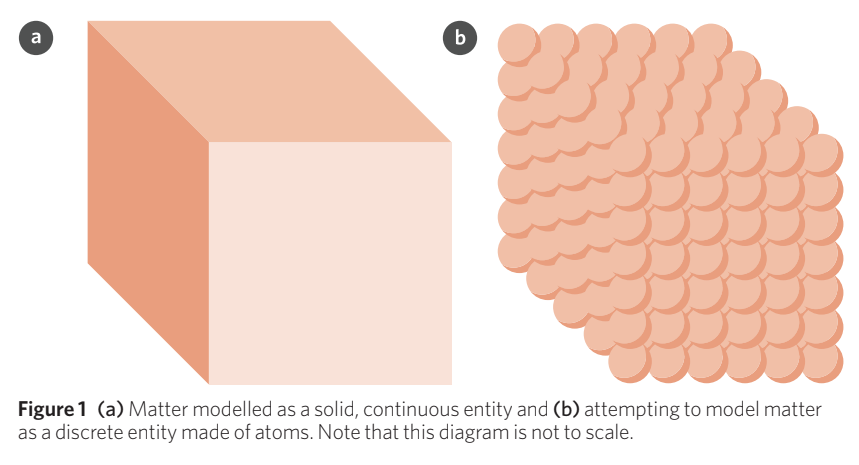
Consider how we model matter. In everyday situations, we often model matter as continuous and solid, like the cube shown in panel (a). However, we know that matter is actually made up of discrete atoms with mostly empty space between them, as suggested in panel (b). The solid model is useful for many purposes even though it's not perfectly accurate.
Other examples of models used in VCE Physics include:
- The particle model of atomic nuclei (representing atoms as simple particles)
- The wave model of light (representing light as electromagnetic waves)
- Vector models for forces (representing forces as arrows)
Note
Important note: All models have limitations. We use them because they're helpful, not because they perfectly represent reality. As our understanding improves or as we develop better technology, models may be refined or replaced.
Evolution of scientific knowledge
It's crucial to understand that theories, models, and laws are not absolutely certain - they represent our current best understanding based on available evidence. As technology improves and we conduct more experiments, scientific knowledge can evolve:
- Theories may be refined to explain new observations
- Models may be modified to better represent phenomena
- New evidence may even overturn previously accepted explanations
This doesn't mean science is unreliable. Rather, it demonstrates the self-correcting nature of scientific inquiry. The scientific method ensures that explanations are constantly tested and improved, leading to increasingly accurate understanding of the natural world.
Summary
Remember! Key Points to Remember:
-
Variables are classified into three types: Independent variables are deliberately changed by the experimenter, dependent variables are measured in response to these changes, and controlled variables are kept constant to ensure fair testing.
-
Data can be classified in two ways: Primary data is collected firsthand through your own experiments, while secondary data comes from other sources. Quantitative data consists of numerical measurements, while qualitative data describes non-numerical characteristics.
-
The scientific method provides a systematic five-step process: (1) Observe and question, (2) Formulate an aim and hypothesis, (3) Conduct experiments to test the hypothesis, (4) Analyse results and draw conclusions, (5) Share findings with the scientific community. This approach attempts to disprove hypotheses rather than prove them correct.
-
Scientific knowledge is organised into theories, laws, and models: Theories explain why phenomena occur and are supported by extensive evidence. Laws describe what happens without explaining why. Models are simplified representations that help us understand complex processes we cannot directly observe.
-
Scientific knowledge evolves over time: Theories, models, and laws represent our current best understanding but may be refined or replaced as new evidence emerges. This self-correcting process is a strength of scientific inquiry, not a weakness.