Scientific Conventions (VCE SSCE Physics): Revision Notes
📚Revision Notes
Scientific Conventions
Introduction
Scientists need to communicate measurements and data in a standardised way so that everyone can understand the size and precision of values being discussed. Whether measuring something as small as a bacterium or as large as the distance to the Sun, scientific conventions ensure clear communication.
Key definitions:
- Magnitude: The size or numerical value of a quantity without sign (positive or negative) or direction
- SI unit: An accepted standard unit used for measuring a quantity
- Significant figures: All digits quoted, starting with the first non-zero digit, giving an indication of the confidence in a measurement
Note
These three concepts form the foundation of scientific measurement and communication. Understanding them will help you express measurements accurately and interpret data from scientific sources.
Units of measurement
Units of measurement provide a standard reference for the magnitude of different quantities. This allows us to compare different physical objects and processes in a consistent way.
Base SI units
The International System of Units (SI) has seven base units. These are defined using physical constants or processes. For example, the metre is defined with reference to the speed of light, and the second is defined by the frequency of energy transitions in caesium-133.
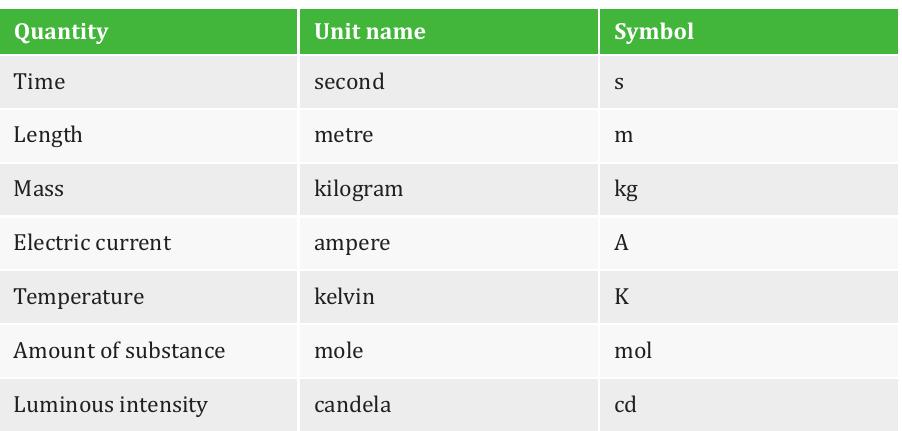
All measurements in physics should ultimately be expressible using these seven fundamental units.
Derived SI units
Derived SI units are formed by multiplying or dividing the base SI units. These units have special names to make them easier to work with. Here are some common examples:
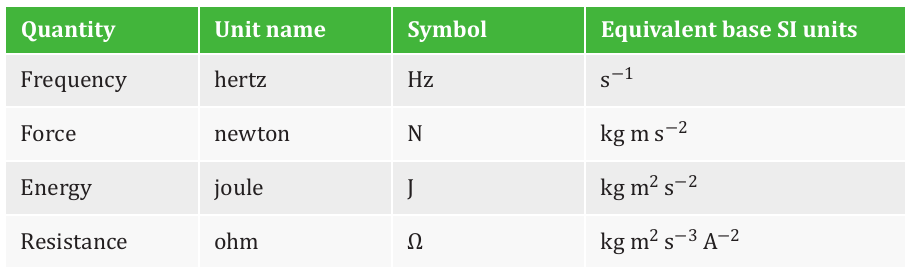
For instance, force is measured in newtons (), which is equivalent to . This tells us that force involves mass, length, and time.
Note
Understanding derived units:
When you see a derived unit, you can work backwards to understand what physical quantities are involved. For example, since velocity has units , you know it involves a length divided by a time.
Quantities without dedicated units
Some quantities don't have their own special unit names. Instead, they use combinations of base and derived SI units:
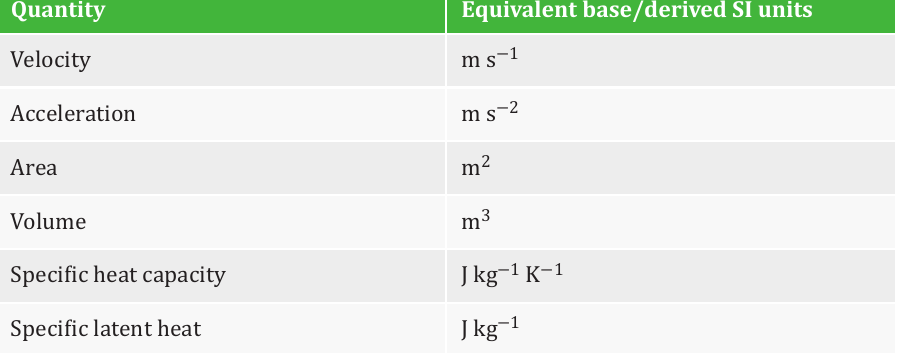
These combinations tell us about the relationship between quantities. For example, velocity is measured in , which shows it's a distance per unit time.
SI prefixes
Prefixes are added to SI units to indicate different orders of magnitude. This makes it easier to work with very large or very small numbers:
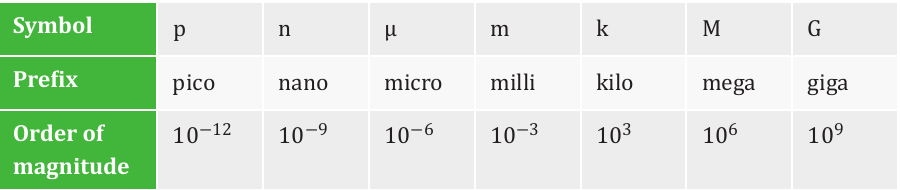
For example, picometres can be written as .
Important
Special case - the kilogram:
The kilogram is a special case because it already contains a prefix ('kilo'). When adding other prefixes to express different masses, we use 'grams' instead. For example, one milligram in SI units would be kilograms, not one 'milli-kilogram'.
Significant figures
When we write down a measurement, the number of digits we use communicates how confident we are in that value. This is where significant figures become important.
Understanding significant figures
Significant figures indicate the degree of confidence we have in a measured value. They help us avoid claiming more precision than our measurements actually have.
Rules for counting significant figures
There are four key rules for determining how many significant figures a number contains:
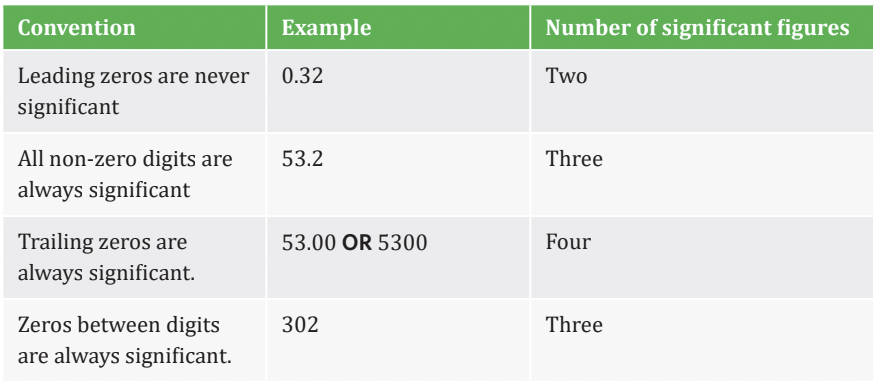
Let's look at some examples:
- has two significant figures (leading zeros don't count)
- has three significant figures (all non-zero digits count)
- has four significant figures (trailing zeros count)
- has three significant figures (zeros between digits count)
Important
Common mistakes to avoid:
Many students incorrectly count leading zeros as significant. Remember: leading zeros NEVER count as significant figures. They're just placeholders to show the decimal position. For example, has only 2 significant figures, not 6.
Rules for calculations
When performing calculations, we need to ensure our answer reflects the appropriate level of precision:
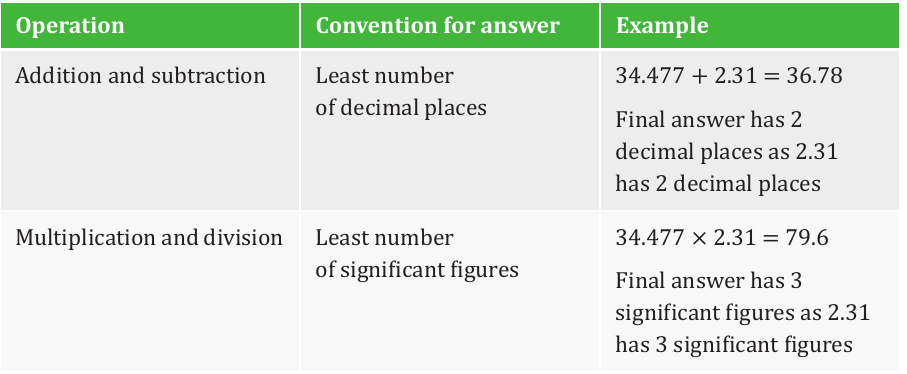
For addition and subtraction: Use the least number of decimal places from your starting values. For example, (rounded to 2 decimal places because has only 2 decimal places).
For multiplication and division: Use the least number of significant figures from your starting values. For example, (rounded to 3 significant figures because has only 3 significant figures).
Important
Critical calculation strategy:
When working through multi-step problems, keep extra significant figures in your intermediate steps. Only round to the correct number of significant figures in your final answer. This prevents rounding errors from accumulating and ensures your answer is as accurate as possible.
Scientific notation
Scientific notation provides a standardised way to express numbers while clearly showing the number of significant figures. Numbers are written in the form:
where is a number with an absolute value between and (such as or ), and is an integer. All the digits in are significant.
We use scientific notation for two main reasons:
- To write very large or very small numbers compactly: For example, is much easier to work with than .
- To correctly show our level of certainty: If we say a building is tall, we're indicating we measured to the nearest metre. However, if we write , we're showing we measured to the nearest (three significant figures instead of one).
Converting to scientific notation
To convert from standard notation to scientific notation:
- Move the decimal point so it comes after the first significant digit
- Count how many places you moved the decimal point - this becomes
- If you moved the decimal point to the left, is positive
- If you moved the decimal point to the right, is negative
Note
Conversion examples:
- (decimal moved 6 places left, so )
- (decimal moved 4 places right, so )
Examples of scientific notation
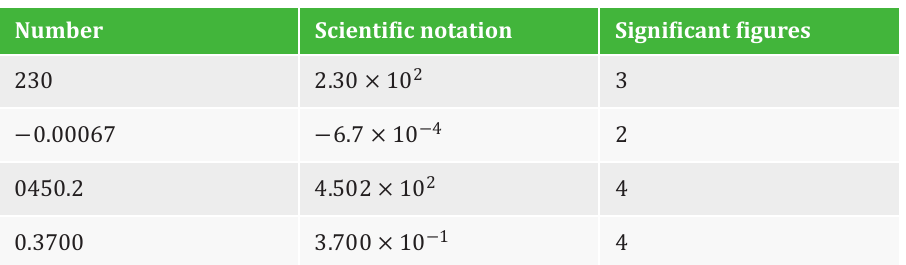
Notice how scientific notation makes the number of significant figures completely clear. Each example shows exactly which digits are significant.
Worked example: unit conversion with significant figures
Example
Worked Example: Unit Conversion with Significant Figures
Question: Convert to the SI unit for length, with two significant figures.
Step 1: Identify what you know and what you need to find.
Known:
Unknown:
Conversion:
Step 2: Substitute values and solve.
Step 3: Round to the required number of significant figures.
Final answer:
Remember!
Summary
Key Points to Remember:
-
SI units provide a standardised system with seven base units (second, metre, kilogram, ampere, kelvin, mole, candela) from which all other units are derived.
-
Significant figures communicate confidence in measurements. Leading zeros NEVER count as significant figures, but trailing zeros and zeros between digits ALWAYS do.
-
For addition and subtraction, round your answer to the least number of decimal places. For multiplication and division, round to the least number of significant figures.
-
Scientific notation () allows us to express very large or small numbers clearly and shows exactly how many significant figures we're claiming.
-
When working through multi-step calculations, keep extra precision in intermediate steps and only round to the correct significant figures in your final answer.