Electricity at Home (VCE SSCE Physics): Revision Notes
📚Revision Notes
Electricity at Home
Introduction to household electrical systems
Electricity plays an increasingly important role in modern homes. While heating and air conditioning systems have traditionally been the largest consumers of household electricity, electric vehicles (EVs) are becoming significant electrical devices in many homes, requiring dedicated charging stations connected to the main electricity supply.
Understanding how electricity is distributed and used safely in homes is essential. This knowledge helps us use electrical energy more efficiently, reduce costs, and improve safety. Modern homes now feature smart meters that can monitor consumption in real time and even account for energy production from solar panels.
Important
Safety Warning: Investigating mains-operated appliances or household electrical installations should only be done under strict supervision. Never open an appliance for study until its mains plug and cord have been permanently removed. Only licensed electricians should work on mains circuits and connected appliances, as unlicensed work can cause fires, equipment malfunction, or personal injury.
Features of mains electrical circuits
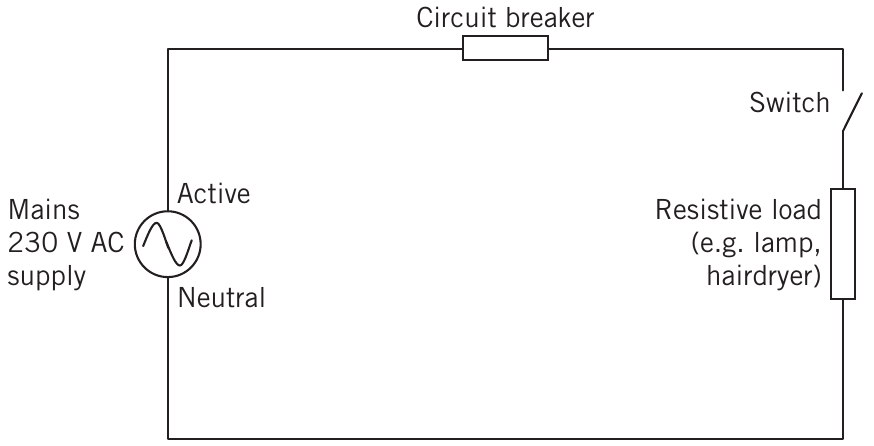
All household electrical circuits share several common features that work together to deliver electricity safely and efficiently:
Source of EMF: The mains supply provides (alternating current). This is the potential difference that drives current through household circuits.
Protection devices: Circuit breakers or fuses protect circuits from excessive current. These automatically disconnect the circuit if current exceeds safe levels, preventing overheating and fire hazards.
Control mechanisms: Switches allow users to control when current flows to an appliance. They are always connected in series with the load in the active wire.
The load: This is any device that converts electrical energy into another form, such as light bulbs (electrical to light), motors (electrical to kinetic), or heaters (electrical to thermal).
Low-resistance cables: Connecting wires must have very low resistance to minimise energy loss. Most of the mains voltage should appear across the load, not the connecting wires. Typically, only about is dropped across the wires and fuses.
Note
The design of household circuits ensures that most voltage appears across the appliance (the load) rather than being wasted in the connecting wires. This is why low-resistance cables are essential for efficient energy delivery.
Understanding AC and DC
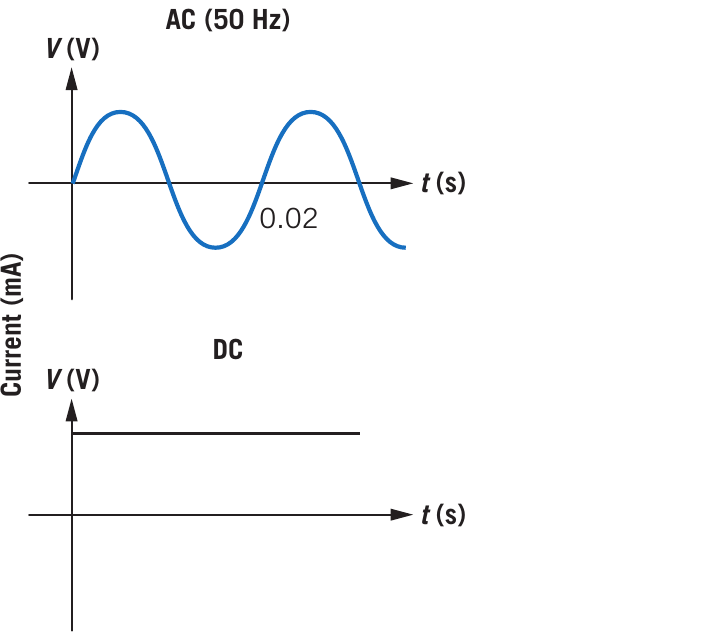
Australian mains electricity uses alternating current (AC), where the current and potential difference oscillate back and forth times per second (frequency of ). This differs from direct current (DC) provided by batteries, where current flows steadily in one direction.
For circuit analysis, we can model AC household circuits as simpler DC circuits. Instead of positive and negative terminals, AC circuits have an active (or live) wire and a neutral wire. The active wire alternates between positive and negative relative to neutral, which remains close to zero potential.
Series and parallel circuits in homes
Understanding the difference between series and parallel circuits is crucial for comprehending household wiring:
Series circuits: Components are connected one after another in a single path. If one component fails, the entire circuit breaks. Current is the same through all components, but voltage divides among them.
Parallel circuits: Components are connected across common points, creating multiple current paths. Each component receives the full supply voltage, and components can operate independently. If one fails, others continue working.
Household circuits predominantly use parallel connections for these important reasons:
- Each appliance receives the full mains voltage (), ensuring proper operation
- Appliances can be switched on and off independently without affecting others
- The failure of one appliance doesn't disconnect the entire circuit
- Different appliances can draw different currents based on their power requirements
Note
The parallel connection is essential for household functionality. Imagine if your lights went out every time you turned off the television - that's what would happen with series connections! Parallel circuits allow each device to operate independently while all receiving the full supply.
House wiring systems
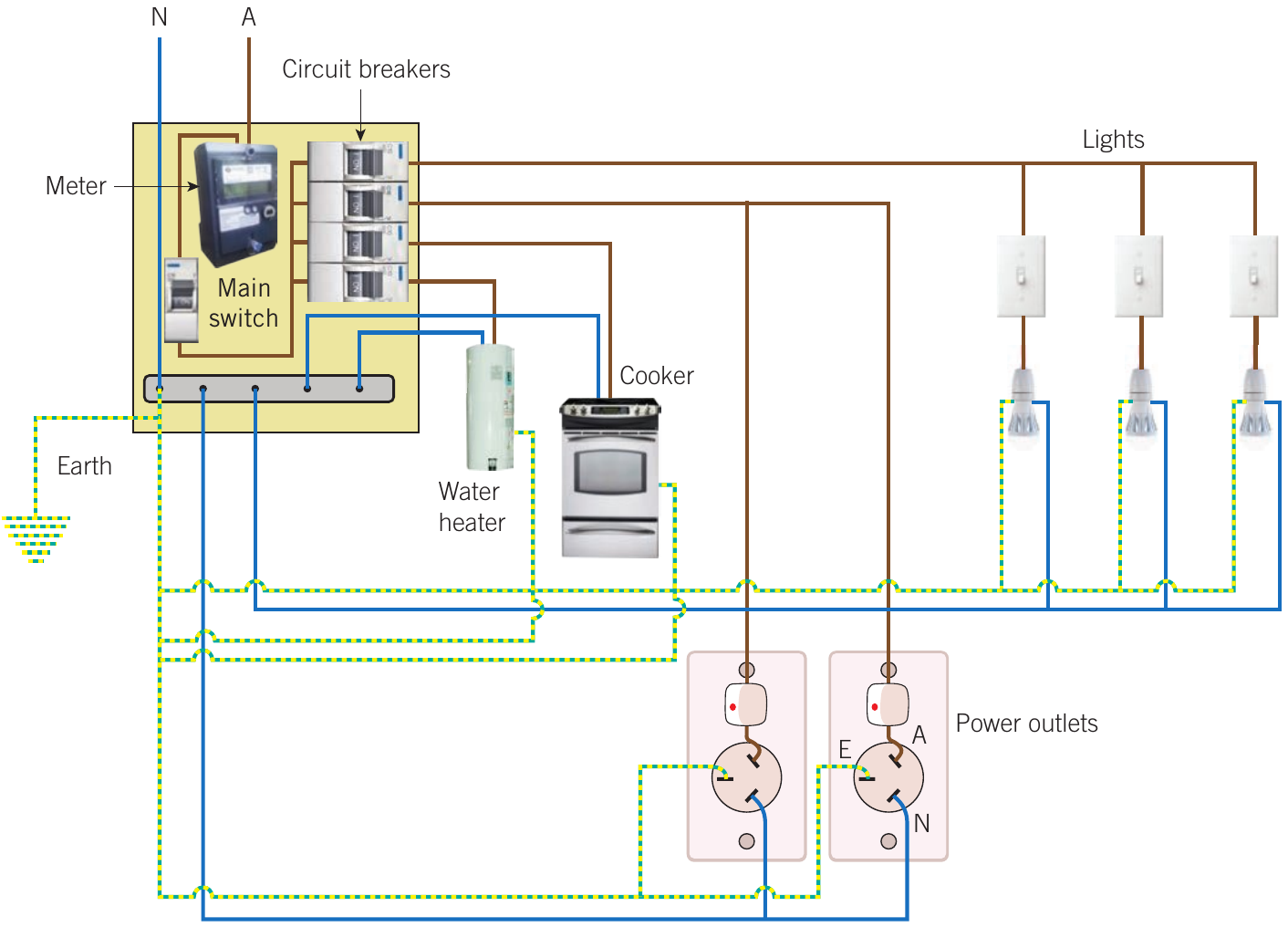
When electricity enters a house, it follows a carefully designed path to ensure safety and functionality:
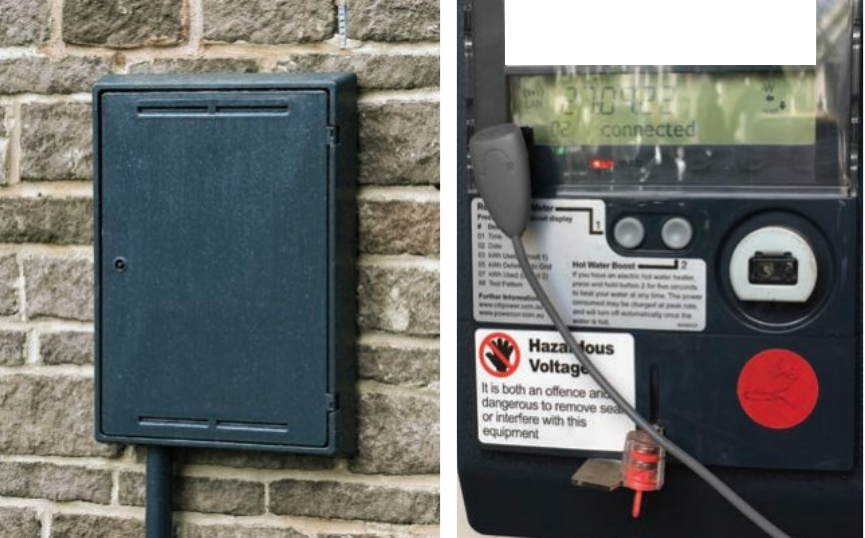
The meter: All current entering the house passes through the meter, which is connected in series with the active wire. This measures total energy consumption for billing purposes. Modern smart meters can be read remotely and track both consumption and production from solar panels.
Main switch: Also in series with the active wire, this allows the entire house's electrical supply to be disconnected for maintenance or emergencies.
Circuit division: The supply divides into separate circuits for different areas and purposes (lighting, power outlets, water heating, cooking). Each circuit operates in parallel with the others.
Circuit protection: Each circuit has its own circuit breaker (or fuse in older homes) connected in series. This isolates individual circuits if excessive current flows, preventing damage to other circuits.
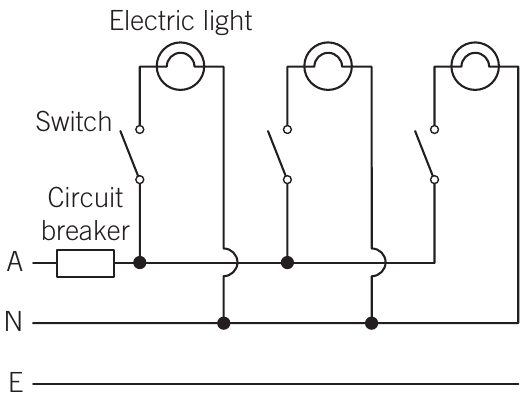
Lighting circuits: Within a room, lights are connected in parallel so each receives and can be controlled independently. The switch connecting them is placed in series with the active wire. Even when light fittings don't require an earth connection (being double-insulated), earth wiring must still be included for future flexibility.
Note
The combination of series and parallel connections in household wiring is deliberate: meters and switches are in series (so all current passes through them), while appliances and lights are in parallel (so they operate independently). This design maximizes both safety and functionality.
Measuring electrical energy: the kilowatt-hour
Electricity meters measure energy consumption in a unit called the kilowatt-hour (kWh). This unit is more practical than joules for household use because it relates directly to appliance power ratings and usage time.
Definition: One kilowatt-hour is the energy consumed when an appliance rated at operates for hour.
We can relate the kWh to the SI unit of energy (joule):
Therefore:
Key formula: To calculate energy consumption:
where:
- = energy in kWh
- = power in kW
- = time in hours
Important
Remember that . This conversion is essential for relating household energy consumption to the standard SI unit of energy. The kWh is simply more practical for everyday use because typical household values would be very large if expressed in joules.
Example
Worked Example: Using kilowatt-hours
Question: An electric kettle has a power rating of .
a) How much energy does it use in hour? Answer in both kWh and joules.
b) How much energy does it use in minutes?
Solution:
a) Power rating:
Time:
Energy:
To convert to joules:
Alternatively: ,
b) In minutes (which is of an hour):
In joules:
Appliance power ratings and energy efficiency
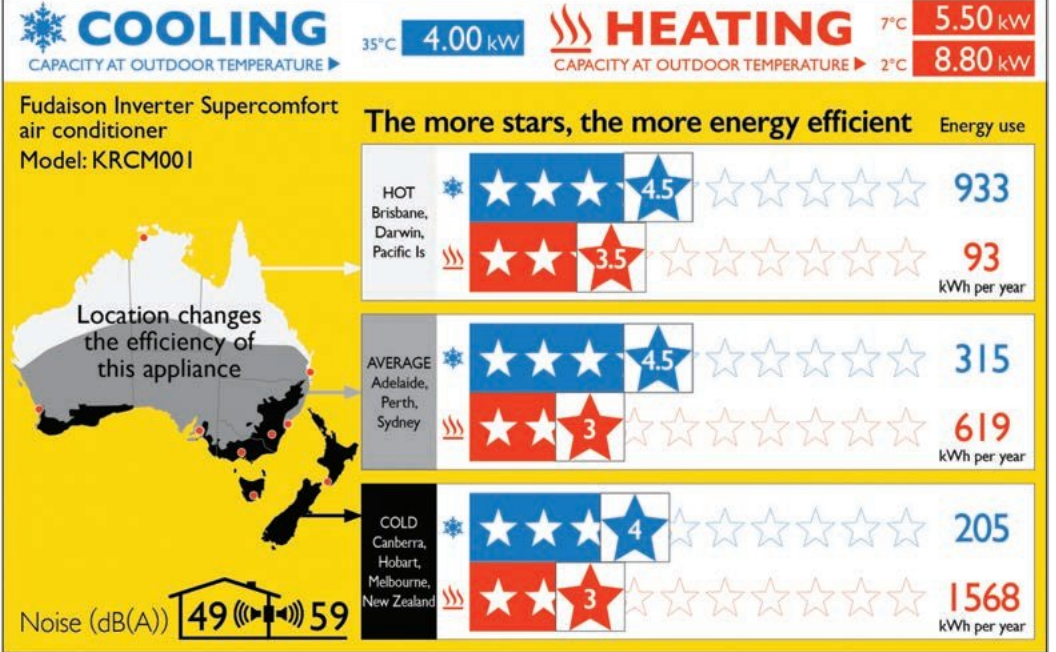
Every electrical appliance sold in Australia must display its power consumption rating (in watts or kilowatts) on a nameplate, usually located underneath or on the back. Additionally, a star rating system helps consumers compare energy efficiency across similar products.
The energy rating label provides crucial information:
- Star rating (more stars = more efficient = lower running costs)
- Annual energy consumption in kWh
- Specific performance data (e.g., cooling/heating capacity for air conditioners)
For air conditioners, ratings vary by climate zone because requirements differ significantly between locations. Most of Victoria falls within the cold climate zone, with the northwestern corner in the mild zone.
Important
Comparing Appliances: When comparing appliances, always check actual energy consumption figures, not just star ratings. A three-star 32-inch television will use considerably less energy than a 65-inch television with five stars simply due to size differences. Compare like with like to make meaningful efficiency decisions.
Energy usage in Australian households
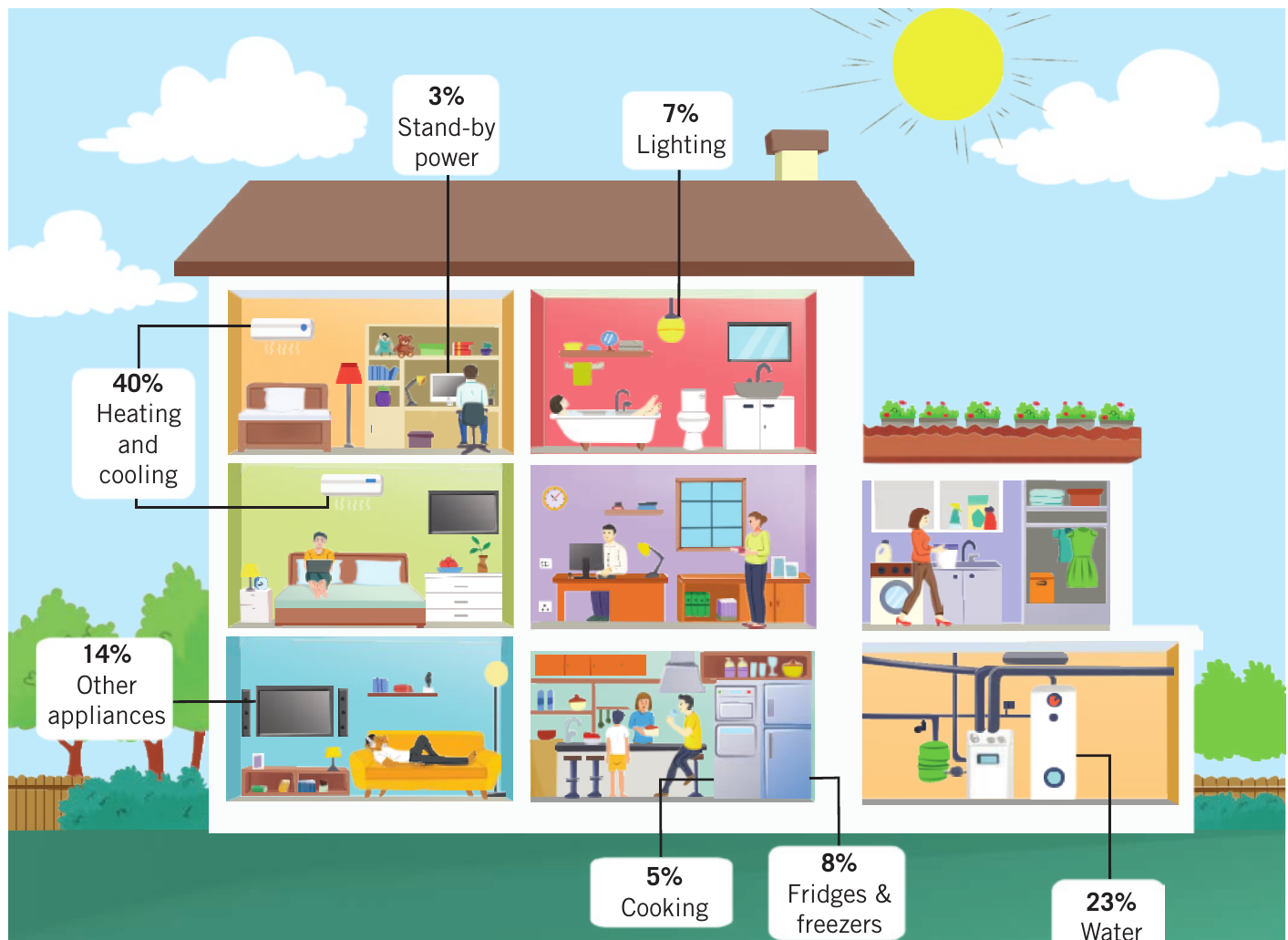
A typical Australian household spent approximately $2000 on electricity in 2021. Understanding where this energy goes helps identify opportunities for savings.
| Appliance type | % of total household electrical energy use | Most efficient options | Energy saving tips |
|---|---|---|---|
| Heating and cooling | 40% | Reverse cycle heat pump for both heating and cooling; DC ceiling fans | Run at warmest comfortable temperature in summer and coolest in winter (each 1°C adjustment = 10% energy difference) |
| Water heating | 23% | Heat pump hot water system, especially with solar power | Use cold water when possible for clothes, dishes, hands, filling kettle |
| Other appliances (washing machine, dryer, TVs, computers) | 14% | Compare similar products carefully; choose appropriate size; LCD TVs over plasma | Use dishwasher (more efficient than hand-washing) on eco mode when full; dry clothes in sunlight |
| Fridges and freezers | 8% | Right-sized units (larger = more expensive to run); avoid keeping old fridges running | Set fridge to 3°C, freezer to -18°C; assess whether deep freezers are worthwhile |
| Lighting | 7% | LED globes (running cost ~10% of incandescent for same output) | Switch to LED lighting |
| Cooking | 5% | Induction cooktops and microwaves | Boil only the water you need |
| Standby power | 3% | Turn off devices at wall when possible | Switch off phone chargers and appliances with clocks when not in use |
Note
Energy-efficient home design incorporating low-emissivity glass and comprehensive insulation in walls, floors, and ceilings significantly reduces heating and cooling requirements. Since heating and cooling account for 40% of household energy use, improving home insulation is one of the most effective ways to reduce both costs and greenhouse gas emissions from electricity generation.
Power and current calculations
We can calculate the current drawn by an appliance using the power equation:
Rearranging:
where:
- = power in watts (W)
- = voltage in volts (V)
- = current in amperes (A)
Example
Worked Example: Power consumption calculations
Question: A 55-inch television is rated at .
a) Calculate the current (in mA) that it draws from the mains supply.
b) In standby mode, the TV draws of current. Calculate the power used in standby and the energy (in kWh) used during one year in standby mode.
Solution:
a) Given: ,
b) Power in standby:
Energy per year (converting to kW):
Time in one year:
This demonstrates that standby power, while small, accumulates significantly over time.
Cost of running appliances
To calculate running costs, multiply energy consumption (in kWh) by the electricity price (in $/kWh):
Or more directly:
Example
Worked Example: Cost calculations
Question: Using the 55-inch television from the previous example ( rating):
a) Calculate the cost of running the TV for hours. Assume electricity costs $0.30/kWh.
b) Calculate the weekly cost if the TV is on for hours daily and on standby for the remaining hours.
c) A household battery stores . How many days could this power the TV under the conditions in part b?
Solution:
a)
Cost 0.048 \approx 4.8~\text{cents}$`
b) Daily energy use:
- Active ( hours):
- Standby ( hours):
- Total per day:
Daily cost = or about cents
Weekly cost = or about cents
c) Battery capacity:
Daily consumption:
Time
The battery could power the TV for approximately days under these conditions.
Techniques for solving kWh problems
Follow these systematic steps to avoid errors:
- Identify given values: Underline each value and its unit, noting the quantity symbol (, , , etc.)
- Write relevant formulas: Determine which equations you need
- Convert units: Before substituting, ensure compatible units:
- For answers in joules: convert hours to seconds (×3600)
- For answers in kWh: convert minutes to hours (÷60)
- Keep conversion factors visible for easier cancellation
- Substitute values: Write the equation, then substitute quantities with their units on the next line
- Calculate: Cancel where possible, then compute the answer with correct units
Important
Exam tip: Think ahead to use the simplest method with fewest calculations. Develop a sense for reasonable answer sizes to catch calculation errors. For example, if you calculate that a kettle uses 500 kWh in one hour, you know something has gone wrong - that would be the energy consumption of an entire house for weeks!
Summary
Key Points to Remember:
-
Parallel circuits are used in homes because each appliance receives full mains voltage and can operate independently
-
The kilowatt-hour (kWh) is the practical unit for household energy:
-
Energy formula: (with in kW and in hours for kWh)
-
Power equation: (use to calculate current from power rating)
-
Star ratings indicate efficiency: more stars mean lower running costs and reduced environmental impact
-
Standby power seems small but accumulates significantly over time—turn devices off at the wall when not in use
-
Heating and cooling consume 40% of household electricity—the biggest opportunity for energy savings
-
Always check actual energy consumption figures when comparing appliances, not just star ratings