Obedience (VCE SSCE Psychology): Revision Notes
📚Revision Notes
Obedience
What is obedience?
Obedience refers to changing behaviour in response to direct commands from an authority figure. This type of social influence is distinct from other forms because it involves explicit orders rather than implicit social pressure. Throughout our lives, we encounter numerous situations where obedience is expected and often necessary for social functioning.
From childhood, people learn to comply with instructions from those holding legitimate power over them in specific contexts. Teachers, police officers, parents, employers, and other authority figures regularly influence behaviour through direct commands. Obedience typically occurs when the authority figure's request falls clearly within their recognised domain of control.
Note
Everyday Examples of Obedience:
Common situations where obedience occurs include:
- Stopping talking when a teacher asks for silence in class
- Pulling over when you see police lights flashing behind your vehicle
- Following workplace instructions from your employer
- Complying with parental rules whilst living at home
These examples show how obedience is woven into daily social interactions and helps maintain order in various contexts.

The decision to disobey authority often comes with an awareness of potential consequences. People may choose to defy authority figures, but usually do so expecting negative repercussions such as punishment, disapproval, or loss of privileges. Interestingly, obedience can be so powerful that individuals sometimes perform actions they would normally consider ethically wrong, solely because an authority figure ordered them to do so.
Historical context and motivation for studying obedience
The systematic study of obedience gained urgency following the Holocaust, during which six million Jews, Romani people, communists, and trade unionists were murdered in Nazi extermination camps. This genocide could not have been carried out by Hitler and a small group of leaders alone. It required the compliance of thousands of guards, administrators, and staff who followed orders to commit horrific acts.
Adolf Eichmann, executed in 1962 for his role in the Holocaust, exemplified this troubling phenomenon. As a logistical coordinator, Eichmann planned the efficient collection and deportation of Jews to extermination camps. During his 1961 trial, Eichmann expressed genuine surprise at being disliked by Jews, claiming he had merely followed orders.
Important
Eichmann's Defence:
In his prison journal, Eichmann wrote: "The commands were, for me, the highest thing in my life, and I had to fulfil them without question."
This statement reveals how deeply ingrained obedience to authority can become, even when the commands involve participating in atrocities. The disturbing reality is that Eichmann genuinely believed his obedience absolved him of moral responsibility.
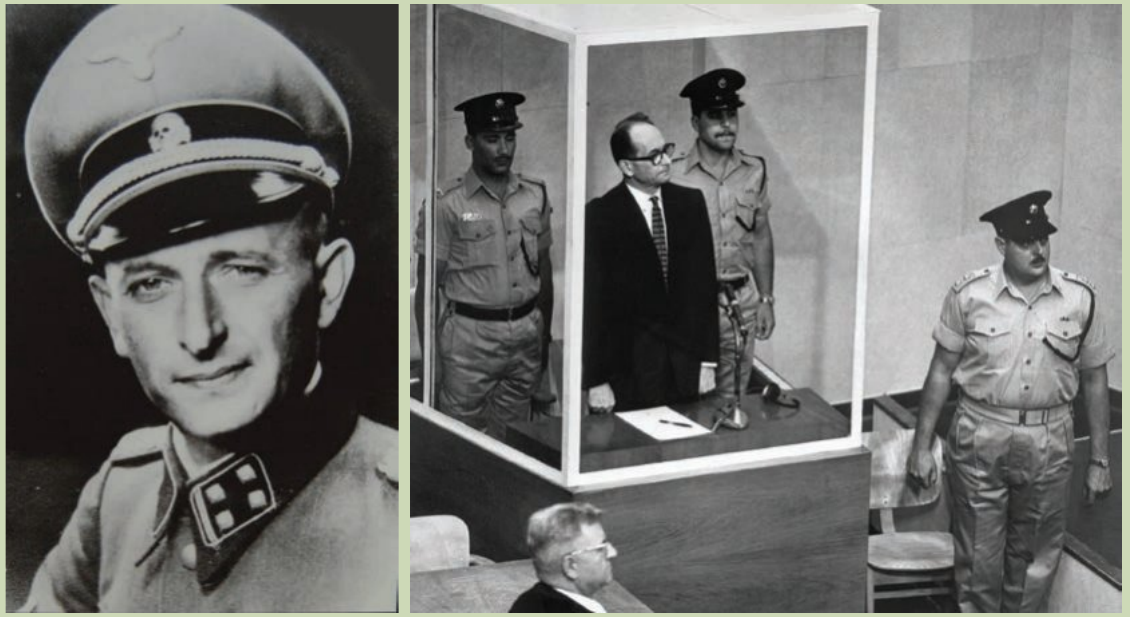
Six psychiatrists who examined Eichmann declared him mentally sound, and observers at his trial described him as an ordinary person with a normal family life. This raised a disturbing question: if Eichmann's behaviour was not the result of mental illness or an abnormal personality, could his actions have been shaped by the social situation in which he found himself? If so, this suggested that ordinary people might be capable of committing terrible acts under certain circumstances.
This unsettling possibility motivated American psychologist Stanley Milgram to investigate obedience scientifically.
Milgram's 1963 obedience experiment
Background and aims
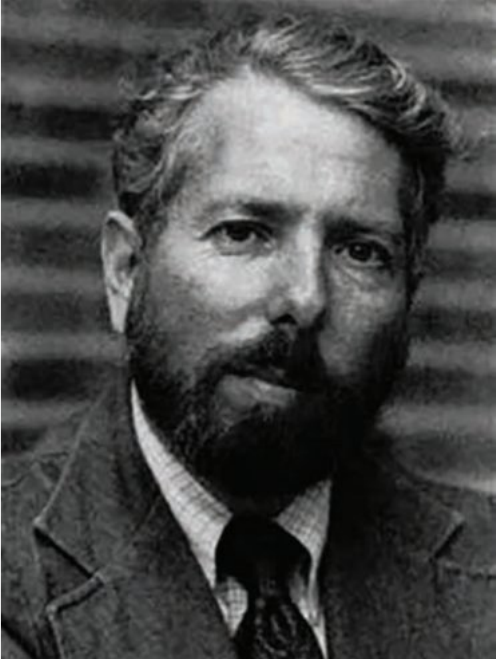
Stanley Milgram wanted to examine the factors that led people to obey authority figures, particularly when those orders involved inflicting pain on another person. During the Nuremberg war trials and Eichmann's trial, the defence "I was just following orders" was repeatedly used. Milgram sought to determine whether this was merely an excuse from willing participants or reflected genuine psychological processes of obedience.
In 1963, at Yale University, Milgram conducted what would become one of the most famous and controversial psychology experiments in history.
Participants
Milgram recruited 40 male participants aged 20-50 through a newspaper advertisement. The sample included men from various professional levels and socioeconomic backgrounds, ranging from factory workers and labourers to businessmen and professional people. Participants were paid $4 for one hour of their time, which represented a substantial amount in 1963.
The advertisement stated that participants were needed for "a study of memory and learning" at Yale University, deliberately concealing the true purpose of the research.
Experimental setup and equipment
The experiment was designed to test obedience, but participants were deceived about this true aim. They were told they would be helping researchers investigate whether punishment through electric shocks could improve memory. This deception was necessary to ensure participants behaved naturally rather than deliberately acting obedient or defiant.
Each real participant arrived separately and met with an experimenter (one of Milgram's staff members) who wore a white lab coat to convey authority and spoke in a serious, authoritative manner. A third person was introduced as another volunteer, but this person was actually a confederate - an actor working with the experimenter whilst pretending to be a genuine participant.
Note
What is a Confederate?
A confederate is someone who is part of the team of experimenters but pretends to be the subject of the experiment (or neutral). In Milgram's study, the confederate played the role of the "learner" who appeared to receive shocks, but was actually working with the experimenter to create a realistic scenario for studying the real participant's behaviour.
The experimenter had both individuals draw slips of paper to determine roles: one would be the "teacher" and one would be the "learner". However, both slips actually read "teacher", ensuring the real participant always became the teacher whilst the confederate pretended to have drawn "learner".
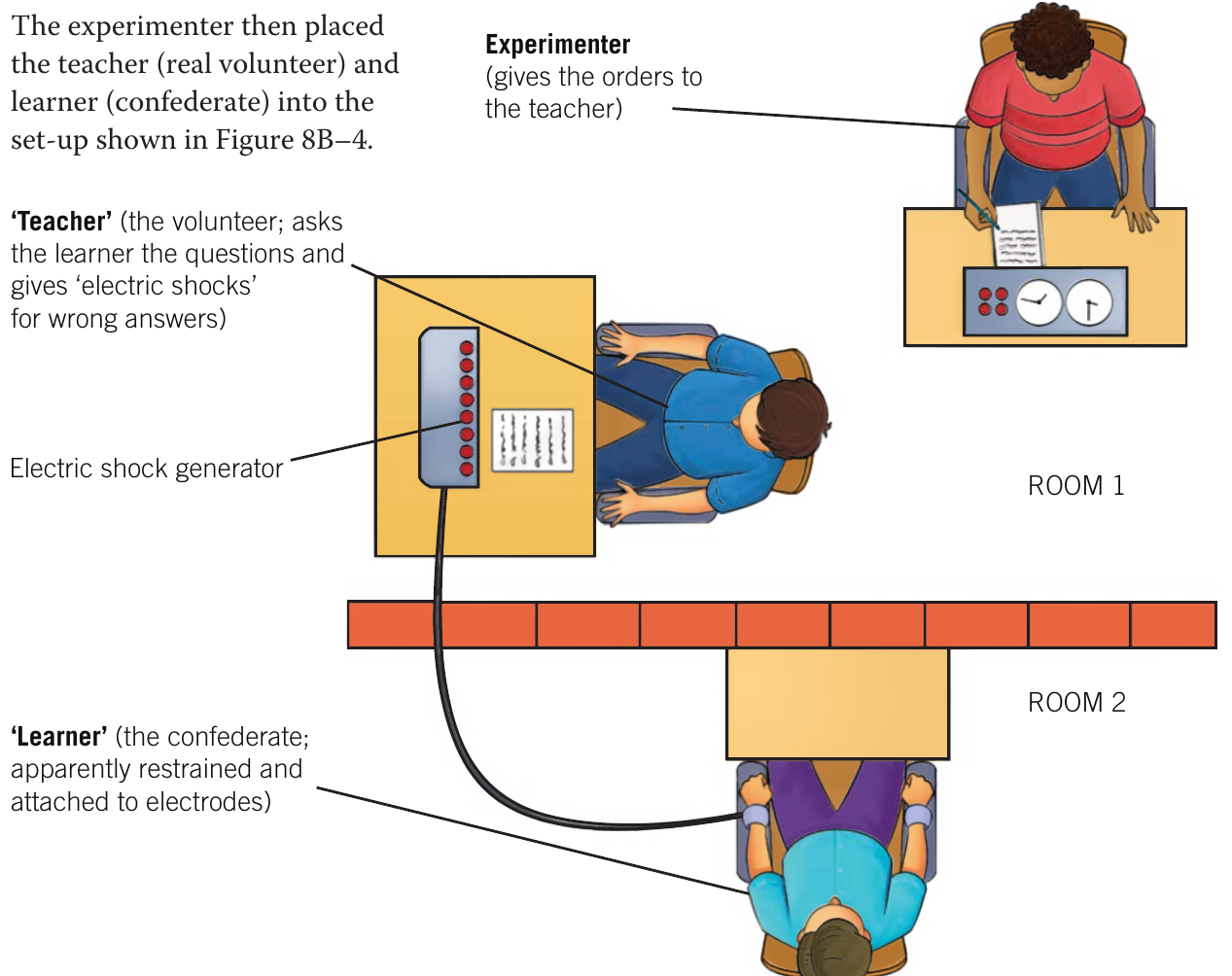
The experimental setup involved two separate rooms connected by audio equipment. The teacher (real participant) sat in one room with an electric shock generator, whilst the learner (confederate) was positioned in another room, apparently restrained in a chair with electrodes attached.
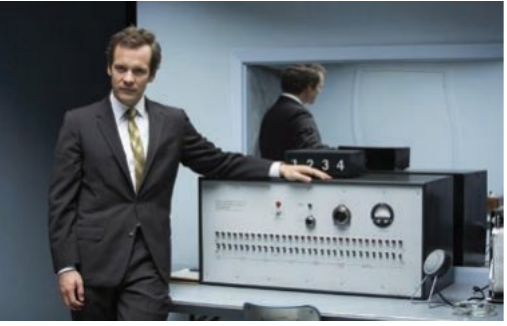
The shock generator was an impressive piece of equipment featuring 30 toggle switches arranged in a row. Each switch was labelled with a voltage level ranging from 15 volts to 450 volts in 15-volt increments. Beneath the switches were descriptive labels indicating shock intensity.
These labels ranged from "Slight Shock" (15V) through "Moderate Shock" (75V), "Strong Shock" (135V), "Very Strong Shock" (195V), "Intense Shock" (255V), "Extreme Intensity Shock" (315V), and "Danger: Severe Shock" (375V), culminating in "XXX" (435-450V).
Procedure
Initial setup:
- The experimenter supervised whilst the learner was strapped into a chair and had electrodes attached, with the teacher watching this process. This created the impression that the learner would genuinely receive shocks.
- The teacher was seated at the generator desk in the separate room and given sheets listing word pairs.
- To convince the teacher that the machine worked, they received a genuine mild shock (45 volts) from the generator.
- The experimenter explained that the teacher's role was to read word pairs aloud for the learner to memorise, then test the learner's memory.
- The teacher was instructed to administer an electric shock each time the learner made a mistake, starting at 15 volts and increasing the voltage with each subsequent error.
- The experimenter assured both individuals that whilst the shocks might be painful, they would cause no permanent tissue damage.
- During the test, the teacher and learner could hear but not see each other.
The teacher's experience:
Example
The Teacher's Perspective: What Participants Experienced
From the teacher's perspective, the experimental session proceeded as follows:
Step 1: Beginning the experiment
- The experimenter instructed the teacher to begin reading word pairs, recording the learner's responses, and administering shocks for incorrect answers.
Step 2: First mistakes and reactions
- The teacher read out the first set of word pairs, which the learner attempted to recall.
- At the first mistake, the experimenter directed the teacher to deliver the slight shock. The teacher heard the learner gasp in apparent pain.
- At the next error, the experimenter ordered a stronger shock. Again, the teacher heard the learner cry out.
Step 3: Escalation and participant objections
- This pattern continued, with the experimenter commanding increasingly powerful shocks for each mistake, and the teacher hearing escalating reactions of pain from the learner.
- Teachers typically began questioning the procedure at this point, objecting that the learner was suffering and suggesting the experiment should stop.
Step 4: The experimenter's prompts The experimenter responded with one of four standardised prompts in a firm, matter-of-fact tone:
- "Continue please" or "Go on"
- "The experiment requires that you continue"
- "It is absolutely essential that you continue"
- "You have no choice"
Step 5: Critical resistance point
- At 150 volts, teachers heard the learner shouting "Get me out of here!" and "I can't go on!"
- Most teachers expressed concern at this point, making statements like "He's yelling in there" or "I think he's hurt"
- However, whenever they paused, the experimenter simply repeated the prompts.
Step 6: Final outcome The experimenter recorded either the voltage level at which the teacher finally refused to continue, or noted if they reached the maximum 450 volts.
The learner's experience (unknown to the teacher):
In reality, the learner was never shocked. After the teacher left for the other room, the learner released himself from the chair and set up a tape recorder. His responses during the memory test, including deliberate errors, gasps, cries, and screams of pain, were all pre-recorded. When the shock generator was activated, the learner simply played back the appropriate pre-recorded reaction for that voltage level. The learner was a skilled actor whose recordings convincingly portrayed increasing distress as voltage levels rose.
Results
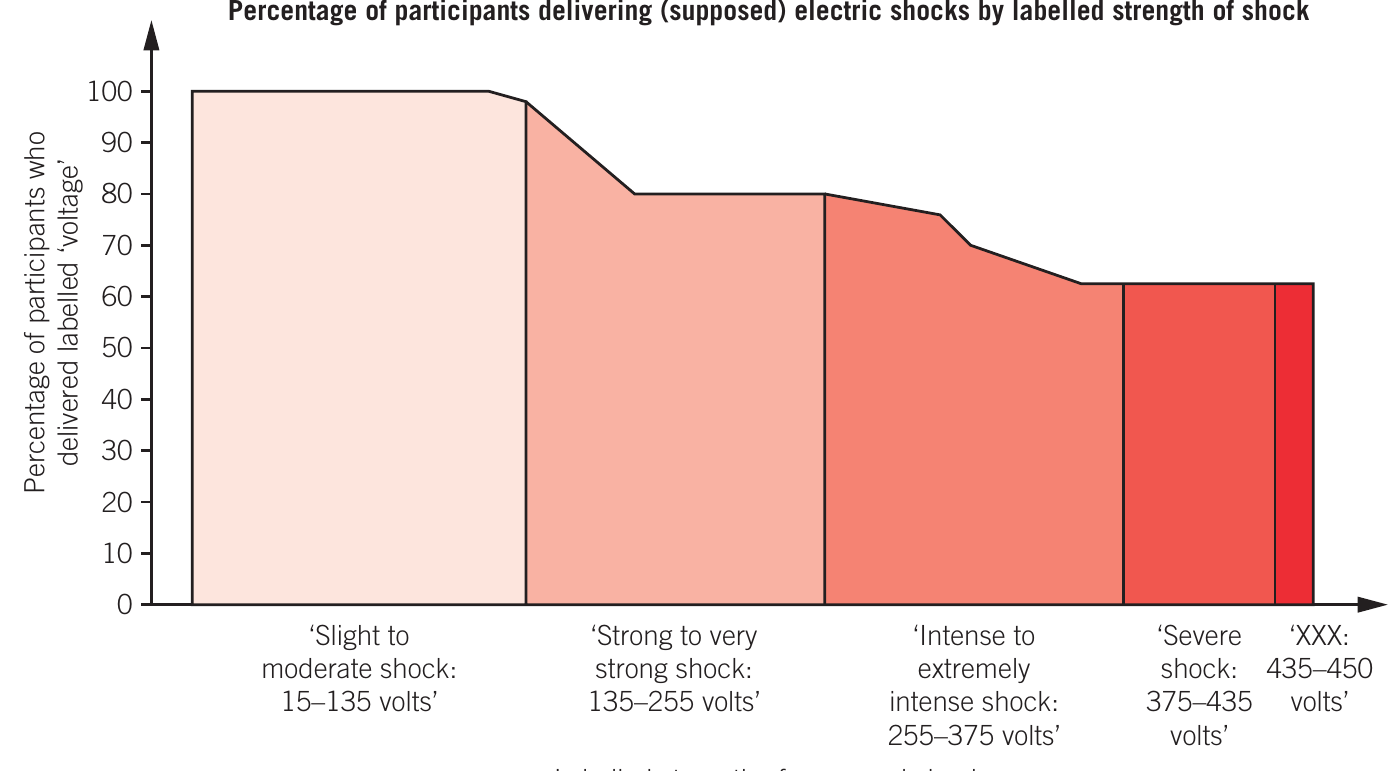
The experimental results shocked the scientific community and contradicted predictions from experts. Before conducting the study, Milgram asked undergraduate psychology students to predict outcomes. They estimated that only 1-2% of the population would administer the full 450 volts. Psychiatrists agreed, suggesting that only individuals with psychopathic tendencies would go to the maximum voltage. Most experts predicted that participants would refuse to continue beyond 150 volts.
Important
Shocking Results:
The actual results proved dramatically different:
- 65% of participants (26 out of 40) administered the supposed maximum shock of 450 volts
- Approximately 90% of participants exceeded 150 volts, the level marked as "Strong to Very Strong Shock" where the learner's protests became intense
These findings far exceeded all expert predictions and revealed that ordinary people were capable of inflicting severe harm when commanded by an authority figure.
The task caused considerable distress for many participants. They frequently looked to the experimenter for guidance and expressed discomfort about shocking another person. Despite these visible signs of stress and moral concern, the majority of these psychologically normal, healthy men continued obeying the experimenter's commands.
Conclusions and implications
Milgram concluded that when confronted with someone perceived as a legitimate authority figure, people tend to set aside their moral judgements and comply with orders without deep reflection. His experiments demonstrated that ordinary, well-adjusted individuals possess the capacity to inflict severe pain and suffering on others under particular situational conditions.
This finding proved overwhelming for many people. How could normal, mentally healthy individuals be capable of potentially killing another person simply because they were instructed to do so by an authority figure?
Note
Replication and Gender Findings:
Milgram's findings have been replicated across various cultures, with most studies reaching similar conclusions. Some replications produced even higher obedience rates.
The research also revealed that women demonstrate the same level of obedience as men. In a 1974 follow-up study, Milgram found that 65% of female participants also administered shocks of 450 volts - identical to the male participants in the original study.
Factors affecting obedience
Milgram conducted 18 variation studies involving 636 additional participants to identify which factors influenced obedience levels. By systematically altering specific aspects of the basic procedure, he could determine what made participants more or less likely to administer the maximum shock. Three key factors emerged: social proximity, legitimacy of the authority figure, and group pressure.

Social proximity
Social proximity refers to the physical distance between people. Milgram discovered that this distance played a substantial role in determining obedience levels, affecting relationships between both the teacher and learner, and the teacher and experimenter.
Distance between teacher and learner:
When the teacher and learner were placed in the same room, standing 40-50 cm apart, obedience to the maximum voltage dropped from 65% to 40%. Physical closeness to the victim made disobedience more likely. This effect intensified when teachers had to force the learner's hand onto an electric plate to deliver the shock - in this condition, only 30% remained fully obedient.
Distance between teacher and experimenter:
Greater physical distance from the authority figure also reduced compliance. When the experimenter left the room and gave instructions by telephone or via tape recording, obedience to the full 450 volts fell to just 20%, compared to 65% when the experimenter was physically present.
Note
Real-World Applications of Social Proximity:
These findings have real-world parallels that help explain behaviour in various contexts:
- Military combat: Soldiers are more willing to kill enemies using long-range weapons than in close combat situations
- Execution procedures: Often position the person activating the electric chair in a separate room from the condemned individual, making it psychologically easier to carry out the order
- Modern warfare: Advanced forces can launch missile or drone strikes from thousands of miles away using computer systems, creating maximum physical and psychological distance from victims
The principle is clear: greater distance from the victim makes harmful actions psychologically easier to perform.

Legitimacy of the authority figure
The perceived status and legitimacy of the person giving orders proved to be another powerful influence on obedience rates. Milgram tested this through several variations examining institutional prestige and symbols of authority.
Institutional prestige:
The original experiment was conducted at the prestigious Yale University, and the experimenter wore a white lab coat - a recognised symbol of scientific authority. To test whether institutional reputation affected obedience, Milgram relocated the experiment to a run-down office building in Connecticut, advertising the study as being sponsored by a private firm rather than mentioning Yale University.
Whilst obedience did decrease in this setting, the drop was smaller than Milgram anticipated. Even in the low-prestige location, 48% of participants still administered the full 450 volts.
Symbols of authority:
The experimenter's appearance had a more dramatic effect. When the experimenter wore ordinary clothing (appearing as a janitor or holding a broom) instead of the white lab coat, compliance dropped sharply to just 20%.
Legitimacy of the authority role:
To isolate the effect of legitimate authority, Milgram created a variation where the experimenter received a phone call and had to leave. A confederate posing as another participant teacher then took charge, suggesting that shocks should continue to increase for wrong answers. The confederate made it appear as though he had decided this himself, rather than following experimental protocol.
Important
The Power of Legitimate Authority:
When the genuine authority figure was removed, compliance plummeted to approximately 20%. Eighty per cent of participants refused to obey the ordinary person giving orders.
Some participants even attempted to physically prevent the confederate from operating the shock generator by unplugging the equipment. This demonstrates that people will obey authority figures, but not peers or those without legitimate status in the situation.

The importance of perceived legitimacy is evident in everyday life. Authority figures typically display easily recognisable symbols of their status. Police officers, paramedics, firefighters, and security guards wear uniforms. Business leaders and politicians wear suits. Medical professionals wear white coats and stethoscopes. These visible emblems of authority encourage obedience from those who encounter them.
Group pressure
Group pressure refers to the influence that observing other people's obedience or disobedience has on an individual's own behaviour. Milgram investigated this by introducing additional confederate teachers into the experimental setup.
In one variation, three teachers participated: Teacher 1 (confederate) read the word pairs, Teacher 2 (confederate) indicated whether answers were correct, and Teacher 3 (the real participant) delivered the shocks. When the learner complained of pain at 150 volts, Teacher 1 refused to continue and left despite the experimenter's requests. Teachers 2 and 3 continued until 210 volts, when Teacher 2 also refused, claiming the learner was suffering too much. The experimenter then instructed Teacher 3 (the real participant) to continue alone.
In this condition, only 10% of participants administered the full 450 volts - a dramatic decrease from the 65% obedience rate in the original study. Observing others disobey the authority figure made participants far more likely to disobey themselves.
Note
Bidirectional Effect of Group Pressure:
The opposite effect also occurred. When two confederate teachers demonstrated complete support for the experimenter's commands throughout the session, participant obedience actually increased from 65% to 72.5%. Witnessing peers comply with authority encouraged participants to do the same.
This demonstrates the powerful role that peer behaviour plays in determining individual responses to authority. People look to others in their social environment for cues about appropriate behaviour, and this extends to decisions about whether to obey or disobey authority figures.
Limitations of Milgram's studies
Whilst Milgram's research has been replicated successfully and has provided valuable insights into obedience, it has also faced substantial criticism regarding both its methodology and ethics.
Methodological issues
Biased sample:
The participants in Milgram's original study were not representative of the broader United States population. All 40 participants were white males, which means the findings cannot be confidently generalised to women or people from other ethnic backgrounds (though later replications with women showed similar results). Additionally, Milgram used a convenience sample, recruiting only those who responded to his newspaper advertisement. This method introduces selection bias, as respondents may differ systematically from non-respondents in relevant psychological characteristics.
Artificial experimental setting:
The studies were conducted in laboratory conditions, which may have affected participant behaviour in several ways. Demand characteristics - environmental or procedural cues that hint at the study's aims or expected outcomes - could have influenced how participants acted. For instance, participants might have suspected that the shocks were not real, or they may have behaved differently because they knew they were in an experiment at a university. These cues can make behaviour less natural and spontaneous, potentially limiting the extent to which findings reflect real-world obedience.
Ethical issues
Important
Ethical Concerns:
Milgram's experiment raised three major ethical issues that continue to be debated in psychology:
1. Harm to participants: Participants experienced highly stressful situations that could have caused psychological damage. Many showed visible signs of distress, including sweating, trembling, and nervous laughter, whilst believing they were inflicting severe pain on another human being. The potential for lasting psychological harm from this experience represents a serious ethical concern.
2. Withdrawal rights: Ethical guidelines state that participants must be free to leave an experiment at any time without penalty. However, when Milgram's participants attempted to withdraw, expressing discomfort with the situation, they received responses such as "you must continue" and "you have no choice". These statements undermined participants' understanding that withdrawal was permitted, effectively coercing them to remain in a distressing situation against their will.
3. Deception: Participants were not informed about the true nature of the experiment. They believed they were participating in a memory study and that they were genuinely shocking another person. This extensive deception violated the ethical principle of informed consent.
Milgram defended this aspect of his research, arguing that deception was necessary to obtain natural behaviour and that participants were thoroughly debriefed afterwards. During debriefing, participants learned the true purpose of the study, were reassured that their behaviour was normal, and met the unharmed "learner". They were also given the option to withdraw their data from analysis.
Note
Participant Feedback:
Milgram conducted a follow-up survey with participants to assess their long-term reactions. The results showed that:
- 84% felt glad to have participated and believed they had learned something valuable about themselves
- Only 2% reported that their experience had not been positive
However, critics argue that this retrospective justification does not excuse the initial distress and lack of informed consent.
Remember!
Summary
Key Points to Remember:
-
Obedience involves changing behaviour in response to direct commands from an authority figure, which differs from conformity (group pressure) or compliance (responding to requests).
-
Milgram's 1963 experiment demonstrated that 65% of ordinary people would administer potentially lethal electric shocks when ordered to do so by an authority figure, far exceeding expert predictions of 1-2%.
-
Three key factors influence obedience levels:
- Social proximity (physical distance from victim and authority)
- Legitimacy of the authority figure (status, symbols, and institutional prestige)
- Group pressure (observing others obey or disobey)
-
Social proximity has opposite effects depending on the relationship: greater distance from the victim increases obedience (65% to 20% when giving orders by phone), whilst greater distance from the authority figure decreases obedience (65% to 20% when experimenter absent).
-
Milgram's research faced substantial criticism for methodological issues (biased sample, artificial setting) and ethical violations (causing psychological harm, restricting withdrawal rights, using deception), though these concerns must be weighed against the important insights the studies provided about human behaviour and obedience to authority.