The Positive and Negative Influences of Heuristics (VCE SSCE Psychology): Revision Notes
📚Revision Notes
The Positive and Negative Influences of Heuristics
What are heuristics?
As humans navigate daily life, we process vast amounts of sensory information and make numerous decisions within limited time frames. When faced with insufficient information but needing to make an immediate decision, we rely on cognitive shortcuts to determine the best and least effortful course of action.
Note
Definition of Heuristics
Heuristics are mental strategies that enable quick decision-making based on limited information. The term 'heuristics' derives from a Greek word meaning 'to find'. These cognitive shortcuts help us make rapid judgements without extensive deliberation.
For instance, when deciding whether to accept a lift from a friend, choosing which public transport to use, or assessing whether a stranger poses a threat, our brains often employ heuristics rather than conducting a thorough analysis of all available information.
The role of cognitive load
Heuristics function as problem-solving strategies that use generalisations or broadly accurate frameworks based on previous experiences with similar problems. They reduce our cognitive load - the amount of information that working memory can hold at any given time.
Working memory is our immediately accessible memory system, which allows us to perceive the world and act in the moment. When we use heuristics to make decisions, we draw upon readily accessible information and simple rules (collected from similar past experiences) rather than engaging in complex analysis.
Example
Worked Example: Heuristics in High Cognitive Load
Imagine you're simultaneously giving relationship advice to a friend on the phone whilst waiting to cross a busy street and noticing a stranger staring at you.
In this situation, heuristics allow you to quickly decide to walk away from the stranger without walking into traffic - all whilst your working memory remains focused on the complex conversation with your friend. Without heuristics, you would need to consciously analyse the stranger's behaviour, traffic patterns, and conversation content simultaneously, which would exceed your cognitive capacity.
Why heuristics are helpful
Heuristics serve several important functions in our decision-making processes:
- Speed up decision-making processes: They enable rapid responses when time is limited
- Reduce mental effort needed: They minimise the cognitive resources required for decisions
- Help with problem-solving: They provide quick solutions based on past experience
- Simplify complex questions: They break down difficult decisions into manageable components
- Increase creativity: They allow flexible thinking when approaching problems
Heuristics are automatic and allow us to make decisions in situations where speed matters more than perfect accuracy. They represent an efficient way to make decisions when we lack complete information.
Types of heuristics
Psychologists Amos Tversky and Daniel Kahneman first developed the study of heuristics in human decision-making during the 1970s and 1980s. In their influential paper 'Judgement under Uncertainty: Heuristics and Biases' (1974), Kahneman and Tversky identified three common heuristics: availability, representativeness and affect.
Availability heuristic
Note
The Availability Heuristic
The availability heuristic is a cognitive shortcut that relies on the first thoughts that spring to mind when evaluating an issue or deciding what to do. This heuristic operates on the principle that whatever is recalled first must be the most important or relevant information.
Consequently, our decisions and ideas use the most recent information, experiences or news we can remember.
Example
Worked Example: The Friend's Driving Record
Imagine you want to attend a party and a certain friend offers to drive you. However, you immediately recall that this friend tends to speed and recently had an accident.
Based on this readily available memory, you decide to take the bus instead. Your brain has used the availability heuristic - the recent accident came to mind first, so it seemed like the most important information for making your decision.

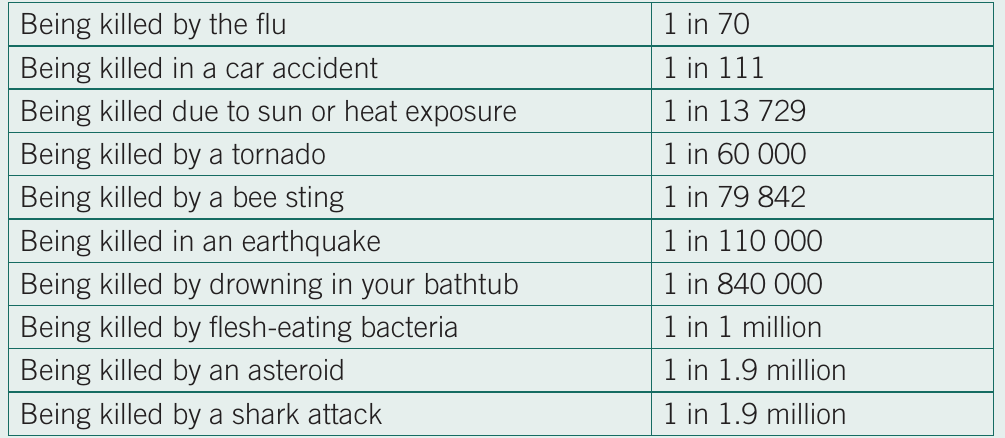
The availability heuristic becomes particularly evident when considering rare but dramatic events. People tend to overestimate the probability of death and injury from events such as shark attacks, plane crashes and murders because examples of such events are easily recalled, especially if they occurred recently or received substantial media coverage.
Positive influences of the availability heuristic
The availability heuristic saves time and effort by allowing us to recall similar past situations quickly without needing to analyse all our historical information. This enables rapid decision-making in everyday contexts where extensive deliberation would be impractical.
Negative influences of the availability heuristic
Important
Common Error: Overestimating Recent Events
Whilst advantageous for quick decisions, the availability heuristic can lead to significant errors in judgement. The heuristic tends to overestimate the likelihood of recently experienced or highly publicised events reoccurring.
For example, after seeing a news report about business failures, a small business owner might decide against investing in new equipment, fearing their business will fail too. However, a more thorough analysis considering older news reports might reveal that their growing business sector generally has a bright future.
Representativeness heuristic
Note
The Representativeness Heuristic
The representativeness heuristic estimates the probability of an event occurring by comparing its similarity to a prototype we already know. A prototype in this context is what we think is the most relevant or typical example of a specific event or object.
For instance, the prototypical chair is big enough for an average person and has four legs, a seat and a back. When you encounter another object with those characteristics, the representativeness heuristic leads you to conclude this object could also be a chair. More generally, this heuristic allows us to quickly determine what something is based on its similarity to a prototype.
Example
Worked Example: Meeting Cameron at the Party
Joanne meets Cameron at a party and notices he is tall, lean and athletic. When asking her friend about him, she's told there are two Camerons - one who plays sports and another who studies chemistry.
Joanne mentally matches Cameron to the 'sportsperson' category because he fits her mental prototype of an athlete. Later, she meets another Cameron who is shorter and stockier. Because he doesn't match her prototype of 'sportsperson', she thinks he must be the Cameron from chemistry class and ignores evidence that he plays sports - even though he's wearing a rugby jersey.
This demonstrates how the representativeness heuristic can lead to incorrect categorisation based on superficial similarity to prototypes.
Positive influences of the representativeness heuristic
This heuristic allows us to understand new objects or events by comparing their characteristics to those we have already established for other objects and events. This enables quick categorisation and helps us know how to interact with unfamiliar situations based on similarity to familiar ones.
Negative influences of the representativeness heuristic
Important
Major Flaw: Similarity ≠ Probability
The representativeness heuristic has a notable flaw - people overestimate its accuracy in predicting what category something fits into or the probability of an event. The heuristic simply assesses similarity, and relying on it can lead to many errors because something being similar does not necessarily mean it is more likely to be that thing.
In the example above, Joanne incorrectly thinks stocky Cameron is unlikely to play sports because she believes leanness is more representative of being sporty. However, stockiness can be highly representative of sportspeople in rugby, wrestling, weightlifting and other strength sports.
A serious consequence of the representativeness heuristic is its potential to promote stereotyping. It is often reported that police are more likely to suspect darker-skinned people of having committed an offence (sometimes referred to as 'racial profiling') when using a representativeness heuristic. In such important and sensitive areas, this heuristic should not be used as a basis for judgement.

Affect heuristic
Note
The Affect Heuristic
The affect heuristic is a cognitive shortcut based on a person's current emotional state. Essentially, your affect (emotional response) influences your decisions and behaviour.
For example, if a friend criticises you for something, making you feel defensive and angry, the next time there's an opportunity to meet them, you might decide to pass due to your emotions. Another example is a smoker constantly exposed to disturbing information and images about smoking consequences. This might provoke negative emotions, which in turn result in the person's decision to quit smoking. In both examples, emotions dictated how a person or situation was thought about, indicating the influence of the affect heuristic.
How mood influences the affect heuristic
Our perception of risks and benefits involved in a decision contributes to the affect heuristic - and our emotional state or mood influences our risk assessment.
Note
The Mood-Risk Relationship
- When a person is in a positive mood, new opportunities are perceived as being low risk with high benefits
- When a person is in a negative mood, new opportunities are perceived as high risk with low benefits
Example
Worked Example: Mountain Biking Friends
Consider two friends who go mountain biking. One friend has recently mastered a specific jump on the track and is in a good mood, whilst the other had an accident on the same track and still feels upset about it.
Friend in good mood:
- Views the jump as low risk (in terms of injury)
- Sees high benefits (an adrenaline rush)
- Decides to attempt the jump
Friend in negative mood:
- Views the jump as high risk (in terms of another injury)
- Sees low benefits (uncertain about the adrenaline rush)
- Decides not to attempt the jump
Ultimately, mood determines the decision-making outcome for both friends, even though they face the same objective situation.
Positive influences of the affect heuristic
The affect heuristic might encourage us to take bigger risks than we usually would when we're in a positive mood. This can lead to new experiences and opportunities for growth that we might otherwise avoid.
Negative influences of the affect heuristic
Important
Risk of Poor Decision-Making Under Pressure
When we're under pressure to make a decision, we're more likely to use the affect heuristic, which might lead to poor choices.
For example, if you were forced to choose between two jobs in a relatively short timeframe, you would be more likely to take the job for which you felt most comfortable and positive during the interview, potentially overlooking other important factors.
If our mood is low and we lack confidence, the affect heuristic tends to keep us there because we won't risk doing new things, thereby limiting our ability to learn from new and challenging situations.
Positive and negative influences: A summary
Whilst heuristics offer many benefits in our decision-making processes, they can also contribute to negative outcomes such as stereotypes and prejudice. People typically use heuristics to avoid exerting too much mental energy, especially when they are not sufficiently motivated to dedicate resources to a task.
When not motivated to make judgements or decisions effortfully, they might rely instead on automatic heuristic responses and, in doing so, risk propagating stereotypes and biases.
Note
Kahneman and Tversky's Stereotype Study
Kahneman and Tversky illustrated how the representativeness heuristic might result in stereotyping when they presented participants with a personality sketch of a fictional man named Steve and a list of possible occupations. Participants were asked to order the occupations in terms of likelihood.
Since the personality sketch described Steve as shy, helpful, introverted and organised, participants tended to indicate that he was most likely a librarian. Although this particular stereotype is less harmful than many others, it illustrates the link between heuristics and stereotyping.
Summary
Comparison of the Three Main Heuristics
Availability heuristic:
- Positive influence: Saves time and effort in recalling similar situations and analysing them
- Negative influence: Tends to overestimate the likelihood of recent events reoccurring
Representativeness heuristic:
- Positive influence: Allows us to understand new objects or events by comparing their characteristics to those already established for other objects and events
- Negative influence: We often overestimate the similarity between the two things we're comparing, leading to mistakes in decision-making
Affect heuristic:
- Positive influence: Might encourage us to take bigger risks than we usually would if we are in a positive mood
- Negative influence: If we are in a negative mood, the heuristic tends to keep us there because we won't risk doing new things, which limits our ability to learn from new and challenging situations
Remember!
Summary
Key Points to Remember
-
Heuristics are mental shortcuts that enable quick decision-making based on limited information, reducing cognitive load and mental effort required for decisions.
-
The three main heuristics are: availability (using first thoughts that come to mind), representativeness (comparing to prototypes), and affect (basing decisions on current emotional state).
-
Positive influences include: saving time and effort, speeding up decision-making processes, reducing mental effort, and simplifying complex questions.
-
Negative influences include: overestimating the likelihood of recent or memorable events, making errors through inaccurate similarity judgements, and potentially promoting stereotypes and prejudice.
-
Context matters: when in a positive mood, we perceive opportunities as low risk with high benefits; when in a negative mood, we perceive them as high risk with low benefits, demonstrating how the affect heuristic influences our decisions.