The Role of Person Perception: Attitudes and Stereotypes (VCE SSCE Psychology): Revision Notes
📚Revision Notes
The Role of Person Perception: Attitudes and Stereotypes
Attitudes
What are attitudes?
An attitude is an evaluation that a person makes about other people, objects, issues, or anything else in their environment. The key element of this definition is 'evaluation' – attitudes involve making judgements (positive, negative, or neutral) about specific aspects of our lives.
We form attitudes about numerous things, including:
- Objects (food items, smartphones)
- People (ourselves, celebrities, friends)
- Groups (family, communities)
- Events (elections, holidays)
- Issues (vaccinations, climate change)
For an evaluation to be considered an attitude, it must be both consistent and long-lasting. Some attitudes are stronger than others, but all represent stable patterns of evaluation rather than fleeting opinions.
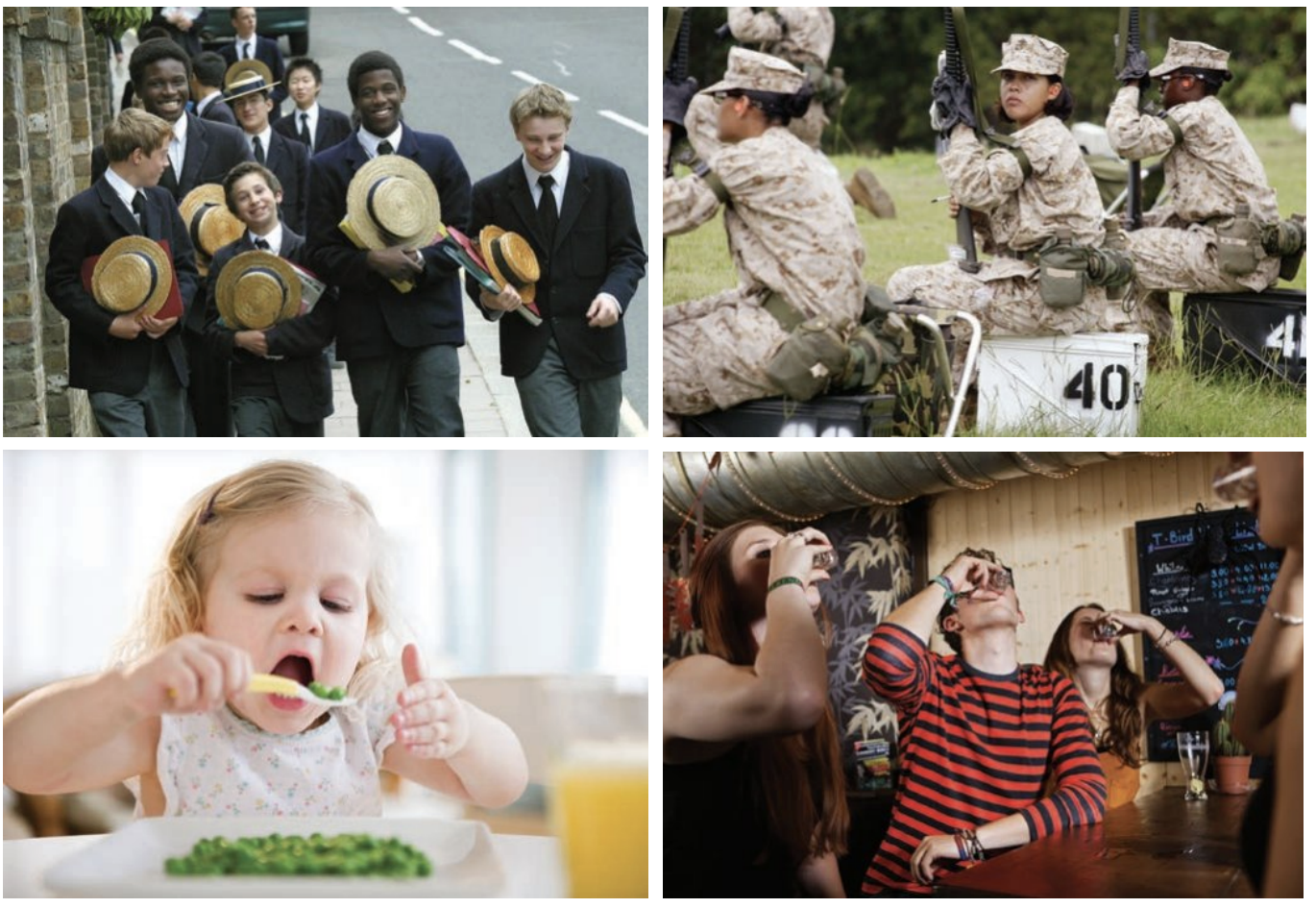
How attitudes are formed
Attitudes are learned rather than innate. Several factors contribute to attitude formation:
Media influence
Media significantly shapes our attitudes, often without our conscious awareness. Australian newspapers, magazines and television channels frequently present specific perspectives on issues whilst omitting opposing viewpoints. This selective presentation can portray issues in particular ways, showing unbalanced views that may alter opinions. Advertisers also utilise existing attitudes to sell products through targeted advertising campaigns.
Note
The media's influence on attitudes is particularly powerful because it often operates below our conscious awareness. The selective presentation of information can gradually shape our evaluations without us realising we're being influenced.
Personal experience
Attitudes often emerge from direct contact or personal experience with the attitude object. For instance, someone might develop the attitude that smoking is harmful because a close relative died from lung cancer, or that dogs make excellent companions through years of dog ownership.
Social influences
Interactions with others who hold specific attitudes – particularly parents, teachers and friends – shape our own attitudes. Parents' values, beliefs, practices and attitudes can transfer to their children. If both parents believe asylum seekers should be allowed entry into Australia, their children are likely to share this belief.
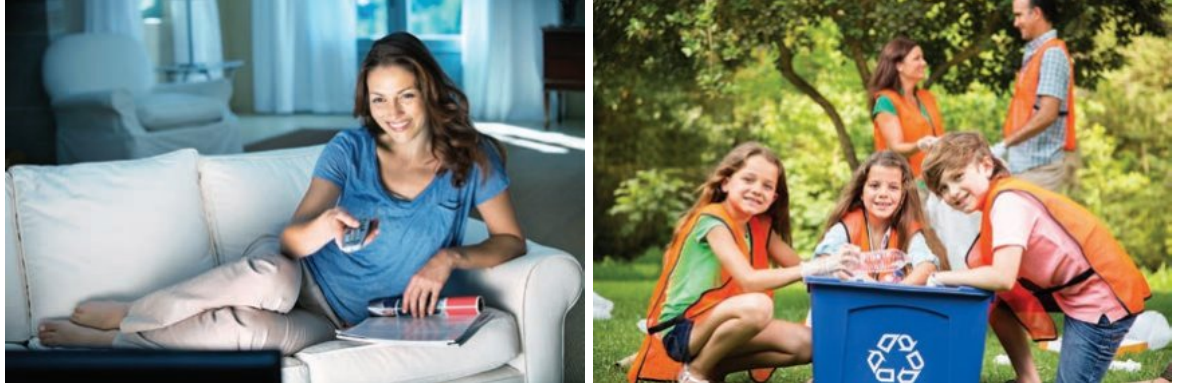
The tri-component model of attitudes
Important
The tri-component model (Rosenberg & Hovland, 1960) is the most widely accepted explanation of attitude structure. This model proposes that attitudes comprise three related components: affective, behavioural and cognitive (the 'ABCs of attitudes'). According to this model, all three components must be present for something to be considered an attitude.
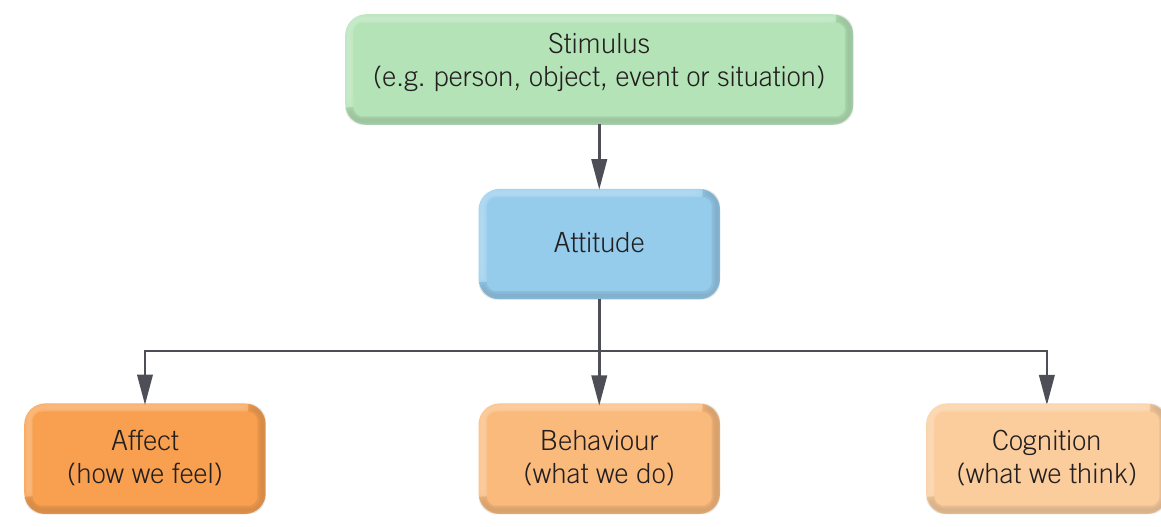
The affective component
The affective component represents the emotional aspect of attitudes. It involves how you feel about people, objects, places, events or ideas. These feelings can be positive, negative or neutral.
Example: "I feel good when I'm with my friends" or "I feel fit when I play basketball"
The behavioural component
The behavioural component represents the action aspect of attitudes. It involves what you do (or do not do) as an expression of your attitude, and also refers to how you might behave if a certain situation occurs.
Example: "I hang out with my friends whenever I can" or "I play basketball every night"
The cognitive component
The cognitive component represents the mental aspect of attitudes. It involves the beliefs or thoughts you have about people, objects, places, events or ideas. These beliefs link to our knowledge about the world and develop from lifelong experiences. Like feelings, thoughts can be positive, negative or neutral.
Example: "I think my friends are nice, funny and cool" or "I think basketball is the best sport to play"
| Component | Description | Example |
|---|---|---|
| Affective component | The emotional component of attitudes – how you feel about people, objects, places, events or ideas. These feelings can be good, bad or neutral. | 'I feel good when I'm with my friends.' 'I feel fit when I play basketball.' |
| Behavioural component | The action component of attitudes – what you do (or do not do) as an expression of your attitude. Also refers to how you might behave if a certain situation occurs. | 'I hang out with my friends whenever I can.' 'I play basketball every night.' |
| Cognitive component | The mental component of attitudes – the beliefs or thoughts you have about people, objects, places, events or ideas. Our beliefs link to what we know about the world and develop from lifelong experiences. These thoughts can be good, bad or neutral. | 'I think my friends are nice, funny and cool.' 'I think basketball is the best sport to play.' |
Consistent and inconsistent attitudes
In many cases, the three components align with each other. For example, you might fear snakes (affective) because you believe they are dangerous (cognitive), so you avoid areas where snakes have been spotted (behavioural). Similarly, you might believe eating broccoli is good for your health (cognitive) and like the taste (affective), so you often serve broccoli at dinner (behavioural).
However, inconsistencies between components occur frequently. The behavioural component is often inconsistent with the affective and cognitive components. For instance, a person might like watching movies with friends (affective) because they believe it's a great way to experience shared interests (cognitive), but choose not to go to a movie due to too much homework (behavioural).
Note
Sometimes the affective or cognitive components are consistent with the behavioural component but not with each other. These inconsistencies often result from one component being considerably stronger or weaker than the other two.
Limitations of the tri-component model
Whilst attitudes influence behaviour, they do not always reliably predict it. Several factors limit the predictive power of the tri-component model:
Attitudes are general, behaviour is specific
Attitudes tend to be broad evaluations, whilst behaviour is highly specific to particular situations. Although the cognitive and affective components might imply certain behaviours, they do not guarantee those behaviours will occur. For example, someone might dislike eating meat (affective) because they believe it's bad for the environment (cognitive), but eat steak served at a friend's house (behavioural).
Situational factors influence behaviour
External circumstances significantly affect how people behave. In the example above, the decision to eat steak might result from extreme hunger, cultural significance of the meal, or concern about offending the host's parents.

Research challenges
Sociologist Richard LaPiere (1934) studied the consistency between attitudes towards people of different races and actual behaviour towards them. He concluded that attitudes do not reliably predict behaviour, leading some psychologists to propose that attitudes only have affective and cognitive components, with no behavioural component.
Important
Many psychologists still support the tri-component model, accepting that attitudes cannot always be consistent with behaviour since behaviour results from many different influences besides attitudes. The tri-component model demonstrates the components that compose an attitude, but does not reliably predict whether these attitudes will be consistent or inconsistent.
Stereotypes
What are stereotypes?
When meeting people for the first time, we tend to judge them based on what we think their likely characteristics will be. For example, meeting a famous footballer might lead to expectations that they are fit, aggressive or not intellectual. This occurs because we tend to place people into categories based on our existing knowledge of the world.
A stereotype is a collection of fixed ideas about members of a certain group in which individual differences are ignored. People might be judged based on gender, age, race, sexuality, or even clothing. For instance, seeing a woman in a corporate suit might lead to assumptions that she is unemotional, ambitious and career-focused, whilst seeing a man in dirty clothes and a beanie might lead to assumptions that he is homeless or a drug user.
Stereotyping is the process of creating stereotypes and assigning people to them. Stereotypes ignore individual characteristics and regard every member of a certain group as possessing the same set of characteristics.


How stereotypes can be helpful or harmful
Although stereotyping often seems immediately harmful, stereotypes serve both useful and problematic functions in how we understand and interact with the world.
Helpful aspects of stereotypes
Information organisation
Stereotypes act like blueprints for types of people or personalities that guide our interactions. We meet too many people to know everyone in detail, so stereotypes save time in determining how to behave towards new people.
Faster decision-making
Stereotyping allows us to use less information about someone to form judgements, making thinking and decision-making skills faster. For example, discovering your new neighbour is a police officer might change your behaviour in your yard because you hold a stereotypical view of them 'always being on the job'.
Protection from harm
Stereotypes might keep us safe. Seeing someone in dirty, smelly clothes, muttering to themselves and moving towards you with a knife might lead you to quickly assume they want to hurt you, allowing you to move to safety.
Improved interaction
Accessing ready information about people helps us interact with them more effectively and quickly. For example, assuming younger children have lower levels of logic and intelligence than adults helps us interact with them more appropriately.

Harmful aspects of stereotypes
Overgeneralisation
Stereotypes tend to be overgeneralisations about group members based on incorrect or inadequate information. Individuals are unlikely to have all the characteristics the stereotype assumes, and individual differences are ignored.
Note
We tend to disregard information about individuals that doesn't fit our stereotype of them, which sometimes leads to mistakes in interactions. For example, meeting a new student in mathematics class, you might assume that because they are Asian, they are studious and good at mathematics, leading you to pair with them for a group project. However, you might discover your new classmate is a gifted artist rather than a mathematics fan, meaning they cannot contribute as much to the project as expected.
Stigma
Stereotyping can lead to stigma – negative attitudes against someone based on a distinguishing characteristic such as mental illness, disability, gender, sexuality, race, religion or culture. Stigma is a negative label placed on anyone who is part of a social group associated with disapproval or rejection.
When stigma attaches to individuals simply because they are members of a stigmatised group, they may feel devalued, ignored and rejected by others. For example, after the events of September 11, some people developed negative stereotypes that people of Middle Eastern appearance were dangerous and a threat to national security, resulting in people from the Middle East (and even those who appeared to come from the Middle East) being unfairly stigmatised.

| How stereotypes are helpful | How stereotypes are harmful |
|---|---|
| • Stereotypes offer us information that helps us interact with people we don't know well. | • Stereotypes often include incorrect information that leads to overgeneralisations about members of a social group. |
| • Stereotypes allow us to make decisions about others more quickly. | • Stereotypes can lead to stigma. |
| • Stereotypes can lead to prejudice. |
Ingroups and outgroups
Stereotyping can lead to prejudice, arising when stereotypes create a feeling of 'us against them'. People tend to classify social groups as either ingroups or outgroups:
- Ingroup: any group that you belong to or identify with (e.g. your family, friends, school, sporting teams)
- Outgroup: any group that you don't belong to or identify with (e.g. a school or sporting team you don't belong to)
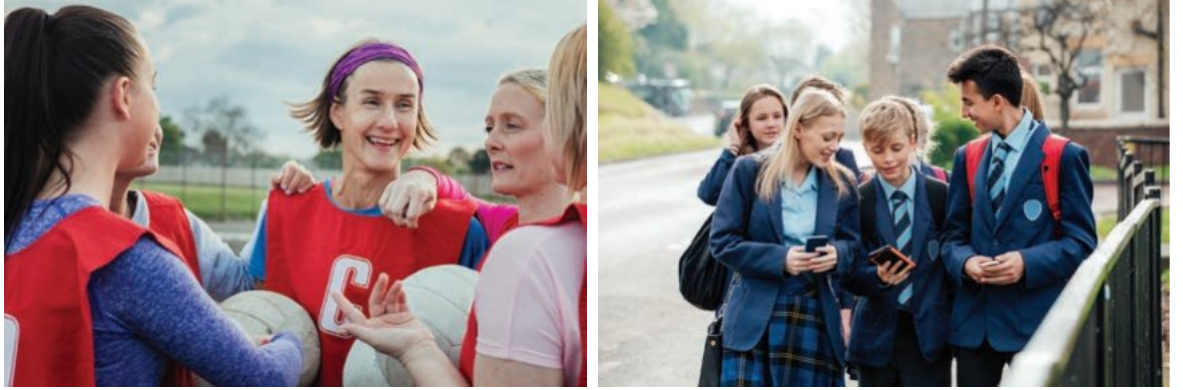

Categorising ourselves and others this way influences attitudes about members of both ingroups and outgroups. Individuals tend to believe that:
- Ingroup members are more like each other
- Outgroup people are dissimilar and like each other
Important
Ingroup members tend to view each other more positively and develop loyalty to each other due to their common group membership. Meanwhile, ingroup members might view people from outgroups more negatively, which can lead to prejudice towards outgroup members.
Remember!
Summary
Key Points to Remember:
- Attitudes are learned evaluations of people, objects, issues or events that are consistent and long-lasting
- The tri-component model explains attitudes as consisting of affective (feelings), behavioural (actions) and cognitive (thoughts) components
- Attitudes do not always reliably predict behaviour due to situational factors and the general nature of attitudes versus the specific nature of behaviour
- Stereotypes are fixed ideas about group members that ignore individual differences
- Whilst stereotypes help organise information and speed decision-making, they can lead to overgeneralisation, stigma and prejudice
- People categorise social groups as ingroups (groups they belong to) or outgroups (groups they don't belong to), which influences attitudes and can contribute to prejudice