Drawing Conclusions and Communicating Scientific Ideas (VCE SSCE Psychology): Revision Notes
📚Revision Notes
Drawing Conclusions and Communicating Scientific Ideas
Analysing and evaluating scientific ideas
When reviewing information from scientific or media sources, it is essential to critically evaluate the quality and nature of the information presented. This involves distinguishing between different types of information and assessing whether claims are based on sound scientific principles.
Types of information
Opinion: A judgement or viewpoint that is not necessarily supported by proof or empirical data. Opinions may reflect personal beliefs or interpretations but lack objective verification.
Anecdote: A brief personal account or story describing an individual event or experience. Anecdotal information, whilst potentially interesting, does not constitute systematic evidence and cannot be generalised to broader populations.
Evidence: Information that has been verified through systematic observation, measurement or experimentation. Evidence forms the foundation of scientific conclusions and can be independently verified by other researchers.
Important
Understanding Information Types
Only evidence-based information can be used to draw valid scientific conclusions. Opinion and anecdotal information, whilst sometimes interesting or persuasive, lack the systematic verification necessary for scientific validity.
Evaluating sources
When examining scientific or media texts, consider:
- The source's credibility and expertise
- Whether claims are supported by empirical evidence
- The methodology used to gather information
- Whether the study has been peer-reviewed
- Potential biases in data collection or interpretation
Drawing conclusions
After analysing research data for patterns, differences and trends, researchers must evaluate whether the evidence supports their initial aims, hypotheses and predictions.
What is a conclusion?
A conclusion is a statement summarising the findings of a study. It directly addresses the investigation's aim and indicates whether the hypothesis was supported or refuted by the evidence collected. Conclusions must be based on observable patterns in the results that align (or conflict) with the original hypothesis.
For controlled experiments, conclusions summarise whether the independent variable caused changes in the dependent variable. This links the hypothesis directly to the results obtained.
Example
Sample Conclusion Statement
"Based on the evidence from this sample, the results are consistent with the hypothesis that sugar consumption results in decreased attention levels in children, compared to when children did not consume sugar."
Note how this conclusion:
- References the specific sample
- Links directly to the hypothesis
- States the direction of the relationship
- Uses cautious language ("consistent with")

Key points when writing conclusions
Important
Critical Guidelines for Writing Conclusions
- Reference that findings apply only to the specific research sample, not necessarily the wider population
- State the direction of results (e.g., whether the IV caused the DV to increase, decrease, etc.)
- Describe the relationship between variables
- Consider the investigation design used
Remember: Conclusions can only determine whether evidence supports or refutes a hypothesis, not whether the hypothesis is definitively "proved true". Findings from summary statistics (e.g., means) apply only to the sample studied unless the study demonstrates strong external validity.
Limitations of conclusions
Limitations of conclusions are design flaws or weaknesses in an investigation that may restrict the validity or generalisability of findings. These differ from extraneous or confounding variables but include them.
Examples of limitations:
- Choice of investigation design that allowed confounding variables
- Measurement instruments that produced errors or lacked precision
- Sampling methods that reduced representativeness
- Insufficient sample size
- Lack of control over extraneous variables
Note
Discussing Limitations Effectively
When discussing limitations, researchers should:
- Explain how each limitation specifically affected the results
- Identify what further evidence is required
- Suggest specific improvements for future research
- Provide recommendations for modifying or extending the investigation

Implications
Implications refer to the potential impact a study might have on:
- The population of interest
- Relevant psychological theory
- Future research directions
- Real-world applications
When discussing implications, researchers must consider:
- How findings will affect the population studied
- Which specific areas require new research
- Whether cultural bias exists in the data or conclusions
- Whether findings from one cultural group apply to other cultural groups
- The appropriateness of applying data to different populations
Important
Cultural Considerations
If a study involves participants from a particular cultural group, the findings may not generalise to people from different cultural backgrounds. Researchers must acknowledge such limitations and avoid overgeneralising their conclusions.
Communicating scientific ideas
Researchers disseminate their findings through various formats to inform the scientific community and interested parties about their discoveries. The most common methods include publishing in scientific journals, presenting at conferences through talks or posters, and writing scientific reports.
Scientific journals
Scientific journals are periodic publications that report new primary research. They may be published in physical form (found in university libraries) or electronically online. Publication frequency varies from weekly to every few months. Each issue typically contains numerous articles reporting different research findings.
Psychology has hundreds of specialised journals covering specific topics, such as the Journal of Cognitive Neuroscience or the Journal of Happiness Studies.

Searching for scientific research articles
Finding appropriate scientific research articles online requires specific search strategies:
Know what you're looking for:
- Seek original articles written by researchers who conducted the investigation
- Articles reporting controlled experiments should contain main scientific report sections (introduction, methodology, results, discussion)
Use effective search terms:
- Combine "journal article" with your independent and dependent variables
- The term "experiment" is less effective for locating scientific articles
- Use scientific search engines (Google Scholar, PubMed, PsycINFO) to refine searches
- Note that these may return complex research articles
Scan search listings for:
- Articles listed by scientific journals
- Digital object identifiers (DOI) – identification numbers restricted to scientific articles
- Author listings formatted as "by [name] [date]"
- Recent publication dates
- "Cited by..." counts showing how often other researchers reference the study
Determine access level:
- "Full text" access allows reading the entire article
- "Limited access" typically shows only the abstract unless you pay or subscribe
- Try searching for the article title in Google Scholar if full text isn't immediately available
- Check researcher personal websites, which sometimes host their publications
- Consider emailing researchers directly to request articles
Note
Using Abstracts Effectively
Read the abstract first to determine article appropriateness. The abstract summarises the entire investigation, allowing you to quickly assess relevance. Use article reference lists to find similar research in the same area.
Scientific reports
In VCE Psychology, scientific reports explain research findings using a standardised structure with specific sections: abstract, introduction, method, results and discussion.
Abstract
The abstract is a concise summary of the entire investigation, including:
- Research aim
- Hypothesis
- Procedures or methods
- Major findings
- Conclusions
This section is typically brief (150-250 words) and allows readers to quickly determine whether the full article is relevant to their needs.
Introduction section
The introduction section provides information necessary for readers to understand what the research aims to achieve and why it matters. This section follows a funnel structure, moving from broad to specific information.
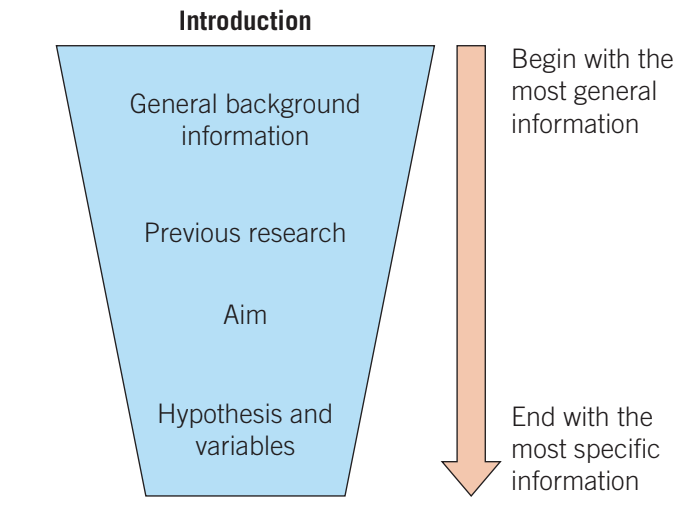
The introduction includes:
- General background information: Rationale explaining where the investigation question originated
- Previous research: Studies conducted in the area of interest
- Psychological concepts: Relevant theories, models and definitions of key terms
- Investigation specifics: Research aim, hypothesis or predictions, and variables
Note
Introduction Flow
The introduction progresses from the most general information (wider context and relevant theory) to the most specific information (the current study's aim, hypothesis and variables).
Methodology section
The methodology section describes how the study was conducted. It typically contains three subsections:
Participants:
- Number of participants
- Population from which they were drawn
- Sampling technique used
- Relevant demographic characteristics (gender, age range, other necessary characteristics)
- Statement about ethics committee approval and ethical frameworks followed (e.g., National Health and Medical Research Council's 'National Statement on Ethical Conduct in Human Research')
Materials/equipment:
- Complete list of all materials and equipment used
- May be presented as a bulleted list
- Should include sufficient detail for replication
Procedures:
- Step-by-step description of how the research was conducted
- Written in past tense
- Includes investigation design
- Describes methods used to generate and analyse data
- Contains sufficient detail to allow easy replication
Results section
The results section displays all relevant findings and evidence collected during the study.
This section includes:
- Tables, charts and graphs displaying data
- Written text summarising key findings
- Clear labels and titles for all visual representations
- Data presented in appropriate formats to illustrate trends, patterns or relationships
Important
Results Section Guidelines
- Generally, the same data should not appear in both a table and a graph
- The results section should not include explanations for the results
- Raw data is not included in the results section (but may appear as an appendix)
Discussion section
The discussion section explains findings and concludes the investigation. This section follows a pyramid structure, moving from specific to general information.
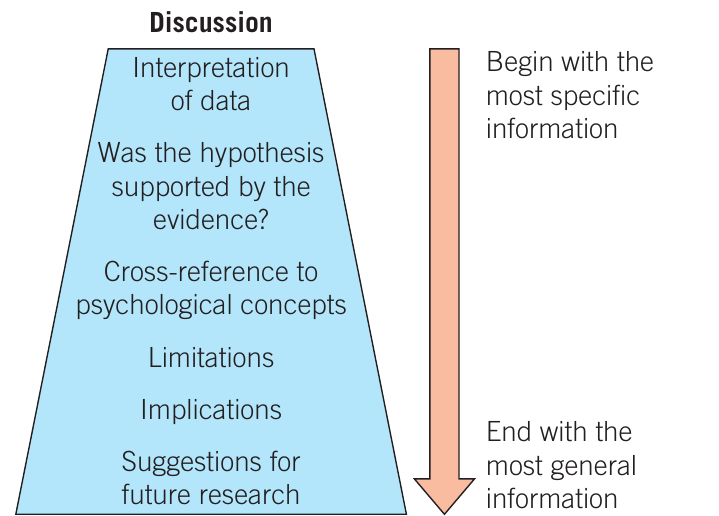
The discussion includes:
- Interpretation of data: Reminder of research objectives; determination of whether hypothesis was supported, partly supported or refuted
- Cross-referencing: Comparison of current findings with background research from the introduction
- Limitations: Analysis of design flaws and acknowledgement of anomalous data potentially resulting from procedural flaws
- Improvements: Suggestions for enhancing the study design
- Implications: Real-world applications of findings
- Future research: Comments on potential research directions
- Final conclusion: Detailed conclusion linking back to the original aim
Note
In scientific reports, the final conclusion appears within the discussion section. On scientific posters, it appears as a separate section.
Referencing sources
The references section contains a complete list of all sources referred to in the report, including background research, theories, concepts, key term definitions and quotes.
APA referencing style
Psychology typically uses APA (American Psychological Association) style, though other formats like Harvard are also acceptable in VCE Psychology.
In-text citations
Include in-text citations when work has been influenced by another source, whether using direct quotes or paraphrasing. Citations are shortened references appearing in the report body, always including the first author's surname and publication year.
Example
Examples of In-Text Citations by Author Number
One author: Zuccon (2021) proposed that... or ...as shown in a recent study (Robinson, 2021)
One organisation: First citation uses full name, subsequent citations use abbreviation: National Health and Medical Research Council (NHMRC, 2018)... later references: (NHMRC, 2018)
Two authors: Both surnames every time, using '&' only within brackets: (Beddoes & Harrington, 2020) or Clark and Dickinson (2020) found that...
Three or more authors: First author's surname followed by 'et al.' and year: (Checkley et al., 2019) or Green et al. (2003) found that...
Reference lists
All sources cited in text must appear in the reference list, arranged alphabetically by author surname or organisation name. Different sources require different formatting details, but generally include four elements: author, date, title and source.
Example
APA Reference Formatting Examples
Journal article example: Peter, M.S., Durrant, S., Jessop, A., Bidgood, A., Pine, J. M., & Rowland, C. F. (2019). Does speed of processing or vocabulary size predict later language growth in toddlers? Cognitive Psychology, 115, Article 101238. https://doi.org/10.1016/j.cogpsych.2019.101238
Book example: Jeffs, S., & Leggatt, M. S. (2020). Out of the madhouse: From asylums to caring community? Australian Scholarly Publishing Pty Ltd.
Website example: Australian Psychological Society. (2020). How to access a psychologist. https://www.psychology.org.au/for-the-public/about-psychology/how-to-access-a-psychologist
Note
Online reference generators can help create properly formatted APA references, but always double-check their accuracy.
Scientific posters
Conventions and conferences are formal meetings where scientists present research findings. Researchers create large scientific posters (often exceeding one metre wide) which they display whilst discussing their work with attendees.
Poster characteristics
A scientific poster includes all main components of a scientific report but in a more concise and visually appealing format. Think of it as an illustrated abstract that succinctly describes main features without excessive detail.
Effective scientific posters contain:
- Small blocks of text in large, simple fonts
- Clear headings visible from a distance
- Graphs, tables and images
- Diagrams, bullet points and flow charts to reduce text
- Clearly labelled images
- Soft colours that don't strain the eyes
- Logical section ordering for easy interpretation
Posters may be portrait or landscape orientation, divided into two, three or four appropriately spaced columns.
VCE Psychology poster requirements
Important
VCE Psychology Poster Specifications
VCE Psychology mandates that posters include:
- Title
- Introduction
- Methodology and methods
- Results
- Discussion
- Conclusion
- References and acknowledgements
Do not include an abstract. Total word count should not exceed 600 words (excluding text in tables, graphs, image captions and references).
Poster section details
Title:
- State the question under investigation
Introduction:
- Brief explanation of why the investigation was undertaken
- Clear aim and hypothesis/prediction
- Relevant background psychological concepts
- May include photos and illustrations
Methodology and methods:
- Brief outline of methodology addressing the investigation question
- Summary of data generation and analysis methods
- Often includes subsections for participants, materials and procedures
- Materials can appear as bulleted lists
- Include only key procedural parts in sufficient detail for replication
- Figures and flow charts can describe procedures
- Diagrams can illustrate equipment set-up
Results:
- Data/evidence presented in appropriate formats illustrating trends, patterns or relationships
- Data in tables or graphs (clearly labelled and titled, appropriate to data type)
- Small amount of text noting key points from tables and graphs
Note
Communication Statement (Centre of Poster)
A simple, engaging one-sentence summary of the major finding that answers the investigation question. This must occupy 20-25% of poster space and serves as the visual focal point.
Discussion:
- Interpretation and evaluation of analysed primary data
- Identification of data and method limitations with suggested improvements
- Cross-referencing of results to relevant psychological concepts and previous research
- Linking of results to investigation question and aim
- Explanation of whether data and findings support the hypothesis
- Investigation implications and/or suggestions for further research
Conclusion:
- Provides response to investigation question
- Identifies extent to which analysis answered the investigation question
- Introduces no new information
References and acknowledgements:
- Acknowledges information sourced elsewhere (quotes, definitions, background research)
- Sources referenced in poster body with full detailed references in reference list
- Reference list follows APA formatting rules
Language in scientific reports and posters
Scientific reports are formal documents requiring scientific language and formal tone.
Person and voice
Reports and posters may be written in:
- First person: "I discovered that...", "Our experiment showed..."
- Third person: "The researcher found...", "The participants were instructed to..."
The scientific community has not reached consensus on this. Third-person voice helps maintain objective tone and is typically recommended.
Tense
Different sections may use different tenses:
- Past tense: For procedures already completed (e.g., "The participants were divided equally into two groups")
- Present tense: For existing theories or concepts (e.g., "The Atkinson-Shiffrin model of memory states that there are three major memory stores")
Summary
Key Points to Remember
-
Distinguish information types: Opinion, anecdote and evidence are fundamentally different; only evidence provides verified facts suitable for drawing scientific conclusions.
-
Conclusions must be evidence-based: Address the aim, state whether the hypothesis was supported or refuted, and acknowledge that findings apply only to the sample studied unless external validity is demonstrated.
-
Acknowledge limitations and implications: Identify design flaws that may restrict conclusions and discuss how findings might impact the population, theory and future research, considering potential cultural biases.
-
Scientific reports follow a standard structure: Abstract, introduction (general to specific), methodology, results, discussion (specific to general), and references form the backbone of formal scientific communication.
-
Scientific posters communicate concisely: VCE Psychology posters must not exceed 600 words (excluding tables, graphs, captions and references) and should include a prominent communication statement occupying 20-25% of poster space.