Shapes of Complex Ions (AQA A-Level Chemistry): Revision Notes
📚Revision Notes
6.2.3 Shapes of Complex Ions
Shapes of Complex Ions
Transition metal ions form complex ions with characteristic shapes based on the size and type of ligands bonded to the metal. These shapes influence the properties, stability, and stereochemistry of the complex ions.
Octahedral Complexes
Note
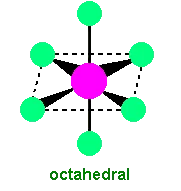
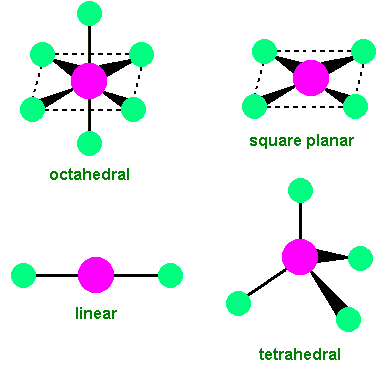
Octahedral complexes have six ligands symmetrically arranged around the central metal ion.
Typical Ligands:
Small ligands like water () and ammonia () often form octahedral complexes with transition metals.
Isomerism in Octahedral Complexes:
Cis–Trans Isomerism:
-
Occurs when two identical ligands are adjacent (cis) or opposite (trans) to each other.
-
This is a special form of E–Z isomerism. Optical Isomerism:
-
When three bidentate ligands form a chiral complex that cannot be superimposed on its mirror image, creating optical isomers.
Example Complex:
Note
Example: shows cis-trans isomerism with and ligands.
Tetrahedral Complexes

Note
Tetrahedral complexes form when four ligands surround a central metal ion in a tetrahedral shape.
Typical Ligands:
Larger ligands, such as chloride ions (), commonly lead to tetrahedral coordination due to steric effects.
Isomerism in Tetrahedral Complexes:
Tetrahedral complexes do not exhibit cis–trans or optical isomerism due to their symmetrical structure.
Example Complex:
Note
Example: , a copper(II) complex with chloride ligands, typically adopts a tetrahedral shape.
Square Planar Complexes

Note
Square planar complexes have four ligands arranged in a square around the central metal ion, commonly seen in complexes of metals like platinum and palladium.
Isomerism in Square Planar Complexes:
Cis–Trans Isomerism:
- Just like octahedral complexes, square planar complexes with two pairs of identical ligands exhibit cis–trans isomerism.
Note
Example of Cis Isomer: Cisplatin, , a square planar complex with platinum, is used in cancer treatment.
Only the cis isomer is effective as a drug because of its ability to interact with DNA.
Linear Complexes

Note
Linear complexes form when two ligands are bonded to a central metal ion, resulting in a straight-line arrangement.
Example Complex:
Note
Example: The silver complex , found in Tollens' reagent, is linear.
Tollens' reagent is used to test for aldehydes, which reduce to metallic silver.
Stereoisomerism in Complex Ions
Stereoisomerism arises when complexes have the same formula but different spatial arrangements.
There are two main types of stereoisomerism:
- Cis–Trans Isomerism: Present in octahedral and square planar complexes where identical ligands can either be adjacent (cis) or opposite (trans).
- Optical Isomerism: Seen in chiral octahedral complexes with bidentate ligands. Optical isomers are non-superimposable mirror images, similar to left and right hands, and rotate plane-polarized light in opposite directions.
Note
Summary of Shapes and Isomerism
Shapes of Complex Ions
| Shape | Common Ligands | Example Complex | Isomerism |
|---|---|---|---|
| Octahedral | Cis–Trans, Optical | ||
| Tetrahedral | None | ||
| Square Planar | (cisplatin) | Cis–Trans | |
| Linear | None |