Classifying Alcohols (AQA A-Level Chemistry): Revision Notes
📚Revision Notes
3.5.1 Classifying Alcohols
Note
Alcohols are a fundamental group of organic compounds. They have a distinctive functional group, -OH (hydroxyl group), which significantly influences their chemical properties. This note will explore the structure, classification, and characteristics of alcohols.
What is an Alcohol?
Note
Alcohols are part of a homologous series characterised by the general formula , where the functional group is the hydroxyl group () attached to a carbon chain. The group is what defines an alcohol and imparts unique properties compared to other organic compounds.
Common Example
When non-chemists refer to "alcohol," they typically mean ethanol (), which is the alcohol present in alcoholic beverages. However, in chemistry, the term "alcohol" encompasses a broad range of compounds that all contain the functional group.
Classification of Alcohols
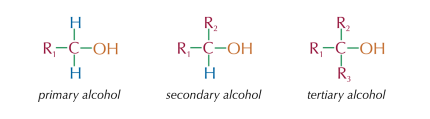
Alcohols are categorised into three main types: primary, secondary, and tertiary. The classification depends on the carbon to which the group is attached and the number of alkyl groups (R groups) connected to that carbon.
Primary Alcohols ()
A primary alcohol has the hydroxyl group attached to a carbon that is connected to only one other carbon (or no other carbon if it's methanol).
- General Structure:
- Example: Ethanol ()
- Methanol () is also a primary alcohol because the carbon with the group is not attached to any other carbon atoms.
Secondary Alcohols ()
A secondary alcohol has the hydroxyl group attached to a carbon that is connected to two other carbon atoms.
- General Structure:
- Example: Propan-2-ol ()
Tertiary Alcohols ()
A tertiary alcohol has the hydroxyl group attached to a carbon that is connected to three other carbon atoms.
- General Structure:
- Example: 2-methylpropan-2-ol