Types of Bonding & Properties (AQA A-Level Chemistry): Revision Notes
📚Revision Notes
1.4.9 Properties of Metallic Substances
Properties of Metals Explained by Metallic Bonding
High melting and boiling points
The strong electrostatic attraction between the ions and delocalised electrons means that a lot of energy is required to break the metallic bonds, giving metals high melting and boiling points.
Electrical conductivity
Metals are good conductors of electricity because the delocalised electrons are free to move and carry an electric charge throughout the structure.
Malleability and ductility
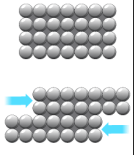
The layers of ions in a metallic lattice can slide over each other without breaking the metallic bond. This makes metals malleable (can be hammered into shape) and ductile (can be drawn into wires).
Note
Summary
Metallic bonding is characterised by the attraction between a lattice of positive ions and a sea of delocalised electrons. This bonding explains key properties of metals, such as high melting points, electrical conductivity, and malleability. The strength of metallic bonding is influenced by the charge and size of the metal ions.